Craigmore and the Tenant Pledge1852 CE
In 1852, post-Famine Ireland remained shaped by depopulation, emigration, poor-law hardship, estate sales and rural insecurity. William Sharman Crawford’s Tenant Right Bill sought recognition of Ulster custom, compensation for improvements and limits on eviction, but failed despite sustained Commons debate. The Tenant Right League united Catholic, Presbyterian and nationalist reformers, securing forty-eight pledged MPs in the July election, though its unity remained fragile. Derby’s government introduced further land bills in November, but fell before settlement. Meanwhile, Craigmore Viaduct opened the Belfast–Dublin route, symbolising industrial investment. Belfast’s British Association meeting also highlighted worsening urban sanitary conditions amid Ireland’s uneven post-Famine transformation.
Dateline
In 1852, Ireland was living through the difficult aftermath of the Great Famine rather than its simple conclusion. Hunger and epidemic no longer struck with the terrible nationwide force of the late 1840s, but their consequences shaped nearly every public question: who occupied the land, who paid for destitution, who left for Britain and North America, and whether Westminster would alter a rural system exposed as profoundly insecure. The year’s most consequential Irish story was therefore political, but it was politics rooted in fields, cottages, workhouses and emigrant routes. It brought together an unusually broad demand for tenant protection, while a great new railway viaduct in south Armagh offered a contrasting image of industrial connection and investment.
Land at the Centre
The immediate political issue was tenant right. In Ulster, custom often allowed a tenant to sell the goodwill of a holding and to receive recognition for improvements; elsewhere the position was much less secure and varied sharply from estate to estate. After the Famine, the question had acquired particular urgency. A farmer who had drained land, erected buildings or improved soil might lose both home and investment at the end of a tenancy. For labourers and holders of tiny plots, the wider pattern of consolidation and clearance after catastrophe made insecurity still more severe.
On 10 February, William Sharman Crawford, an Irish-born reformer then MP for Rochdale, sought leave in the Commons to introduce a Tenant Right (Ireland) Bill. It proposed legal recognition for Ulster custom, compensation for tenant-made improvements, and restrictions on eviction in specified circumstances. Crawford presented the measure not as a local technicality but as a response to Ireland’s central social problem. His claims naturally met resistance: landlords and conservative politicians feared compulsory interference with contracts and property. Nevertheless, the bill brought into parliamentary form a demand already being organised in Ireland by the Tenant Right League.
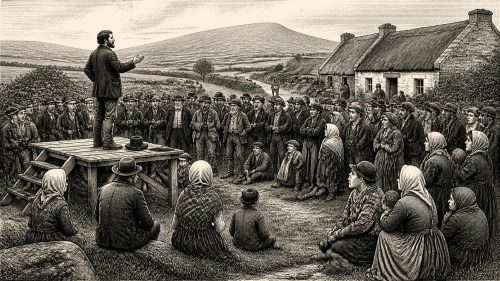
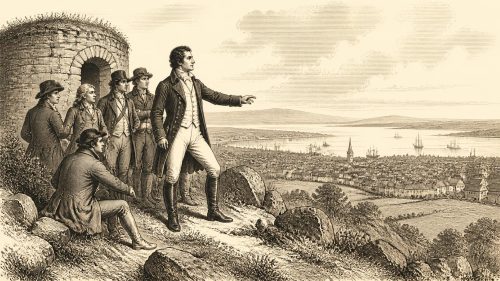
The League’s importance lay in its attempt to bridge divisions that had often weakened Irish reform movements. Its leading advocates included Charles Gavan Duffy of The Nation, the Catholic journalist Frederick Lucas, John Gray of the Freeman’s Journal, and James McKnight of the Presbyterian Londonderry Standard. Catholic priests, Presbyterian ministers, reforming farmers and nationalist publicists could all find a place in a campaign centred on security for occupiers. That did not mean that they shared a complete constitutional programme. Some supporters sought land reform alone; others connected it to repeal of the Union, denominational grievances or a larger Irish national politics.
When the bill received extended Commons debate on 31 March and again on 5 May, its advocates argued that Irish tenants commonly supplied improvements from their own labour and capital. Opponents insisted that legislating for an uncertain and locally variable custom would damage the landlord’s legal interest. Neither argument was merely abstract. The fate of improvements determined whether many families could risk putting savings into roofs, fences, drainage, stock or better cultivation. The measure did not become law, but its debates made tenant compensation a question that ministers could no longer plausibly treat as peripheral.
An Election of Conditional Support
Lord Derby’s Conservative minority ministry took office in February. In Ireland, the Earl of Eglinton remained lord lieutenant; Lord Naas became chief secretary, Joseph Napier attorney general, and James Whiteside solicitor general. Their arrival mattered because the Dublin administration continued to manage policing, law, poor-law business and much of the state’s daily contact with Irish society, even as Irish MPs sat at Westminster. The ministry had little secure parliamentary support, however, and a general election followed in July.
Polling ran from 7 to 31 July, as elections then took place on different days in different constituencies. Tenant-right candidates and existing MPs who endorsed the League’s pledge contested seats amid an atmosphere historians have described as exceptionally violent by nineteenth-century Irish standards. The pledge promised independence from any British government that would not make a meaningful tenant-right measure a cabinet commitment. It was a deliberately disciplined formula: Ireland’s representatives were to use their votes together rather than be absorbed separately into Conservative or Whig alliances.
The results seemed, at first, a striking advance. Forty-eight MPs are conventionally counted as having been returned with Tenant Right League endorsement, among them Duffy for New Ross. The number should not be mistaken for a modern party bloc with a settled whip, uniform programme or identical electorate. Yet it was substantial enough to demonstrate that post-Famine Ireland could send a recognisable reforming interest to Westminster. Its achievement was both practical and symbolic: a demand born from rural insecurity had become the basis for an all-Ireland electoral alliance joining parts of Catholic nationalist Ireland with reform-minded Protestant and Presbyterian opinion, especially but not exclusively in Ulster.
Relief, Departure and Estate Sales
The election took place in a country whose social geography had already been transformed. The census taken in 1851 recorded a dramatically reduced population, the result of famine mortality and emigration. Its figures are essential evidence for understanding 1852, but they should not be treated as an event of that calendar year: they describe the condition inherited by it. Nor did departure cease once the worst years of starvation had passed. Emigration remained a normal, painful and often necessary calculation for families with too little land, too little work or relatives already established across the Atlantic.
The Poor Law likewise remained part of everyday life. Ireland’s 130 poor-law unions, each focused on a workhouse, had been overwhelmed during the Famine. By March 1851, nearly four per cent of the population had been driven into workhouses, far beyond the system’s original assumptions. In 1852, boards of guardians, ratepayers, medical officers, clerks and inmates were still dealing with an institutional inheritance of destitution, disease, orphanhood and debt. Falling crisis numbers could not restore lost households or recreate the dense settlement pattern of the early 1840s.
At the same time, the Encumbered Estates Court continued to alter the ownership of land. Created in 1849 to facilitate sales of heavily indebted properties, it enabled creditors to obtain sales with a secure parliamentary title. Famine-reduced rents and long-standing mortgages had made many estates insolvent. For buyers, the court promised an opening into landed property; for tenants, a sale could bring uncertainty, since a new proprietor might retain old arrangements, raise efficiency through consolidation, or press for larger farms and fewer occupiers. An extant sale book for 1852 is a modest but telling archival reminder that these transactions were active business in the year, not merely a later consequence of famine.
Napier’s Unfinished Code
The Derby government did attempt a late response. On 22 November, Napier introduced four Irish land bills: measures on improvement of landed property, compensation for tenants’ improvements, beneficial leases and the wider law of landlord and tenant. They did not amount to the League’s full programme, and their provisions were debated from very different assumptions about property and custom. Even so, the introduction of a connected group of bills showed that tenant security had become impossible to ignore.
The opportunity was short-lived. Benjamin Disraeli’s budget was defeated in the Commons on 16 December; Derby’s ministers tendered their resignations, accepted on 20 December. By 27 December the Earl of Aberdeen was explaining the formation of a new coalition ministry. Napier’s proposals consequently fell with the outgoing administration. The year ended with no statutory settlement for the tenant, and the apparent parliamentary unity of the Tenant Right interest still untested by office, patronage and division. The land question had been placed at the heart of national politics, but it had not been solved.
Craigmore’s Arches
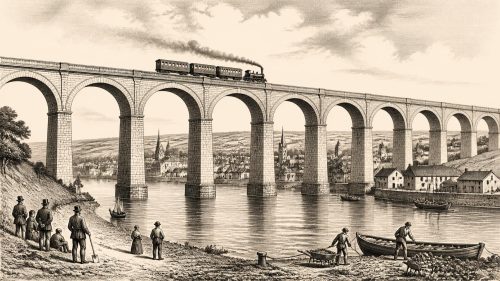
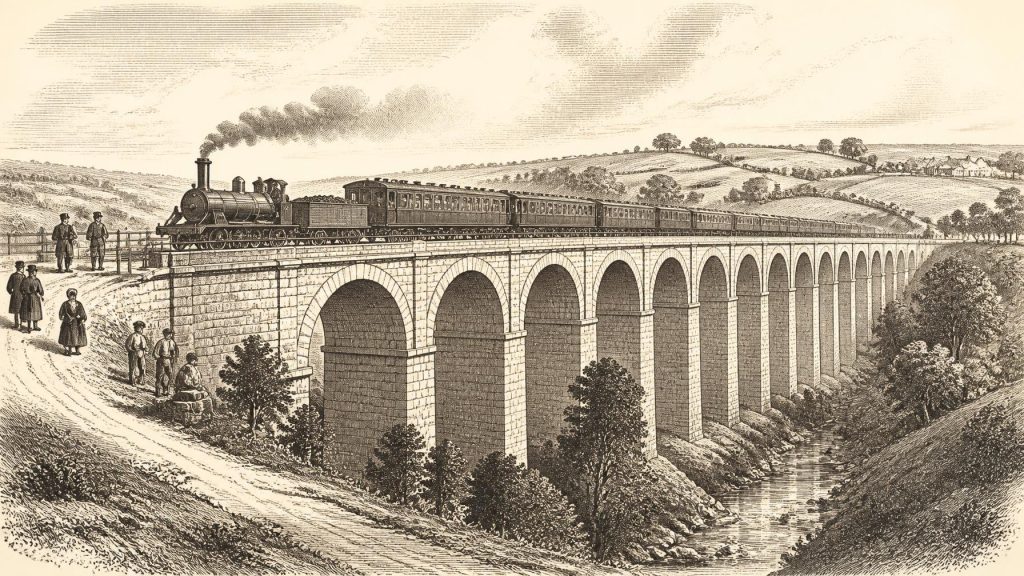
Political frustration was not the whole story of 1852. Near Bessbrook in County Armagh, completion of Craigmore Viaduct enabled through running on the Belfast–Dublin railway route. Built in 1851–52 under the chief engineer Sir John Macneill, with William Dargan responsible for construction, the granite structure carried a double track across the Camlough River valley on eighteen semicircular arches. It was an imposing statement of engineering capacity: expensive, carefully built and dependent on the organisation of labour, capital and materials on a large scale.
The viaduct did not erase Ireland’s regional inequalities, and rail travel was far beyond the means of many people affected by rural poverty. But it strengthened the physical axis between Belfast, Newry, Dublin and the ports, assisting the movement of passengers, mail, goods and information. Its completion also belongs beside another firmly dated northern event: the British Association for the Advancement of Science met in Belfast in September. Among the papers delivered was A. G. Malcolm’s study of Belfast’s sanitary condition, an indication that industrial growth and urban crowding were already producing urgent questions of public health.
Thus 1852 presents an Ireland of striking contrasts. The Craigmore arches embodied durable connection and technical confidence; the Tenant Right campaign gave organised political expression to those whose labour on the land lacked durable legal protection. The first development pointed towards an increasingly integrated commercial world. The second exposed the unequal terms on which much of rural Ireland entered it. Both were real features of the same post-Famine year.
Primary Sources
- Tenant Right (Ireland), 10 February 1852
- Tenant Right (Ireland) Bill, 31 March 1852
- Tenant-Right (Ireland) Bill, 5 May 1852
- Landlord and Tenant (Ireland), 22 November 1852
- Tenants' Compensation (Ireland) Bill, 7 December 1852
- State of Ireland, 10 February 1852
- The Ministry, 27 February 1852
- Resignation of the Ministry, 20 December 1852
- Lords Chamber, 27 December 1852
- General Election Dates 1832-2024
- 1852 General Election – Parties
- The Office of the Chief Secretary of Ireland
- Duffy, Sir Charles Gavan
- Napier, Sir Joseph
- Census through History
- Census 1851
- Poor Law Records
- The Panicked Flood: Emigration and the Great Famine
- Landed Estate Court: Rough Note Books; L.E.C.; Sale Book; 1 Vol; 1852
- Incumbered Estates Court
- Background to Landed Estates
- Craigmore Viaduct, Bessbrook, Newry, Co Armagh
- Schaw, Alexander
- Report of the British Association for the Advancement of Science: Twenty-Second Meeting; Held at Belfast in September 1852
- The Sanitary State of Belfast, with Suggestions for its Improvement