Dargan’s Glass Palace1853 CE
Dublin’s Great Industrial Exhibition opened on Leinster Lawn in May 1853, funded largely by railway contractor William Dargan and organised with the Royal Dublin Society. Its glass-and-iron halls displayed art, manufacture, machinery and Irish antiquities, projecting modernity after the Famine, though access remained socially limited. Queen Victoria’s August visit amplified its civic and imperial significance. Meanwhile, population decline, emigration, workhouses and estate sales showed continuing hardship. Tenant Right politics fractured as leading advocates accepted office. Gladstone extended income tax to Ireland despite objections. Plans for a gallery and Catholic university developed, while John Mitchel escaped transportation, symbolising enduring nationalist exile.
Dateline
An Exhibition Opens
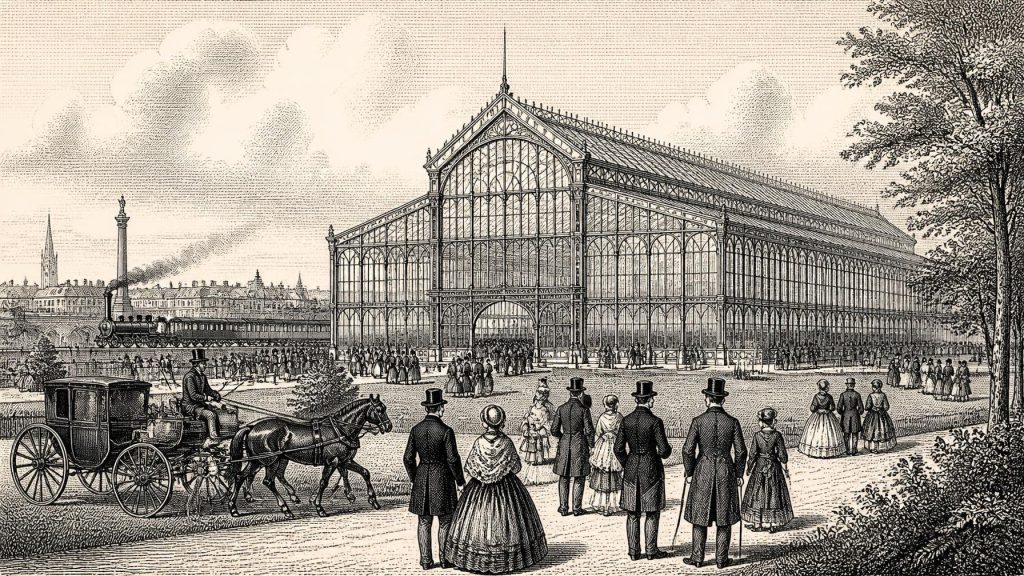
On 12 May 1853 Dublin acquired a striking, temporary landmark: the Great Industrial Exhibition opened on Leinster Lawn, beside Leinster House. Organised in connection with the Royal Dublin Society, it was the most conspicuous Irish public event of the year. Its glass-and-iron halls, designed by John Benson, consciously echoed London’s Great Exhibition of 1851. Yet this was not simply a smaller Irish copy of the Crystal Palace. It was a declaration that Ireland, only beginning to emerge from the catastrophe of the Great Famine, possessed skill, resources, artistic inheritance and a place in an international commercial world.
The driving force was William Dargan, the Carlow-born railway contractor whose work had helped create much of Ireland’s early rail network. Dargan offered to underwrite the venture and accepted the risk of loss. His generosity gave the exhibition an unusual character: a large public institution depended heavily on the resources and reputation of a self-made businessman rather than on direct state finance. The RDS supplied experience in agricultural and industrial display, while Dargan supplied the ambition and much of the money. Contemporary observers soon treated the building itself as an exhibit: an emblem of modern construction placed in a city whose Georgian streets and institutions represented an older order.
Art, Manufacture and Memory
The official catalogue divided the exhibition between fine art and the many branches of art-industry and manufacture. Visitors encountered machinery, furniture, textiles, decorative work, agricultural products and imported goods, as well as paintings and sculpture. The arrangement encouraged comparison: practical manufacture could be judged beside design, and Irish products beside those from Britain, continental Europe and farther overseas. This mattered in a country commonly represented in British public debate as agricultural, impoverished and dependent. The exhibition offered a more complicated picture, one in which technical capability, consumer goods and artistic labour could be visibly Irish.
Its treatment of antiquity was equally revealing. Irish medieval ornament and its modern imitations appeared in a commercial setting, bringing ancient forms into contact with jewellery, furnishings and fashionable taste. The famous object later widely called the Tara Brooch was among the antiquarian attractions associated with this world of display and reproduction. Such objects were not being presented through a modern national museum; that institution did not yet exist. Instead, archaeology, scholarship, retail and design overlapped. The exhibition helped make early Irish visual motifs available to a broader urban audience, while also turning them into desirable commodities.
The scale of attendance made the exhibition remarkable. More than a million admissions were recorded across its run, which lasted until 31 October. That figure should not conceal the limits of access. Admission prices, travel costs and distance placed the spectacle more easily within reach of Dublin residents, visitors of means and those connected by railway than of many rural households. Reduced rail excursions near the end broadened attendance, but they also showed the obstacle. The grand hall was an image of an Ireland linked by new transport and consumption; it was not a representative cross-section of a society in which poverty, emigration and insecure landholding remained commonplace.
A Royal Visit, Carefully Staged
Royal attention enhanced the exhibition’s political importance. Queen Victoria, Prince Albert and their children arrived at Kingstown on 29 August for an Irish visit centred on Dublin. The royal party attended the exhibition during the visit, and Dargan was publicly honoured for the enterprise. Victoria also visited his home at Mount Anville. The encounter joined monarchy, industrial patronage and civic ceremony, but it should not be mistaken for evidence of political harmony throughout Ireland. Royal enthusiasm could validate Dargan’s individual achievement; it could not resolve the unsettled questions of land, taxation, religion and political representation that shaped post-Famine life.
Even so, the visit gave Dublin a week of illuminations, crowds, ceremonies and exceptional visibility. For people who took part in it, the occasion was a break from ordinary routines and a source of local pride. For officials, merchants and civic bodies, it was a chance to present the capital as orderly, loyal and capable of hosting an event of international standing. The pageantry therefore had a double meaning. It celebrated connection with the United Kingdom and empire, but it also made a case for Irish distinction within that framework.
Recovery Without Security
Beyond Dublin’s exhibition grounds, 1853 remained a difficult year to live through. The worst mortality of the Famine was past, but recovery was neither even nor complete. The census taken in 1851 had counted 6.55 million people in Ireland, a fall of more than 1.65 million since 1841. Those figures were already a recent, inescapable fact of life in 1853: villages had lost neighbours and kin; holdings had been abandoned or combined; workhouses, burial grounds and emigrant letters preserved the memory of the preceding years. The population continued to decline, above all because departure overseas had become an established family strategy rather than an exceptional escape.
Workhouses remained central to local welfare under the Poor Law, supported by rates raised within the unions. Their role had changed from emergency refuge during famine to a harsh and continuing element of local administration. Some unions and landlords assisted emigration, sending paupers or distressed tenants across the Atlantic. Such schemes could offer a route from destitution, but they also transferred people from a crisis-ridden Irish countryside into uncertain lives abroad. Emigration was simultaneously an act of family survival, an administrative expedient and a profound remaking of Irish communities.
Land was changing hands as well as losing people. The Encumbered Estates Court, established in 1849 to sell financially burdened properties, remained extremely active in 1853. Parliamentary discussion in April recorded sales worth many millions of pounds since the court began, while petitions, rentals and auctions continued through the year. Individual estates in Clare, Waterford, Tipperary and elsewhere were brought to market. The court did not produce one uniform outcome: some purchasers sought improvement and consolidation, others continued established practices, and tenants could face a new landlord without gaining secure tenure. Nevertheless, it accelerated the transfer of landed property after the Famine and made the rural social order less stable.
Representation and the Tenant Cause
The political consequences of that insecurity appeared at Westminster. Ireland had been part of the United Kingdom since 1801, and its MPs sat in the House of Commons rather than in a domestic parliament. The Tenant Right League had sought to unite Catholic and Protestant reformers behind fair rents, compensation for improvements and security of tenure. Its parliamentary supporters had helped defeat Lord Derby’s ministry late in 1852 after it refused to advance a tenant-right measure. But the apparent leverage of the Irish independent members soon weakened.
In 1853 John Sadleir accepted office as a junior lord of the Treasury in Lord Aberdeen’s coalition government. William Keogh, an important Catholic lawyer and former tenant-right advocate, held the post of Irish solicitor general. Their acceptance of office provoked denunciation from League activists, who saw it as a breach of pledges to maintain an independent Irish parliamentary force. Keogh and fellow Irish officeholders briefly resigned in June amid controversy over anti-Catholic remarks by Lord John Russell, before returning to office. The episode demonstrated both the attraction of influence within government and the fragility of a movement attempting to hold together MPs, clergy, tenants and reformers with different priorities.
Gladstone’s New Tax
Finance gave those political disputes an immediate edge. In his budget of 18 April, Chancellor of the Exchequer William Ewart Gladstone proposed to extend income tax to Ireland, alongside an increased duty on spirits. He framed the measure as part of equalising taxation across the United Kingdom. The government proposed in return to remit the remaining consolidated annuities: liabilities arising from advances made for Irish famine relief and Poor Law purposes. Gladstone explicitly acknowledged that Ireland was recovering from a season of profound distress, but argued that relief from the annuities and from some indirect taxes justified the new arrangement.
Irish critics disputed both the arithmetic and the principle. They stressed that the country’s apparent fiscal equality obscured a much lower level of wealth and the particular burden created by famine-era debts and poor rates. Parliamentary debate revealed a basic disagreement about what fairness meant: identical taxes imposed across the United Kingdom, or taxes adjusted to very unequal social conditions. The new income tax was to begin later in the year. For Irish property owners and professionals it brought a fresh state demand at a moment when the economic after-effects of the Famine were still visible everywhere.
Culture, Education and Exile
The exhibition’s legacy began before its doors closed. In November 1853 the Irish Institution considered possible sites for a permanent Dublin gallery, an initiative encouraged by the success of Dargan’s art displays. A National Gallery of Ireland would not open until 1864, but the year’s exhibition helped convert the idea of a public art collection from aspiration into organised campaigning. It was a modest but meaningful development in the cultural infrastructure of the capital.
Educational and religious questions also remained live. Catholic bishops had been pursuing a Catholic university as an alternative to the denominational tensions surrounding higher education. John Henry Newman had been invited to lead the projected institution, though the university did not open until 1854. It would be anachronistic to treat it as operating in 1853; the important point is that the planning reflected a growing Catholic institutional confidence and a demand for higher education shaped by Catholic principles.
Meanwhile, the transnational Irish political world gained a dramatic symbol. John Mitchel, the Young Ireland writer transported after the events of 1848, escaped from Van Diemen’s Land in July 1853 and reached New York on 29 November. His flight did not alter conditions in Ireland directly, but it connected Irish nationalism, exile and the expanding diaspora. In a year when Dublin displayed industrial modernity and royal ceremony, Mitchel’s escape was a reminder that the unresolved political passions of the Famine and Young Ireland era had travelled far beyond the island.
Thus 1853 cannot be reduced to a glittering exhibition. Dargan’s glass palace offered a powerful vision of progress: railways, design, commerce, art and international exchange gathered on a Dublin lawn. Yet the same year saw continuing emigration, sales of indebted estates, conflict over tenant representation and an unpopular extension of taxation. Ireland was rebuilding, but it was rebuilding after demographic ruin and amid arguments over who would own the land, pay the state and define the country’s future.
Primary Sources
- Art and Industry: The Role of the RDS in the Organisation of the Dublin Great Industrial Exhibition of 1853
- Official Catalogue of the Great Industrial Exhibition, in Connection with the Royal Dublin Society, 1853
- Dargan, William
- Great Industrial Exhibition, Dublin 1853
- The 1853 International Industrial Exhibition
- History of the Gallery
- William Dargan (1799–1867), Railway Magnate and Sponsor of the 1853 Dublin Exhibition
- The Financial Statement—The Budget, 18 April 1853
- Income Tax Bill, 23 May 1853
- Income Tax Bill, 6 June 1853
- Sale, Etc., of Lands (Ireland), 27 April 1853
- Incumbered Estates (Ireland) Act Continuance Bill, 22 July 1853
- Incumbered Estates Court, Ireland: List of Petitions Filed to July 1853
- Distressed Estates Collection: Dates of Sales and Landowners
- Census 1851
- The Census of Ireland for the Year 1851
- Sadleir, John
- Keogh, William Nicholas
- Mitchel, John
- Young Irelanders: Exiles in Paradise — Their Story
- The Panicked Flood: Emigration and the Great Famine
- Irish Emigration Patterns and Citizens Abroad
- Famine and Land, 1845–80
- Agricultural Change
- Irish Migration Before and After the Great Famine
- Queen Victoria’s Journals: Browsing
- Royal Archives Online
- The Queen’s Visit to Ireland—1853
- Here Be Monsters: The Irish Industrial Exhibition of 1853 and the Growth of Dublin Department Stores
- Newman, John Henry