
April 2026: Fuel, Protest and Political Survival
April 2026 saw fuel price protests disrupt transport and supply networks across Ireland. Farmers, hauliers and other demonstrators blocked routes and facilities as the cost of living generated widespread anger. Garda interventions helped restore access to the Whitegate refinery, while the Government announced fuel supports and tax reductions. A parliamentary confidence vote subsequently tested the coalition, which survived. In another significant development, reports from the former Mother and Baby Home at Tuam renewed national attention to the treatment and commemoration of institutionalised women and children. April demonstrated the interconnected consequences of economic pressure, public protest, political survival and historical accountability.
Dateline
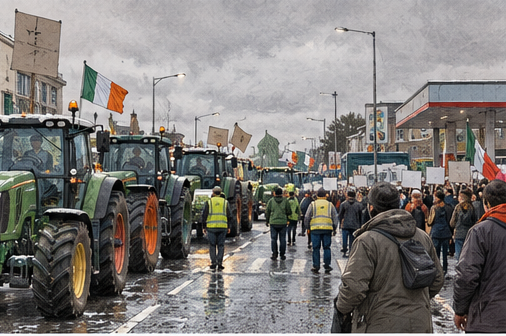
April 2026 produced one of the most serious episodes of social and political disruption experienced in Ireland for years. Beginning on 7 April, farmers, hauliers, taxi drivers and other groups organised slow-moving convoys and blockades in protest at rapidly rising fuel prices and wider cost-of-living pressures. Access to ports, distribution facilities and the Whitegate refinery in County Cork was obstructed, interrupting deliveries and leaving many filling stations without fuel.
The demonstrations grew quickly through social media and lacked the single leadership structure familiar from established trade-union campaigns. That made negotiation difficult and created uncertainty over who could speak for participants. Supporters presented the action as the response of households and small businesses unable to absorb further costs. Critics argued that blocking essential infrastructure endangered food distribution, healthcare and other services.
On 11 April Gardaí, assisted by Defence Forces vehicles, restored tanker access to Whitegate. Images of police, protesters and military equipment at the refinery became defining records of the crisis. The following day the Government announced a €505 million package of fuel-related supports and tax reductions. Supplies began to recover, although officials warned that normal distribution would take time.
The political consequences were immediate. Opposition parties accused the coalition of responding too slowly and tabled a motion of no confidence. Micheál Healy-Rae resigned as a Minister of State shortly before the vote. On 14 April Taoiseach Micheál Martin’s administration survived by 92 votes to 78. The result preserved the coalition but did not remove the economic pressures that had produced the confrontation.
April also brought renewed attention to the former Bon Secours Mother and Baby Home at Tuam, where the discovery of further infant remains was announced. The news returned public focus to institutional treatment of women and children and to the difficult process of recovering, identifying and respectfully commemorating the dead.
The month’s events showed how quickly economic anxiety could become a crisis of political legitimacy. Rising prices were international in origin, but their consequences were felt at pumps, farms, businesses and household budgets. Protest, policing, emergency relief and parliamentary survival combined to make April a decisive chapter in the public history of 2026.