Éogan Mór
ail Mogh Nuadat .i. Eogan mac Mogha Nét. It says that there was then in Ireland a remarkable champion, Núaidha Sálfada mac Aengusa mic Fir Da Crích of Cúailnge, and that he was brought to Daire m-Barrach for the making of Dún Aillinne. The story then presents the event at the fort as the occasion on which the name Mog Nuadat was given, and it closes by saying that he was so named from that incident. Here the account names Eogan mac Mogha Nét in the episode of Dún Aillinne.
Dateline
ail Mogh Nuadat .i. Eogan mac Mogha Nét. It says that there was then in Ireland a remarkable champion, Núaidha Sálfada mac Aengusa mic Fir Da Crích of Cúailnge, and that he was brought to Daire m-Barrach for the making of Dún Aillinne. The story then presents the event at the fort as the occasion on which the name Mog Nuadat was given, and it closes by saying that he was so named from that incident.
Name Tradition
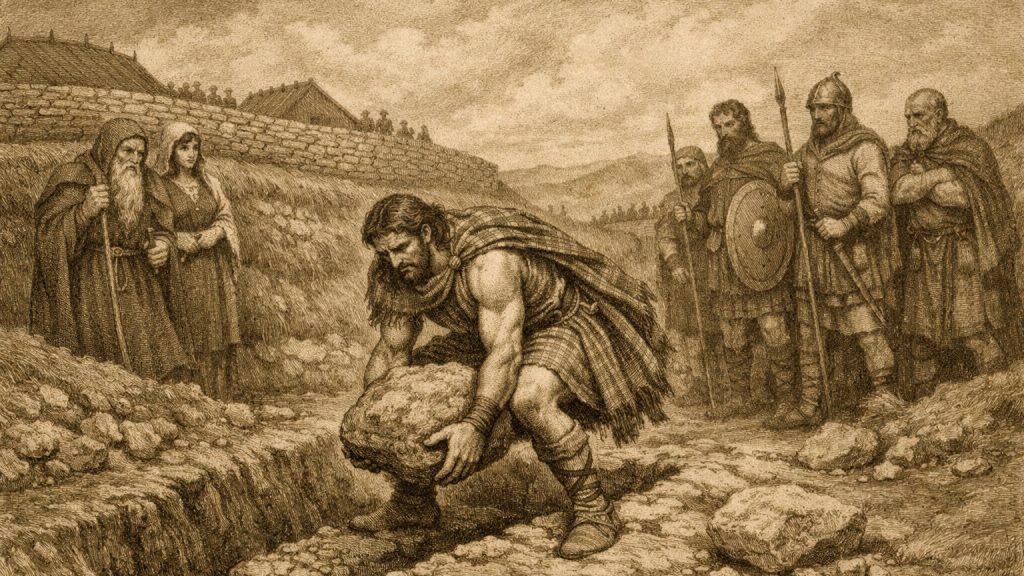
Here the account names Eogan mac Mogha Nét in the episode of Dún Aillinne. Daire m-Barrach mac Cathair had the fortification made, and the great champion Núaidha Sálfada mac Aengusa mic Fir Da Crích was brought to him for the work at Dún Aillinne. While the men were in the trench digging, a large stone came to them in the trench and the champion was compelled to lift it. The men of the fort and Eogan were there together, with Eogan among them watching the champion as he handled the task. When the champion asked the men to move the stone out of the trench, the men refused it, except Eogan alone. Then Eogan went into the trench, put both hands around the stone, lifted the stone by himself, and set it on the south shoulder of the fort. After that, the text says, it remained there ever since.
The same episode is repeated here with the naming form Mogh Nuadat. The passage says that Daire m-Barrach mac Cathair caused Dún Aillinne to be made, and that the champion was brought to him for the work there. While they were digging in the trench, a large stone came to them in the trench and the champion had to raise it. Eogan was among the men of the fort, standing by the trench and looking on as the champion measured the task. When the champion asked the men to remove the stone from the trench, the men refused, except Eogan alone. Eogan then went into the trench, placed both hands around the stone, raised it by himself, and set it on the south shoulder of the fort. The druid then spoke to the champion and said, “Is saé[r] do mogh anedu, a Núaidha!” From that, the text says, he was called Mog Nuadhat thereafter.
Learned Setting
ail Mogh Nuadat .i. Eogan mac Mogha Nét. Dorighnedh cumdach Dúin Aillinne fecht ann la Dára m-Barrach mac Cathair. Robhói tra ráthmhoghaidh amra a n-Érinn intan sin .i. Núaidha Sálfada mac Aengusa mic Fir Da Crích a crich Cuailgne, nert céit ann, sáith cóicait nomheleth. Tucad co Dára m-Barrach in mogh sin do chumdach Dhuine Aillinne. INtan badar isin cluidh iga tochailt dorala íarsin cloch mhór dóibh isin cluidh & forfeimidh in mogh a tógbáil. Dobhadar maccraidh in dunaidh & Eogan etarru ar in claidhe na rátha ig fechain in mogaidh ag locad in fedhma. Do iarr in mogh for in maccraidh in chloch do chur assin chlaidh. Rus-eitigh in maccraidh inní sin acht Eogan a aenur. Dochuaidh tra Éogan isin cluidh & do íadh a dhí laimh iman cloich, & rus-tógaibh ‘na aenur in chloch, & do chuir ar uillinn deiscertaigh in duni. Conus fil ann o sin a leth. IS ann asbert in drái frissin mogh: “Is saé[r] do mogh anedu, a Núaidha!” or in drai. Conid de sin rolil Mog Nuadhat de, & is úaidh rohainmnighedh iarsan slicht sin.
Source References
Hover over a number to see the source. Select it to open the source.
The source gives the form Eogan mac Mogha Nét and says that, after the feat with the stone at Dún Aillinne, he was called Mog Nuadat. The druid said, “Is saér do mogh anedu, a Núaadha!” and the text adds that it was from this that he was called Mog Nuadat, and that he was named so afterwards.
Traditional Figure
The passage identifies him in the form Eogan mac Mogha Nét and places the naming episode at Dún Aillinne in the time of Daire m-Barrach mac Cathair. It also names the champion brought there as Núaidha Sálfada mac Aengusa mic Fir Da Crích, from Crích Cuailnge, with “nert céit ann” and “sáith cóicait nomheleth.” The text says that he was brought to Daire m-Barrach for the making of Dún Aillinne, and that while they were digging in the trench a large stone came to them there and the champion was required to lift it. The men of the fort and Eogan were together by the trench, and Eogan watched the champion as he was testing the task. When the champion asked the men to take the stone out of the trench, the men refused except Eogan alone. Eogan then went into the trench, put both hands around the stone, lifted it by himself, and placed it on the south shoulder of the fort. The text then says that it remained there ever after. The druid’s words are addressed to the champion, and the naming that follows is given explicitly: “Is saé[r] do mogh anedu, a Núaidha!” and therefore he was called Mog Nuadhat, with the passage adding that he was so named from that episode.
ail Mogh Nuadat .i. Eogan mac Mogha Nét. Dorighnedh cumdach Dúin Aillinne fecht ann la Dára m-Barrach mac Cathair. Robhói tra ráthmhoghaidh amra a n-Érinn intan sin .i. Núaidha Sálfada mac Aengusa mic Fir Da Crích a crich Cuailgne, nert céit ann, sáith cóicait nomheleth. Tucad co Dára m-Barrach in mogh sin do chumdach Dhuine Aillinne. INtan badar isin cluidh iga tochailt dorala íarsin cloch mhór dóibh isin cluidh & forfeimidh in mogh a tógbáil. Dobhadar maccraidh in dunaidh & Eogan etarru ar in claidhe na rátha ig fechain in mogaidh ag locad in fedhma. Do iarr in mogh for in maccraidh in chloch do chur assin chlaidh. Rus-eitigh in maccraidh inní sin acht Eogan a aenur. Dochuaidh tra Éogan isin cluidh & do íadh a dhí laimh iman cloich, & rus-tógaibh ‘na aenur in chloch, & do chuir ar uillinn deiscertaigh in duni. Conus fil ann o sin a leth. IS ann asbert in drái frissin mogh: “Is saé[r] do mogh anedu, a Núaidha!” or in drai. Conid de sin rolil Mog Nuadhat de, & is úaidh rohainmnighedh iarsan slicht sin.