Domnall ua Néill
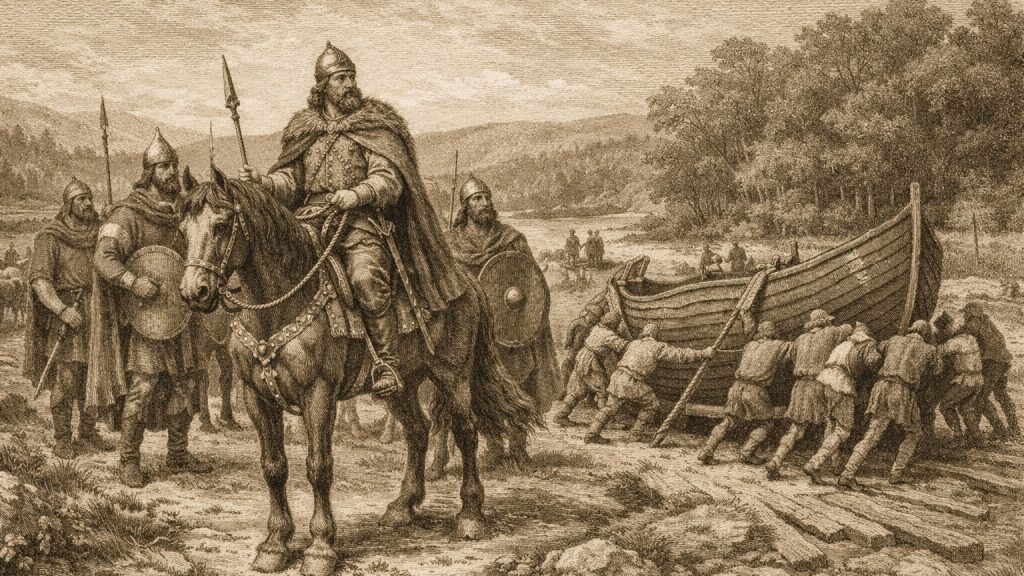
Domnall ua Néill appears in the Irish annals in notices that identify him as king of Temair, and in one entry as king of Ireland. The surviving notices record particular actions and events rather than a continuous narrative, and they provide the basis for what can be said about his activity in the years preserved in the annalistic record. The earliest notice places him in 963, when Domnall ua Néill brought ships from the Daball across Sliab Fuait to Loch Aininne, something that, according to the annal, had not been done since ancient times.
Dateline
Domnall ua Néill appears in the Irish annals in notices that identify him as king of Temair, and in one entry as king of Ireland. The surviving notices record particular actions and events rather than a continuous narrative, and they provide the basis for what can be said about his activity in the years preserved in the annalistic record.
Royal Account
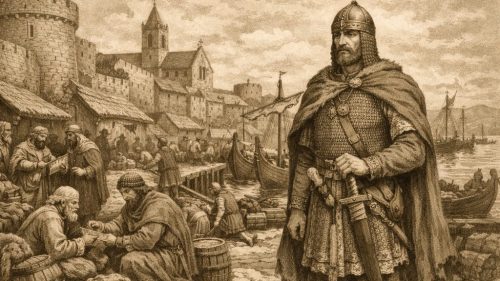
The earliest notice places him in 963, when Domnall ua Néill brought ships from the Daball across Sliab Fuait to Loch Aininne, something that, according to the annal, had not been done since ancient times. The same entry adds that this report was also in the Book of Dub dá Leithe. The notice preserves the movement itself and the annalistic comment on its antiquity.
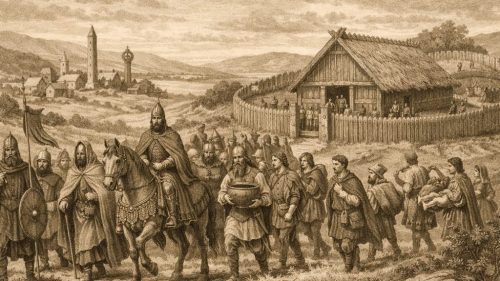
In 965 Domnall ua Néill is styled king of Temair when he made an expedition and plundered Connacht, taking hostages from ua Ruairc. The annals also note a later entry in which he is called king of Ireland when the sacking of Mainister and Lann Léire is recorded, and in that same notice three hundred and fifty people were burned in one house. These entries preserve his titles alongside the actions attributed to him.
Battle Campaigns
In 968 the annals say that Domnall ua Néill led an army to Laigin and plundered them from Berba westwards to the sea, taking a great spoil in cows, and that he beleaguered the foreigners and the Laigin for two months. The notice records both the movement of the army and the length of the siege-like pressure described by the annalist. It is followed in the record by other notices that continue to name him in the surrounding years.
The annals connect Domnall ua Néill with the battle of Cell Móna in 970, where Domnall son of Congalach and Amlaíb were victorious against him. The entry names those who fell there, including Ardgar son of Matudán, king of Ulaid, Donnacán son of Mael Muire, king of Airgialla, and Cinaed son of Cróngall, king of Conaille, together with very many others. The notice preserves the outcome and the names attached to the event.
Home Struggles
Another annalistic notice, under 971, states that Domnall ua Néill, king of Temair, was driven from Mide by the Clann Cholmáin. This entry preserves the title by which he is named and the action reported of the Clann Cholmáin. It adds a further dated notice to the sequence of references to him in the annals.
The surviving notices about Domnall ua Néill consist of dated entries that record a ship movement across Sliab Fuait, an expedition into Connacht with the taking of hostages, a raid and burning in Leinster and in the place named Mainister and Lann Léire, the plundering of Laigin from Berba to the sea, the battle of Cell Móna, and his being driven from Mide. They also preserve the forms in which the annals identify him, including king of Temair and king of Ireland.
Historical Legacy
Domnall ua Néill is therefore present in the annals through a sequence of notices that date his activity in the 960s and 970s. The record includes his bringing of ships from the Daball across Sliab Fuait to Loch Aininne, his expedition against Connacht and taking of hostages from ua Ruairc, his plundering of Laigin and beleaguering of the foreigners and the Laigin for two months, his defeat at Cell Móna, and the notice that he was driven from Mide by the Clann Cholmáin.
Source References
Hover over a number to see the source. Select it to open the source.