
Connolly Records
At a Glance
Chronology Outline
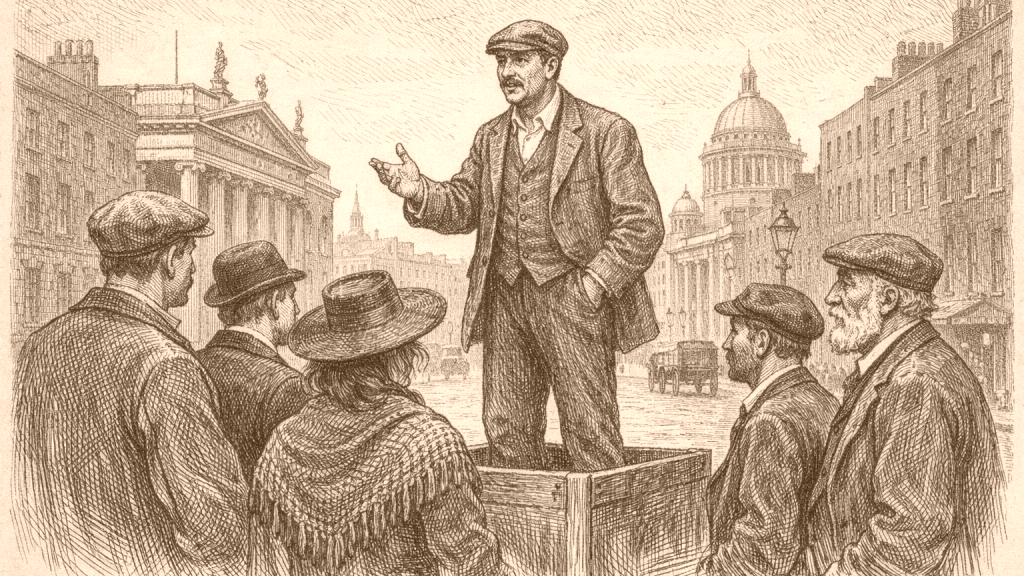
The chronology presents James Connolly as a figure whose life can be traced in dated milestones rather than in extended commentary. It records his birth in Edinburgh, early employment at printing works, and later military service with the Royal Scots Regiment. It also notes his marriage, his move to Dublin for paid socialist organizing, and the publication of Erin's Hope. The sequence is compact and factual, giving names, places, and years without interpretive framing. [1]
Later entries show a continuing movement between politics, writing, and travel. Connolly is recorded as taking part in a demonstration commemorating 1798, being arrested, and then released after a fine was paid. The chronology also lists subsequent publications, lecture tours, and travel to the United States on behalf of socialist organizations. Read literally, these lines document activity and mobility, but they do not discuss asylum law, legal doctrine, or any judicial proceeding about asylum. [1]
Labour Context
A passage from The Workers' Republic shows Connolly writing in the first person about conflict in Dublin. He refers to a proclaimed public meeting, arrests of leaders of the Irish Transport and General Workers' Union, baton attacks, and police brutality. He then describes support from the British Trades Union Congress, food shipments, and money raised for the Dublin men and women. The text is polemical, yet its evidential value lies in its concrete references to events and organized labour responses. [2]
The same passage continues by describing a broad labour coalition made up of trade unionists, socialists, anarchists, industrialists, and syndicalists. It also contrasts united opponents with disunited workers, then links Dublin with earlier struggles in London and Leith. These comparisons are internal to the text and are directly observable. They show Connolly arguing for common action, but they still do not mention asylum law or immigration procedure. [2]
Legal Access
The National Library of Ireland describes its official publications holdings as a research resource covering government publications from Irish, British, and international sources, with some earlier items. The collection includes Irish official publications and access routes for researchers through reading rooms and digitised materials. This is a statement about where legal and governmental texts may be consulted, not a description of Connolly himself. In that sense, the page establishes research infrastructure rather than historical narrative. [3] [4]
The Law Society guidance identifies specific legal reference tools. It points researchers to the Irish Statute Book for Acts, statutory rules and orders, and statutory instruments, and it points to courts and case-law search tools such as the Courts Service and BAILII. The page is procedural and practical, describing how to search for law sources. On its face, it supports legal research generally, but it does not itself mention asylum law in the excerpted material. [5]
Irish Records
The NLI eResources page makes a similar point in a more expansive way. It says the library provides access to hundreds of Irish newspaper titles and serials, full text reference works, records of government and official publications, and digitised books, manuscripts, and maps. It also notes that some subscription resources are available to registered readers in reading rooms. This is a clear description of research access, and it is compatible with work on Irish legal history without naming any specific asylum materials. [4]
The same page also lists genealogy and newspaper tools, including Irish newspapers archives and the British Newspaper Archive, both available on site through the National Library. For a historian, these references indicate a route to contemporary reporting and public records, but the page itself does not supply a topic-specific index for asylum law. What it does provide is evidence that modern Irish research frequently depends on layered access to newspapers, legislation, and official documents. [4]
Asylum Gap
Within these excerpts, asylum law appears only as a topic that is not named. The chronology of Connolly records birth, work, travel, publications, arrest, and execution. The legal pages record where statutes, judgments, newspapers, and official publications can be searched. Yet none of the quoted passages identifies asylum legislation, asylum hearings, refugee procedure, or a Connolly case connected to asylum. The absence is therefore limited and documentary: it concerns these selected passages alone. [1] [3] [4] [5]
That limited absence should not be overstated. The materials are capable of supporting legal-historical research because they point to legislative and judicial repositories, and they also preserve a biographical timeline for Connolly. Still, direct evidence for asylum law would require passages naming statutes, procedures, or cases on that subject. In the retrieved excerpts, the closest material remains general legal access guidance and Connolly’s own political chronology, not asylum-specific content. [1] [3] [5]
Research Limits
The evidence also shows the limits of what can responsibly be said. The Connolly chronology reaches from the 1860s to 1916 and gives only concise life events. The legal-access pages are modern institutional guides to collections and research tools. Because the excerpts are narrow, a careful account should distinguish between what they state and what they do not state. They support a biographical and documentary outline, but not a detailed account of asylum law. [1] [3] [4] [5]
A final comparison is straightforward. Connolly is presented as an organizer, writer, and political actor whose life includes arrest and wartime execution. The law pages are presented as gateways to statutes, judgments, newspapers, and official publications. These are different kinds of documents, and their overlap is methodological rather than thematic. Together they show how a researcher might begin to trace context, while still needing additional, asylum-specific sources before drawing firmer conclusions. [1] [2] [3] [4] [5]
Source References
Hover over a number to see the source. Select it to open the source.

What do the available biographical and legal-reference excerpts reveal about James Connolly, legal research access in Ireland, and the absence of direct evidence for asylum law in these materials?