Sitric Silkbeard
Sitric Silkbeard appears in the historical record as a ruler of Dublin at the turn of the eleventh century. He belonged to the Uí Ímair dynasty, the Scandinavian-descended ruling family that had long been prominent in the Irish Sea world. Later discussion of his career has emphasised that he was part of a Christian, Hiberno-Norse royal milieu rather than a simple outsider figure. The same tradition also places him within a web of Irish dynastic relationships, with a Leinster connection through his mother and close links to Brian Boru’s family through marriage. Sitric Silkbeard ruled Dublin for over four decades, from 989 to 1036.
Dateline
Royal Beginnings
Sitric Silkbeard appears in the historical record as a ruler of Dublin at the turn of the eleventh century. He belonged to the Uí Ímair dynasty, the Scandinavian-descended ruling family that had long been prominent in the Irish Sea world. Later discussion of his career has emphasised that he was part of a Christian, Hiberno-Norse royal milieu rather than a simple outsider figure. The same tradition also places him within a web of Irish dynastic relationships, with a Leinster connection through his mother and close links to Brian Boru’s family through marriage.
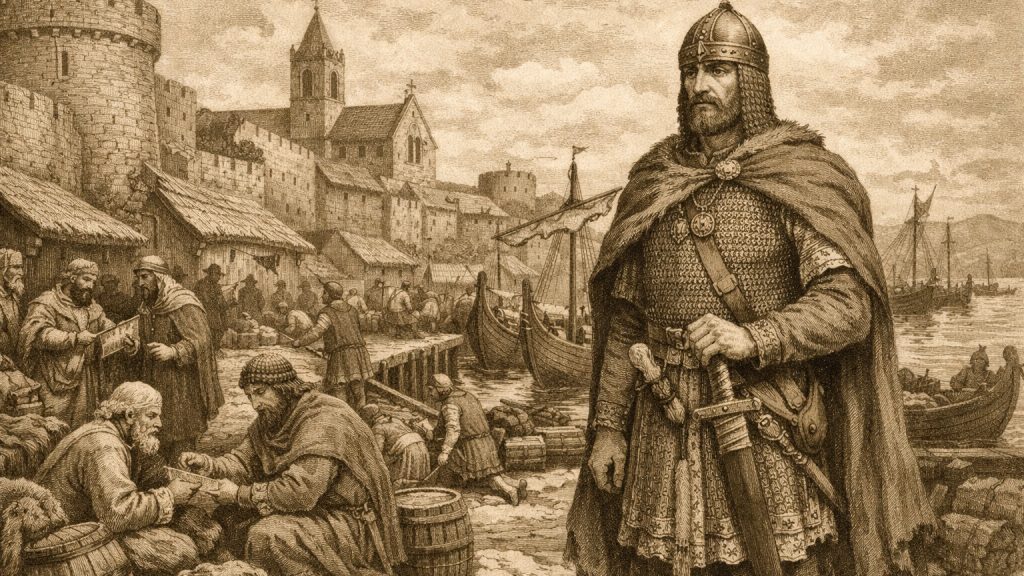
Sitric Silkbeard ruled Dublin for over four decades, from 989 to 1036. He came to the throne after Ímar had reigned in Dublin after Sitric son of Olaf, and after Ímar again fled from Dublin, Sitric reigned in his place. The records also show him acting as king of the Foreigners of Dublin in the years around 1002, when he went in his galleys on a foray into Ulster and plundered Cell Cleithe and Inis Cumscraig, carrying out many captives. Other notices place Dublin and its kings within the wider politics of Ireland: the Foreigners of Dublin were involved in the battle of Dublin in 989, the burning and plundering of places in Leinster and Meath are repeatedly recorded, and Sitric himself appears in the annals beside Brian son of Cennéidigh and Máel Sechnaill son of Domhnall in the campaigns and negotiations of the period. He minted coins in Dublin, with the inscription SIHTRIC REX DYFLINN, and these pennies are described as bearing both a profile of a king and a Christian cross. On his return from a pilgrimage to Rome in 1028, he is said to have founded Christ Church Cathedral in Dublin in the image of the great city of Cologne. Christ Church soon became one of the most powerful churches in Ireland. His father Amlaíb Ólaf had previously been defeated by Máel Sechnaill mac Domnaill at the Battle of Tara in 980 and retired in pilgrimage to Iona, and Sitric’s position in Dublin was established after later struggles in which his half-brother Glún Iarainn was killed in 989. The annals and later accounts therefore place him repeatedly in the political, religious, and dynastic record of Dublin and Ireland over a long reign.
Dublin Power
Several sources associate Sitric with the strengthening of Dublin’s urban and commercial life. A modern exhibition from Edward Worth Library notes that he introduced coinage in Viking Dublin, and that this move reflected both the role of the city in sea trade and the administrative sophistication of his government. The same source says he ruled from 989 to 1036. Maynooth University likewise presents him as a king who helped turn Dublin into a rich, thriving, cosmopolitan European city. His coinage is especially important because it shows rulership being expressed in a recognisably public and monetary form, with silver pennies carrying his name and title. In that sense, his government belonged to the broader history of early medieval urbanisation in Ireland.
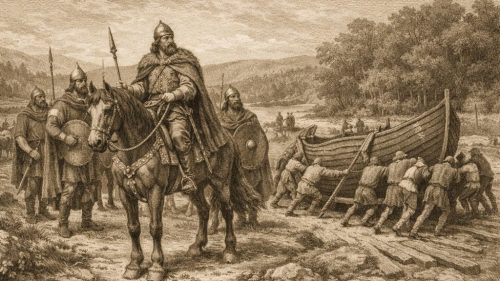
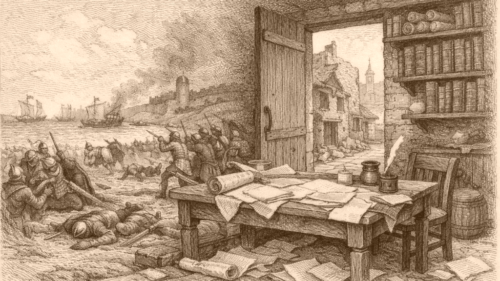
The evidence also shows Dublin under Sitric as a city repeatedly drawn into conflict. The Annals of Tigernach record that in 999 Brian, son of Cennétig, entered Dublin, carried off gold, silver, and captives, burned the fortress, and banished Sitric. Yet other annalistic entries show Sitric still active afterwards, which fits a pattern of defeat followed by return. In 1002 he led a raid into Ulster in his galleys and plundered Cell Cleithe and Inis Cumscraig. These notices present him as an energetic maritime ruler, able to use ships as instruments of war and plunder.
Clontarf Context
Sitric’s name is most famous in connection with the Battle of Clontarf, but the surviving accounts are not straightforward. Later literary tradition, especially the Cogad Gáedel re Gallaibh, cast him as the frightened king sheltering in Dublin while others fought. Modern historians have treated that picture with caution. Maynooth University notes that source traditions disagree about his role, and states that the only thing that can be said with confidence is that he survived. The same discussion explains that his conduct would have been shaped by earlier experiences, including the sack of Dublin after the battles of Tara and Glen Mama. Rather than presenting a single dramatic scene, the evidence supports a more limited statement: Sitric remained a central figure in Dublin during the great conflict of 1014, but the details of his battlefield role are uncertain.
Later accounts of Sitric Silkbeard vary in emphasis. The medieval poem Cogad Gáedhel re Gallaibh presents Brian Bórama as the hero of Clontarf and Sitric as part of the opposing Dublin side, while later histories also describe the battle in different ways. Other notices are more limited and factual: Sitric ruled Dublin after 989, he survived the encounters associated with Tara and Glen Mama, he minted coinage in Dublin, and he later went on pilgrimage to Rome in 1028 before founding Christ Church Cathedral on his return. The annals place him among the rulers and actors of Irish affairs, including the records for 1002, when he went in his galleys on a foray into Ulster and plundered Cell Cleithe and Inis Cumscraig. They also record the wider setting of his reign, with Dublin linked to raids, hostages, battles, and changing kingship among the Foreigners and the Irish. Sitric is named beside Brian son of Cennéidigh and Máel Sechnaill son of Domhnall in this period, and the evidence preserves him as a ruler of Dublin within those political events.
Pilgrimage Church
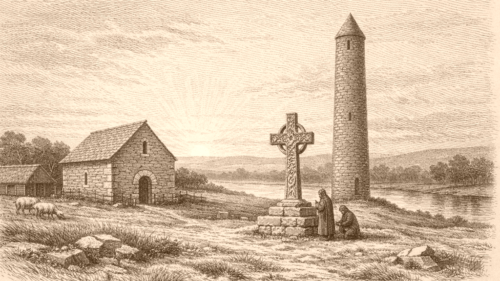
One of the clearest later events connected with Sitric is his pilgrimage to Rome in 1028. The Edward Worth Library material states that on his return he founded Christchurch Cathedral in Dublin, reportedly after the model of the great church he had seen in Cologne. That same source presents Christchurch as soon becoming one of the most powerful churches in Ireland. This episode is important because it shows Sitric not only as a warrior king, but also as a patron acting in a Christian urban setting. It aligns with the broader picture of a Hiberno-Norse ruler whose authority was expressed through both commerce and religion.
Maynooth University also describes Sitric as a Christian king and places him within a long-lived dynasty of Dublin rulers. The surviving evidence therefore supports a biography in which kingship, urban development, warfare, pilgrimage, and church patronage all belong together. Sitric Silkbeard emerges as a ruler whose career linked Dublin to the wider Irish Sea world and whose reign left traces in annals, coinage, and ecclesiastical history.
Source References
Hover over a number to see the source. Select it to open the source.