Colum Cille — Foundations elsewhere563 CE
The annals for the mid-sixth century preserve several notices that modern readers may group under 563 CE, but the texts do not place them in exactly the same way. The Annals of Ulster, Tigernach, Inisfallen, and the Four Masters each attach different calendar headings or relative year labels to notices of battles, deaths, and Colum Cille’s voyage. Some entries are duplicated with variant dating, while others appear only in one compilation. Reading them separately shows a compact cluster of notices about conflict, succession, and ecclesiastical movement without forcing the records into a single reconciled year.
Dateline
Year notices
The notices relevant to 563 CE are distributed unevenly across the annals, and the printed headings are part of the record. In the Annals of Ulster, U563.0 reads with the heading AD 562, while U564.0 reads with the heading AD 563. In the Annals of Tigernach, T563 begins under Annal T563, and in the Annals of Inisfallen AI563.1 is placed under Annal AI563. [1] [2] [4] [3]
These headings do not place all the relevant notices in one identical year, and the records themselves keep their own sequence. The Ulster text places the voyage of Colum Cille under U563.4 and prints AD 562 at U563.0, while the later entry U564.0 prints AD 563 and contains a wind-storm, Laisre’s death, and a note about Brénainn founding Cluain Ferta. Inisfallen’s AI563.1, by contrast, gives Colum Cille in exile and his first night in Alba during Pentecost. [1] [4]
Battle records
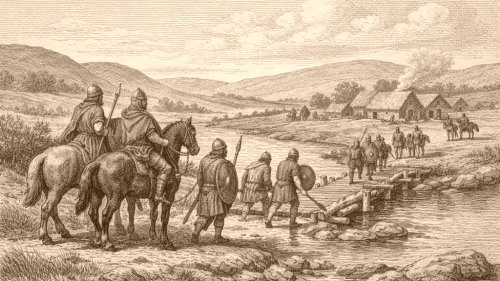
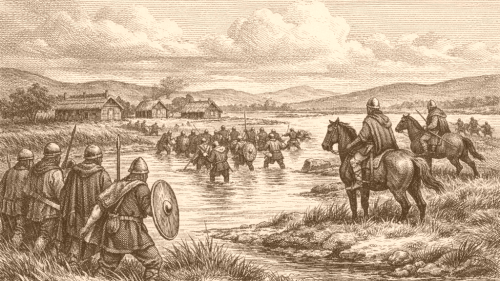
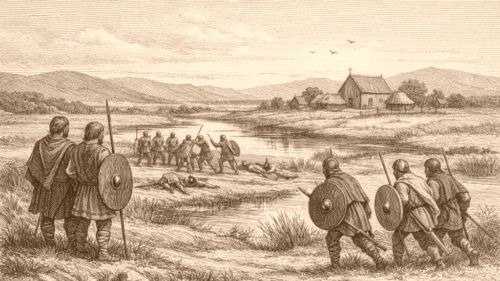
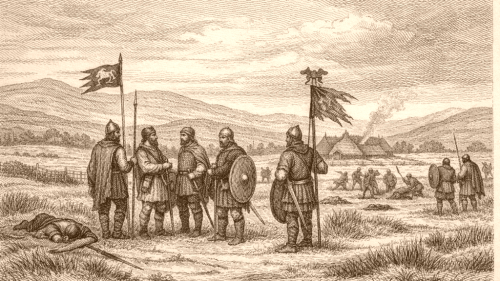
The battle notices attached to this cluster are recorded separately and with different attributions. In the Annals of Ulster, U563.1 says the battle of Móin Daire Lothair was won over the Cruithin by the Uí Néill of the North, and the same entry names Baetán son of Cenn and mentions Cenél nEógain and Cenél Conaill as hired forces. U563.1 also contains a poetic passage that repeats the battle of the Cruithin and names Eilne, Gabar Liphi, and Cúail Dreimne in a chain of conflict notices. [1]
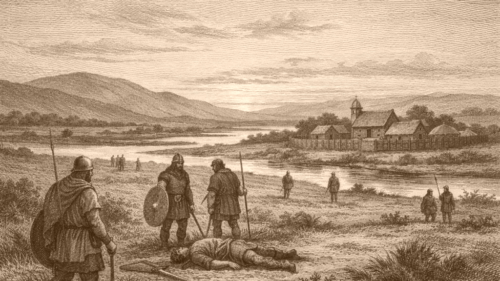
Other compilations preserve related battle notices but do not present them in the same form. Tigernach’s T563.4 records that Diarmaid son of Cearbhall was killed in Rath Bec in Magh Line by Aodh Dubh son of Suibne Araidhe, and that his head was taken to Cluain while his body was buried in Connere. Inisfallen’s AI561.1 records the battle of Cúl Dreimne, naming Ainmire son of Sétna, Ainnedid son of Fergus, and Domnall as victors and stating that Diarmait was put to flight. [2] [4]
Royal deaths
The annals also record changes in kingship by death, and they do so in separate notices. The Annals of Tigernach at T563.5 say that Diarmaid son of Cearbhall was killed by Aodh Dubh son of Suibne Araidhe, king of Ulster, and that two sons of Mac Earca, Forgus and Domnall, succeeded him. The Annals of Ulster U565.1 likewise state that the slaying of Diarmait son of Cerball was by Aed Dub son of Suibne, and that Forgus and Domnall succeeded him.
The same cluster includes deaths of other named figures, but the records do not merge them into one event. The Annals of Ulster U563.2 give the death of Aedán son of Fiachra, and U563.3 the killing of Colmán Mór son of Diarmait. Tigernach T562.3 notes Aodhan hua Fiachrach’s death, while T562.4 records the death of Molaissi of Devenish. The Four Masters M563.1 record the death of St. Molaisi, Abbot of Daimhinis, on the twelfth of September. [1] [2] [3]
Voyage notice
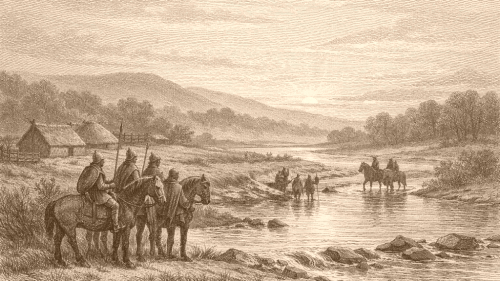
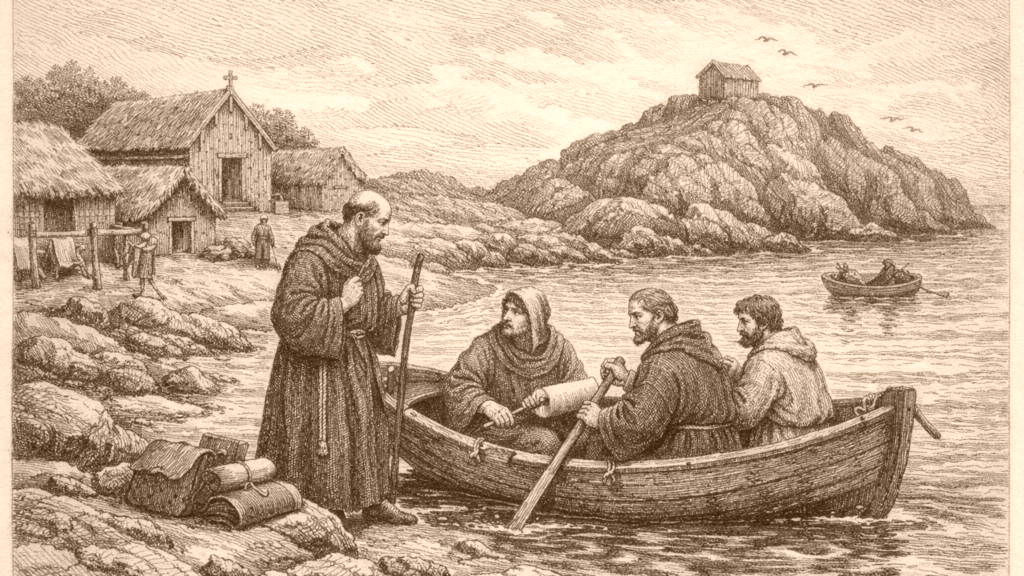
Colum Cille’s departure is one of the clearest notices in the cluster. In the Annals of Ulster, U563.4 records the voyage of Colum Cille to the island of Í in the forty-second year of his age. Inisfallen AI563.1 describes Colum Cille in exile and says his first night in Alba was during Pentecost. The two entries agree that he is at a stage of movement away from Ireland, but they preserve different wording and different details. [1] [4]
The surrounding Ulster notices keep the voyage within a larger sequence of dated items. U564.0, with the printed heading AD 563, follows U563.4 and lists a great wind-storm, the death of Laisre from Daiminis, and an alternative note that Brénainn founded the church of Cluain Ferta in that year. The sequence shows Colum Cille’s voyage placed beside other notices, not isolated from them. The text itself does not add a reason for the voyage in these excerpts. [1]
Foundations elsewhere
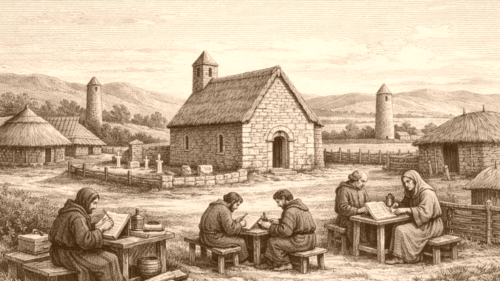
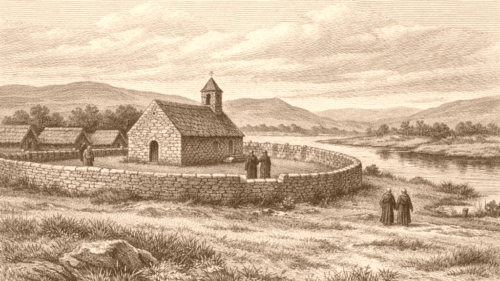
Some notices linked to the same chronological cluster concern religious foundations. In the Annals of Ulster, U564.3 says that in this year Brénainn founded the church of Cluain Ferta, though the wording is introduced as an alternative. Inisfallen AI561.1 places the founding of Cluain Ferta Brénainn on the day of the battle of Cúl Dreimne and says it was done at the order of an angel. These are separate notices with different placements and different narrative framing. [1] [4]
The same pattern appears in notices of ecclesiastical death and repose. The Annals of Ulster U565.2 say the repose of Brénainn of Biror occurred, as some say. Tigernach T572.2 likewise states that Brénainn of Birr rested and adds a brief laudatory stanza. Because the texts preserve the notices separately, it is enough to say that both compilations record Brénainn’s death or repose without combining their formulations into one statement. [1] [2]
Comparative reading
Read together, the notices show that the year cluster contains battles, deaths, succession, and movement by a named holy man. The Annals of Ulster supply the most detailed sequence for Colum Cille’s voyage, the battle of Móin Daire Lothair, and several deaths, while Tigernach and the Four Masters preserve parallel notices for Diarmait, Aedán, and the later transfer of power. Inisfallen preserves the battle of Cúl Dreimne and Colum Cille in exile. The overlap is real, but the wording and placement vary. [1] [2] [3] [4]
The safest historical reading is therefore a documentary one. The annals for the mid-sixth century preserve a compact set of notices that can be compared, but they do not yield a single uniform 563 CE narrative from these excerpts alone. They show exact identifiers such as U563.4, T563.4, AI563.1, and M563.1, and they show that different compilations attach different calendar headings and different details to related events. Beyond that, the excerpts themselves do not support further claims. [1] [2] [4] [3]
Source References
Hover over a number to see the source. Select it to open the source.