Cúil Conaire549 CE
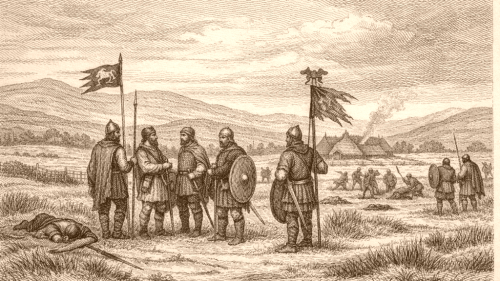
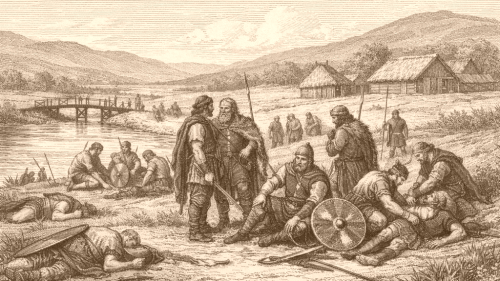
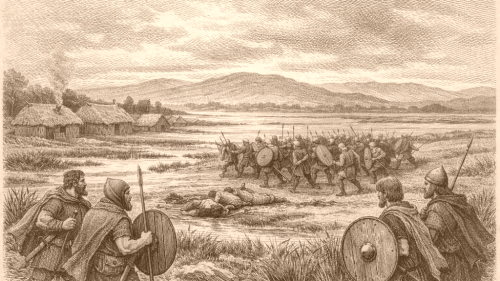
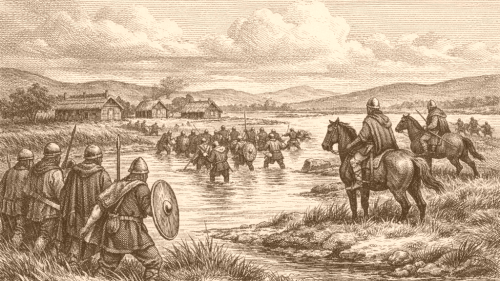
The annals for 549 CE are narrow but not empty. The clearest securely dated notice is the battle of Cúil Conaire in Cera, where Ailill Inbanda and his brother Aed Fortamail fell and Fergus and Domnall were victors. A second tradition in another annalistic collection gives the same battle with slightly different names for the dead and the victors. The year also appears beside a notice for Diarmait’s reign beginning in 549. Other entries near the year concern mortality and religious deaths, but they belong to adjacent annal positions rather than the battle year itself.
Dateline
Year Scope
The year 549 CE is represented most clearly by one battle notice. In the Annals of Ulster, the printed AD heading 549 accompanies the entry for the battle of Cúil Conaire in Cera, so the notice is directly tied to that year in the source’s own presentation. The same source places this battle under identifier U550.1, but the printed heading is the part used here for the year. The record gives a battle, named place, and named dead and victors, without adding further explanation. [1]
In the Annals of Tigernach, the notice appears under T549.1 and records the battle of Cúil Conaire, where Ailill the Womanly, king of Connacht, and Aodh the Prevailing, his brother, fell; Fergus and Domnall, two sons of Mac Erca, were victors. [2]
Battle Report
The Ulster account states that the battle took place in Cera and names the fallen as Ailill Inbanda, king of Connacht, and Aed Fortobol, his brother. It then identifies Fergus and Domnall, the two sons of Muirchertach Mac Erca, as the victors. The same notice is brief and formulaic, with no description of troop movements, causes, or aftermath. Its value lies in the identification of the combatants and the outcome. [1]
The Tigernach notice is broadly parallel but not word-for-word the same. It again places the battle in Cúil Conaire and Cera, and again records the deaths of a Connacht king and his brother. In this version the names are Ailill the Womanly and Aodh the Prevailing, and the victors are Fergus and Domnall, two sons of Mac Erca. The comparison shows agreement on the battle and its result, while preserving the different forms found in each source. [2]
Diarmaid Reign
The Annals of Inisfallen place another notice in the same year: the beginning of the reign of Diarmait, son of Cerball, in his thirty-first year. This entry is not a battle notice, but it is another item attached to 549 in the source’s own year sequence. The entry gives no explanation for the beginning of the reign and does not connect it to the battle at Cúil Conaire. It should therefore be read as a separate dated notice, not as a gloss on the battle record. [5]
The Four Masters place notices under 550, including the age-of-Christ heading, the twelfth year of Diarmaid, and the death of David, son of Guaire Ua Forannain, bishop of Ard Macha and legate of all Ireland. [3]
Nearby Mortality
The surviving excerpts also show that mortality notices cluster around, but are not the same as, the 549 battle entry. In the Annals of Ulster, the printed AD heading 548 contains the death of Ciarán, the abbot of Cluain Moccu Nóis, the death of Tigernach of Cluain Eóis, and a great mortality naming several dead abbots and saints. These notices are under a different printed heading from the battle year and therefore should not be moved into 549. They belong to the immediately preceding year in that source’s presentation. [1]
Comparable mortality material appears in other annals under their own year labels. The Annals of Tigernach place a great mortality under T550, and Chronicon Scotorum places the Crom Conaill mortality under CS551 with a note identifying it as the same kind of plague. The Annals of Inisfallen likewise have a Crom Conaill notice in AI551. These entries are useful for context, but they are not evidence for a mortality event in 549 itself. [2] [4] [5]
Source Comparison
The battle of Cúil Conaire is recorded in the Annals of Ulster under AD 549, in the Annals of Tigernach under T549.1, and in Chronicon Scotorum under CS550. The Annals of Ulster and Chronicon Scotorum name Ailill Inbanda and say that Aed Fortobol, his brother, fell, while the Annals of Tigernach name Ailill the Womanly and say that Aodh the Prevailing, his brother, fell. In all three notices, Fergus and Domnall, sons of Mac Erca, were victors. [1] [2] [4]
The same comparison also shows what the excerpts do not provide. None of these notices gives a narrative of why the battle happened, how long it lasted, or what changed afterward. The Inisfallen notice on Diarmait’s reign stands apart from the battle, and the mortality notices stand apart from both. The year 549 can therefore be described from these passages as a year with one securely dated battle and one separate regnal notice in another compilation, rather than as a year with a larger reconstructed sequence. [5] [1] [2]
Recorded Year
The excerpts preserve a battle notice for Cúil Conaire in the Annals of Ulster under AD 549, a parallel notice in the Annals of Tigernach, and a notice in Chronicon Scotorum under CS550. The notices record the battle in Cera, the fallen Ailill Inbanda and Aed Fortobol, and Fergus and Domnall as victors. [1] [2] [4]
Beyond that core, the year’s surrounding record must remain separate. Inisfallen gives a regnal beginning for Diarmait in 549, while Ulster and other annals place mortality and saintly deaths in adjacent years rather than in 549 itself. The excerpts do not justify merging those notices into a single reconstructed event. They instead show how one sixth-century year can be represented by a battle in one set of annals and by a reign notice in another, without forcing the texts into one unified story. [1] [3] [5]
Source References
Hover over a number to see the source. Select it to open the source.