Owen Roe
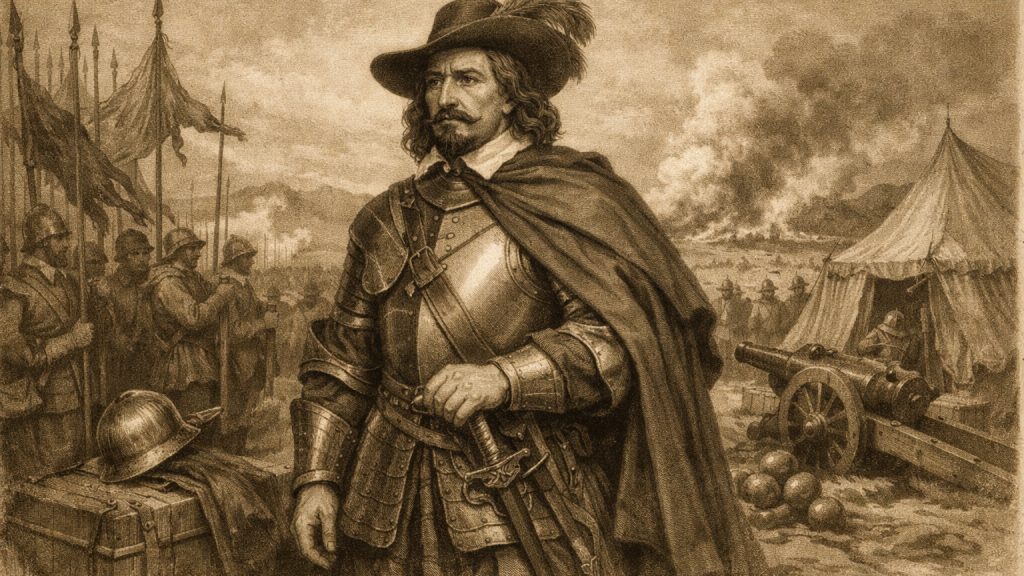
Owen Roe O’Neill was a Gaelic Irish soldier and one of the most famous figures of the O’Neill dynasty of Ulster. He left Ireland at a young age and spent most of his life as a mercenary in the Spanish Army. In that service he fought against the Dutch in Flanders during the Eighty Years’ War. His career later returned him to Ireland, where he took command of the Irish Confederate Ulster Army after the Irish Rebellion of 1641. His year of birth is unknown, though it is likely to have been around 1585. The exact place of his birth is also not known.
Dateline
Owen Roe O’Neill was a Gaelic Irish soldier and one of the most famous figures of the O’Neill dynasty of Ulster. He left Ireland at a young age and spent most of his life as a mercenary in the Spanish Army. In that service he fought against the Dutch in Flanders during the Eighty Years’ War. His career later returned him to Ireland, where he took command of the Irish Confederate Ulster Army after the Irish Rebellion of 1641.
Early Years
His year of birth is unknown, though it is likely to have been around 1585. The exact place of his birth is also not known. He was probably born near Loughgall in County Armagh. He was the illegitimate son of Art MacBaron O’Neill, a son of Matthew O’Neill, 1st Baron Dungannon and younger half-brother of Hugh O’Neill, Earl of Tyrone, who held lands in County Armagh. His mother was the daughter of Hugh Connolly O’Reilly, lord of Breifne O’Reilly in County Cavan.
He was already connected with the conflicts of his age while still young. He fought against the English in the Nine Years’ War, although the extent of his role is not specified in the available material. He would have been only a teenager at the time. As a young man, he left Ireland, likely in 1607 during the Flight of the Earls. He afterwards spent most of his life abroad. He grew up in the Spanish Netherlands and served for about forty years in the Irish regiment of the Spanish army.
Spanish Service
O’Neill served in the Spanish Army for about forty years. Much of this time was spent in the Spanish Netherlands, fighting in the wider struggle between Spain and the Dutch Republic. His combat was also in the Franco-Spanish War against the French. He became known as an expert in defensive warfare. His military career was shaped by continental war as much as by Irish affairs.
Within that Spanish service he was associated with defensive warfare. He is linked in the sources to the siege of Arras in 1640, where he commanded the Spanish garrison. In that engagement he held out for forty-eight days with about 2,000 men against a French army of 35,000. He was noted for this defence in Spanish service.
His service also placed him among those Irish officers abroad who remained hostile to English rule in Ireland. In 1627, he was involved in petitioning the Spanish monarchy to invade Ireland using the Irish Spanish regiments. O’Neill proposed that Ireland be made a republic under Spanish protection to avoid in-fighting between Irish Catholic landed families over which of them would provide a prince or king of Ireland. This plan came to nothing.
Irish Return
After the Irish Rebellion of 1641, O’Neill returned to Ireland and took command of the Irish Confederate Ulster Army. In the course of the conflict he was at the centre of the Confederate struggle. He is especially known for his victory at the Battle of Benburb in 1646. His later years were marked by infighting among the Confederates, and in 1647 he led his army to seize power in the capital of Kilkenny. His troops clashed with rival forces of the Confederacy, and he formed a temporary alliance with Charles Coote’s English Parliamentary forces in Ulster.
In 1647 he led his army to seize power in Kilkenny, the capital of the Confederacy. His troops then clashed with rival forces of the Confederacy. The record also says that he initially rejected a treaty of alliance between the Confederates and the Irish Royalists. When faced with the Cromwellian invasion, however, he changed his mind. This shift led him to agree to a treaty with the 1st Marquess of Ormond, the Lord Lieutenant of Ireland.
He initially rejected a treaty of alliance between the Confederates and the Irish Royalists, but faced with the Cromwellian invasion he changed his mind. The agreement with the 1st Marquess of Ormond included the promise of an earldom. O’Neill died soon after this arrangement, on 6 November 1649. He died shortly after agreeing to the alliance with Ormond. The date of his death was Tuesday, 6 November 1649.
Source References
Hover over a number to see the source. Select it to open the source.