Samthrosc Plague553 CE
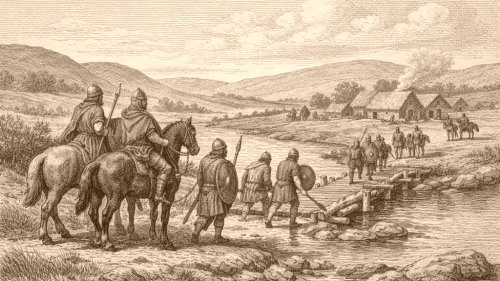
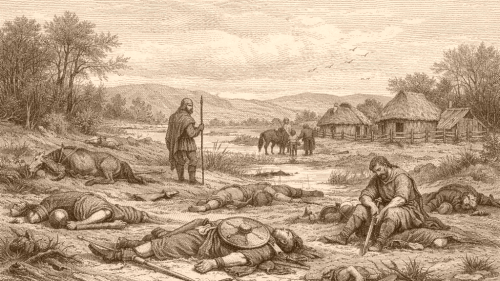
The annalistic notices attached to 553 CE are brief and uneven. Some sources open the year with calendar headings marked 553, while others preserve notices under identifiers that do not automatically convert to CE dates. In these records, a plague named samthrosc appears beside a birth notice for Lugaid moccu Óchae or MoLua moccu Óchae, depending on the text. Other annals place related notices under adjacent headings or give only broader chronological framing. The evidence allows comparison of wording and placement, but not the invention of missing events or harmonization beyond the texts themselves.
Dateline
Calendar Notices
For the year identified in these annals as 553, the clearest chronological markers are the year headings themselves. In the Annals of Ulster, the relevant block is printed with the heading for 553 and begins with U554.0, “Kalends of January […] AD 553.” The same cluster continues with U554.1, “Birth of Lugaid moccu Óchae,” and U554.2, “A pestilence i.e. leprosy called the samthrosc.” These are the notices explicitly attached to that year-heading sequence in the excerpt, and the source label should be read as the manuscript’s own identifier rather than as an instruction to convert dates. [1]
The Annals of the Four Masters likewise present 553 as a year block. Their entry M553.0 reads “The Age of Christ, 553,” followed by M553.1, “The fifteenth year of Diarmaid.” Within the same sequence, M553.2 says that Brenainn of Birra “was seen ascending in a chariot into the sky this year,” and M553.3 records that “Cluain Fearta was founded by St. Brenainn.” In this source, the year is framed not by an AD heading in the Ulster manner but by the annalists’ own Age of Christ formula and regnal dating. [3]
Birth Notice
Ulster has U554.1, “Birth of Lugaid moccu Óchae.” Tigernach has T553.1, “The birth of My Lua, grandgrandson of Oche.” Inisfallen’s AI553.1 instead records “The battle of Cuilen gained by the Corcu Oche through the prayer of Íte.” These are not identical notices, but they do show that the same chronological span preserved different kinds of items in different annalistic traditions. [1] [2] [5]
Chronicon Scotorum’s CS553 entry includes a birth notice, naming MoLua moccu Óchae, and then, after the year boundary in the excerpt, turns to a pestilence notice for 554, called the samthrosc. The sequence is brief and factual, with no explanatory narrative attached to either notice. In this entry, the year 553 is therefore marked by a birth notice, while the following line introduces disease under the next year heading. The arrangement is useful for seeing how the annal can place different kinds of notices close together in one chronological sequence without expanding them into a fuller account. [4]
Pestilence Record
The pestilence is named in more than one annal. Ulster’s U554.2 calls it “a pestilence i.e. leprosy called the sámthrosc.” Tigernach’s T553.2 gives the shorter form, “The plage which is called Samtrusc.” Inisfallen’s AI551.1 uses a different plague name altogether, “The Crom Connaill, i.e., a great plague.” The wording varies, but each source preserves a concise notice rather than an expanded description. [1] [2] [5]
Chronicon Scotorum offers the briefest formulation: “A pestilence called the samthrosc.” That wording does not attempt to identify causes, place, or scale. The Four Masters excerpt for 553 does not contain a plague notice; instead its 553 block is filled by the Age of Christ heading, Diarmaid’s regnal year, the vision of Brenainn of Birra, and the foundation of Cluain Fearta. The evidence therefore supports comparison of year structure and thematic selection, not a single standardized annalistic template. [4] [3]
Adjacent Records
Chronicon Scotorum’s CS553 is a source label, not a converted CE date. Within that block the notices include the death of Eochu son of Conlaed, the death of Béc son of Dé, the birth of MoLua moccu Óchae, and a pestilence called the samthrosc. The source itself also warns that identifiers are labels and that missing dates must not be inferred, so the record should be described exactly as it appears. [4]
The Ulster and Tigernach excerpts show that year-title practice is not uniform across editions. Ulster prints explicit AD headings in the chronology table, while Tigernach preserves identifier labels such as T553.0 and T553.1 without an AD heading. Because the excerpted table itself warns against converting labels into dates, the notices have to be treated in the form in which each source transmits them. [1] [2]
Source Comparison
Taken together, the annals show that 553 is a shared chronological point but not a shared narrative. Ulster’s 553 entry includes the birth of Lugaid moccu Óchae and a pestilence; Tigernach’s 553 entry includes the birth of My Lua and the plague called Samtrusc; Chronicon Scotorum’s CS553 entry includes the birth of MoLua moccu Óchae and a plague notice; and the Four Masters’ 553 block records the Age of Christ 553, Diarmaid’s fifteenth year, Brenainn of Birra ascending, and the founding of Cluain Fearta. [1] [2] [4] [3]
Inisfallen stands partly apart from that pattern. Its AI553.1 records the battle of Cuilen, and AI554.1 says “Justinian dies. Justin reigned.” These are adjacent notices in the same annalistic sequence, but they are not the same kind of subject matter as the birth and plague items found elsewhere. The safest conclusion is that the year framework is comparable across the corpora, while the selected notices vary by compiler and by local emphasis. [5]
Source References
Hover over a number to see the source. Select it to open the source.