Connacht Conflict — Royal Death543 CE
The annals preserve a small but distinct body of material for 543 CE. Some notices are year headings, while others record battles, a royal death, and a plague notice under nearby or conflicting chronological frames. Annals of Ulster, Annals of Tigernach, Chronicon Scotorum, and the Annals of the Four Masters do not always place the same event under the same annal year. This article keeps the notices separate, identifies the printed year heading where present, and limits itself to directly attested entries. The result is a cautious survey of what the sources actually place in, or near, 543 CE.
Dateline
Year Frame
The year frame is not uniform across the annalistic witnesses, and the notices have to be read by each source’s own headings rather than by assuming a single converted date. In the Annals of Ulster, U543.0 is printed under AD 542 and U544.0 under AD 543, while U542.0 is printed under AD 541 and U545.0 under AD 544. The chronology table explicitly warns that identifiers are source labels, not converted CE dates, and that missing dates should not be inferred. [1]
Other annals place comparable notices under their own headings. Chronicon Scotorum has CS543 with A.D.543 and records the battles of Tortan and Sligech, while also attaching the mortality called Belefeth to CS541 and Tuathal Maelgarbh’s death to CS544. Tigernach has T543 and records Tuathal Maelgarb’s death at Grellach Eilte, the deaths of Mac Cuilinn and Odhrán from Letracha, and Diarmaid son of Cearbhall’s taking of the kingship of Ireland. [4] [2] [5]
Battles Recorded
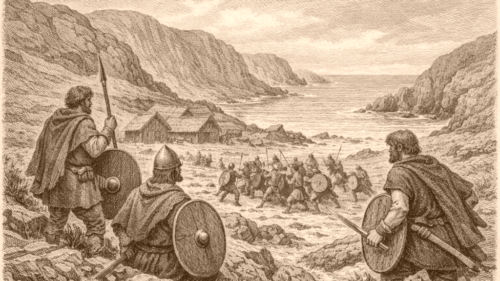
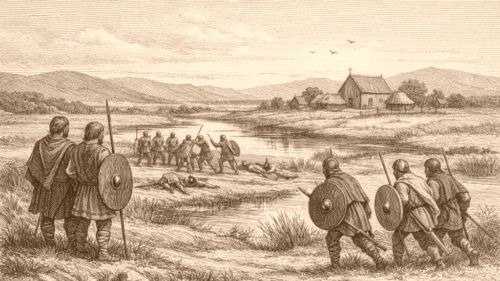
The military notices in the Annals of Ulster are under U543.1 and U543.2, with the printed AD heading 542. U543.1 states that the battle of Tortu was won by the Laigin and that Mac Erca son of Ailill Molt fell there. U543.2 states that the battle of Slicech followed, and that Eógan Bél, king of Connacht, fell. The Ulster entry also names the victors in the second battle: Forgus and Domnall, two sons of Mac Erca, together with Ainmire son of Sétna and Ninnid son of Sétna. [1]
The same pair of battles appears in Tigernach and Chronicon Scotorum under their own headings. Tigernach records the battle of Tortu by the Leinstermen and the battle of Sligo, and its prose similarly identifies Eogan Bél as the slain king of Connacht while naming Fergus and Domnall, two sons of Muircheartach son of Erc, and Ainmire son of Setna and Naindid son of Dua as victors. [2] [4]
Royal Death
Tigernach’s T543.1 says that Tuathal Maelgarb, king of Tara, fell at Grellach Eilte by the hand of Maolmór son of Argadan of Conaille Muirthemne, and that Maolmór also fell. Chronicon Scotorum gives the parallel notice at CS544, saying that Tuathal Maelgarbh, son of Cormac Caech son of Coirpre son of Niall, king of Temhair, died from a wound inflicted by Maelmor Ua Machí, who was also slain at once. The two notices agree on the central sequence: Tuathal dies at Grellach Eilte, and his killer does not survive the encounter. [2] [4]
The Annals of Ulster record the next dynastic step under U544.1: Tuathal Maelgarb was killed in Grellach Allta by Mael Mórda, and Diarmait son of Cerball succeeded him. Tigernach likewise notes at T543.6 that Diarmaid son of Cearbhall took the kingship of Ireland. The Annals of the Four Masters add a chronological frame, calling 543 the fifth year of Diarmaid and 544 the sixth year, while the Annals of Ulster preserve Diarmait son of Fergus Cerrbél’s beginning to reign under U545.3. [1] [2] [3]
Plague Notices
The annalistic cluster also includes plague notices, and the wording suggests more than one tradition of naming the same sort of mortality. The Annals of the Four Masters place M543.2 under the Age of Christ 543 and say that there was an extraordinary universal plague through the world, which swept away the noblest third part of the human race. Chronicon Scotorum has a mortality notice at CS541 about Belefeth, in which Mobhi Clairinech, whose name is Bercan, perished. [3] [4] [1]
The Annals of Inisfallen preserve a closely related mortality notice at AI544.1: “the first mortality, which is called bléfed, in which Mo-Bí Chlárainech fell asleep.” Their wording confirms the same memorial focus found in the other annals, even though the year placement is not the same. In the Ulster and Inisfallen texts, the saintly or clerical figure is named, while the Four Masters emphasize the scale of the plague itself. Chronicon Scotorum’s brief notice also keeps the plague attached to an individual death. [5] [4] [3] [1]
Clerical Deaths
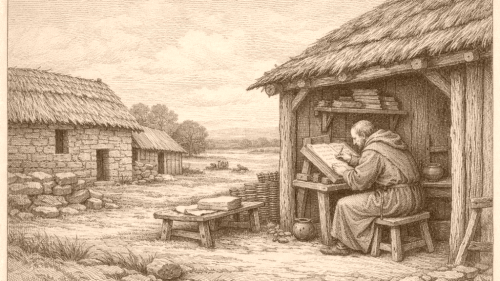
Tigernach’s T543.3 says Ciarán mac an tSaoir died in the 31st year of his life, and T543.4 adds the decapitation of Ambacuc at the fair of Tailtiu by a miracle of St Ciarán. Chronicon Scotorum gives a similar pair of notices: Ciarán the Great, son of the Carpenter, quievit in the 33rd year of his age, in the seventh month after he began to build Cluain-muc-Nois, and the decapitation of Ambacuc at the Fair of Taillten follows as a miracle of Saint Ciaran. [2] [4]
Other clerical notices stand nearby. Chronicon Scotorum records the quies of Mac Cuilinn and of Odrán from Letracha, and the Annals of Ulster place Ailbe’s rest under U542.2 with printed AD heading 541. The Annals of Tigernach also note Ailbe Senchua Ó nAilella’s death, and the Annals of the Four Masters record St. Ailbhe, Archbishop of Imleach Iubhair, on the twelfth day of September. [4] [1] [2] [3]
Source Pattern
The surviving notices are clustered rather than comprehensive. The excerpted annals preserve battle notices, royal deaths, clerical deaths, and plague notices, but the same event is not always assigned to the same printed year heading. The pattern is visible in the battle sequence of Tortu and Sligo/Sligech, in the death of Tuathal Maelgarb, and in the mortality called bléfed or Belefeth. Each source preserves a recognizable core, yet each also places that core within its own chronological framework. [1] [2] [3] [4] [5]
The annals sometimes include kinship, location, succession, or verse. Tigernach gives Tuathal Maelgarb’s death at Grellach Eilte by Maolmór son of Argadan, of Conaille Muirthemne, and records Diarmait son of Cearball taking the kingship of Ireland. It also preserves a verse after the battle of Sligo. The Four Masters describe the plague as an extraordinary universal plague through the world, while Inisfallen and Chronicon Scotorum record the first mortality called bléfed and the death of Mo-Bí Chlárainech. [2] [3] [5] [4]
Source References
Hover over a number to see the source. Select it to open the source.