Ireland Remembered628 CE
The annalistic record for 628 CE is unusually compressed and must be read with care. One set of excerpts fixes the year as AD 627, alias 628, while others place the same cluster of notices under different regnal or calendar headings. Securely dated material includes the death of Cathal son of Aed, king of Mumu, and several battle notices associated with Laigin, Dál Riata, and the kingship of Ireland. The surviving passages also preserve strong evidence of chronological overlap, duplication, and retrospective alignment. This narrative separates what the excerpts place in 628 from what they only imply by comparison.
Dateline
Year Dating
The clearest single marker for 628 comes from the Annals of Ulster, which labels the entry as the Kalends of January and states that it is AD 627, alias 628. In that same notice the year is attached to a sequence of events: a battle at Bolg Luatha, another at Both, the slaying of Suibne Menn, the repose of Colum son of Bairdéne, the killing of Cuiméne son of Colmán, the devastation of Laigin by Domnall, and Domnall son of Aed son of Ainmire beginning to reign. This is the firmest chronological anchor among the excerpts.
That same cluster is echoed, but not identically, in other annalistic traditions. The Annals of Tigernach place a series of notices under T628 and list the battle of Lether Midenn in Drong, the death of Fiachna son of Baetán, the death of Fiacha Finn king of Cenél Boghuine, the battle of Dún Cethirn, and the beleaguering of Crundmael. The Annals of Inisfallen place Cathal son of Aed, king of Mumu, under AI628, while also sending the Oclad battle to AI630 with an AU 628 cross-reference. The year is therefore secure, but the alignment is not uniform.
Ulster Evidence
The Annals of Ulster preserve a compact Irish sequence for the year. Besides the battle notices, they record that Suibne Menn, identified as king of Ireland, was slain in Taerr Bréni by Congal Caech son of Scanlán. They also note the repose of Colum son of Bairdéne, the killing of Cuiméne son of Colmán, the devastation of Laigin by Domnall, and Domnall son of Aed son of Ainmire beginning to reign. The passage reads as a coherent year notice, though it offers no further explanation within the excerpt.
Chronicon Scotorum preserves a closely related sequence under CS629 rather than CS628, showing the same battle at Fid Eoin, the fall of Dál Riata, the death of Eochu Buide son of Aedán, the battle of Dún Ceithirn, and the fall of Guaire Gaillsech. That version also records the death of Aella, king of the Saxons, which is not part of the Irish-focused notices in the Ulster entry. The comparison shows overlap in material without perfect agreement in dating or contents.
Tigernach Notices
In Tigernach, the year-marker T628 is followed by a sequence that includes the battle of Lether Midenn in Drong, where Fiachna son of Baetán king of Dál Riata was slain and Fiachna son of Deman was victor. The same annal group also includes the death of Fiacha Finn, king of Cenél Boghuine, the battle of Dún Cethirn between Domhnall son of Aodh and Congal Caoch, and the beleaguering of Crundmael, king of South Leinster, by the Uí Néill. The excerpt gives no month or day, only the annal-year frame.
The same Tigernach material is useful because it also shows nearby notices that are not 628 itself. T629 contains the battle of Ard Corann and the fall of Fiachna son of Deman, while T630 includes the battle of Duma Aichir, the battle of Both, the slaying of Suibne Menn, and the devastation of Leinster by Domnall son of Aed. These entries are not evidence for 628 as such, but they show that some names and places recur across adjacent year blocks. That recurrence warns against collapsing nearby notices into one event.
Inisfallen Crosses
The Annals of Inisfallen offer a useful cross-check because they preserve the death of Cathal son of Aed, king of Mumu, under AI628. That entry is short and direct, and it is one of the few notices in the corpus here that is explicitly located in the year 628 without an added regnal sequence. The same annal tradition then moves to AI629 for the battle of Carn Feradaig, where Fáilbe Fland was victor and Guaire Aidne fled, a notice that belongs to the following annal year.
Inisfallen also keeps the relationship between year labels and cross-references visible. The battle of Oclad is placed under AI630, but it is glossed with AU 628, and the same record identifies Crunnmael and Suibne, called Mend, as the fallen. This does not create a second independent date for 628; rather, it shows that the compiler or later cross-reference links the battle to 628. The entry therefore supports caution: the text records association, not a plain local chronology.
Northern Warfare
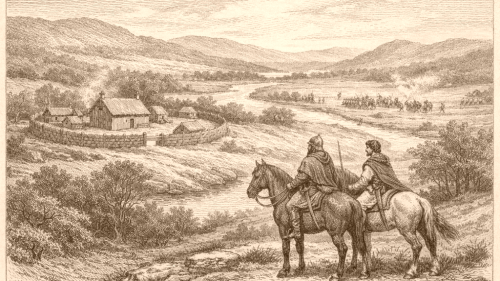
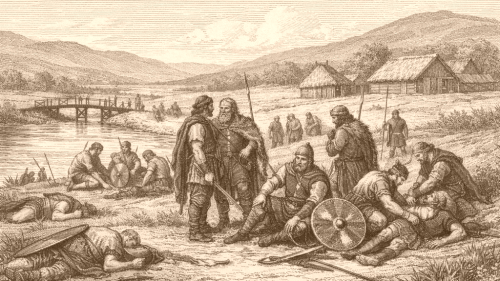
The year 628 is dominated, in these annals, by warfare rather than by ecclesiastical detail. Across the Ulster, Tigernach, and Four Masters traditions, battles appear at Bolg Luatha, Both, Lether Midenn in Drong, Dún Cethirn, and Ard Corann. The named dead include Suibne Menn, Fiachna son of Baetán, Guaire Gaillsech, and Crundmael in South Leinster, while one notice emphasizes Domnall’s devastation of Laigin. The sources give names, outcomes, and affiliations, but not any narrative of cause or campaign.
The Four Masters also preserve a parallel 628 notice for Ath Goan in western Liffey, where Faelan son of Colman, Conall son of Suibhne, and Failge or Failbhe Flann, king of Munster, were connected with the event, and Crimhthann son of Aed son of Seanach, king of Leinster, was slain with many others. This does not sit exactly beside the Ulster and Tigernach notices, yet it belongs to the same broad annal year in the tradition. The comparison shows that 628 is remembered as a year of multiple armed encounters.
Kingship Change
A smaller but important part of the 628 record concerns rulership. The Annals of Ulster say plainly that Domnall son of Aed son of Ainmire begins to reign in the same year as the battles and deaths already listed. The Four Masters place the fifth year of Domhnall under 628, which fits the same reign-marker, though the year-counting formula is different. The evidence is strongest for a change or consolidation of kingship associated with the annal year, not for any fuller political narrative.
The surrounding entries help define what can and cannot be said. In Tigernach, the years immediately before and after 628 contain the reign of Domnall son of Aed, the battle of Duma Aichir in T630, and later notices about Cúil Caeláin and the founding of Rechrainn. These are broader chronological neighbors, not 628 events. They show that the year sits within a larger sequence of connected rulers and conflicts, but the excerpt itself does not narrate any transition beyond the brief reign notice.
Regional Scope
The notices tied to 628 cover several regions of Ireland and adjacent political communities. Leinster appears through Bolg Luatha, the devastation of Laigin, the death of Crimhthann at Ath Goan, and the destruction of Ráith Guala in a nearby Inisfallen sequence that is assigned to an earlier year. Munster appears through Cathal son of Aed and through Failbhe Flann in the later comparison. Dál Riata and the Cruithin world appear through the deaths of Fiachna son of Baetán and Eochu Buide. The records are geographic in range, but terse in explanation.
What these excerpts do not provide is equally important. They do not furnish a continuous narrative for the year, and they do not establish a single unified chronology across all annals. Instead, they preserve short notices that sometimes agree and sometimes shift by a year or by a cross-reference. For 628, the historian can speak securely of named deaths, battles, and a reign notice; beyond that, any larger synthesis must remain cautious and bounded by the exact wording of each entry.
Cautious Reading
Taken together, the excerpts make 628 CE visible as a year of conflict, death, and a kingship transition, but they also expose the limits of the record. Some traditions agree closely, especially around Suibne Menn, Domnall son of Aed, and the devastation of Leinster; others preserve comparable material under different annal years. That is not a defect to be smoothed over. It is the evidence that the surviving annals themselves offer: brief notices, partial overlaps, and no need for invented narrative where the record is silent.
For Ireland in 628, the most secure summary is therefore modest. The year contains a set of annalistic notices about battles, the deaths of named rulers, and Domnall’s accession or continued rule, with Cathal son of Aed’s death as another fixed point in one tradition. The passages do not justify adding motives, alliances, or causal sequences. They only allow a careful reconstruction of what the year was said to contain, and of how other annals place the same material nearby rather than identically.