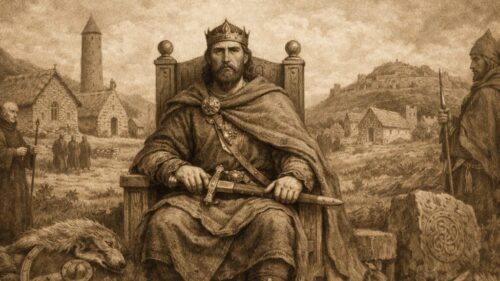
Domnall mac Áedo
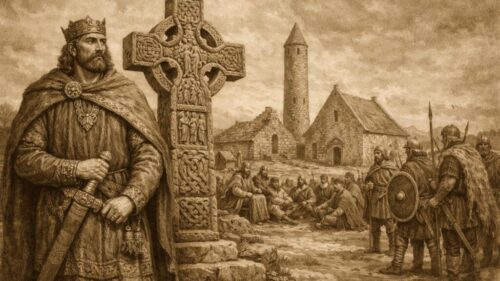
Domnall mac Aedo mic Ainmire is identified as the ruler who was victorious at the Battle of Mag Rath in 637 and as the “King of Ireland.” The same account places him in the seventh century. In that period, the Ulaid continued in Ulster as the De1l Fiatach; they were predominant in Ulster in 600 and were variously aligned with or hostile to the De1l Riata of Antrim and the De1l nAraide between Belfast Lough and the Mournes. The Ued Ne9ill again routed De1l nAraide at Dfan Ceithirnn in 629, and together with their expatriate Argyll branch, De1l Riata joined with De1l nAraide to strike at the Ued Ne9ill and were routed at Mag Rath, Co.
Dateline
Domnall mac Aedo mic Ainmire is identified as the ruler who was victorious at the Battle of Mag Rath in 637 and as the “King of Ireland.” The same account places him in the seventh century. In that period, the Ulaid continued in Ulster as the De1l Fiatach; they were predominant in Ulster in 600 and were variously aligned with or hostile to the De1l Riata of Antrim and the De1l nAraide between Belfast Lough and the Mournes. The Ued Ne9ill again routed De1l nAraide at Dfan Ceithirnn in 629, and together with their expatriate Argyll branch, De1l Riata joined with De1l nAraide to strike at the Ued Ne9ill and were routed at Mag Rath, Co. Down, in 637 by Domnall mac Aedo mic Ainmire. The account also states that after the battle De1l Riata and De1l nAraide contracted, and De1l Fiatach moved west of the Bann.
Royal Setting
In Connacht the account lists the minor population groups Irrus Domnainn of County Mayo; Conmaicne and Delbna of Lough Mask and Connemara; Luigni, Gailenga, and Grecraige of Lough Gara; Ciarraige of Roscommon; and Calraige of Drumlease. It also names the Ued Maine in an area along Lough Derg in East Galway. Connacht’s foremost peoples are identified as the Ued Ailello; the Ued Fiachrach, with Muaide in Mayo and Aidhne in southeast Galway; and the Ued Brifain of central Connacht, Seola, south near Carnfree, and Bre9ifne. The same account adds that the Ued Brifain expanded later during the 700s, that by 734 they drove a wedge between the Northern and Southern Ued Ne9ill, that the Ued Brifain Seola dominated the homeland between 700 and 723 and ousted the Ued Ailello in 764, and that by 766 Ued Brifain Bre9ifne had defeated Ued Brifain Seola. In the north and midlands it also notes the rise and hegemony of the Ued Ne9ill, their expansion eastwards from Mag ncdtha, southwards to defeat the Laigin between the mid-fifth and sixth centuries, and northwards to Glen Gaimin. Several subpeoples lay within Ued Ne9ill territories: the De9is of Tara; west of these, the Fir Thulae; southwest, the Cene9l Fiachach; Conaille in Muirthemne between Airthir and the sea; Gailenga; Luigne; and Ciannachta.
Mag Rath
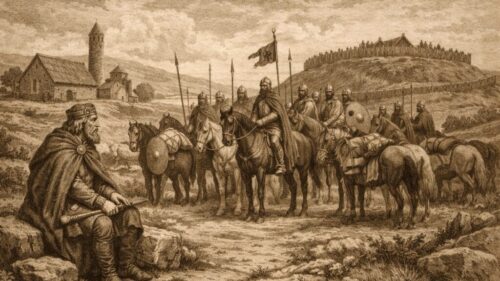
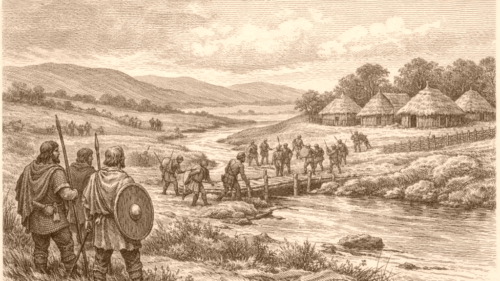
Domnall mac Aedo mic Ainmire is linked to the Battle of Mag Rath in 637. The source says that De1l Riata and De1l nAraide had joined together against the Ued Ne9ill and were routed at Mag Rath by the “King of Ireland,” Domnall mac Aedo mic Ainmire. It also states that De1l Riata and De1l nAraide contracted, and that De1l Fiatach moved west of the Bann.
Historical Context
Domnall mac Aedo mic Ainmire is described as the victor at Mag Rath in 637, where he is called the “King of Ireland.” The account says that De1l Riata and De1l nAraide had allied and were routed at Mag Rath. It also states that De1l Riata and De1l nAraide contracted and that De1l Fiatach moved west of the Bann.
The summary lists the Ued Ne9ill and several of their branches, including Cene9l Conaill, Cene9l nEogain, Clann Cholme1in Mf3r, Cene9l Cairpre, Cene9l Fiachach, Cene9l Loegaire, and Cene9l nArdgaile. It also notes the De9is of Tara, the Fir Thulae, Conaille in Muirthemne, Gailenga, Luigne, and Ciannachta within Ued Ne9ill territories. In Connacht, it identifies Irrus Domnainn, Conmaicne, Delbna, Luigni, Gailenga, Grecraige, Ciarraige, Calraige, Ued Maine, Ued Ailello, Ued Fiachrach, and Ued Brifain. In Ulster, it distinguishes the Ulaid, the De1l Fiatach, the De1l Riata, and the De1l nAraide. Domnall mac Aedo mic Ainmire is named in this setting as the ruler associated with Mag Rath and with the title “King of Ireland.”
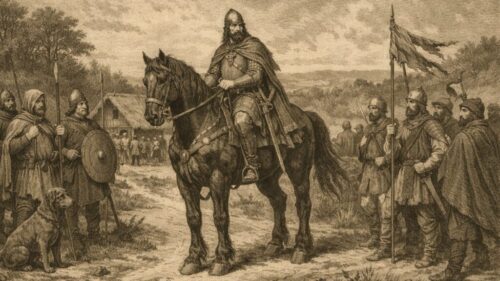
Mag Rath is described as the battle in which the Ued Ne9ill defeated De1l Riata and De1l nAraide, and the same account states that Domnall mac Aedo mic Ainmire was the ruler who won that battle.
Source References
Hover over a number to see the source. Select it to open the source.