Dunadry
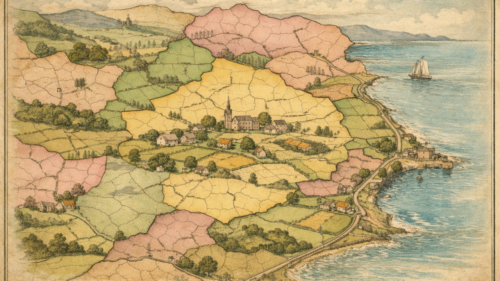
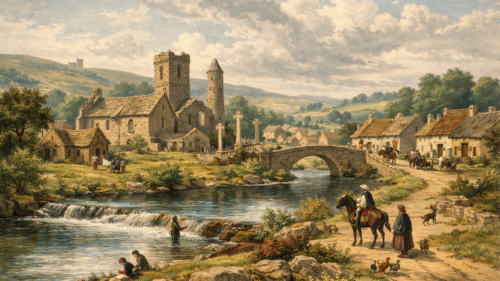
Dunadry is securely identifiable as a historic village/hamlet and townland on the Six Mile Water in County Antrim. Modern gazetteer evidence places it in County Antrim, and townland reference data places it in the civil parish of Grange of Nilteen, within the historic barony of Antrim Upper.12 This matches the older local-historical framing of Dunadry as part of the Grange of Nilteen lands, rather than as an isolated modern suburb or a separate county settlement.3 The county assignment is not ambiguous in the historical record used here: the townland is consistently treated as County Antrim in gazetteers, census material, and later administrative records.124 The 1901 census volume for County Antrim even notes Dunadry as a distinct place-name entry and distinguishes it from nearby townlands, confirming that it was recognised administratively as part of Antrim in the late nineteenth and early twentieth centuries.4
Dateline
Settlement identity and historical setting
Dunadry is securely identifiable as a historic village/hamlet and townland on the Six Mile Water in County Antrim. Modern gazetteer evidence places it in County Antrim, and townland reference data places it in the civil parish of Grange of Nilteen, within the historic barony of Antrim Upper.12 This matches the older local-historical framing of Dunadry as part of the Grange of Nilteen lands, rather than as an isolated modern suburb or a separate county settlement.3
The county assignment is not ambiguous in the historical record used here: the townland is consistently treated as County Antrim in gazetteers, census material, and later administrative records.124 The 1901 census volume for County Antrim even notes Dunadry as a distinct place-name entry and distinguishes it from nearby townlands, confirming that it was recognised administratively as part of Antrim in the late nineteenth and early twentieth centuries.4
Name forms and Irish-language forms
The spelling Dunadry is the established English form in the sources consulted.12 The Irish-language form given by place-name authorities is Dún Eadradh, a form repeated by townland records and secondary place-name listings based on authoritative gazetteer work.25 A local historic explanation preserved in community and council material says that an earlier form was Dun Eadargabhail or Dun Eadarghabhal, glossed as a fort “between forks,” referring to a fort at the meeting of the Six Mile Water and the Rathmore Burn.6 That explanation is valuable because it preserves an older interpreted form alongside the standard modern Irish rendering, showing that the name has a layered history rather than a single fixed spelling tradition.6
Medieval and early modern associations
The strongest historical theme attached to Dunadry is the presence of an old fort and ecclesiastical attachment in the Grange of Nilteen. Local historical writing on the granges of County Antrim states that the hamlet of Dunadry lay in the grange of Nilteen and links the place to the former church or chapel of Nilteen.3 This supports the view that Dunadry belonged to a medieval ecclesiastical landscape associated with Muckamore and its dependent churches, rather than emerging first as a purely industrial settlement.3
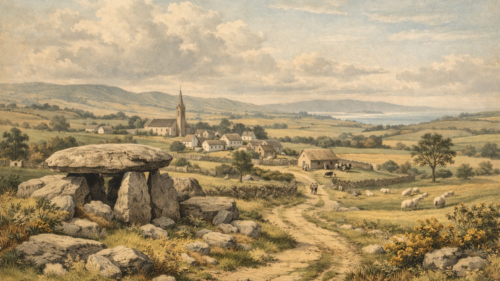
Later place-name and local-history material adds that the name was associated with a fort standing just north of the village, with the 1838 Ordnance Survey memoir cited in later summaries as recording that association.16 Even where the exact wording survives only through later quotation, the historical point is consistent: Dunadry was understood as a place named from an ancient fort, and the settlement’s later growth occurred around that older topographical core.16
Nineteenth-century village history
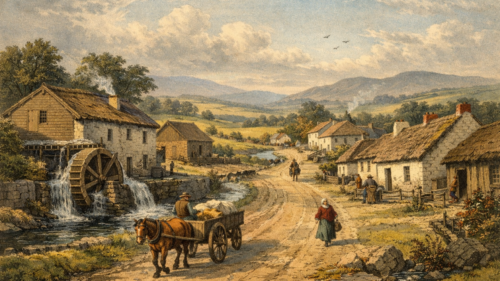
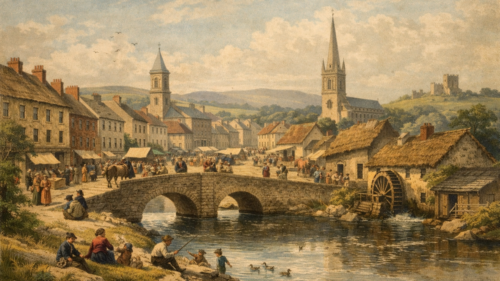
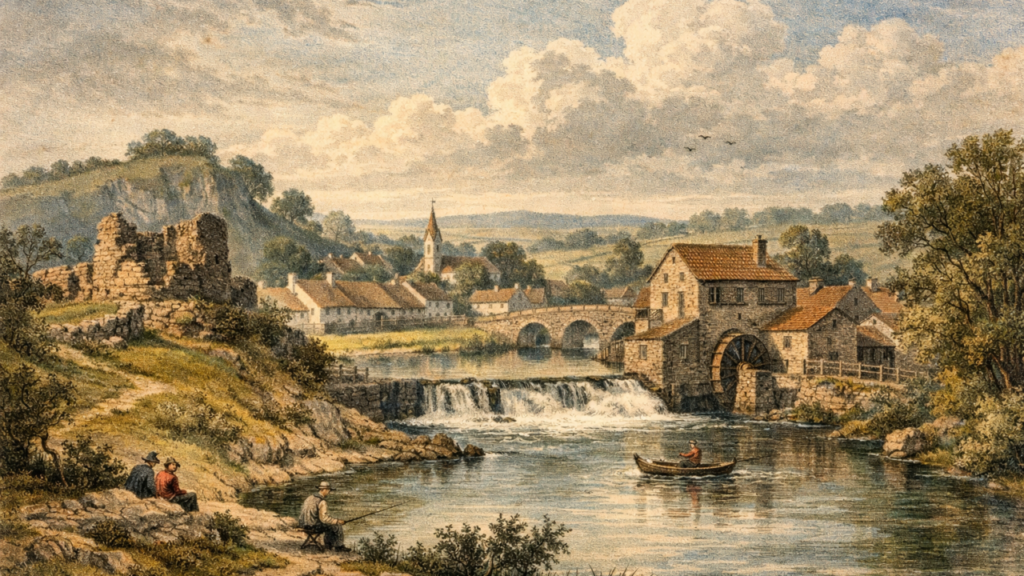
By the nineteenth century Dunadry appears as a small settlement on the Six Mile Water, closely tied to milling and bleaching activity. Local historical material describes a paper mill founded in the seventeenth century at the site later known as Blow’s Mill, followed by linen-related use into the nineteenth and early twentieth centuries.7 The river location and mill history explain why Dunadry remained a compact working settlement rather than a large market town.7
The census record for County Antrim also helps measure the settlement’s size in the pre-modern era. In the 1901 report, Dunadry is listed with a population and household count under County Antrim, while an editorial note explains that Dunadry town had fewer than twenty inhabited houses and was included within the townland of Dunadry for census purposes.4 That note is useful historically because it shows the village’s limited scale and how closely it was identified with the surrounding townland at the turn of the century.4
Overall, the historical evidence portrays Dunadry as an old Antrim place-name with medieval ecclesiastical associations, a fort-based toponymic origin, and a later history shaped by river power, mills, and a small clustered village form.1367
Historical Sources
- Gazetteer of British Place Names: Dunadry, Antrim
- Townlands.ie: Dunadry Townland, Co. Antrim
- The Granges of County Antrim – Glens Of Antrim Historical Society
- Census of Ireland for the year 1901, County of Antrim
- Dunadry Townland, Co. Antrim (Irish name listing on townlands.ie result text)
- Antrim and Newtownabbey Borough Council: Dunadry Gate street-naming agenda/minutes
- Dunadry Hotel history booklet