Lisburn
Lisburn’s older identity is tied to the settlement then known as Lisnagarvey. The Irish Linen Centre & Lisburn Museum explains that the place-name comes from an earlier Irish form, Lissnakarvagh, and that Lisburn’s original name was Lisnagarvey; it further notes the Irish element as Lios na gCearrbhach, glossed as “fort of the gamesters” or “gamblers’ fort.” 1 That same account connects the name to a ringfort site and makes clear that “Lisburn” is a later development, not the original medieval form. 1 The significance of this naming history is that Lisburn’s identity can be traced through successive spellings rather than a single fixed label.
Dateline
Early settlement and name
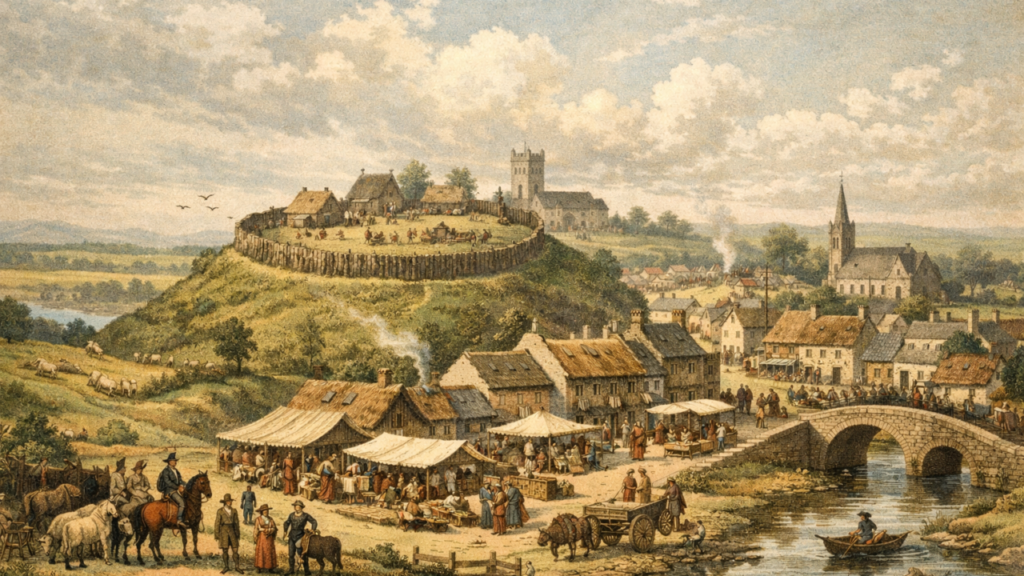
Lisburn’s older identity is tied to the settlement then known as Lisnagarvey. The Irish Linen Centre & Lisburn Museum explains that the place-name comes from an earlier Irish form, Lissnakarvagh, and that Lisburn’s original name was Lisnagarvey; it further notes the Irish element as Lios na gCearrbhach, glossed as “fort of the gamesters” or “gamblers’ fort.” 1 That same account connects the name to a ringfort site and makes clear that “Lisburn” is a later development, not the original medieval form. 1
The significance of this naming history is that Lisburn’s identity can be traced through successive spellings rather than a single fixed label. The museum article states that “Lisburn” is not used until after the 1660s, while the older form Lisnagarvey remained the point of reference for the site and its fort. 1 In other words, the historical settlement is securely identifiable, but the name evolved from an Irish place-name into the English form now in use. 1
County assignment in historical sources
For the county question, the evidence points to Lisburn as a County Antrim settlement in historical reference works, while also showing why some records straddle the Antrim–Down boundary. Irish History Online indexes Frederick Kee’s Lisburn miscellany with the place as “Lisburn (County Antrim and County Down),” reflecting how the town’s historical record touches both counties. 2 However, the Queen’s University Belfast record for Samuel Lewis’s County Antrim: a topographical dictionary of the parishes, villages, and towns of County Antrim in the 1830s shows Lisburn within the County Antrim topographical tradition, and the book title itself confirms the county framework used for that historical description. 3
A further historical clue comes from the standard gazetteer tradition. The Vision of Britain transcription of Lewis’s entry identifies Lisburn in relation to the Antrim county structure and nearby administrative units, showing that nineteenth-century gazetteers treated it as part of the Antrim side of the Lagan valley settlement pattern. 4 Taken together, these sources support “County Antrim” as the historical county assignment, while acknowledging that some later cataloguing and local-history indexing notes the town’s proximity to County Down and its cross-boundary context. 24
Historical character of the settlement
The available historical references present Lisburn as a settlement that grew from an older Irish-named site into a town whose later prominence made it a subject for local-history compilation. The museum account’s emphasis on the fort, the name evolution, and the post-1660s emergence of the modern name suggests continuity of occupation alongside a major linguistic and political transition. 1 By the nineteenth century, Lisburn was established enough to be treated in county-level topographical literature as a distinct place within County Antrim, rather than merely a locality attached to Belfast or to the county border. 34
So, on historical evidence, Lisburn is the later English-named form of a much older settlement called Lisnagarvey, with the Irish-language form Lios na gCearrbhach attested in modern scholarship and museum interpretation. 1 Its historical county is best verified as County Antrim, even though some bibliographic and local-history records note the town’s Antrim–Down setting. 234
Historical Sources
- The origins of the name Lisburn (Lios na gCearrbhach or Lisnagarvey ) – what does it mean? – Irish Linen Centre & Lisburn Museum
- Irish History Online – Lisburn miscellany
- County Antrim : a topographical dictionary of the parishes, villages, and towns of County Antrim in the 1830s – Queen's University Belfast
- LISBURN | As described in Samuel Lewis's A Topographical Dictionary of Ireland (1837)