Archived: 14 November 2026
Abstract
Year SettingThe year 585 appears in several annalistic sequences as a dated notice rather than as a continuous narrative. In the Annals of Ulster, the relevant cluster includes U586.0, which carries the printed heading AD 585, followed by U586.1 and U586.2. The Annals of Tigernach mark the same year under Annal T585, while the Four Masters print M585 as The Age of Christ, 585. These headings show that each compilation preserves a year-labelled notice, even when its internal numbering differs.The Inisfallen annals also align a notice with this year, though by a different system of cross-reference. AI585.1 records the death
Read Article
Archived: 14 November 2026
Abstract
Year FrameThe printed year frames differ, but each text provides a way to locate notices for the period around 586 CE. In the Annals of Ulster, the relevant material appears under U586.0 and U587.0, printed as AD 585 and AD 586 respectively, and the cluster includes the killing of Baetán son of Ninnid and the note, “Or this year, the battle of Druim Meic Erca.” In Tigernach, the matching cluster appears under T586, where the same year block contains the rest of Carillan bishop of Armagh, the rest of Senach bishop of Clonard, the conversion of Constantine to lord, great
Read Article
Archived: 13 November 2026
Abstract
Annal YearThe Ulster annals place an eclipse notice in U591.1, but the printed heading attached to that notice is AD 590, and the same entry calls it a dark morning. In the same sequence, U592.0 carries printed AD 591 and includes the death of Lugaid of Les Mór, the birth of Cuiméne Fata, another dark morning, and the beginning of the reign of Aed son of Ainmire. These are separate notices, not a single unified statement.The Tigernach annals also give a notice under Annal T591, where T591.1 records the death of Aognus son of Amalgaid and T591.2 gives a notice
Read Article
Archived: 13 November 2026
Abstract
Year DatingThe surviving annal entries for this year are headed in different ways. The Annals of Ulster place the notices under U593 and print AD 592. The Annals of Tigernach give Annal T592. The Four Masters print the Age of Christ, 592. These headings show the same calendar year expressed in different editorial forms within the texts, without changing the notices themselves.The notices grouped under those headings are short and discrete. In the Annals of Ulster, the year heading is followed by the death of Aengus son of Amalngaid, Gregory of Rome, and an alternative battle notice. In Tigernach, the
Read Article
Archived: 13 November 2026
Abstract
Year NoticesThe surviving notices linked to 594 CE are not presented in one uniform form. In the Ulster annals, the heading printed as U594.0 gives AD 593 and then records the battle of Gerrthide at Éudann Mór, with Fiachna son of Baetán as victor. A later Ulster heading, U595.0, is printed as AD 594 and then records the repose of Colum Cille, followed by the death of Eógan son of Gabrán and two uncertainty formulas about other deaths in the same year. These are separate notices and should be read separately.The Annals of the Four Masters also place a major
Read Article
Archived: 13 November 2026
Abstract
Yearly FrameThe notices attached to 598 CE are not identical from one annal to another. In the Annals of Tigernach and the Four Masters, the year is marked as 598; in the Annals of Ulster and Chronicon Scotorum, the same cluster appears within adjacent regnal and calendar sequences. The result is a compact record with overlapping but not perfectly identical year labels.Across these entries, the material for the year is limited and concrete. The most securely dated items are a saint’s death and a battle, while nearby notices include other deaths, a killing, and a brief conversion notice in the
Read Article
Archived: 13 November 2026
Abstract
Year ContextThe annalistic sequence places the year 600 between notices for 599 and 601. In the excerpt, the year-marker for 600 is followed by a compact list of events, while the adjacent years carry their own separate lists. That layout supports only a limited claim: the record preserved here assigns the cited deaths and battles to 600, not to the surrounding years. The source gives a dated annal entry rather than a continuous story, so the year must be read as a heading under which separate notices are grouped.The same excerpted chronology is visible in nearby entries that continue through
Read Article
Archived: 13 November 2026
Abstract
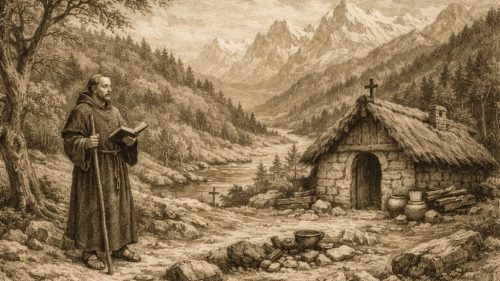
Saint Gall is remembered in the tradition of St Gallen as a missionary Irish monk who withdrew in 612 to an untamed mountain valley beside the River Steinach and lived there as a hermit. The cathedral of St.Gallen stands on the spot where the Irish itinerant monk Gall built his hermitage in the year 612. The abbey history says that the monastic settlement grew from a community of hermitages established by Gall, and that his cell became the beginning of the later abbey. Irish Beginnings The surviving institutional accounts present Gall as a missionary Irish monk and, in one modern
Read Article
Archived: 13 November 2026
Abstract
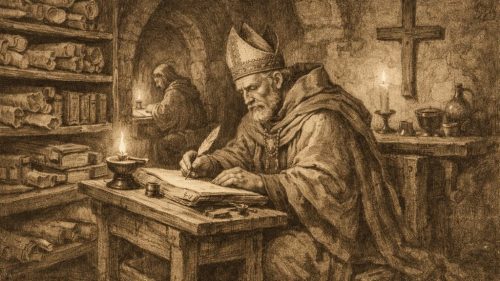
Tírechán is known from a short introductory sentence attached to the Collectanea, a Patrician text preserved in the Book of Armagh. The sentence identifies him as a bishop and says that he wrote from the words and the book of Bishop Ultán, whom he calls his fosterling and pupil. That brief notice is the firm basis for what can be said about him as a historical figure. The surviving material linked with his name is not a full biography in the modern sense, but a compilation concerned with the life and activity of Saint Patrick in Ireland. Textual Witness The
Read Article
Archived: 13 November 2026
Abstract
Ulster RecordIn the Annals of Ulster, the notice headed U597.0 gives Kalends of January, third feria, seventh of the moon, and AD 596. Under that heading, U597.1 records the killing of Cumascach son of Éd by Brandub son of Eochu in Dún Buchat, U597.2 records the battle of Sliab Cua in the territories of Mumu in which Fiachna son of Baetán was victor, and U597.3 records the death of Tipraite son of Calgach. These are the entries directly attached to the year heading in that source.The same annal also places a notice immediately before the AD 596 heading and a
Read Article
