Archived: 1 November 2026
Abstract
In 741, the Annals of Inisfallen record the death of Cúán, abbot of Ferna, probably Ferns in County Wexford, and Flann Feórna son of Colmán, king of Ciarraige Luachra in western Munster. These brief notices reveal the importance of ecclesiastical and local royal leadership in early medieval Ireland. Ferns was a significant religious and economic community, while Ciarraige Luachra was a petty kingdom within Munster’s layered political order. The entries provide no details of succession or circumstance. They instead demonstrate how annalists preserved selected deaths within Christian chronology, reflecting a rural, hierarchical society shaped by churches, kinship and regional kingship.
Read Article
Archived: 1 November 2026
Abstract
An annalistic dossier assigned to 742 by the Annals of Ulster, but often dated 743, records intense political, ecclesiastical and social change in Ireland. At Seredmag near Kells, Domnall Midi defeated and killed Áed Allán, gaining wider kingship and strengthening Clann Cholmáin against Cenél nÉogain. Other regional battles and killings reveal widespread instability. Deaths of Affrica of Kildare and abbots of Rechru and Mag Bile marked ecclesiastical successions. Suanach’s law was enacted, and relics of Trian of Cell Delge travelled on circuit. The annals also report widespread bolgach, probably a smallpox-like disease, showing warfare, religious authority and illness shaped communities.
Read Article
Archived: 1 November 2026
Abstract
In 743, at Seredmag, probably Kells, Domnall Midi of Clann Cholmáin defeated and killed Áed Allán of Cenél nÉogain, king of Tara, with three Airgíallan allies. The victory shifted Uí Néill pre-eminence from northern to midland hands, though Ireland remained divided among kingships. Annalistic dating differs slightly, but denotes one battle. It occurred during a summer of conflicts across Brega, the midlands, Connacht and the north. Notices also record ecclesiastical law, relics on circuit, a widespread disease called bolgach, deaths of church leaders, and a later tradition of airborne ships. The year reveals contested authority, religious influence and social insecurity.
Read Article
Archived: 1 November 2026
Abstract
In the political moment around 744, Irish annals record regional deaths, warfare and the close alliance of kingship and church authority. Ardgal, king of Éile, died, while bishops and ecclesiastical leaders including Laidcnén of Saigir and Colmán of Lesán were killed. Conflicts claimed Conchobor of Uí Fhidgente and other elites, and the Déisi defeated Corcu Mo-Druad. Most significantly, Forggus son of Cellach, Uí Briúin king of Connacht, jointly enforced the laws of Saints Ciarán of Clonmacnoise and Brénainn of Clonfert, securing ecclesiastical rights through royal power. Differing annalistic chronologies place much of this cluster in 743 or 744. Sources differ.
Read Article
Archived: 1 November 2026
Abstract
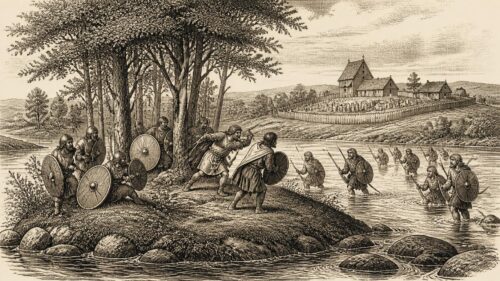
In 745, Irish annals recorded a battle at Inis eter dá Dabul between the Uí Thuirtri and Airthir. Congal son of Éicnech led the Airthir to victory; notable opponents were killed or fled. The conflict reflected shifting local power within Airgíalla, despite Domnall Midi’s wider kingship of Tara. The same annalistic year saw the deaths of abbots at Clonard, Lann Léire and Tech Taille, an anchorite, a church superior and the scribe Conall Foltchain. A remarkable night-time celestial sign was also reported. Together, these concise notices illuminate interconnected warfare, ecclesiastical leadership, learning, rural resources and belief in early medieval Ireland.
Read Article
Archived: 1 November 2026
Abstract
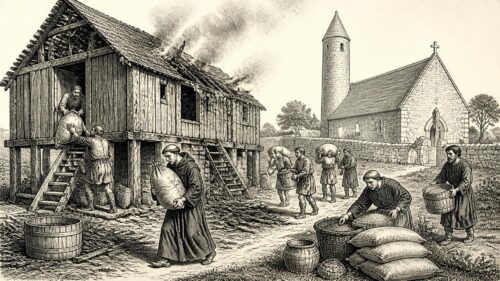
In 746, Irish annals recorded the violation of sanctuary at Domnach Pátraic, where six unnamed captives were hanged, exposing the religious and political weight of ecclesiastical protection. They also noted local warfare, including deaths among rival leaders, defeat of the Conmaicne, slaughter among southern Uí Briúin, and kin-slaying at Les Mór. Obits of abbots, bishops and rulers reveal a dispersed network of churches and regional powers. The Four Masters record fire damage to half Clonard’s granary, highlighting institutional resources and vulnerability. Notices concerning Domnall Midi’s era and dragons seen in the sky further convey a fragmented, unsettled Ireland in transition.
Read Article
Archived: 1 November 2026
Abstract
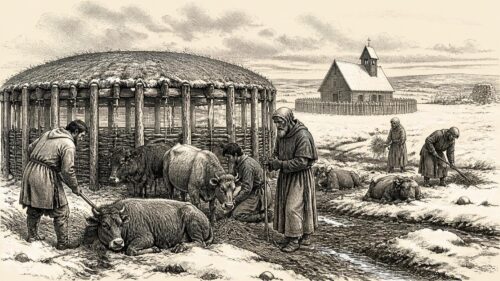
In 747, Ireland experienced exceptionally deep snow, widespread cattle mortality and subsequent drought, shocks that endangered a rural economy dependent on livestock for food, labour, tribute and status. The annals do not establish famine or population loss, but attest severe island-wide disruption. Political life continued: Indrechtach of the Ciannachta and Queen Muirenn died, while Congal of the Airthir was slain. Suanach’s grandson’s law operated in Leth Cuinn, indicating public legal or ecclesiastical authority. Obituaries recorded abbots, anchorites and scholars, including Cúan Cam. Munster sources noted fighting at Cúil Géisi. Together, the entries reveal interconnected environmental, political, legal and religious pressures.
Read Article
