310th Century Ireland BCE
Archived: 22 September 2026
Abstract
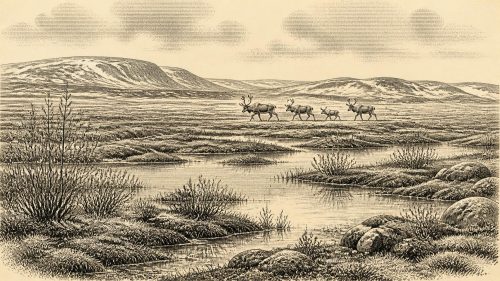
Around 30,901 BCE, Ireland lay within a fluctuating cold phase before the Last Glacial Maximum, not a precisely recoverable year. Derryvree, County Fermanagh, preserves evidence of an ice-free freshwater wetland between glacial advances, with tundra vegetation, mosses, sedges and aquatic plants. Castlepook Cave, County Cork, contains a long, disturbed archive of mammoth, reindeer, giant deer, brown bear and spotted hyaena remains, demonstrating intermittent ecological links with north-west Europe. A cut-marked reindeer bone may indicate brief Upper Palaeolithic human activity, but cannot prove settlement. Changing ice, sea levels and routes made Ireland environmentally variable, while beliefs, societies and institutions remain unknowable.
Read Article

Archived: 22 September 2026
Abstract
30,902 BCE is a modern label within a broad calibrated radiocarbon range, not a historical year. Derryvree, County Fermanagh, preserves freshwater silts between glacial tills, indicating an ice-free interval of treeless tundra, wetlands, insects and cold-adapted vegetation before renewed ice advance. Ireland was environmentally varied but approaching extensive Last Glacial Maximum glaciation, which erased much earlier evidence. Castlepook Cave, County Cork, records mammoth, reindeer, giant deer, predators and other cold-stage fauna, accumulated over long periods. A cut-marked reindeer femur may indicate brief human butchery, but lacks supporting artefacts or occupation evidence. No society, settlement, politics or culture can be reconstructed.
Read Article

Archived: 22 September 2026
Abstract
Labelled 30,903 BCE, this period cannot be dated in Ireland, but falls within climatically unstable Marine Isotope Stage 3. At Derryvree, County Fermanagh, organic sediments beneath glacial tills, dated by BIRM-166, record a freshwater wetland during an ice-free interval roughly 36,900–31,700 calibrated years BP. Plant and insect remains indicate cold, open tundra-like terrain. Cave faunas, notably Castlepook, attest to cold-adapted mammals including reindeer, mammoth and predators, though deposits span long periods. A marked reindeer bone may indicate early human butchery, but remains unconfirmed and cannot establish settlement. Evidence reveals environments, mobile fauna and possible human presence, not societies or history.
Read Article

Archived: 22 September 2026
Abstract
Around 30,904 BCE, Ireland lay within the fluctuating cold conditions of Marine Isotope Stage 3, although no exact annual reconstruction is possible. At Derryvree, County Fermanagh, freshwater sediments between glacial tills record an ice-free interval containing tundra wetland, sedges, mosses, aquatic plants and arctic-alpine species. They indicate local water and vegetation amid severe periglacial conditions before later ice expansion. Castlepook Cave, County Cork, produced remains of mammoth, reindeer, giant deer, predators and other cold-stage animals, accumulated across different episodes. A possibly cut-marked reindeer bone suggests human contact but not settlement. Evidence depicts a habitable cold-world frontier, not a frozen island.
Read Article

Archived: 22 September 2026
Abstract
Thirty thousand years ago, Ireland’s environmental history is better documented than any human activity. At Derryvree, County Fermanagh, freshwater sediments between glacial tills preserve an ice-free Middle Midlandian wetland, radiocarbon dated broadly to roughly 34,950–29,750 BCE. Plants, pollen, mosses and insects indicate open, treeless, periglacial muskeg with sedges, shallow pools and cold-tolerant vegetation. The sequence records changing ice margins, not conditions across all Ireland. Castlepook Cave’s mammoth, reindeer and hyaena remains demonstrate Pleistocene fauna, while a possible human-made mark on a reindeer bone remains debated. No secure evidence establishes human settlement, society or events in 30,905 BCE there at all.
Read Article

Archived: 22 September 2026
Abstract
Although 30,906 BCE is a modern label rather than a recordable Irish date, evidence illuminates its wider Late Pleistocene setting. At Derryvree, County Fermanagh, freshwater silts between glacial tills indicate a cold, treeless tundra wetland formed during an interval between ice advances. Comparable deposits confirm episodic, regionally variable glaciation before the Last Glacial Maximum. Southern cave faunas, including reindeer, mammoth and hyaena, show changing connections to open northern environments, though assemblages are chronologically complex. No secure human settlement exists; a possibly butchered reindeer bone remains inconclusive. Lower seas changed movement; later ice buried landscapes, making environmental evidence the surviving history.
Read Article

Archived: 22 September 2026
Abstract
About 30,907 BCE, Ireland formed part of a changing Late Pleistocene landscape rather than a historical society. Derryvree, County Fermanagh, preserves freshwater sediments beneath glacial tills, indicating open, treeless, wet periglacial ground with sedges, herbs and cold-adapted plants. Castlepook Cave, County Cork, yielded diverse fauna, including mammoth, reindeer, giant deer, bears, wolves, foxes, lemmings and Ireland’s only known spotted hyena remains. These sites show intermittent ecosystems before the Last Glacial Maximum, amid expanding ice and altered coastlines. A possibly butchered reindeer bone hints at transient human activity, but provides no secure evidence for settlement, institutions, trade, religion or political communities.
Read Article
Archived: 21 September 2026
Abstract
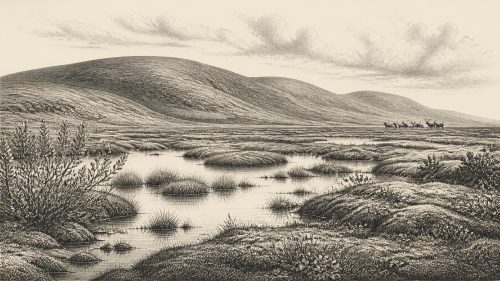
Around 30,908 BCE, Ireland’s history is reconstructed from environmental evidence rather than dated events. At Derryvree, County Fermanagh, freshwater sediments between tills record an ice-free periglacial interval, probably 36,900–31,700 calibrated years BP, with treeless tundra, sedgy pools, mosses and frost-disturbed ground. Ice advances before and afterwards demonstrate regional climatic instability, not island-wide conditions. Castlepook Cave in County Cork preserves time-mixed remains of mammoth, reindeer, giant deer, predators and scavengers, showing cold-stage fauna reached Ireland. No secure archaeological site establishes human presence, though a marked reindeer bone is debated. These fragmentary records reveal a harsh but biologically active Late Pleistocene landscape.
Read Article
Archived: 21 September 2026
Abstract
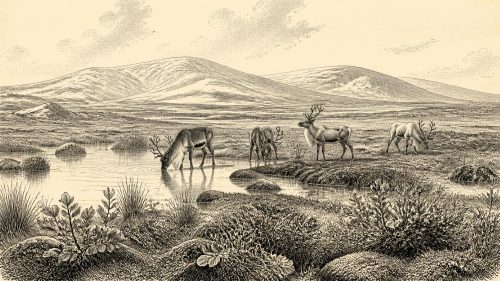
At modern reference date of 30,909 BCE, Ireland’s history is reconstructed from environmental and faunal evidence, not annual records. Derryvree, County Fermanagh, preserves freshwater sediments between glacial tills, revealing open, treeless, periglacial wetlands with sedges, mosses, insects and aquatic plants. Castlepook Cave, County Cork, contains time-mixed remains of mammoth, giant deer, reindeer, bears, wolves, Arctic foxes, lemmings and spotted hyenas, demonstrating episodic ecological links with Europe. Ice sheets and changing seas shaped access and habitats. Possible butchery marks suggest humans may have visited, but no settlement is proven. This was a productive yet harsh Ice-Age landscape, later obscured by glaciation.
Read Article

Archived: 21 September 2026
Abstract
30,910 BCE is a modern label for a broad later MIS 3 interval, not a recoverable Irish historical year. Before the Last Glacial Maximum, Ireland experienced severe, fluctuating periglacial conditions rather than uniform ice cover. At Derryvree, Fermanagh, freshwater sediments between glacial tills preserve evidence of treeless tundra, wet hollows, aquatic plants and insects. Castlepook Cave, Cork, records a long-accumulated fauna including reindeer, mammoth, giant deer, bears and hyaenas. A possibly cut-marked reindeer bone suggests, but cannot prove, brief Upper Palaeolithic human visitation. Later glaciation destroyed much evidence; surviving deposits provide ecological probabilities, not settled communities or precise calendar-year events.
Read Article
Loading more articles…

