New Boroughs1613 CE
In 1613, the administration intensified its remaking of Ireland through Ulster plantation surveys, municipal charters and a contested parliament. Josias Bodley’s inspection exposed settlement, while London’s Irish Society incorporated Londonderry and developed its county; Belfast and Coleraine gained corporations and parliamentary representation. These boroughs promoted trade and security but supplied Protestant votes. When parliament met in Dublin, conflict over Sir John Davies’s election as Speaker revealed Catholic fears of engineered representation, religious coercion and dispossession. Petitions and a inquiry failed to secure accommodation. Henry Ussher’s death marked change amid conformity. New institutions reshaped land, faith and politics without achieving consent.
Dateline
In 1613, the English crown’s programme for remaking Ireland became unusually visible. It appeared in surveyors’ itineraries through Ulster, in the legal creation of new corporate towns, in building schemes funded from London, and most dramatically in the disputed opening of an Irish parliament at Dublin Castle. These were not isolated initiatives. Lord Deputy Sir Arthur Chichester’s government sought to bind territory, property, religion and political representation more closely to the Stuart monarchy. The year did not bring a new war, but it exposed how fragile the proclaimed peace after the Nine Years’ War remained.
Surveying a Plantation
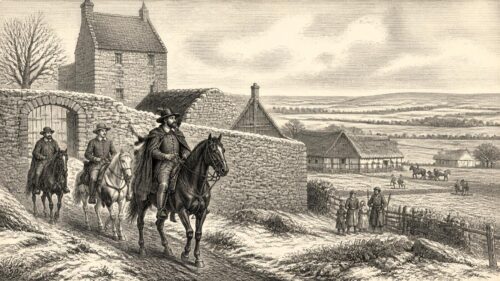
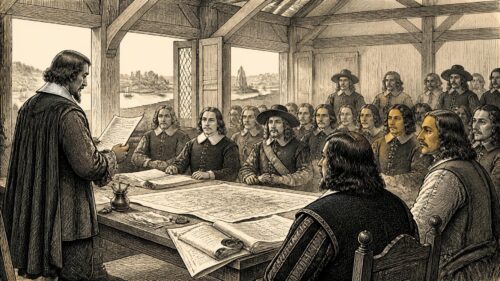
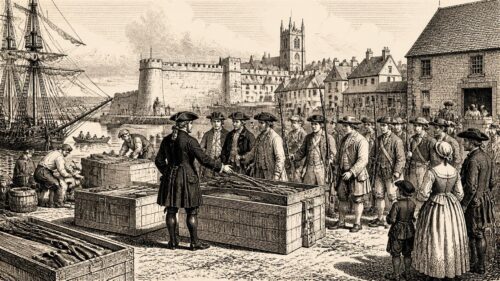
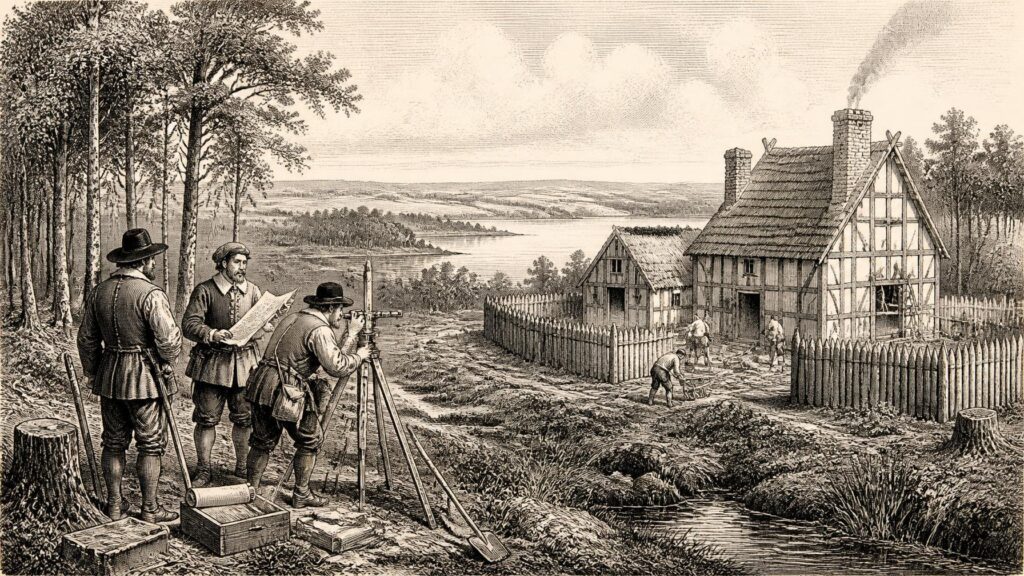
One firmly dated development belongs to the opening months. Between 2 February and 25 April, Sir Josias Bodley carried out a royal survey of the Plantation of Ulster. This was not simply a map-maker’s exercise. The Crown had confiscated extensive lands after the Flight of the Earls and subsequent upheavals, then divided much of the six ‘escheated’ counties among English and Scottish undertakers, military servitors, churches and selected Irish proprietors. Grantees had been expected to bring in British tenants, erect defensible houses and bawns, establish villages and keep armed settlers available for defence.
Bodley’s inspection measured the difficult distance between paper settlement and occupied landscape. Some grantees had made progress in building, farming and attracting tenants; others lagged badly. Roads were poor, woodland, bog and rough ground constrained movement and cultivation, and settlers had to reckon with the cost of timber, labour, livestock, transport and security. The survey is therefore important not because it proves a settled Ulster, but because it records a Crown still auditing an unfinished colonial project. Its categories—freeholders, leaseholders, cottagers, buildings and arms—also reveal the intended social order: compact, supervised communities owing secure title and military service to a new regime.
That programme did not erase the Irish population. Native landholders retained some grants, and Irish tenants remained necessary to the rural economy. Yet land was being rearranged under English legal forms, with consequences for customary relationships, access to pasture and woodland, and the authority formerly exercised by Gaelic lords. For many families, 1613 was less a single recorded event than the continuing experience of altered landlords, new rents, surveys, fortified neighbours and an administration determined to make local life legible to Dublin and London.
Londonderry Takes Shape
On 29 March, a royal charter incorporated the Honourable The Irish Society, the body through which the City of London and its livery companies were to direct their northern plantation enterprise. In the same settlement, Derry was incorporated and formally styled Londonderry, while the new County Londonderry assembled the former County Coleraine with adjoining territory taken from Antrim, Donegal and Tyrone. The new name advertised both the financial role of London and the political purpose of the settlement.
The Irish Society’s undertaking combined commerce, security and colonisation. London companies received estates to develop with British tenants; the towns of Londonderry and Coleraine were intended to become defensible centres of markets, crafts, administration and river-borne trade. In June, London’s Common Council sent Alderman George Smithes and Matthias Springham to inspect progress. Their subsequent report makes clear that the venture was already beset by practical shortcomings and complaints about agents who had enriched themselves while neglecting the investors’ interests. Even at this early stage, the Plantation was not a seamless transfer of metropolitan capital into a new orderly townscape.
The later stone walls for which Londonderry is famous should not be projected backwards wholesale into 1613. Construction and planning were beginning, not complete. Nevertheless, the charter marked a decisive change: an old ecclesiastical and Gaelic place on the Foyle was being recast as a corporate city with a new name, county framework, investors and intended population. It was one of the clearest examples that year of the Crown using municipal institutions to secure a frontier.
Belfast’s Controlled Corporation
On 27 April, Belfast also received a charter of incorporation. It became a corporation governed by a sovereign, twelve burgesses and a commonalty, and gained the right to return two members to the Irish House of Commons. Sir Arthur Chichester, newly created Baron Chichester of Belfast, was central to this arrangement. The charter expanded the town’s legal standing, court powers and commercial prospects, but it did not create broad local self-government in a modern sense.
The original burgesses were closely connected to Chichester: estate tenants, servants, military associates and men transferred from his other interests. The lord of Belfast Castle retained decisive influence over nominations, while the sovereign and burgesses controlled the election of the borough’s MPs. Belfast’s charter thus illustrates the dual purpose behind many incorporations: to promote an urban economy and to create dependable political communities. A corporate seal, a market and the prospect of representation could foster settlement; the same machinery could ensure that settlement answered to its proprietor and the Crown.
Coleraine, too, received charters in 1613. Taken together, these acts did more than confer civic dignity. They tied new and remodelled towns into a system of parliamentary seats. In a kingdom where religious allegiance and landed power were deeply contested, the number and location of boroughs mattered greatly.
A Parliament Engineered
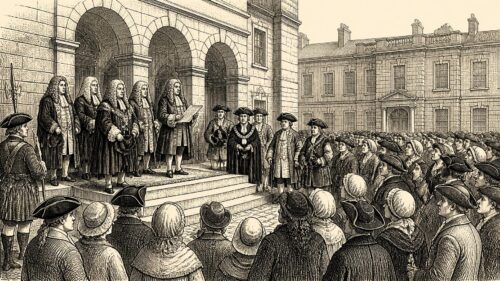
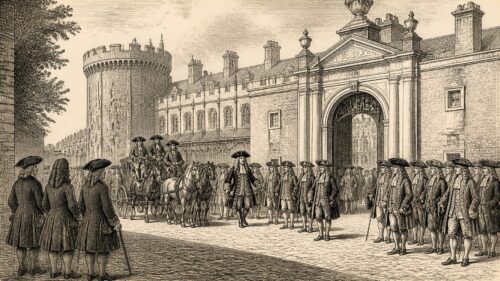
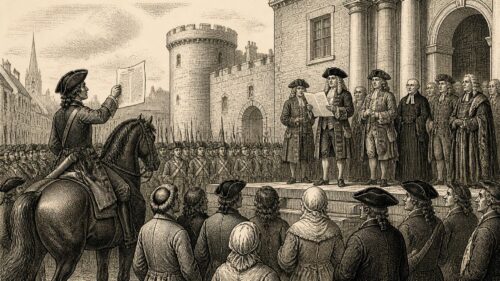
The Irish parliament summoned by James I met on 18 May at Dublin Castle, the first parliament held in Ireland for more than a quarter of a century. The Crown presented it as an opportunity to settle and reform the kingdom after war. Catholic peers and gentry, however, regarded the proliferation of new boroughs as an attempt to manufacture a Protestant majority in the Commons. Their objection was not merely theoretical. Many new corporations were small settlements with narrow electorates, often dependent on a landlord or official.
The dispute exploded immediately over the speakership. Chichester recommended Sir John Davies, the attorney general and one of the government’s most forceful advocates of legal and plantation reform. Catholic MPs supported Sir John Everard, former justice of the king’s bench and knight of the shire for Tipperary. Contemporary accounts agree on the broad outline, though they come from partisan circumstances: Everard was placed in the chair, Davies’s supporters challenged the election, and a physical struggle followed. Everard was removed; Davies was installed; Catholic members withdrew in protest.
The incident has sometimes been remembered for its theatrical detail—Davies being lifted onto Everard’s lap—but its real significance lay in the constitutional argument beneath it. Was parliamentary consent meaningful if the executive could create boroughs, influence returns and arrange a majority before members entered the chamber? Could a Catholic political elite accept participation when public office entailed oaths that rejected papal authority? The confrontation in Dublin Castle showed that the Crown’s language of peace, law and commonwealth did not resolve these questions.
Grievances and Investigation
Opposition did not end with the walkout. On 17 May, before parliament opened, Irish lords had submitted a petition to Chichester challenging the new corporations, the suitability of some boroughs and the political consequences of plantation. On 19 May they wrote to James I protesting the Commons proceedings. Their complaints joined representation to religion: political exclusion, they argued, was inseparable from pressure on Catholic worship and office-holding.
The government’s own surviving narrative is sharply hostile to Catholic critics, calling their actions seditious and depicting religious practice as a threat to public order. It must therefore be read as advocacy rather than neutral reportage. Yet it preserves the issues that contemporaries were actually contesting: the oath of supremacy, recusancy fines, Catholic clergy and schools, overseas education, new corporations and the ownership of Ulster. Its language demonstrates how readily administration interpreted dissent as potential disloyalty.
On 27 August, James appointed George Calvert, Sir Humphrey Wynch, Sir Charles Cornwallis and Sir Roger Wilbraham to examine grievances brought by Catholic representatives, especially those arising from the parliament. Their report of 12 November found little electoral malpractice, played down the broader complaints and broadly vindicated Chichester’s administration. Its recommendations favoured stricter religious conformity, suppression of Catholic schools and punishment of clergy deemed troublesome. The inquiry therefore offered investigation, but not the accommodation sought by the petitioners.
Faith, Learning and Loss
Religion was consequently a central practical concern in 1613, not simply a matter of private belief. The established Church of Ireland held the legal privileges of the state, but Catholic worship and clerical networks endured widely. Catholic elites could attend parliament and seek redress from the king while refusing the religious tests expected of officeholders. Protestant settlement schemes, parish structures and borough government made confessional identity part of the architecture of landholding and civic life.
On 2 April, Henry Ussher, Church of Ireland archbishop of Armagh, died at Termonfeckin and was buried in St Peter’s, Drogheda. A founding fellow of Trinity College Dublin and primate since 1595, he belonged to the generation that had tried to build a reformed ecclesiastical establishment amid war and limited resources. His death was a specific ecclesiastical change in a year when the state was moving towards a more exacting Protestant policy. His nephew James Ussher, already an influential scholar and clergyman, was part of the wider learned world connected with Trinity, but he did not succeed him as archbishop in 1613.
An Unsettled Settlement
By year’s end, Ireland had acquired new corporate names, new county boundaries, new parliamentary seats and another official inquiry. It had not acquired political consent. The machinery of plantation and borough incorporation promised security, trade and ‘civility’ to its architects; to critics, it altered land, faith and representation in favour of newcomers and officeholders. Parliament had been convened to demonstrate a kingdom united under law. Instead, the struggle over Davies’s speakership made the limits of that unity unmistakable.
For ordinary inhabitants, the year’s largest changes were likely encountered locally: a surveyor at the gate, a landlord’s demand for a lease, newcomers clearing ground, a town acquiring a seal or market privileges, and rumours from Dublin about oaths and parliament. The events of 1613 did not settle Ireland’s future. They laid administrative and physical foundations whose conflicts would shape the decades ahead.

Primary Sources
- Brief Relation of the Passages in the Parliament summoned in Ireland in 1613
- CELT Project: Brief Relation of the Passages in the Parliament summoned in Ireland in 1613
- The Parliament of 1613–1615: TEI Header
- Davies, Sir John
- Everard, Sir John
- Calvert, George
- Ussher, Henry
- Plantations in Ulster, 1600–41: A Collection of Documents
- Plantations in Ulster, 1600–41
- Sources: Ulster Plantation
- Plantation People
- Movement of British Settlers
- Names in Seventeenth-Century Belfast
- County Antrim: Irish Parliament Constituencies and Elections
- Charter Towns
- The Charter of Belfast, 1613
- History of Parliament in Ireland
- Schedules of the Lands in Ulster Allotted to the London Livery Companies, 1613
- Plantations in Ulster, 1600–41
- The Plantation of Ulster: Story of the Irish Map
- State Papers Ireland 1509–1782: Government Papers on Irish Affairs
- Calendar of the State Papers Relating to Ireland, James I, 1611–1614
- Calendar of State Papers Relating to Ireland
- Irish History Online: 1613