

Derryvree’s Periglacial Census30908 BCE
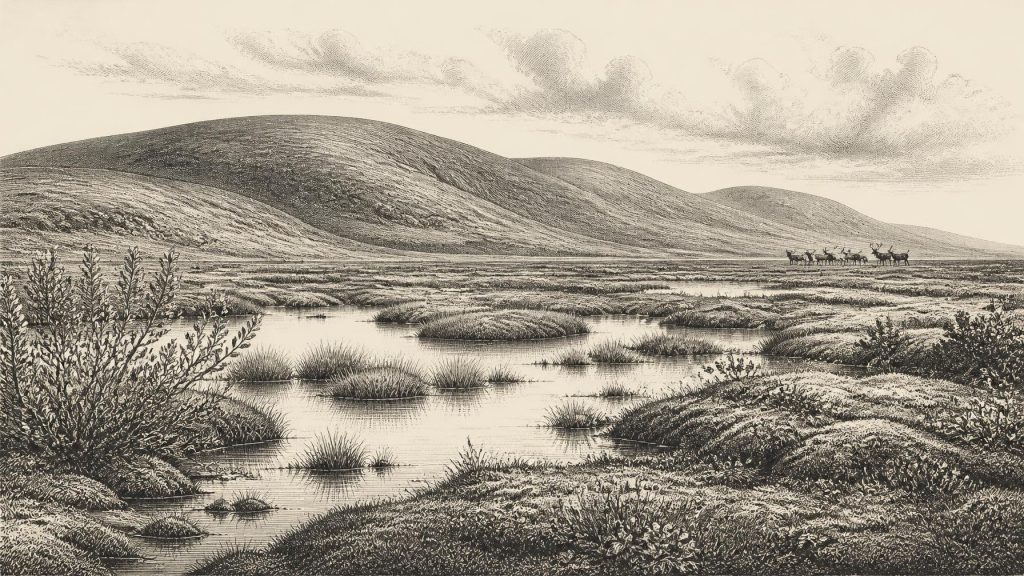
Around 30,908 BCE, Ireland’s history is reconstructed from environmental evidence rather than dated events. At Derryvree, County Fermanagh, freshwater sediments between tills record an ice-free periglacial interval, probably 36,900–31,700 calibrated years BP, with treeless tundra, sedgy pools, mosses and frost-disturbed ground. Ice advances before and afterwards demonstrate regional climatic instability, not island-wide conditions. Castlepook Cave in County Cork preserves time-mixed remains of mammoth, reindeer, giant deer, predators and scavengers, showing cold-stage fauna reached Ireland. No secure archaeological site establishes human presence, though a marked reindeer bone is debated. These fragmentary records reveal a harsh but biologically active Late Pleistocene landscape.
Dateline
Modern calendar-year precision is not available for Ireland in 30,908 BCE. No people on the island recorded a year, and neither radiocarbon dating nor glacial stratigraphy can identify an event to a particular season, let alone a day. The label is a modern chronological convenience, placing this article roughly 32,900 years before AD 1950, within the Late Pleistocene and Marine Isotope Stage 3 (MIS 3). Ireland’s history at this depth of time is therefore not an annal of rulers, battles or settlements. It is a reconstruction assembled from sediments, plant remains, animal bones and the marks left by moving ice.
A Date Within a Broad Range
The most informative Irish evidence close to this notional date comes from Derryvree, near Maguiresbridge in County Fermanagh. Road works in 1969 cut through a drumlin and exposed an exceptional sequence: a bed of freshwater silts, sands and organic material enclosed between two thick layers of till, the unsorted debris deposited by glacier ice. The order of those deposits is crucial. An earlier glacier had affected the locality; an intervening period then allowed water, plants and small animals to leave a record; later ice advanced and buried it beneath another till.
Organic material from the freshwater beds produced the radiocarbon measurement BIRM-166, conventionally reported as 30,500 radiocarbon years BP, with an uncertainty of more than a thousand years either way. A radiocarbon age is not a calendar age. Atmospheric carbon-14 has fluctuated through time, and calibration produces wide probability ranges at this antiquity. Published discussion places the Derryvree deposit broadly within a range of approximately 36,900–31,700 calibrated years BP. That range overlaps the chronological neighbourhood of 30,908 BCE, but it does not date a single pool, animal, journey or human action to that year.
Fresh Water Beneath a Drumlin
Derryvree provides unusually detailed evidence for an Ireland that was cold but biologically active. Pollen was poorly preserved, so it cannot furnish a complete vegetation map. Plant macrofossils, mosses and insect remains are more informative. They indicate open tundra vegetation and a periglacial regime: ground strongly affected by frost, freezing and thawing, but not necessarily lying beneath glacier ice. The site is evidence for a particular local environment during a broad interval, not a photograph of the whole island at one moment.
The landscape around the freshwater deposit was probably a mosaic. Shallow pools and wet margins supported sedges, mosses and aquatic plants. Finds associated with bogbean, water-milfoil, mountain avens, dwarf willow and lesser clubmoss point to wet ground and open, cold-tolerant vegetation. Exposed patches may have held sparse herbs and grasses on thin, frost-disturbed soils. A few grains attributed to trees such as pine or hazel do not prove a nearby woodland: wind can transport pollen over long distances, while older material can be redeposited. The firmer conclusion is that south Fermanagh was largely treeless or nearly treeless country, with short growing seasons and seasonally waterlogged hollows.
Such conditions had practical consequences for every living thing. Winter frost, wind and prolonged snow cover would have constrained plant growth. Summer, however brief, could bring standing water, insect activity and new grazing. The Derryvree evidence has been compared with muskeg-like ground: wet, organic-rich terrain with low vegetation and shallow pools. It was not the blanket of permanent snow often imagined as an Ice Age landscape, nor was it the wooded island familiar from much later Irish prehistory.
Ice, Coasts and Regional Change
Ireland lay in an unstable North Atlantic climatic world. The great maximum of the last British–Irish Ice Sheet was still to come, but ice was expanding and reorganising over long timescales. Modern reconstructions show that advance, maximum extent and retreat were not synchronous across every Irish region. At Derryvree, the sediments demonstrate that the site was ice-free while the freshwater deposits accumulated; the tills above and below demonstrate glacial occupation before and after. They cannot establish that every part of Ireland was simultaneously ice-free.
Later glaciation destroyed, mixed or concealed much earlier evidence. This is one reason why the archaeological record of Ireland around 30,908 BCE is so thin. It also cautions against neat maps showing a fixed ice margin or a uniform national climate. Coasts, drainage, local relief and distance from ice all changed. Lower global sea levels altered the extent of shelves and shorelines, but the exact routes by which animals or people could have reached Ireland remain difficult to reconstruct. The evidence does not support assuming an easy, permanent land connection with Britain or continental Europe at this particular time.
Animals in a Cold Landscape
Cave deposits in southern Ireland nevertheless show that substantial mammals reached the island during MIS 3. Castlepook Cave, also called Mammoth Cave, near Doneraile in north County Cork is the best-known site. Collections made during early twentieth-century excavations included remains attributed to mammoth, reindeer, giant deer, wolf, fox, Arctic fox, bear and spotted hyena, alongside smaller animals. A spotted-hyena skull from the cave is preserved by the National Museum of Ireland. Together, these finds overturn any idea that Ice Age Ireland was simply empty ice.
They must, however, be handled with care. Castlepook was used as a natural bone trap, den or shelter by animals over long periods, and its early excavations disturbed or removed much of the original sediment. Direct dates on different specimens span many millennia. The cave assemblage therefore demonstrates that these species occurred in Ireland during broad Pleistocene intervals; it does not prove that every listed animal met at Castlepook in 30,908 BCE. Nor can the animal list be projected without qualification across the entire island.
The fauna is still revealing. Reindeer fit open, cold grazing country; mammoth and giant deer imply that parts of the wider landscape could sustain large herbivores; wolves and hyenas indicate predators and scavengers within those food webs. Their presence suggests intermittent ecological connections with north-western Europe, whether by shifting coastal routes, crossings available under particular sea-level conditions, or movements across landscapes since erased by ice and sea. Precisely how and when each population arrived remains a matter for evidence rather than assumption.
The Human Question
There is no securely identified Irish house, hearth, grave, tool assemblage or settlement surface dating to around 30,908 BCE. Consequently there is no responsible basis for describing clans, leaders, territorial politics, warfare, diplomacy, religious institutions, trading networks, agriculture or established communities in Ireland at this date. There is likewise no evidence for a local artistic or learned tradition that can be assigned to this horizon. Silence in these categories is not proof that no individual ever entered the island, but it is decisive against writing a conventional social history for the year.
A reindeer femur from Castlepook has made this restraint especially important. One deep mark on the bone has been interpreted as a cut or chop made with a sharp implement during carcass processing, and the specimen has been presented as possible evidence of very early human activity in Ireland. It is an important claim, because a confirmed human modification would greatly extend the island’s known human story. Yet a single modified bone from a complicated cave context cannot establish a settlement, a population, a date-specific hunt or a continuing occupation. Its interpretation and chronological implications require further scrutiny.
If people did reach Ireland during the wider MIS 3 interval, they would most plausibly have been small, mobile foraging groups, as elsewhere in Upper Palaeolithic north-west Europe. That is a regional comparison, not demonstrated Irish evidence. No Irish site currently permits a reconstruction of their camps, food-sharing, belief or relations with other groups. The disciplined conclusion is narrower: animal remains make a human encounter with this landscape conceivable, but archaeology has not yet converted that possibility into a documented society.
What This Year Can Mean
The importance of 30,908 BCE lies in the survival of rare environmental archives rather than an event. Derryvree preserves a cold freshwater wetland briefly protected between advances of ice. Castlepook preserves a partial, time-mixed record of mammals that inhabited or reached Ireland during the long lead-up to the Last Glacial Maximum. Both records are incomplete, and both have been transformed by natural processes and early excavation. Yet together they show an Ireland of sedgy pools, frost-worked ground, open vegetation and large cold-stage animals: harsh, changing and far from lifeless.
That is the appropriate historical perspective for this deep prehistoric date. The island had no known polity or calendar, but it had environments, ecological thresholds and geological changes that shaped every later possibility of habitation. The evidence is fragmentary, but its lesson is substantial: before the great ice-sheet maximum remade much of the landscape, parts of Ireland were briefly available to freshwater life, tundra plants and a remarkable Pleistocene fauna.
Primary Sources
- A Middle Midlandian Freshwater Series at Derryvree, Maguiresbridge, County Fermanagh, Northern Ireland
- Palaeoecology
- Figure 6—The Subdivision of the Quaternary Period in Ireland
- A Reconsideration of the Radiocarbon Dating of the Marine Isotope Stage 3 Fauna from Southern Ireland
- The Irish Quaternary Fauna Project
- The Exploration of Castlepook Cave, Co. Cork. With 3 Plates.
- Occurrence of Mammalia Relicts at Site Castlepook Cave
- Mammoth Cave
- Areas of Scientific Interest in County Cork: Castlepook Caves
- 32564: Castlepook Cave, Castlepook South, Cork
- New Insights on the Fauna of Ireland’s Younger Dryas and Early Holocene from Alice & Gwendoline Cave
- Spotted Hyena Skull
- Growth and Retreat of the Last British–Irish Ice Sheet, 31,000 to 15,000 Years Ago: the BRITICE-CHRONO Reconstruction
- Pattern and Timing of Retreat of the Last British-Irish Ice Sheet
- Early Deglaciation of the British-Irish Ice Sheet on the Atlantic Shelf Northwest of Ireland Driven by Glacioisostatic Depression and High Relative Sea Level
- Radiocarbon Constraints on the Age of the Maximum Advance of the British-Irish Ice Sheet in the Celtic Sea
- Trimlines, Blockfields and the Vertical Extent of the Last Ice Sheet in Southern Ireland
- The Timing and Magnitude of the British–Irish Ice Sheet Between Marine Isotope Stages 5d and 2
- The Problem of a Late Quaternary Landbridge Between Britain and Ireland
- Deglaciation, Earth Crustal Behaviour and Sea-Level Changes in the Determination of Insularity: A Perspective from Ireland
- Ireland: Submerged Prehistoric Sites and Landscapes
- The IntCal20 Northern Hemisphere Radiocarbon Age Calibration Curve (0–55 cal kBP)