Hyaena Bones30901 BCE
Around 30,901 BCE, Ireland lay within a fluctuating cold phase before the Last Glacial Maximum, not a precisely recoverable year. Derryvree, County Fermanagh, preserves evidence of an ice-free freshwater wetland between glacial advances, with tundra vegetation, mosses, sedges and aquatic plants. Castlepook Cave, County Cork, contains a long, disturbed archive of mammoth, reindeer, giant deer, brown bear and spotted hyaena remains, demonstrating intermittent ecological links with north-west Europe. A cut-marked reindeer bone may indicate brief Upper Palaeolithic human activity, but cannot prove settlement. Changing ice, sea levels and routes made Ireland environmentally variable, while beliefs, societies and institutions remain unknowable.
Dateline
There is no recoverable event for Ireland in 30,901 BCE, no contemporary Irish calendar and no evidence that can identify a particular season, person or action in that numbered year. The label is a modern conversion, roughly 32,850 years before AD 1950, rather than a date known to anyone then living. The responsible view is therefore framed by radiocarbon determinations, calibrated ranges and geological sequences. Around this point lies the later part of Marine Isotope Stage 3, a fluctuating cold interval before the fullest expansion of the last British–Irish Ice Sheet.
Ireland at this time was neither simply an ice-covered blank nor a familiar green island. It was a changing northern landscape in which glaciers, exposed ground, wetland basins, rivers, limestone caves and an altered coastline existed at different places and times. Later ice growth, erosion and rising seas have removed or buried much of its evidence. What survives is especially valuable, but it cannot support a conventional annual history of rulers, battles or settled communities.
A Date Within Broad Ranges
Calendar precision is not available at this depth of time. Radiocarbon dates measure the decay of carbon-14, not BCE years directly, and must be calibrated against independently dated records of past atmospheric carbon. At ages above 30,000 years, the resulting calendar ranges can be wide. The date 30,901 BCE should consequently be treated as a point inside a broad chronological horizon, not as a moment that can be isolated archaeologically.
The closest important Irish environmental sequence is at Derryvree, near Maguiresbridge in County Fermanagh. Road works exposed freshwater and organic deposits sealed between two tills: unsorted sediments laid down by glacier ice. The lower till records glacial conditions, the organic silts and sands indicate an intervening ice-free local environment, and the upper till shows that ice later returned across the site. A radiocarbon determination from the organic material has been placed by later calibration in a broad range of approximately 36,900–31,700 calibrated years before present. That range overlaps the world represented by 30,901 BCE, but does not date every layer, plant or animal at Derryvree to this exact year.
This distinction is fundamental. Derryvree is a stratified record of environmental change over a substantial interval, not a weather report for all Ireland and certainly not a diary. Its importance lies in demonstrating that, before the Last Glacial Maximum, at least one part of Fermanagh could support freshwater conditions between episodes of glaciation.
Derryvree’s Cold Wetland
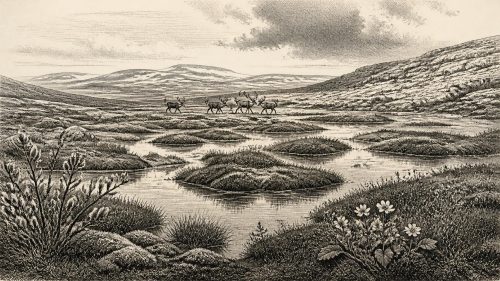
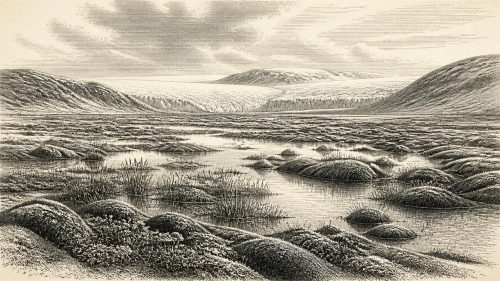
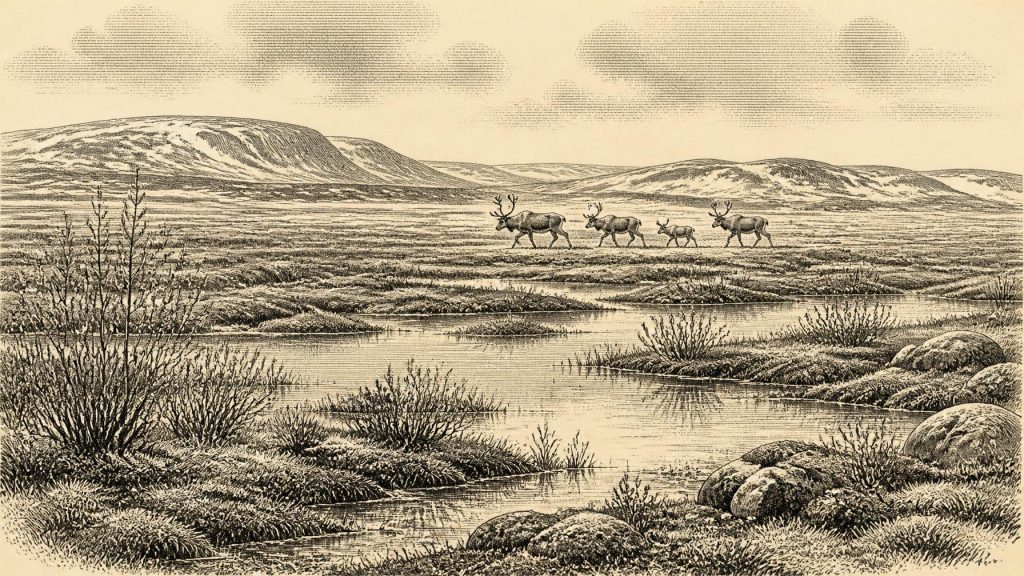
The plant remains from the Derryvree sediments portray open, treeless and cold-adapted country. Mosses, sedges, dwarf willow, mountain avens, lesser clubmoss, bogbean and aquatic plants indicate shallow water, wet ground and tundra-like vegetation rather than woodland. The term ‘muskeg’ has often been used for this kind of mossy, waterlogged terrain. Such a place may have held pools, sedge margins and poorly drained ground amid frost-shattered mineral soils.
This was not necessarily a lifeless wilderness. Wetlands can be productive in cold landscapes, offering water, vegetation and sheltering topography. Yet the evidence allows only an environmental reconstruction. It cannot tell us how extensive the wetland was in a particular decade, whether it was frozen for much of each year, or how far similar plant communities reached beyond the basin. Pollen, plant macrofossils and insects preserve ecological traces, not a complete map.
For the wider island, glacial history remains regionally complex. Modern reconstructions show that the British–Irish Ice Sheet grew asynchronously: different sectors advanced, thickened and later retreated at different rates. Around 31,000 years before present, the ice sheet was building towards a maximum volume reached much later, around 23,000 years ago. It would be wrong to project the later maximum over every part of Ireland in 30,901 BCE. Equally, an ice-free wetland in Fermanagh cannot prove that all districts were accessible, vegetated or hospitable.
Castlepook’s Bone Archive
County Cork provides the other major line of evidence. Castlepook Cave, near Doneraile, is a limestone maze cave whose chambers received animal remains over a very long period. Excavations begun by Richard J. Ussher and colleagues in the early twentieth century recovered more than 2,000 bones. Geological Survey Ireland describes it as the country’s richest known vertebrate archive for the period leading towards the Last Glacial Maximum.
The fauna is striking: woolly mammoth, reindeer, giant deer, brown bear and spotted hyaena are among the animals represented. Their presence establishes that Ireland, during portions of the Middle and Late Pleistocene, was connected ecologically to the cold-stage animal worlds of north-west Europe. Large herbivores could exploit open vegetation, while predators and scavengers formed part of the food web. Spotted hyaenas matter particularly because caves can be dens and feeding places: carnivores may carry bones inside, gnaw them, fragment them and mix the remains of animals killed or found elsewhere.
But Castlepook must not be imagined as one simultaneous scene. Individual specimens have yielded dates spanning many thousands of years, while water disturbance, animal activity and antiquarian excavation complicated the original contexts. A mammoth bone and a reindeer bone from the same cave may not represent the same generation, season or even climatic phase. The cave provides a long archive of repeated deposition, rather than a securely excavated settlement floor dating to 30,901 BCE.
Re-dating has transformed the significance of this archive. Improved bone preparation and accelerator radiocarbon methods showed that several earlier determinations were too young, placing elements of Castlepook’s fauna more firmly within Marine Isotope Stage 3. The revisions indicate that some cold-stage species were present in southern Ireland well before the Last Glacial Maximum and that populations such as spotted hyaena and giant deer may have disappeared locally before its height. This is a powerful reminder that scientific chronology is provisional: old collections can yield new history when methods improve.
A Possible Human Trace
A reindeer femur from Castlepook has been interpreted as bearing marks made during carcass processing with a stone tool and has been publicised as evidence of human activity in Ireland around 33,000 years ago. If that interpretation remains secure, it pushes the island’s known human story far earlier than the later Mesolithic settlement record. It is directly relevant to the broad period surrounding 30,901 BCE.
It does not, however, prove a resident Irish population in that numbered year. The bone is not a house, hearth, campsite, tool-kit or burial. Nor does it demonstrate continuous occupation, a named cultural group, or a route followed by a particular hunting party. Its cave context was disturbed, and a single modified bone can represent a brief encounter rather than a durable settlement. The most cautious conclusion is that one or more Upper Palaeolithic people may have reached Ireland during this wider cold-stage interval and processed a reindeer carcass there.
That possibility is historically important but socially limited. There is no sound basis for describing clans, chiefs, territorial polities, diplomacy or warfare in Ireland at this date. There is likewise no evidence for agriculture, domestic animals, permanent villages, long-distance Irish trade, writing or formal institutions. If people were present, they would have depended on mobile foraging, knowledge of seasonal animals and flexible movement through a hazardous landscape. Such statements are informed comparison with Upper Palaeolithic lifeways elsewhere, not direct proof of a Castlepook community.
Coasts, Routes and Risk
Sea level was lower than today because vast quantities of water were stored in continental ice sheets. Ireland’s coastline was therefore different, with areas of the present continental shelf exposed or transformed. Yet lower sea level should not be turned into a simple land-bridge story. The Irish Sea basin, local ice margins, rivers, lakes and changing coastlines created obstacles as well as possible routes. Whether people or animals crossed by exposed land, ice, short sea passages or combinations of these depended on changing conditions that cannot be reconstructed year by year.
For animals, movement into Ireland need not mean permanent abundance. Populations could arrive during favourable episodes and vanish as vegetation, predation, snow cover or ice barriers changed. The Castlepook evidence is best read as proof of intermittent ecological connectivity. It shows that Ireland was not wholly isolated from the Pleistocene fauna of Britain and continental Europe, while also revealing how fragile that connection could be.
Silence on Belief and Learning
No securely dated Irish cave art, portable art, ritual structure or symbolic object belongs to this horizon. Religion, stories, languages, kinship rules and learning cannot responsibly be reconstructed from plant beds and cave bones. It is tempting to infer a rich spiritual life from the dramatic animals of the Ice Age, but the Irish evidence does not permit it. Nor can the later names given to Castlepook’s chambers, such as Hyenahall and Elephant Hall, be projected backwards: they are products of modern exploration.
The great development represented by 30,901 BCE is thus environmental and evidential. Ireland was entering a period of intensifying glacial pressure, while parts of its landscape still contained wet ground, open vegetation and large mammals. Derryvree preserves the ecological setting; Castlepook preserves the animal record and a possible human action. Together they replace the false certainty of a year-by-year narrative with a more compelling picture: a difficult, mutable island at the edge of Ice Age worlds, whose earliest human traces remain rare, contested and scientifically alive.

Primary Sources
- A Middle Midlandian Freshwater Series at Derryvree, Maguiresbridge, County Fermanagh, Northern Ireland
- Figure 6.— The Subdivision of the Quaternary Period in Ireland
- References and Recommended Reading
- A Reconsideration of the Radiocarbon Dating of the Marine Isotope Stage 3 Fauna from Southern Ireland
- Castlepook Cave: Cork County Geological Site Report
- The Exploration of Castlepook Cave, County Cork, Being the Third Report from the Committee Appointed to Explore Irish Caves
- 2022:564 – Castlepook Cave, Castlepook South, Cork
- New Insights on the Fauna of Ireland's Younger Dryas and Early Holocene from Alice & Gwendoline Cave
- The Irish Quaternary Fauna Project
- Investigating Seasonal Mobility in Irish Giant Deer (Megaloceros giganteus Blumenbach) Using Sequential Stable Isotope Analysis
- Growth and Retreat of the Last British–Irish Ice Sheet, 31,000 to 15,000 Years Ago: the BRITICE-CHRONO Reconstruction
- Late Pleistocene Chronostratigraphy and Ice Sheet Limits, Southern Ireland
- Last Glacial Maximum Cirque Glaciation in Ireland and Implications for Reconstructions of the Irish Ice Sheet
- Trimlines, Blockfields and the Vertical Extent of the Last Ice Sheet in Southern Ireland
- Pattern and Timing of Retreat of the Last British-Irish Ice Sheet
- The IntCal20 Northern Hemisphere Radiocarbon Age Calibration Curve (0–55 cal kBP)
- Ireland: Submerged Prehistoric Sites and Landscapes
- The Colonization of Ireland: A Human Ecology Perspective
- Local Pleistocene Glaciation and the Level of the Snow Line of Croaghaun Mountain in Achill Island, Co. Mayo, Ireland
- Glacial Geomorphology in the Wicklow Mountains, Ireland
- BRITICE-CHRONO: Constraining the Retreat of the Last British-Irish Ice Sheet