
Ireland, 11–17 January 2026: Public Trust, Migration Reform and the Memory of the Airwaves(c.2020s)
Between 11 and 17 January 2026, Ireland’s week was shaped by institutional repair and cultural memory. The Dáil returned to housing, costs, migration and a turbulent world; Government published sweeping asylum reforms and civil-justice changes while confronting AI-generated abuse on X. RTÉ’s radio centenary, marked at the GPO and by an An Post stamp, placed new media anxieties beside a century of public broadcasting. Jessie Buckley’s Golden Globe win lifted Irish culture internationally. In Northern Ireland, Westminster debate on Stormont reform showed unresolved questions about power-sharing, consent and stability as the Good Friday institutions neared their third decade under pressure.
Dateline
A week of institutions under strain
The completed week from 11 to 17 January 2026 was historically significant less because of one single rupture than because several strands of Irish public life moved at once: migration law, digital regulation, courts reform, housing delivery, diaspora policy, public broadcasting memory, international diplomacy and the future of Northern Ireland’s institutions. In retrospect, it reads as a week about trust. The State sought to make systems faster and more legible; critics warned that efficiency could shade into exclusion; cultural institutions celebrated continuity; and Irish politics looked outward at an unstable world while trying to answer domestic pressures on housing, childcare, costs and public services.
The Dáil returned after Christmas on Tuesday, 13 January, with familiar domestic arguments sharpened by international anxiety. Leaders’ Questions ranged across the cost of living, housing, employment figures, disability services and foreign affairs. Taoiseach Micheál Martin pointed to record employment, while Opposition leaders pressed the Government on affordability and on Ireland’s response to authoritarianism, war and threats to sovereignty abroad. The week therefore reopened the parliamentary year with a characteristic 2026 tension: Ireland as a small state dependent on international law, but also a state judged daily on whether it could deliver homes, services and security at home.
Asylum reform and the politics of speed
The most consequential Government act of the week was the publication, on 13 January, of the International Protection Bill 2026. Minister for Justice, Home Affairs and Migration Jim O’Callaghan described it as the most significant reform of Irish asylum law in the history of the State. Its central promise was speed: faster first decisions, faster appeals, a new Tribunal for Asylum and Returns Appeals, a border procedure with tight time limits in specified cases, and a new Chief Inspector of Asylum Border Procedures. The Bill was also tied to Ireland’s implementation of the EU Migration and Asylum Pact, placing domestic asylum policy firmly inside a European framework.
Supporters presented the reforms as overdue administrative repair. They argued that long processing times were unfair to applicants, costly to taxpayers and damaging to public confidence. The Bill’s stated objective was a fair, sustainable and efficient system that could grant protection sooner to those who qualified and return those who did not. Yet the week also exposed the moral and political fault line within migration policy. Proposals under development would prevent adult beneficiaries of international protection from seeking family reunification for three years, and would link reunification to financial self-sufficiency. Refugee advocates and Opposition figures argued that such measures would punish people who had already been recognised as needing protection. The historical importance of the week lies partly in that collision between administrative efficiency and the older Irish self-image of refuge, kinship and emigration.
Courts, civil justice and state capacity
On 15 January, the Government published the General Scheme of the Civil Reform Bill, aimed at overhauling judicial review and streamlining civil court processes. The proposals drew on the Review of the Administration of Civil Justice, often associated with the Kelly Report, and included case conduct principles, limits on adjournments, wider pre-action protocols, discovery reforms and changes to District and Circuit Court monetary limits. In a week dominated by asylum and housing, the courts package mattered because it addressed another recurring Irish problem: the time and cost of getting decisions through public systems.
Judicial review has long been a necessary check on executive power, planning decisions and administrative error. But it has also been criticised as slow, expensive and unpredictable. The reform effort therefore sat beside the asylum Bill as part of a broader agenda of state capacity: make procedures quicker, reduce delay, and try to preserve rights while preventing processes from becoming unusable. Whether that balance would be achieved remained open, but the week marked a clear legislative push towards a more managerial, deadline-conscious State.
Housing signals and childcare anxieties
Housing remained the inescapable domestic backdrop. On 15 January, the Department of Housing published December 2025 commencement data showing 3,065 new home starts, double the November figure and the highest monthly total of 2025. The Department also highlighted the use of modern methods of construction in scheme developments and apartments. As a statistical release, it was not a turning point by itself; as a political signal, it mattered. The Government needed evidence that supply was moving, while the Opposition continued to frame housing as the defining test of competence.
Childcare also intruded into the Dáil’s return. During the Order of Business on 13 January, concerns were raised about early-years facilities closing in Cork and about pressures on providers, staff and parents. The Taoiseach replied that 4,590 services had signed up for core funding, the highest number since the scheme began in 2022, and said many services that had left had returned. Two days later, Minister Norma Foley opened applications for €350,000 in Parent and Toddler Group Grants, a modest but symbolically important reminder that family infrastructure is not confined to schools or hospitals. The week showed how childcare had become part of Ireland’s wider debate about work, gender equality, affordability and the viability of community services.
AI harm and Irish digital regulation
Another historically revealing episode unfolded around X, Grok and AI-generated explicit images. By midweek, Gardaí and regulators were dealing with reports concerning potential child sexual abuse material and non-consensual intimate imagery generated or shared through AI tools. On 16 January, Minister of State Niamh Smyth met X executives and said she had expressed serious dismay at what had been facilitated on the platform. X told her that Grok, as integrated on X, had been disabled from removing or reducing clothing on individuals worldwide. Smyth welcomed corrective actions but sought assurances that such capability would not return.
The issue mattered because Ireland was not a bystander. As the European base for major technology firms and as a State with regulators central to EU digital enforcement, Ireland was again at the junction of global platform power and local harm. The controversy also connected constitutional rights, child protection, policing, platform design and the EU Digital Services Act. In historical terms, the week captured a familiar Irish twenty-first-century role: small state, large regulatory responsibility.
One hundred years of Irish broadcasting
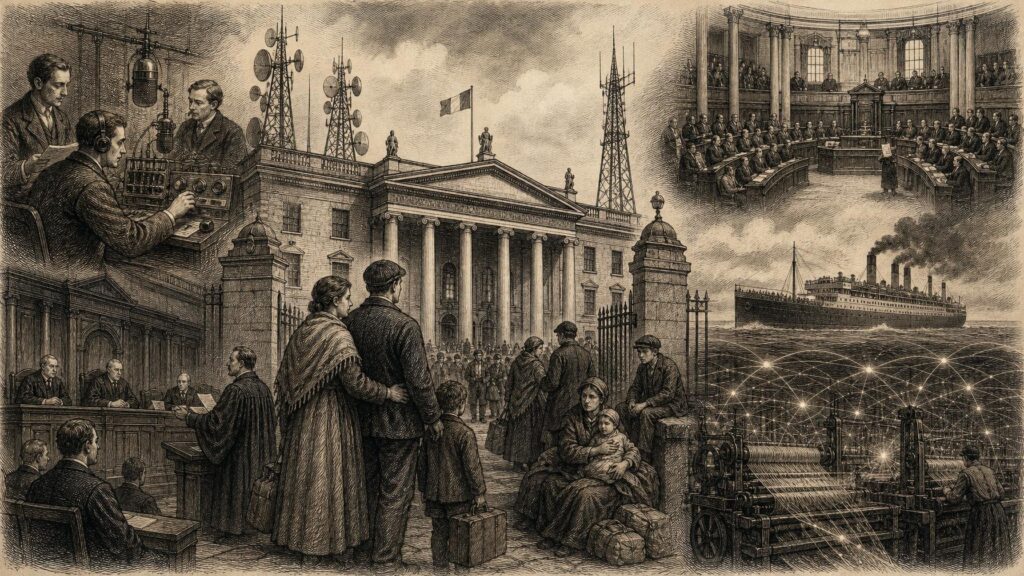
Against these anxieties, 15 January offered a deliberate act of commemoration. RTÉ launched its centenary year of public broadcasting with live broadcasts from the GPO in Dublin, running across RTÉ 2FM, Radio 1, lyric fm and Raidió na Gaeltachta. The location was carefully chosen. Irish radio began with 2RN’s first public transmission on 1 January 1926, and Radio Éireann later operated from the GPO until 1976. An Post also issued a national stamp marking 100 years of broadcasting, placing the story of 2RN, Douglas Hyde, Little Denmark Street and the GPO into everyday circulation.
The centenary was more than nostalgia. Public broadcasting in Ireland has carried language revival, sport, music, emergency information, election coverage, scandal, apology and national ritual. In a week when AI-generated abuse raised questions about digital trust, the radio centenary invited comparison between regulated public media and the volatile global platforms now shaping public conversation. The GPO setting also linked broadcasting to the older symbols of Irish statehood, independence and communication.
Irish culture abroad: Jessie Buckley’s Golden Globe
The week began with a cultural achievement that resonated beyond the arts pages. On 11 January, Killarney-born Jessie Buckley won the Golden Globe for Best Female Actor in a Motion Picture – Drama for her performance in Hamnet. The film also won Best Motion Picture – Drama, and Irish political leaders, including President Catherine Connolly and Taoiseach Micheál Martin, publicly congratulated Buckley. Her success formed part of a wider period of international visibility for Irish actors, writers and film-makers.
Its historical weight was not simply a matter of celebrity. Buckley’s win reflected Ireland’s expanding cultural capital: regional training, theatre, television, independent film and international production networks feeding into global awards circuits. It also sat neatly beside the broadcasting centenary. Together, they suggested a century-long arc from the Free State’s first crackling radio transmission to Irish creative labour at the centre of world cinema.
Northern Ireland and the unfinished settlement
On 13 January, Westminster Hall debated reform of Northern Ireland’s political institutions, led by Alliance MP Sorcha Eastwood. The debate revisited the durability and limitations of the Good Friday Agreement architecture: mandatory coalition, designation, vetoes, petitions of concern and the ability of a single party to block Executive formation. Speakers differed sharply. Some argued that reform was necessary to prevent collapse and reflect a society no longer divided into two simple blocs. Others warned against weakening safeguards designed to protect minorities and maintain cross-community consent.
The discussion was significant because it treated institutional reform not as an academic matter but as a practical question of public services, budgets and legitimacy. Nearly three decades after 1998, the core achievement of peace remained widely acknowledged, but the mechanisms of power-sharing were again under scrutiny. The week therefore placed the whole island’s governance questions side by side: Dublin seeking faster systems; Belfast and Westminster asking how systems can remain stable, inclusive and consent-based.
Small-state diplomacy and the diaspora
Ireland’s external identity appeared in two further developments on 15 January. Minister of State Thomas Byrne spoke with Denmark’s European Affairs Minister about Greenland, underlining Irish support for Denmark and Greenland and insisting that sovereignty is not a commodity to be bought and sold. The statement echoed the Dáil’s wider concern about international law and the vulnerability of small states in a world of renewed great-power pressure.
That same day, Minister Neale Richmond opened the 2026/2027 Emigrant Support Programme, with a record allocation of €17.5 million for Irish communities abroad. The programme’s history since 2004, supporting welfare, culture, heritage and community organisations in dozens of countries, offered a quieter but durable expression of Irish statecraft. Ireland’s week thus ended with two related ideas: defend sovereignty in the international order, and maintain bonds with a global people shaped by centuries of migration.
Why the week endures
Viewed as an archive week, 11–17 January 2026 was a hinge between memory and modernity. The centenary of radio looked back to the cultural infrastructure of the young State; the Grok controversy looked forward to unresolved harms of generative AI. The asylum and civil justice Bills sought administrative speed; debates on family reunification, judicial review and Northern Ireland reform warned that speed and stability must not come at the expense of rights, consent or trust. Jessie Buckley’s award demonstrated Ireland’s cultural reach, while housing and childcare kept politics grounded in daily life. The week’s central theme was the same across these fields: how Ireland maintains humane, credible institutions in a faster and more unsettled age.
Primary Sources
- Minister Jim O’Callaghan publishes International Protection Bill 2026
- New Legislation to significantly reform Irish asylum laws
- Ceisteanna ó Cheannairí – Leaders’ Questions – Dáil Éireann, Tuesday 13 January 2026
- An tOrd Gnó – Order of Business – Dáil Éireann, Tuesday 13 January 2026
- Civil Reform Bill to overhaul Judicial Review and streamline courts processes
- Statement following meeting with X regarding AI generated explicit images
- Irish police investigating 200 reports of Grok child abuse material
- RTÉ to mark 100 Years with special broadcasts live from the GPO this Thursday, January 15
- 100 Years of Broadcasting – National Stamp
- ‘This is a real honour’ – Jessie Buckley wins Golden Globe award
- ‘Fantastic recognition’ – President congratulates Buckley
- Commencement data for December 2025 shows significant jump in new home starts
- Minister Richmond launches 2026/2027 Emigrant Support Programme
- Call on Greenland held between Minister Byrne and Danish Minister for European Affairs
- Northern Ireland Political Institutions: Reform — 13 January 2026