

Clanricarde’s Limerick Council1544 CE
In 1544, Tudor authority in Ireland depended on negotiation rather than uniform control. During Sir Anthony St Leger’s absence, Lord Justice William Brabazon managed finance, military levies and invasion rumours, while Irish kern joined Henry VIII’s war against France and Scotland. Local conflicts persisted: English forces aided O’Donnell’s siege at Lifford, and warfare engulfed Ulster through raids, castles, hostages and Scottish mercenaries. At Limerick, a council addressed the Clanricarde succession after Ulick Burke’s death, recognising Richard Burke but empowering a rival custodian, leaving conflict unresolved. Former monastic property passed to crown servants, illustrating primarily economic, rather than immediate religious, transformation.
Dateline
In 1544 the Tudor crown’s recently proclaimed Kingdom of Ireland was tested less by a single island-wide war than by the fragility of the agreements on which it rested. Henry VIII had taken the title king of Ireland only three years earlier, and his deputy, Sir Anthony St Leger, had sought to bring Gaelic and Old English lords into a common political framework through negotiated submissions, titles, land grants and personal alliances. That programme could look impressive in Dublin and London. On the ground, however, succession quarrels, cattle raids, contested castles and rival kinships continued to decide power.
A Deputy Leaves, a Lord Justice Governs
St Leger left Ireland for England about 10 February 1544. In his absence Sir William Brabazon, vice-treasurer and a veteran royal administrator, acted as lord justice from February to August. The change mattered. St Leger’s authority depended greatly on direct personal dealings with magnates whose loyalties were neither automatic nor permanent. His departure gave opponents room to question his influence and gave local disputes greater scope to intensify.
St Leger’s journey also showed that Irish government was embedded in Henry VIII’s wider monarchy. On 25 April he was appointed to the Order of the Garter and was installed at Windsor on 18 May. The honour, followed by his reappointment as lord deputy on 3 July and an increase of £200 in his salary, made plain that he retained the king’s favour despite criticism from allies of James Butler, ninth earl of Ormond. St Leger returned to Ireland on 11 August. These dates are secure; the deeper political implication is clear enough: royal approval in England remained essential to the standing of a governor in Dublin.
Brabazon’s interim administration was not merely a caretaker government. He controlled royal finance as vice-treasurer, while the council had to deal with disorder, intelligence reports and the demands of an expanding continental war. The problems exposed the limits of a Dublin-centred administration. The crown could appoint officers, issue instructions and pay captains, but much of Ireland remained governed day to day through lordships, family networks and negotiated obedience rather than through a uniform machinery of county government.
Kern for Henry’s War
England’s war against France and Scotland drew Ireland directly into European conflict. At first the English council requested 3,000 Irish kern, the lightly equipped Gaelic foot soldiers valued for rapid movement and skirmishing. On 30 March the order was reduced to 1,000: 500 for the Scottish borders and 500 to serve with the king’s army. The reduction did not make recruitment simple. A March report from the Irish government noted arguments among leading men and difficulty in persuading kern to cross the sea.
The concern was practical as well as political. Men who travelled to a foreign campaign needed a commander whom they trusted to secure their relief, pay and return. On 6 May Ormond reported that he had raised the 100 kern required of him, together with another 100, and sent his nephews Piers Power, Lord le Power and Curraghmore, and Piers Butler with them. The following day the lord justice and council stated that the kern were waiting for a favourable wind and had been placed under Lord Power’s command. Such letters reveal an Ireland connected to military routes across the Irish Sea and Channel, but also the dependence of Tudor warfare on aristocratic patronage.
Irish contingents did reach Henry’s forces in the French theatre. The siege of Boulogne ran from July to September, and Lord Power was wounded there; he did not die immediately, but his wound proved fatal in the following year. The service of these men should not be mistaken for uncomplicated national allegiance. Gaelic and Anglo-Irish lords could serve the king overseas while pursuing their own local interests at home. Yet the levy was a substantial demonstration of St Leger’s recent success in securing cooperation: leading Irish magnates supplied men at a moment when Henry needed every available resource against France and Scotland.
Rumour, Coasts and Castle Politics
War abroad sharpened anxiety about invasion at home. In May and June, Brabazon’s council reported rumours that the young Gerald FitzGerald, heir to the Kildare earldom and then abroad, might return with French support. One report placed him in Brittany and suggested a landing among the MacCarthys; another spoke of a French fleet at Brest and wildly large numbers of prospective invaders. These were reports and fears, not an invasion. Their importance lies in what they disclose: the memory of the Kildare rebellion of the 1530s remained politically dangerous, and French assistance was still imagined as a route by which discontented Irish interests might overturn the settlement.
In the north-west, diplomacy could be inseparable from armed coercion. Calvagh O’Donnell, son of Manus O’Donnell of Tír Chonaill, went to the English lord justice and returned with English captains and a substantial force. At Lifford they joined the O’Donnells in besieging the castle held by descendants of Hugh O’Gallagher. Hostages were handed to the English, apparently to intimidate the defenders. When an English soldier was killed, one hostage, Cahir son of Tuathal O’Gallagher, was killed while still in fetters. The defenders then surrendered the castle in exchange for the release of other prisoners, and the English captains departed after being paid.
This episode does not show a simple extension of royal rule into Donegal. Rather, an English force was hired into an O’Donnell dispute and used siege equipment against a local rival. The killing of a hostage underscores the human cost of such bargaining. It also demonstrates the continuing value of castles, hostages and armed retainers in a political world where control of a river crossing or fortified settlement could matter more immediately than a statute passed in Dublin.
Conflict from the Route to Tyrone
The annals record a wider sequence of warfare in Ulster during the year. Manus O’Donnell campaigned in the Route, captured the Loughan Islands, took a wooden stronghold of MacQuillin and handed it to O’Kane, then seized Ballylough Castle and nearby islands. The chroniclers list booty that included weapons, armour, copper, iron, butter and provisions. This inventory offers a rare glimpse of the material stakes of raiding: food supplies and metal goods were as significant as territorial prestige.
The victory did not settle the region. MacQuillin brought in James and Colla MacDonnell with a band of Scots, retook the island position and burned O’Kane’s warders and their possessions. O’Kane then hired MacSweeney gallowglass and recovered seized cattle after pursuing MacQuillin across the Bann. Meanwhile, war between O’Donnell and O’Neill produced ambushes, prisoners and reciprocal raids along the Finn and into Tír Eógain. None of these operations can responsibly be assigned a day or month from the surviving annals, but they firmly belong to 1544.
Amid this violence, the death of Niall, son of Art Óg O’Neill, removed a potential successor in Tír Eógain. The annalist praised him not only as a hardened participant in the wars between Cenél Conaill and Cenél Eógain, but as a man skilled in learning, art and music. Such conventional praise should not be read as a modern biography, yet it is valuable evidence of the qualities admired in elite Gaelic society: military endurance existed alongside hospitality, knowledge and artistic accomplishment.
Clanricarde’s Unfinished Settlement
The year’s most consequential succession crisis unfolded in Connacht. Ulick Burke, known as Uilleag na gCeann and created first earl of Clanricard under Henry’s policy of surrender and regrant, faced a problem common to many lordships: how could a title framed in English legal language be reconciled with competing dynastic claims? His sons were minors, and the question was complicated by his three marriages and divorces.
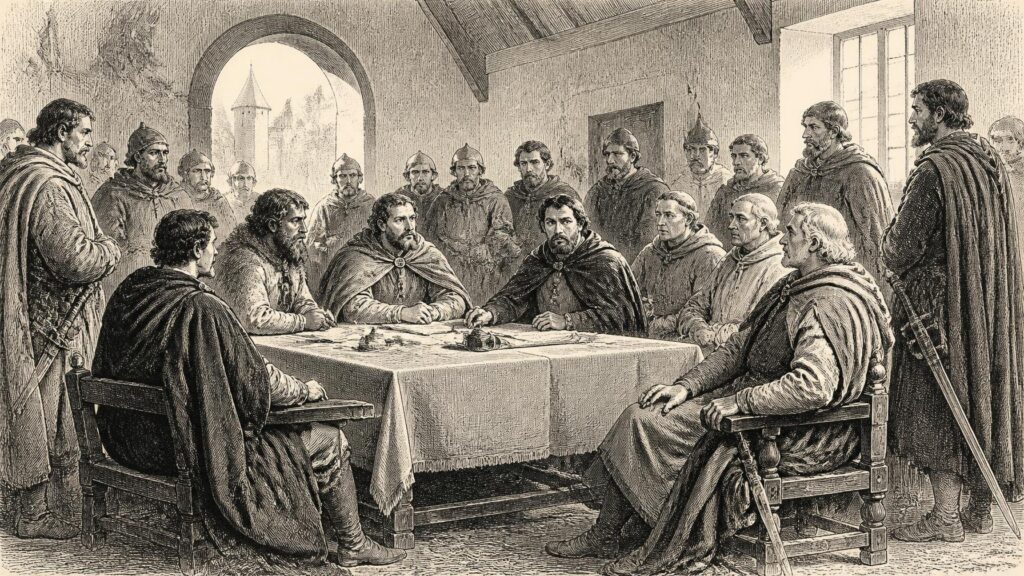
A great council met at Limerick on 9 October to determine the succession. Ulick died during its proceedings, on 19 October. The council recognised Gráinne O’Carroll as his sole lawful wife and her son Richard as rightful heir to the earldom. Yet it also compromised with a rival, another Ulick Burke, by appointing him custodian during the young earl’s minority. The arrangement preserved the earldom in principle while conceding power to a formidable local claimant.
The compromise did not end conflict. The Irish annals record that Ormond entered Clanricarde to support his kinsman William Burke, only for the sons of Richard Óg Burke to defeat him; more than forty of Ormond’s men and a notable follower, Mac Oda, were said to have been killed at the gate of Athenry. The exact circumstances are not independently detailed, but the annal makes the underlying point unmistakable. Earldoms, Gaelic lordships, urban gateways and kin alliances overlapped, and no royal policy could erase those rival claims by decree.
Land, Water and Religious Change
Religious change continued to reshape property more visibly than worship. In January, St Leger received a grant of two watermills formerly belonging to St Mary’s priory at Trim, together with their watercourses, weirs and a stretch of the Boyne. Valued at £3 yearly, the grant converted assets once administered by a religious house into the estate of the king’s deputy. Mills were not symbolic ruins: they controlled the grinding of grain, drew rents and depended on the management of water, riverbanks and labour.
This was part of the longer dissolution of religious houses, not evidence that Ireland had suddenly become Protestant in 1544. In and beyond the Pale, many established forms of religious observance persisted, while the royal supremacy was accepted by some bishops and lords for political reasons. Christ Church, Dublin, having been remade as a secular cathedral earlier in the decade, had a secure institutional future by this point. The more immediate transformation for many communities was economic: former monastic land, mills, fisheries and buildings were being reassigned to crown servants and local elites.
Thus 1544 was a year of connected but uneven change. Irish soldiers sailed to fight Henry’s wars; government at Dublin passed temporarily to Brabazon; and St Leger returned with enhanced royal backing. Yet in Lifford, the Route, Tyrone, Clanricarde and Leix, power still turned on hostages, cattle, forts and family succession. The Limerick council over Clanricarde captures the year best: Tudor titles and institutions were advancing, but they had to bargain continually with the older, resilient politics of Irish lordship.
Primary Sources
- Annals of the Four Masters, Part 5: Annal M1544
- Annála Connacht: Annal 1544
- State Papers during the Reign of Henry the Eighth, Part III, Volume II
- St Leger, Sir Anthony
- Brabazon, Sir William
- Burke, Ulick (de Burgh, Uilleag) (‘Uilleag na gCeann’)
- O'More (Ó Mórdha), Rory (Ruaidhrí Caoch)
- Fitzgerald, James fitz John
- The Ormond—St Leger Feud, 1544–6
- A ‘New Departure’ in Mid-Tudor Ireland?
- Transforming Medieval Trim: The Town, Its Economy and Society, c.1200–1540
- Religious Communities and Their Closures in Ireland during the Sixteenth Century
- George Browne, First Reformation Archbishop of Dublin, 1536–1554
- The Dignitas Decani of St Patrick’s Cathedral, Dublin
- Registrum Diocesis Dublinensis: A Sixteenth-Century Dublin Precedent Book
- Ireland Under the Tudors
- Anthony St Leger
- William Brabazon (Lord Justice of Ireland)
- Ulick na gCeann Burke, 1st Earl of Clanricarde
- Annals of the Kingdom of Ireland