

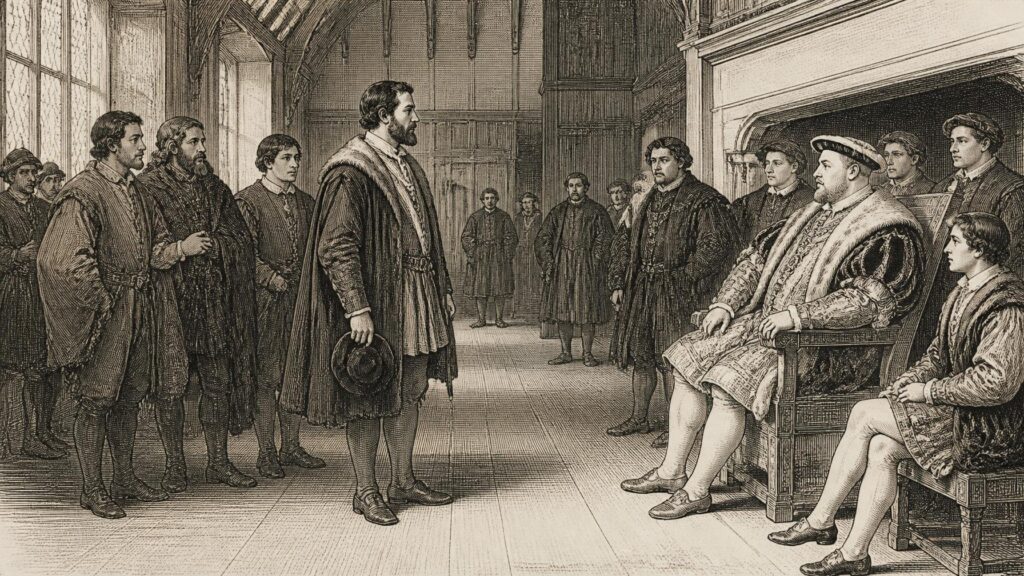
Conn Bacach at Greenwich1542 CE
In 1542, Henry VIII’s Irish monarchy relied on negotiated submission rather than direct control. Conn Bacach O’Neill travelled to Greenwich, renounced his Gaelic title’s authority, and became earl of Tyrone; Matthew O’Neill’s recognition as heir intensified succession conflict. Parliament met at Limerick, while Murchadh O’Brien, Ulick Burke and the earl of Desmond engaged with royal policy, though promised earldoms for O’Brien and Burke followed in 1543. Campaigns and alliances demonstrated limited royal reach. Religious change included friary suppression, marriage legislation, and a Jesuit mission, yet Gaelic learning and worship endured. The kingdom remained diverse, contested, and dependent on local lordships.
Dateline
In 1542, the Tudor crown’s attempt to turn Ireland from a lordship of uncertain reach into a kingdom of obedient subjects acquired its most striking northern convert. Conn Bacach O’Neill, lord of Tír Eoghain, travelled to Henry VIII’s court and in October accepted the earldom of Tyrone. His elevation did not mean that Ulster had become English in culture, law or political habit. It did, however, mark an important bargain: a leading Gaelic ruler accepted a place in the king’s peerage, while the crown recognised his commanding position in Tyrone.
The year should not be treated as the simple beginning of the Kingdom of Ireland. The parliamentary act making Henry VIII king of Ireland had been passed in June 1541, during the previous calendar year, although it is conventionally styled the Crown of Ireland Act 1542 because of its regnal dating. Henry was proclaimed king in England in January 1542, and the new royal title became an increasingly conspicuous part of government in Ireland. In practice, however, the king’s authority remained highly uneven. Dublin administration was strongest in the Pale and in some towns; much of the island was governed day to day through powerful Gaelic and Gaelicised lordships.
A Parliament at Limerick
One sign of the government’s wider ambitions came when the Irish parliament met at Limerick from 15 February until early March. Its location mattered. Parliamentary government had normally been concentrated in Dublin and the Pale; holding a session in the great Shannon-side city brought the king’s political language into Munster. The meeting was not a popular national assembly in any modern sense, but it assembled lords, bishops and representatives of boroughs within the constitutional machinery of the crown.
Murchadh O’Brien of Thomond was central to this western and southern policy. At Limerick he renounced claims to lands east of the Shannon and was received into royal favour. The crown was already considering the title of earl of Thomond for him, though the actual creation followed in 1543, not 1542. This distinction is important. In 1542, the settlement was still an arrangement under negotiation: submission, pardon, territorial compromise and a promise of status, rather than a completed remaking of Thomond.
The logic was what later historians call surrender and regrant. A lord was expected to yield an independent or customary claim to land and authority, acknowledge the king, and receive a title and estate under English law. The offer could make political sense to a ruler seeking recognition and protection against rivals. Yet it also introduced principles that sat awkwardly beside Gaelic political life: royal jurisdiction, written grants, and inheritance arranged through English legal forms rather than the flexible, kin-based succession practices commonly described as tanistry.
Conn Bacach’s Calculation
Conn Bacach’s decision was the most consequential example of the year. The O’Neills of Tír Eoghain were among the foremost dynasties in Ireland, and Conn had long balanced warfare, diplomacy and alliances with neighbouring powers. Government campaigns in Tyrone during 1540 and 1541 had demonstrated the crown’s capacity to threaten him, while rivalries within Ulster made a settlement useful. By early 1542 he was prepared to respond to Sir Anthony St Leger, the lord deputy.
In May Conn renounced papal supremacy in favour of Henry VIII and promised obedience. In June he made peace with Feidhlimidh Ruadh O’Neill of the Fews. Such agreements did not erase rival claims or make the region quiet; they were practical moves in a landscape where lordships competed for men, cattle, tribute and strategic routes. But they cleared the way for Conn’s journey to England.
The Irish annals record that Conn went to Henry VIII, who made him an earl and ordered that he should no longer be called “The O’Neill”. The language captures the constitutional point of the transaction. “The O’Neill” was not merely a surname but a Gaelic lordly office, associated with leadership of a wider kin-group and territory. The earldom of Tyrone was a dignity granted by the king. Conn accepted the latter without instantly making the former meaningless to his followers.
On 1 October 1542 he was created earl of Tyrone, while Matthew, or Feardorcha, whom Conn acknowledged as his son, became baron of Dungannon. The choice of Matthew had far-reaching consequences. His birth was disputed, and Conn’s legitimate son Shane had a powerful claim in Gaelic eyes. The crown’s recognition of Matthew as successor under the new settlement attempted to impose a clearer dynastic order. Instead, it sharpened a family conflict that would later convulse Tyrone. What appeared at Greenwich to be a tidy settlement contained the seeds of a prolonged succession struggle.
Losses Within Tyrone
The annals give the political bargain a more human setting. They report that Feidhlimidh Caech, a son of Conn Bacach, was killed by a single cast of a javelin from a MacDonnell gallógach, or gallowglass. Two other sons of Conn also died in the year. Another prominent kinsman, Brian son of Niall son of Art Óg, described as heir to the lordship of Tyrone, died at the Old Castle. The sources do not provide dependable dates for all these deaths, but together they underline the fragility of succession in a great lordship.
These were not private family bereavements alone. A lord’s adult sons and close male relatives could command fighting men, build alliances through marriage and fosterage, and become candidates for leadership. In that context, Conn’s promotion of Matthew was not an abstract legal manoeuvre. It changed the prospects of living men and their followings at a moment when several other potential figures within the dynasty had disappeared.
Munster, Connacht and Royal Service
The crown’s diplomacy reached well beyond Ulster. James fitz John FitzGerald, earl of Desmond, travelled to London in June and rendered personal homage to Henry VIII. He required an interpreter, a revealing reminder that one of the most powerful peers within the king’s Irish polity did not speak English. His visit showed that loyalty to the crown did not demand cultural uniformity. It was a personal and political relationship, negotiated through rank, service and reward.
In September St Leger reinforced Desmond with 400 royal soldiers against opposition among the MacCarthy lordships of Cork and Kerry. Leading lords in the region submitted during the campaign. This was a notable assertion of royal force, but its limits should be kept in view: the government worked through Desmond’s local power as much as through its own troops. Submission to the king was also, in effect, submission to an earl acting as royal commissioner.
In Connacht, Ulick Burke, Mac William of Clanricarde, was also moving towards the court. He had allied with Mac William of Mayo in an effort to extend influence in northern Connacht early in the year, but set out for England by August and reached court in October. The annals place both Ulick and Murchadh O’Brien in England and say that each was made an earl; the chronology needs care. Their journeys belong to 1542, but Ulick’s creation as earl of Clanricarde and Murchadh’s as earl of Thomond occurred in 1543. The annalistic notice nevertheless conveys how contemporaries connected these leading men with the new royal order.
Manus O’Donnell, Conn Bacach’s great rival in Tír Chonaill, did not make such a personal submission in 1542. He sent his son An Calbhach to St Leger to ratify peace, and reached an agreement with Maguire of Fermanagh involving the return of disputed lands. Ulster therefore remained a field of competing lordships, not a province absorbed by the Dublin government. The crown’s new kingdom depended on making arrangements with its strongest rulers rather than replacing them.
Church, Friaries and Learning
Religious change was equally uneven. The Henrician state repudiated papal authority and extended its claims over the Irish church, but established practices and loyalties did not suddenly vanish. Bernard O’Higgin, an Augustinian, was appointed bishop of Elphin in May and consecrated on 7 September. His career illustrates the persistence of clerical networks linked to the older religious orders at a time when crown policy was reworking the institutional church.
The first Jesuit mission to Ireland also belongs to this year. Paschase Broët and Alfonso Salmerón, sent under papal authority, crossed into Ulster during Lent. Their mission was brief and unsuccessful: the political and religious circumstances were too insecure for a sustained intervention. Its significance lies less in immediate achievement than in showing that Ireland had become a concern in the emerging European contest between papal reform and Henrician supremacy.
At Armagh, the Franciscan friary was suppressed in 1542 as part of the dissolution of religious houses. Suppression changed ownership, income and access to buildings, but it did not end religious memory or practice overnight. Elsewhere, friars, clergy and lay patrons adapted, departed or continued worship in less formal ways. The same year’s Irish marriage legislation denounced papal jurisdiction and asserted the authority of the king and parliament over matrimony, bringing the Reformation into questions of household, inheritance and legitimacy as well as doctrine.
The annals also preserve glimpses of a learned Gaelic world that the crown could not simply legislate away. Cormac O’Clery, a Franciscan of the Donegal convent, died in 1542. Brian Doragh Mac Conmidhe, praised as a man skilled in poetry and literature and as a generous host, died about the feast of St Columba. Such notices point to the continuing importance of hereditary learned families, religious communities, hospitality and patronage. Their cultural authority remained embedded in lordly society even as Tudor officials promoted a different legal and ecclesiastical framework.
A Kingdom Still Being Made
By the end of 1542, Henry VIII’s claim to be king of Ireland had acquired prestigious Irish collaborators. Conn Bacach had become earl of Tyrone; Desmond had paid homage; O’Brien and Burke were being drawn towards comparable settlements; and royal military force had been displayed in Munster. Yet the achievements were conditional. They rested on personal bargains, local rivalries, garrisons and the expectation of rewards.
For most people, everyday life still turned on harvests, herds, kinship, rents, local lordship, parish worship and the dangers of raiding or troop movements. The changes of 1542 mattered because they began to recast who could claim land, inherit power, appoint authority and define lawful obedience. But the new kingdom was not a finished political reality. It was a programme being tested, adapted and contested across an Ireland that remained remarkably diverse.
Primary Sources
- Crown of Ireland Act 1542
- Pre-Union Irish Statutes Affected
- Marriage Act, 1542
- Annals of the Four Masters, Part 5
- Annals of the Four Masters, Irish text, Part 5
- CELT Project: Annals of the Four Masters
- O'Neill (Ó Néill), Conn ‘Bacach’
- O'Neill (Ó Néill), Matthew (Feardorcha)
- St Leger, Sir Anthony
- Fitzgerald, James fitz John
- O'Brien (Ó Briain), Murchadh
- Burke, Ulick (de Burgh, Uilleag) (‘Uilleag na gCeann’)
- O'Donnell, Manus (Ó Domhnaill, Maghnas)
- O'Higgin, Bernard
- A Note of the Creation of Conacius O'Neill, Earl of Tyrone, 1 October 1542
- A Note Concerning the Proclaiming King Henry VIII King of Ireland, 1542
- To Fathers Broët and Salmerón
- Volume I: 36–47 (1542) – Polanco's Chronicon
- Armagh Friary
- Dissolution of the Monasteries 1536–1540
- A ‘New Departure’ in Mid-Tudor Ireland?
- Gaelic Lordship and Tudor Conquest: Tír Eoghain, 1541–1603
- Creating Facts on the Ground: The Destruction of Clandeboye
- Ireland in the Reign of Henry VIII
- The Dissolution of the Monasteries in 1539–40