Timeless Ireland
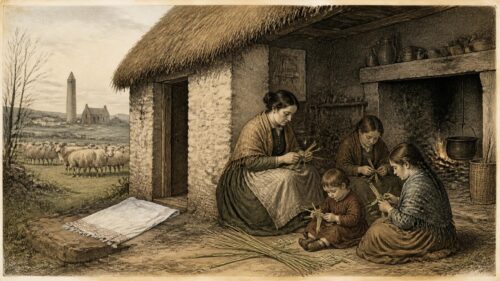
AI generated historical illustration, not a contemporary photograph.
At a Glance
Tír na nÓg, conventionally translated as the Land of Youth, is not a recoverable prehistoric place, nor a single unchanging ‘Celtic myth’. It is a powerful Irish imaginative tradition formed across many centuries: through medieval Irish accounts of the Otherworld, Fenian stories of Oisín, early modern and eighteenth-century poetry, nineteenth-century print, and twentieth-century oral recollection. The familiar tale of Niamh, Oisín and the fatal return to Ireland belongs to that long history, but its best-known narrative shape must be distinguished carefully from the much older body of Irish literary evidence that helped to make it possible.
Names Matter
The Irish phrase Tír na nÓg means ‘Land of the Young’ or, more idiomatically, ‘Land of Youth’. Its grammar is often obscured in English retellings: tír is land or country, while na n-óg means ‘of the young’. The name denotes a condition as much as a territory. Youth there is not merely a stage of life but an exemption from ordinary deterioration: old age, infirmity and death are absent or suspended. This makes the phrase an apt modern shorthand for an Irish Otherworld, although medieval Irish texts more commonly employ other names, among them Mag Mell, the Plain of Delight, Tír Tairngire, the Land of Promise, and the dwellings of the síd, supernatural beings associated in literature with mounds and hidden domains.
That distinction matters historically. It prevents a misleading assumption that every medieval reference to a blissful realm describes one fixed country called Tír na nÓg, or that all Irish people told one canonical story. Medieval authors and later storytellers worked with a vocabulary of related places, beings and narrative situations. A beautiful visitor might cross from the Otherworld into Ireland; a mortal might enter a mound, travel beneath water, or sail westward over the sea. Time might pass differently, but not invariably. The later fame of Tír na nÓg has gathered these motifs together, sometimes so successfully that the complex earlier record is forgotten. John Carey’s study of Irish Otherworld locations remains useful precisely because it cautions against treating their geography as simple or uniform.
The term also has a modern cultural life independent of strict philology. It appears in schoolbooks, tourism, children’s retellings, music, drama and Irish-language publishing. Such use is not fraudulent merely because it is modern; it shows that an inherited story-world continues to be useful. Yet historical writing should ask a different question from the one asked by a storyteller: when, in surviving evidence, does this particular phrase and this particular Oisín narrative occur? The answer reveals both continuity and creative remaking.
Written Worlds
Irish literature preserves one of medieval Europe’s richest bodies of vernacular narrative. The surviving manuscripts were copied by literate professionals, clergy and learned families, but the material they transmit does not offer a transparent window on a pre-Christian religious system. Texts were copied, revised and framed in Christian Ireland. They preserve old names, motifs and social memories, while also showing the priorities of the periods in which scribes and authors worked. The scholarly task is therefore not to declare the Otherworld either wholly pagan or wholly Christian. It is to observe how writers placed traditional supernatural material in changing intellectual settings.
Several early narratives establish patterns later recognisable in Tír na nÓg. In Echtrae Chonnlai, the Adventure of Connla, an Otherworld woman comes to the human world and invites Connla to a country without death, old age, sorrow or conflict. He departs with her across the sea. The text is not the Niamh and Oisín story, and it should not be presented as such. Nevertheless, it supplies a strikingly early literary model: a woman mediates passage between worlds, the destination is blessed and ageless, and the sea is a threshold rather than a barrier. Scholarship on Otherworld women has underlined how frequently female figures perform this mediating role in early Irish literature.
Other texts demonstrate that the Irish Otherworld could be imagined in more than one direction. Some tales locate it in hills or beneath the earth; some in an island reached by voyage; others allow it to overlap with familiar landscapes. Immram Brain, the Voyage of Bran, famously develops the maritime possibility. Its Otherworld island is a place of abundance and delight, but the voyage also creates a problem of contact: a traveller who returns may no longer belong among ordinary people. The digital edition and bibliography supplied by the Corpus of Electronic Texts show the substantial critical tradition concerned with the terminology of echtrae, adventure, and immram, voyage.
It would be tempting to identify these narratives as exact survivals of ancient belief. Evidence does not justify that confidence. The texts are medieval literary works, often elaborately composed and transmitted through manuscript culture. Their writers may preserve inherited conceptions, but they also borrow, adapt and argue. Christian language, biblical learning and European narrative fashions appear alongside indigenous names and imagined landscapes. The most supportable conclusion is that medieval Irish authors possessed a flexible, prestigious repertoire of Otherworld ideas. Later writers of Fenian material could draw upon that repertoire without simply reproducing any one early story.
Fenian Memory
The hero most closely tied to Tír na nÓg is Oisín, son of Fionn mac Cumhaill. Oisín belongs to the Fenian or Ossianic cycle, a broad and changing body of stories and poems centred on Fionn and his warrior-band, the fíanna. This was not a historical army documented in contemporary records. It was a literary and traditional world in which hunting, combat, hospitality, love, landscape and poetic memory could be explored. Its chronology was deliberately elastic. Medieval and later narratives routinely place Fionn’s company before the coming of Christianity, while allowing surviving Fenian figures to meet St Patrick. That meeting gives the tradition one of its most memorable dramatic structures: old Ireland speaking with new Ireland.
Acallam na Senórach, usually translated as The Colloquy of the Ancients, is central to understanding that structure. Composed in the medieval period and preserved in later manuscripts, it imagines Caílte and Oisín, aged survivors of the Fianna, travelling through Ireland with Patrick and his followers. The narrative is immense, geographically wide-ranging and profoundly interested in place-lore. The saints ask questions; the old warriors answer with stories, poems, genealogies and explanations of names. Far from depicting a clean replacement of pagan by Christian culture, the work stages a series of negotiations. Patrick and the Fenian survivors disagree, admire one another and share authority over memory. The CELT edition makes this complex Irish text accessible, though readers should remember that a digital transcription is an edition of a manuscript tradition, not a medieval voice heard without mediation.
Oisín in the Acallam is not simply the young lover later familiar from popular retellings. He is one of the old men who can remember the vanished company. In one episode he remains physically formidable, fetching water and carrying a vessel with living fish, while Patrick and King Diarmait divide its contents. The scene is at once marvellous and social: strength, food, royal gift and ecclesiastical claim are all in play.
Later Lay
The familiar full story of Oisín, Niamh and Tír na nÓg owes an exceptional debt to an early modern or eighteenth-century Irish poem, Laoi Oisín ar Thír na nÓg. It is attributed to the County Clare poet Mícheál Ó Coimín, who died in 1760. The poem is often loosely described as ancient, because it works with ancient-seeming heroes and inherited motifs. That description is misleading. Its surviving literary form is much later than the earliest Irish Otherworld texts, and responsible interpretation must preserve the distinction. It is an important Irish-language work in its own right, not merely a faded transcript of remote antiquity.
The lay connects older narrative materials with the shape now recognised around the world. Oisín is approached by Niamh Cinn Óir, Niamh of the Golden Hair, and carried to the Land of Youth. The land promises abundance, music, beauty and freedom from decay. Oisín’s later return gives the poem its poignant frame, bringing him into conversation with Patrick and making him the interpreter of an earlier heroic order. The poem thereby combines the Otherworld invitation associated with older adventure tales, the Fenian-Petrine dialogue familiar from medieval tradition, and an emotionally persuasive account of historical displacement.
Its textual history illustrates how Irish literature circulated beyond print. Manuscript copies passed between readers and performers before the lay was published in the nineteenth century. In 1859 Brian Ó Luanaigh, usually anglicised as Bryan O’Looney, edited and translated it for the Ossianic Society. The Royal Irish Academy’s Dictionary of Irish Biography notes both his edition of Ó Coimín’s poem and the influence of his translation on W. B. Yeats. Dictionary of Irish Biography, ‘Ó Luanaigh, Brian’ The edition was a landmark, but it was not the beginning of the story; it was one moment in its transmission.
Later editions made the poem accessible to language learners and English readers. A 1896 edition, catalogued in the Royal Irish Academy’s Historical Irish Corpus, identifies the work as Oisín i dTír na nÓg and records its editorial and publishing context. Royal Irish Academy, ‘Oisín i dTír na nÓg’ Such editions necessarily shaped reception. Headings, translations, glossaries, explanatory notes and Victorian ideas of national literature guided readers towards a coherent legend. They did not invent every element, but they helped turn a variable Irish poem into a widely recognisable emblem.
Golden Rider
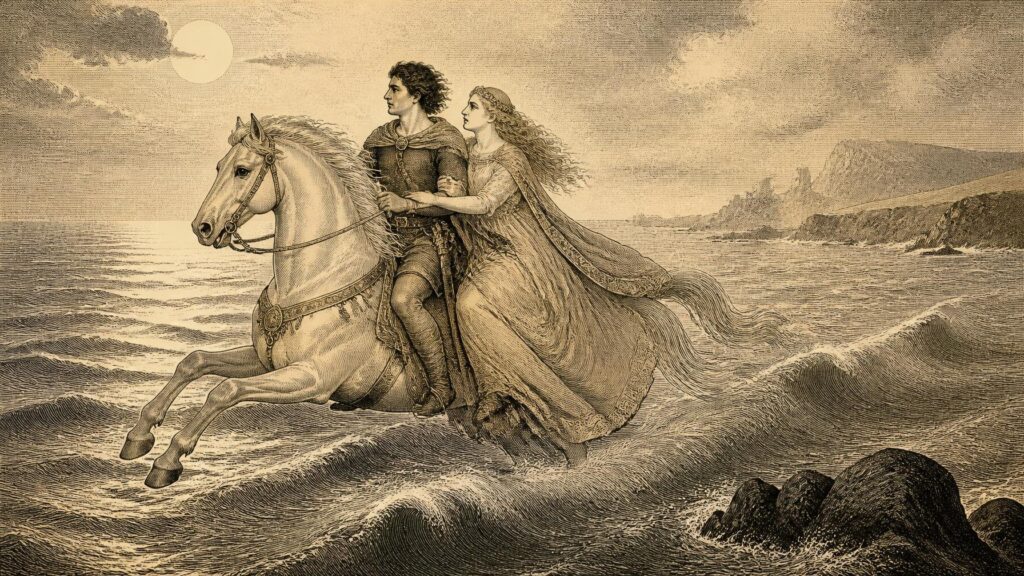
Niamh is among the most enduring figures in the story. She is usually portrayed as beautiful, richly dressed and mounted on a white horse capable of crossing the sea. Modern pictures tend to make her a fairy princess in a generic fantasy realm. The literary tradition is more interesting than that simplification. Her arrival belongs to a deep Irish narrative pattern in which an Otherworld woman initiates a crossing, offers an alternative life and tests the attachments of a male hero. She is active rather than merely decorative: she chooses Oisín, brings him away and sets the condition of his return.
At the same time, Niamh should not be converted into evidence for a neatly defined goddess cult. No surviving source allows such certainty. It is possible to compare her with other supernatural women in early Irish literature, and such comparisons reveal recurrent narrative functions: invitation, seduction, sovereignty, warning, healing or dangerous encounter. But recurring functions are not identities. The historical evidence records literary characters and stories, not a reliable catalogue of pre-Christian deities preserved intact through later centuries.
The golden-hair epithet is especially revealing as poetic language. Gold signals splendour, rarity and Otherworldly distinction. The white horse also serves several purposes at once. It is an aristocratic mount, a miraculous vehicle and a marker of the boundary-crossing action. Sea and horse combine two different kinds of movement: a rider remains physically seated, but the landscape itself becomes impossible. Oisín does not build a ship, navigate or conquer an island. He entrusts himself to Niamh’s power. That dependence gives the story much of its emotional tension.
Interpretation can legitimately go further, provided it is labelled as interpretation. Niamh’s invitation may be read as an image of desire for an unspoiled world, while her warning against touching Irish soil may represent the impossibility of returning unchanged after exile, love or radical experience. These are readings, not documented medieval explanations. Their strength lies in explaining why the narrative remains moving, not in proving authorial intention for every version.
Christian Meetings
St Patrick’s presence is essential to the mature Oisín tradition. In modern summary he is sometimes made the villain who ends the heroic age, or the kindly priest who receives the last pagan. Neither reduction does justice to the evidence. Medieval Fenian narratives often make Patrick a listener, questioner and organiser of memory. He can be stern, but he also validates the telling of old stories. The encounter is creative precisely because it permits both difference and contact between heroic tradition and Christian learning.
In the Acallam, Patrick’s companions write down stories and poems as Caílte and Oisín recount them. This is a literary representation of preservation: the Christian present does not simply silence the old world but records it. The device reflects the culture of manuscript Ireland, where clerics and learned laypeople copied texts containing material that modern categories might label pagan, secular or folkloric. It would be wrong to infer uncomplicated tolerance from this. Christian scribes and authors frequently reshaped inherited material. Yet it would be equally wrong to imagine a simple bonfire of old tales. Their preservation is itself evidence of sustained engagement.
The dialogue also creates anachronism deliberately. Historical Patrick belongs to the fifth century, while Fionn, Oisín and the Fianna inhabit a legendary past whose chronology cannot be converted into secure history. Their meeting is not an event that historians can date. It is an imaginative bridge. By allowing Oisín to survive, the tradition allows a poet to ask how a Christian Ireland might hear and judge its heroic ancestors. The answer varies: admiration, argument, mourning and conversion may coexist.
Later oral versions often sharpen the ending by having Patrick baptise Oisín before he dies. A Schools’ Collection account from Corofin, County Clare, records just such a concise version: a woman takes Oisín to Tír na nÓg, he returns to find the Fianna dead, and Patrick baptises him. National Folklore Collection, ‘A Story of Oisín’ This is valuable evidence of transmission in the 1930s, but it is not a verbatim survival from medieval times. It shows folklore in use: compressed, adapted and given a morally complete ending.
Oral Currents
The story cannot be understood through manuscripts and printed books alone. Irish oral tradition continued to carry Fenian lore, local legends and story fragments into the twentieth century. The National Folklore Collection’s Schools’ Collection and Main Manuscript Collection preserve records made by collectors, schoolchildren, teachers and informants. Their holdings are extraordinarily important, not because every account is ancient, but because they document what people remembered and narrated at particular places and dates.
One manuscript item catalogued by Dúchas records Oisín i dTír na nÓg in Irish from the Kenmare and Kilgarvan area of County Kerry, dated 16 October 1936. National Folklore Collection, ‘Oisín i dTír na nÓg’ The catalogue record establishes provenance: it identifies a collection setting, a date, language and archival reference. It does not by itself establish the age of every narrative feature, nor does it prove that an informant’s wording had been transmitted unchanged. Archives are strongest when read for what they demonstrably record: an encounter between collector, informant, memory and writing.
Variation is not a defect in folklore. It is evidence that a tradition was alive. Names change, episodes expand or vanish, the duration in Tír na nÓg is altered, and Patrick’s role can become more or less prominent. Local storytellers may attach the action to nearby hills, islands, wells or graves. Such adaptation allowed a broad narrative to become meaningful within particular communities. It also means that no single retelling should be declared the only authentic one merely because it is famous in English.
Oral tradition and literary tradition were not sealed compartments. Printed editions could enter oral circulation; oral performances could influence manuscript copies; schoolbooks could standardise motifs; Irish-language speakers could move between local storytelling and national cultural revival. The path is best understood as reciprocal. A later poem may preserve older motifs, while a twentieth-century narrator may remember a nineteenth-century printed form. Historical method asks what can be traced, while accepting that not every link can be recovered.
Revival Pages
Nineteenth-century Ireland gave the story a new public career. Antiquarians, language activists and literary societies collected, edited and translated Irish texts at a time when the Irish language was under severe pressure but also becoming central to cultural nationalism. The Ossianic Society’s publication of Ó Coimín’s lay helped place Oisín before English-reading audiences. The title’s resonance was amplified by wider European interest in Ossianic poetry, stimulated in part by James Macpherson’s influential but deeply contested Scottish ‘Ossian’ publications.
Irish writers did not merely receive that wider fashion passively. They used Oisín to explore language, authenticity, colonisation, memory and artistic inheritance. Yeats’s The Wanderings of Oisin, published in 1889, is not a translation of the Irish lay. It is an original English poem that reworks Oisín material through late nineteenth-century symbolism and aesthetic ambition. Scholarship has identified Bryan O’Looney’s translation of Ó Coimín’s poem as a principal source for Yeats. Irish Studies Review, ‘Celticism, Ballad Transmission, and the Schizoid Voice’ The relationship shows how translation can become new literature rather than transparent transfer.
This revival period also encouraged the mistaken belief that all national legends were ancient in their surviving form. The desire for antiquity was understandable in a colonised society seeking cultural authority, but it can obscure the artistry of later Irish-language poets such as Ó Coimín. To call his lay ‘only modern’ would be dismissive; to call it a direct prehistoric relic would be inaccurate. Its historical importance lies in its position between old narrative resources and new circulation, between manuscript culture and print, and between Irish-speaking communities and an expanding English-language readership.
The modern canonical story is therefore a layered creation. Medieval Otherworld literature supplied motifs and imaginative habits. Fenian texts supplied Oisín, Fionn and Patrick. Ó Coimín’s lay gave the story an influential coherent form. Nineteenth-century editors and translators widened access. Twentieth-century schools and collectors recorded local versions. Contemporary retellings continue the process. The result is not less Irish because it changed; change is the documented condition of its survival.
Landscape Claims
Many places in Ireland are associated with the Fianna, Oisín or Niamh. Headlands, caves, islands, megaliths, wells and hills attract stories because landscape invites explanation and because legendary figures lend emotional depth to visible features. Such associations can be historically significant as local folklore, but they do not automatically prove that a monument was built for, used by or named in the lifetime of a legendary hero. Archaeological dates and literary stories answer different questions.
Care is particularly necessary with prehistoric monuments. A portal tomb or cairn may be thousands of years older than the earliest surviving Irish texts that link it to Fionn’s world. A nineteenth-century poem, guidebook or local tradition may have influenced what visitors later take to be immemorial lore. Folklore can indeed preserve long attachments to place, but it cannot be used without corroboration as a straightforward record of prehistoric events. The appropriate approach is to record both layers: the archaeological monument and the later story told about it.
The same principle applies to the sea. Tír na nÓg is often pictured as lying west of Ireland, beyond the Atlantic horizon. This is a persuasive image and has real roots in Irish voyage literature, but not every text locates the Otherworld in the same place. Some sources make it insular, subterranean or adjacent to human settlements. Its power comes partly from this mobility. The Otherworld may be distant enough to be unreachable, yet close enough to intrude upon ordinary life.
Historical prose should therefore resist turning Ireland’s map into a chart of literal fairy kingdoms. It is more revealing to ask why particular communities associated a place with the Fianna. The answer may involve local pride, tourism, literary influence, storytelling practice, religious change or the striking form of the landscape itself. Legends are part of a place’s cultural history even when they are not evidence for its prehistoric use.
Enduring Meanings
Tír na nÓg endures because it makes several losses imaginable at once. It is the loss of youth, the loss of companions, the loss of a language or social order, and the loss involved in leaving home. Oisín’s tragedy is not that he chose pleasure over duty. The tradition generally gives his choice dignity: he loves Niamh and accepts her world. His suffering begins when he attempts an impossible reconciliation between two times. He cannot return to the Fianna, and he cannot remain wholly in Tír na nÓg once he has re-entered Ireland.
The story’s relation to Irish history has consequently been interpreted in many ways. It can seem to dramatise the disappearance of a pre-Christian heroic past before Christianity; the decline of Gaelic aristocratic culture; the experience of emigration; or the ache of cultural revival. These are interpretations arising from particular readers and periods. None should be imposed as the single original meaning. The oldest recoverable witnesses do not deliver one final explanation. They document repeated acts of retelling by people with different religious, linguistic and political horizons.
Its very flexibility has made the tale vulnerable to simplification. Generic ‘Celtic’ imagery can detach Tír na nÓg from the Irish language, Irish manuscripts and named Irish collectors who sustained it. Conversely, an excessively narrow search for origins can drain the story of its later life. A sound historical account holds both truths together. Tír na nÓg is specifically rooted in Irish literary and folkloric traditions, and its famous form is the product of many periods rather than a frozen survival from any one of them.
The strongest evidence is documentary: medieval texts about the Otherworld and the Fianna; manuscript catalogues; printed Irish editions; archival folklore records; and scholarship that studies their relationships. Folklore supplies meaningful testimony about transmission, not a dated chronicle. Interpretation helps explain emotional and cultural power, but should remain visible as interpretation. Approached in that way, Tír na nÓg is not diminished by uncertainty. It becomes more remarkable: a land of youth continually renewed by the historical work of telling, copying, translating, remembering and listening.
Digital Afterlives
“Timeless” is a useful description of the emotional force of Tír na nÓg, but not of the means by which its materials have survived. What readers now encounter as an apparently seamless legend is available through a chain of specific acts: manuscript copying, editorial selection, translation, collecting, cataloguing and digitisation. That chain is not an obstacle to the story’s value. It is part of its history. The online edition of Acallam na Senórach, for example, identifies an anonymous work, an electronic editor and several manuscript witnesses. Its detailed documentation makes visible the distance between a medieval composition, later handwritten copies and a modern searchable text.
Digital access can make old material seem immediate. A reader may move in seconds from an episode in Acallam na Senórach to the manuscript information that underlies its edition, or from the text of Immram Brain to a description of witnesses ranging from medieval to early modern manuscripts. Yet this convenience should encourage attentiveness rather than an illusion of direct contact with a remote past. A web edition is a scholarly presentation of an inherited textual record. It permits comparison, quotation and discovery, while its editorial framing reminds readers that spelling, division, bibliography and source description are all interpretative aids.
The modern record also preserves the work of Irish-language editors whose names can disappear behind the legend itself. The Dictionary of Irish Biography entry for Brian Ó Luanaigh records that his edition of Mícheál Ó Coimín’s Laoi Oisín i dTír na nÓg appeared in the Transactions of the Ossianic Society in 1859, and notes the reported influence of his translation on W. B. Yeats. This is a reminder that transmission depended on skilled readers of Irish manuscripts as well as on anonymous storytellers. The route into English literary culture was not accidental; it was made by editorial and translational labour.
Print likewise gave the lay new audiences and new practical uses. The Royal Irish Academy’s Historical Irish Corpus record for Oisín i dTír na n-Og dates the item it catalogues to 1896, names Eoin Mac Néill as compiler or editor, and preserves a notice recommending an edition with English translation, notes and vocabulary to students of Irish. Such evidence shows that Oisín’s story was not only an object of antiquarian admiration. It could also serve language learning, placing literary Irish before readers who needed help with words, grammar and context.
Folklore archives add another kind of afterlife: not a single authoritative text, but a record of collection. The National Folklore Collection’s catalogue entry for “Oisín i dTír na nÓg” places the item in a 1936 volume collected by Breandán Ó Séaghdha in the Kenmare and Kilgarvan area of County Kerry. The catalogue lists it among material that also includes Fianna lore and fairy stories. That setting matters. It locates an Oisín narrative within a gathered body of regional lore rather than isolating it as a museum-piece version of one national myth.
The Schools’ Collection provides a related but different archive of narration. Its An Chluain record identifies a school in County Cork, its teacher, and an entry entitled “St Patrick and Oisin.” The surviving catalogue structure is modest evidence, but valuable evidence: it records that this meeting of saint and Fenian hero was entered into a school-based collection alongside many other local stories and customs. It should not be made to prove an unchanged medieval survival. Rather, it documents a later occasion on which inherited narrative was selected, written down and preserved.
These archives do not make Tír na nÓg less enchanted. They make its endurance more intelligible. The story has remained available because successive communities found forms in which to hold it: vellum and paper, learned edition and classroom text, collector’s notebook and digital catalogue. Its “timelessness” is therefore not freedom from time. It is the remarkable capacity of Irish storytellers, scribes, editors and readers to carry a world of youth, loss and return across changing historical moments.