Irish Sustenance
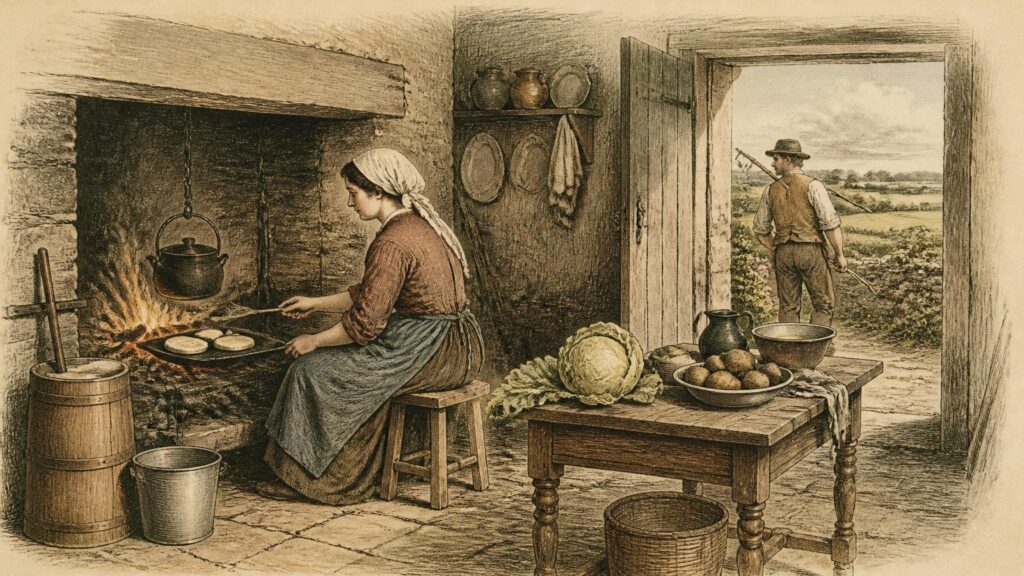
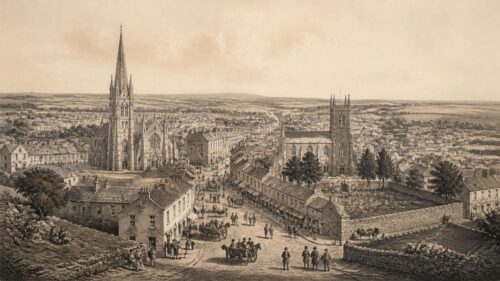
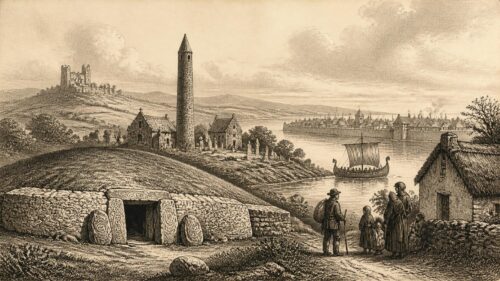
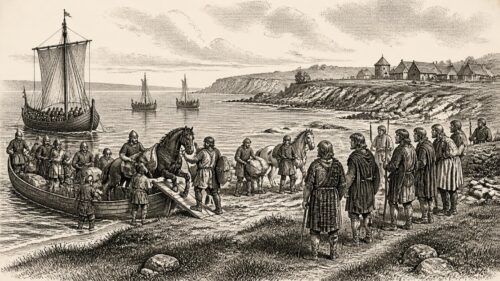
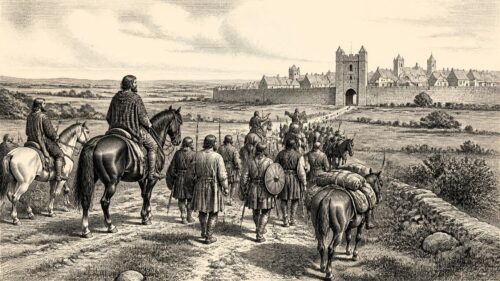
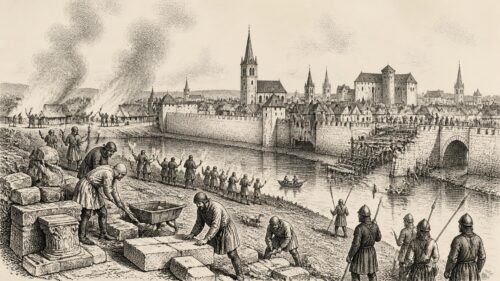
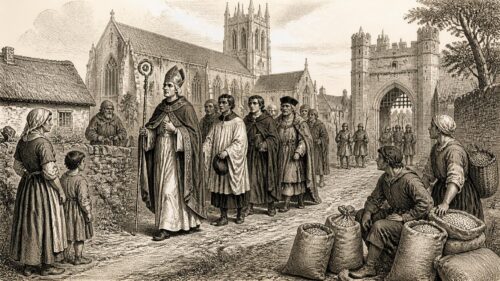
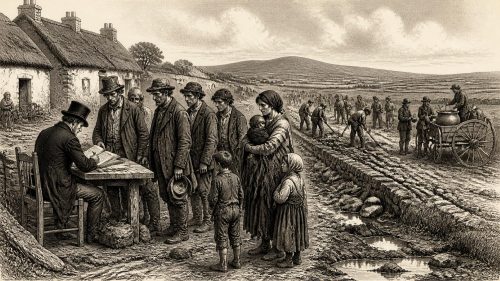
AI generated historical illustration, not a contemporary photograph.
At a Glance
Food in Ireland has never been merely a catalogue of dishes. It has been a means of survival, an expression of rank and hospitality, a commodity shaped by landholding and export, and a field in which women’s domestic labour was especially consequential. The potato is indispensable to this history, and the Great Famine made it inseparable from Ireland’s historical imagination. Yet an Irish history of food is much broader: it begins with grain, cattle, milk and shore-gathering; includes butter preserved in bogs, fish supplied through religious and commercial networks, ale and bread at feasts, and the work of gardens, hearths and markets; and continues through emigration, rationing, electrification and global trade. The evidence is uneven. Archaeology shows materials and practices, written sources often record elite expectations or official anxieties, and folklore preserves remembered custom rather than a simple record of ancient fact.
Material Beginnings
The earliest food history of Ireland cannot be written as a menu. It must be reconstructed from animal bone, charred seeds, pottery residues, quern-stones, field systems, hearths and the locations in which people made and discarded things. Such evidence establishes that farming, stock-keeping and food processing have very deep roots on the island, but it does not permit a precise, unbroken account of what every household ate. Nor should later ideas of a distinctively “Irish” cuisine be projected backwards. Prehistoric communities changed over long periods, responded to local soils and waters, and participated in wider movements of people, crops, animals and technologies.
Archaeological evidence nevertheless makes clear that cereals and cattle mattered profoundly. Grain required labour beyond cultivation: harvesting, drying, storing, grinding and cooking. Quern-stones, used to reduce grain to meal, point to repeated domestic work as well as to staple foods such as porridges and breads. Livestock supplied meat, hides, traction and manure, but cattle also supported a dairy economy whose importance became unusually prominent in later Irish legal and literary traditions. The practical significance of milk is therefore not a romantic inference from green pasture; it is supported by the material and documentary record, even if quantities and seasonal patterns remain difficult to recover.
Burnt mound sites commonly called fulachtaí fia are among the most familiar archaeological features associated with prehistoric cooking in Ireland. They generally consist of spreads of fire-cracked stone beside troughs or pits. A long-standing interpretation holds that heated stones were dropped into water to heat it, perhaps for cooking. That interpretation is plausible, and experimental work has shown that stone-heating can boil water, but archaeologists have also proposed bathing, textile-working, brewing and other activities. It is sounder to describe these places as evidence of repeated heating and water-use than to claim that every example was a prehistoric kitchen. The National Museum of Ireland places such domestic sites within the varied archaeological landscape of Bronze Age Ireland, while also cautioning, by implication, against treating one site type as proof of one universal practice.
Coasts, rivers and lakes enlarged the food possibilities available to communities, though access was never identical across the island. Fish, shellfish, wildfowl, game, berries, nuts and edible plants could supplement cultivated food. Their role varied with ecology, season, settlement and social choice. Later accounts of Irish diet sometimes list nettles, cress, seaweeds and wild fruits as if their use were timeless and universal. Such lists are useful reminders that cultivated fields were not the only larders, but they should not be mistaken for a statistical dietary survey. What archaeology offers is a framework: food was produced, gathered, stored, transformed and shared through skills tied to landscape.
That framework also complicates the modern assumption that meat represented prosperity while plant food denoted want. Meat could be valued and restricted; cattle might be more useful alive for milk, calves and labour than dead for a single meal. Grain was not a minor accompaniment but a fundamental source of calories. Dairy products could be nutritionally significant and economically exchangeable. Food history begins, then, with mixed resources and seasonal constraints rather than with any single emblematic crop.
Dairy Worlds
Milk, butter, curds and cheese occupy a striking place in the evidence for early and medieval Ireland. The centrality of cattle to status, tribute and wealth in early Irish law and literature has often encouraged an image of a society living almost entirely on dairy produce. That is too simple, yet the sources do show that dairy foods were culturally and economically important. A historical survey produced through University College Dublin notes that milk and its products were central to the ancient and medieval diet, alongside cereals and other foods.
Butter was especially useful because it converted a perishable liquid into a storable, portable substance. It could be eaten, traded, rendered into cooking fat and offered as payment. The best-known physical testimony is bog butter: deposits of butter, usually enclosed in wooden containers or other wrappings, recovered from peatlands. Some deposits may have been placed for storage, where peat’s cool and low-oxygen conditions helped preserve them. Others may have had ritual significance. The material itself does not always reveal motive. The National Museum of Ireland explicitly identifies bog butter among votive deposits displayed in the context of kingship and sacrifice, but that context should not be expanded into an assertion that all bog butter was an offering.
The distinction matters because food is often both practical and symbolic. A cache of butter could protect wealth from theft, preserve it until a season of need, fulfil an obligation, or participate in a ceremonial act; more than one explanation could apply in different cases. The temptation to choose the most picturesque explanation is understandable, especially where bog finds have become symbols of a supposedly mysterious Celtic past. Historical method requires a more modest conclusion: bog butter proves that butter was valuable enough to be deliberately deposited and that peatlands became part of its social as well as physical history.
Dairy foods also shaped household rhythms. Milking, skimming, churning, washing vessels, salting butter and making curds demanded regular, skilled work. In later rural households, surplus butter and eggs were frequently sold, bringing small but important income under conditions where cash could be scarce. The National Museum’s Folklife collections describe households that sought relative self-provisioning through crops, livestock, foraging and preservation, while noting the sale of butter and eggs.
This was not a self-sufficient idyll. Selling the best produce could leave producers with plainer food, and dairy work was entangled with tenancy, market prices and gendered expectations. The familiar image of Irish butter as naturally abundant conceals unequal access to cows, grazing, equipment and time. It also conceals the fact that a dairy economy could coexist with hunger. Food historians must therefore distinguish a region’s productive capacity from an individual family’s right to consume what it produced.
Medieval Tables
Medieval evidence broadens the picture further. Ireland’s religious houses, lordly households, towns, ports and dispersed rural settlements generated differing foodways. Grain, dairy produce, pork, beef, fish, vegetables, honey and drink all appear in sources, but not in equal proportions for all people. Feasting records and legal texts are particularly revealing about hierarchy because they specify who should receive particular portions, hospitality or tribute. They are also limited: prescriptions for kings, clerics or guests do not automatically describe ordinary daily meals.
Cereals remained essential. Oats and barley were important, with wheat more strongly associated with better land, urban markets and higher-status bread. Meal could be made into porridge, gruel, cakes or loaves. The grit found in archaeological teeth is consistent with the abrasive effects of stone-ground grain, though dental evidence cannot identify a complete diet. A rough, cereal-heavy diet is a material fact; it should not, however, be read as evidence that medieval people were ignorant of refinement. Food was differentiated by processing, seasoning, brewing, serving vessels and access to imported goods as well as by ingredients.
Fish had religious, economic and geographical importance. Christian fasting practices encouraged fish consumption on designated days, while coastal and inland waters provided varied supplies. Fish was also salted, dried and traded. Recent scholarship on Ireland’s sea fisheries stresses that provisioning in the fifteenth and sixteenth centuries involved not only production but culture, taste, ritual and commercial choice. It also warns against allowing the later potato story to eclipse other food histories.
Drink supplied another route into social relations. Ale and mead were consumed in many settings; wine, though imported and costly, circulated among elites and ecclesiastical institutions. The mether, a multi-handled communal drinking vessel, survives as material evidence for the ceremonial presentation of drink. The National Museum notes that medieval feasting involved wine, ale, mead, broth and milk, and describes a four-handled mether being passed around a banqueting hall under a chieftain’s direction.
Such a vessel makes hospitality visible, but it should not be treated as a democratic symbol. Banquets ordered people as well as feeding them. Rank determined portions, seating, service and obligation. Hospitality could be generous, compulsory, political and burdensome at once. This is one reason why food belongs in the history of power: who was fed, what was offered, and who bore the cost were all social questions.
Medieval Ireland was also connected to wider worlds. Norse towns, Anglo-Norman settlements, monastic networks and maritime trade affected provisions and tastes. The arrival of new populations and institutions did not replace existing foodways overnight. Rather, cuisines changed through overlapping practices: local dairy and grain traditions, market exchange, imported spices or wine, new gardening methods, and shifting rules of estate and town. The historical record is strongest for institutions and those with purchasing power; it is weaker for the ordinary meal eaten in a small rural dwelling. That imbalance should be admitted rather than filled with invented detail.
Colonial Markets
From the seventeenth century onward, the food history of Ireland became increasingly inseparable from conquest, land redistribution, commercial agriculture and imperial markets. This did not mean that every household ceased growing food for itself. It meant that access to land, the organisation of labour and the destinations of agricultural produce were increasingly shaped by political economy. Ireland could export livestock, grain and provisions while many labouring families remained vulnerable to scarcity. The apparent contradiction is central to the later history of famine and should not be reduced to the misleading statement that “Ireland had no food”.
The potato entered this changing world as an American crop adapted to Irish conditions and household economies. Its exact early chronology and routes of adoption remain subjects for research, and popular stories that attribute its introduction to a single famous individual are not reliable history. What is clear is that potatoes were known in Ireland by the seventeenth century and became increasingly important to poorer households over the eighteenth century. Rebecca Earle’s study of the crop’s movement through Europe notes evidence of potatoes forming much of poor people’s food in Ireland in the 1650s, while emphasising that adoption was uneven rather than a simple national conversion.
The crop’s attraction was practical. Potatoes could yield substantial food from small plots, could be grown alongside other activities, and could support families with limited cash. Combined with buttermilk, and sometimes with fish or other additions, they could provide an energetically and nutritionally substantial diet. But a diet can be adequate in calories and still be monotonous, socially precarious and dependent on access to a particular plot. The potato did not cause poverty; rather, it fitted an agrarian system in which many people had insecure holdings, low wages and restricted alternatives.
Contemporary observers often misunderstood this relationship. Some political economists and travellers treated potato dependence as proof of laziness, improvidence or racial deficiency. Such judgements converted a structural problem into a moral accusation against the poor. Ian Miller’s account of nutritional debates shows how nineteenth-century commentators connected Irish potato consumption to wider claims about social development, population and bodily discipline.
These arguments deserve attention not because they were correct, but because they influenced policy and public sympathy. To describe labourers as naturally content with potatoes could make deprivation seem chosen. To present the crop as the source of population growth could encourage officials to regard hardship as an inevitable correction. Food science itself was still developing, and contemporary nutritional claims were often entangled with class prejudice, colonial assumptions and political economy.
The eighteenth-century diet was also regionally and socially diverse. People ate oats, bread, milk, butter, vegetables, pork, fish and, where possible, meat. Towns created markets for flour, drink, meat and imported groceries; estates could encourage particular crops; fishing districts had different possibilities from inland tillage areas. Yet the growing centrality of the potato among the rural poor was real enough that its failure would expose the danger of dependence on one staple under conditions of unequal landholding.
Potato Ascendant
By the decades before 1845, the potato had become central to the subsistence of a substantial share of the population, especially agricultural labourers and cottiers. “Central” does not mean exclusive in every home, county or season. Households varied in their access to milk, fish, oats, vegetables and occasional meat. Nor did all potatoes belong to a single botanical variety. The danger lay in the overlap of biological vulnerability with poverty, subdivision of holdings, insecure employment and the limited capacity to purchase alternatives when the crop failed.
Historical estimates convey the scale without making the diet seem uniform. A study of famine-era nutritional controversy reports that an estimated 40 per cent of Ireland’s population in 1845 subsisted principally on potatoes, commonly accompanied by buttermilk, water, fish or whiskey. It also records repeated earlier potato shortages and failures, underscoring that the blight crisis did not arrive in a society unfamiliar with food insecurity.
The often-repeated image of an Irish labourer consuming enormous quantities of potatoes has a basis in official enquiries, but it requires context. Potatoes were bulky, water-rich and ordinarily eaten as the main source of energy after heavy physical work. Estimates vary by source and circumstances. It is therefore better to say that consumption could be extremely high among particular labouring populations than to repeat a single number as the experience of all Irish people. Nutritional adequacy, furthermore, depended on the additions to the potato diet and on the age, work, health and living conditions of those eating it.
Buttermilk had a special place in this system. It was a by-product of butter-making and could provide protein and other nutrients; potatoes supplied energy and vitamin C when fresh. The combination could sustain hard labour better than hostile observers admitted. Yet this should not be romanticised as a complete or secure dietary ideal. It left little margin for crop failure, loss of a cow, eviction, illness, seasonal unemployment or price shocks. A family whose food security rested on a small patch and access to dairy was not insulated from crisis merely because its ordinary meal had nutritional strengths.
The potato also acquired symbolic force before the Famine. Reformers praised it as productive; critics condemned it as an obstacle to “improvement”; landlords and officials debated its effects on labour and population. The food became a political shorthand, and that shorthand persists. Modern accounts should resist two opposite myths: that the potato was an inherently inferior food responsible for Irish misery, and that it was an uncomplicated gift whose only problem was disease. The historical reality was a crop valuable to poor families within a profoundly unequal rural economy.
Famine Rupture
The failure of the potato crop in the mid-1840s was a catastrophic turning point, but calling it simply a “potato famine” can obscure its human causes and consequences. Phytophthora infestans, the blight organism, devastated the crop in 1845 and again in subsequent years. The impact was magnified because many poor households depended heavily on potatoes and lacked reserves, land security, cash and political power. Government policy, landlord behaviour, the Poor Law, relief systems, public works, food prices, disease and emigration all shaped who suffered and how.
The official Irish National Famine Commemoration site describes the crop failure of the 1840s as a transforming event and notes the range of names through which people have tried to understand it, including the Great Hunger and An Gorta Mór. That variety of language is historically important. It signals that the event was not experienced only as an agricultural failure but as bereavement, dispossession, migration, state failure and cultural rupture.
Food continued to be produced in Ireland during the Famine, and some food continued to leave the country. That fact is documented and morally significant, but it needs precise interpretation. Exports do not prove that a single stockpile could simply have been redistributed without difficulty; markets, ownership, transport, contracts and purchasing power mattered. Equally, these complications do not absolve the systems that left people unable to command food. Famine historians therefore distinguish between aggregate production and entitlement: hunger occurs when people lose the means to obtain nourishment, even where food exists in a wider economy.
Relief took several forms, including public works, soup kitchens, charitable provision and workhouse assistance. These were frequently inadequate, delayed, conditional or overwhelmed. Workhouses were designed within a Poor Law system that deliberately made institutional support unattractive, and their diets expose both the bureaucratic calculation and the monotony of relief. Records from Dunshaughlin Poor Law Union describe rations of oatmeal, buttermilk, potatoes and bread, with a proposed Christmas meat dinner as an exceptional variation.
Mortality arose not only from starvation but from epidemic disease, weakened resistance, exposure and the movement of desperate people through overcrowded institutions and roads. Emigration was both an escape and another ordeal, with unequal access to passage and varying outcomes. The demographic losses reshaped family life, settlement, language communities and the age structure of the population. The Famine’s place in Irish food history is therefore not limited to the disappearance of a meal; it is the history of a social order in which millions had been placed at exceptional risk.
Later memory sometimes compresses this complexity into a simple narrative of potatoes, ships and abandonment. Such memory can communicate a real inherited trauma, but historical explanation needs more than one cause. The blight was necessary to the crisis; it was not sufficient to explain its scale. The same caution applies to death totals, which are necessarily reconstructed from incomplete records and estimates. It is secure to say that the Famine killed about a million people and drove mass emigration; false precision should be avoided where sources cannot sustain it.
Domestic Skills
After the Famine, households adapted within altered demographic, economic and cultural conditions. The potato remained important, but its former dominance diminished gradually and unevenly. Bread, tea, sugar, shop-bought goods and imported foods took larger roles; wage labour, migration and market access reshaped what could be cooked and when. There was no abrupt national conversion from “traditional” food to modern food. Rather, families combined inherited practices with new purchases, tools and expectations.
The hearth remained central in many rural dwellings. Cooking involved managing fuel, suspended pots, griddles, pans and baking equipment, often while tending children, animals and other work. The National Museum records the use of kettles, three-legged pots, griddles, bread irons and roasting spits, and notes the later spread of the pot oven, which made both roasting and baking more flexible.
These objects illuminate technique, not a fixed national repertoire. Oatcakes, soda breads, potato breads, boxty, colcannon, broths and stews have strong regional and family associations, but recipes altered with local flour, available fats, the size of a griddle and the circumstances of a household. “Traditional” can therefore mean several things: long established, locally remembered, commercially promoted, or retrospectively selected as representative. A dish need not be ancient to be historically meaningful.
Women’s work is indispensable to this account. They frequently managed milking-related tasks, butter-making, egg sales, vegetable plots, food preservation, cooking and the stretching of scarce provisions. Yet it would be inaccurate to present the rural kitchen as an isolated female domain: men and children also contributed through cultivation, fishing, fuel gathering, marketing and livestock work, while hired labour and neighbourhood exchange could be essential. What can be said confidently is that food preparation made visible neither all the labour that preceded it nor the unequal burden of keeping a household fed.
Folklore helps recover the texture of these practices, particularly where formal records are silent. The National Folklore Collection contains material on food gathered through fieldwork and the Schools’ Collection, including beliefs and customs around milk and butter. Such material is invaluable for studying memory, ritual and local language, but it is not a direct transcript of remote antiquity. Folklore records what collectors and contributors remembered, valued or chose to narrate at a particular time.
Folkloric stories about butter being stolen through supernatural means, for example, should be treated as beliefs and social commentary rather than as evidence of literal events. They can reveal anxieties about luck, neighbours, milk yield and the vulnerability of household production. Their historical value lies not in proving magic, but in showing how people gave meaning to uncertain material outcomes.
Urban Appetites
Food history is too often written from the countryside alone. Dublin, Belfast, Cork, Limerick, Derry and smaller towns were places of markets, bakeries, butcheries, public houses, street selling, domestic service, factories and imported groceries. Urban diets could include bread and tea in greater quantity, as well as meat, fish, dairy and cheap prepared foods, but poverty remained severe and food quality was uneven. The city did not erase scarcity; it changed its setting and its dependence on cash.
Industrial labour and commercial distribution altered daily rhythms. A family without land had to buy more of what it ate and was exposed to wage interruptions and price rises. Conversely, towns could provide access to goods unavailable in isolated places. Railways and improved transport widened circulation, but they did not distribute purchasing power equally. Food adulteration, sanitation and inspection became public concerns as the distance between producer and consumer grew.
The early twentieth century shows the persistence of both resourcefulness and inequality. A UCD historical supplement on Ireland in 1916 describes cooking over turf or coal fires, the importance of oatmeal, buttermilk and potatoes in rural areas, and the extensive use of offal and cheaper cuts of meat in many homes. Its account is a useful corrective to restaurant-style histories that privilege celebratory dishes over ordinary economy.
Tea deserves particular attention. Once an imported luxury, it became an everyday purchase in many households. Its spread was not simply a matter of taste: tea fitted new patterns of retailing, fuel use, work breaks and household aspiration. It could offer warmth and sociability, but reliance on sweet tea and bread could also signal a restricted diet when more substantial food was unaffordable. Contemporary criticism of tea consumption often carried class judgement, and historians should avoid repeating it as a neutral diagnosis.
In Northern Ireland, industrialisation and the political partition of the island created further differences in administration, trade and welfare, while family food practices continued to cross formal borders through kinship, migration and shared markets. A single Irish food history must therefore acknowledge both connectedness and divergence. The island’s cuisines were never uniform, and the twentieth century did not make them so.
Modern Transformations
The decades after the Second World War brought major shifts in domestic technology, public health, farming, retail and international trade. Rural electrification changed food storage, lighting and kitchen work in the Republic; refrigerators, cookers and later freezers altered shopping and preservation. In Northern Ireland, British welfare, rationing and consumer systems shaped post-war conditions differently. These changes were gradual, socially uneven and dependent on income, housing and infrastructure.
Dietary surveys show a long movement away from the overwhelming pre-Famine centrality of potatoes, though not a disappearance of the crop from daily life. Juliana Adelman notes that average Irish adult potato consumption in 2010 was far below both late-1940s levels and estimates for the pre-Famine labourer, while bread, sugar and meat formed larger proportions of diet than in earlier periods. Her wider point is more valuable than any isolated figure: foodways changed through cultural practice and technology as well as through nutrients and prices.
Post-war prosperity did not arrive evenly, and nutritional change had mixed effects. Greater access to meat, dairy fats, processed foods and sugar could signify security and choice after generations marked by scarcity, while also contributing to new public-health concerns. Historical interpretation should not treat earlier poverty as healthier merely because some staples were minimally processed, nor assume that abundance automatically produced well-being. Diet reflects income, work, advertising, education, gender, time and the availability of cooking facilities.
Migration also mattered. Irish emigrants carried food memories and adapted to ingredients abroad; return migrants and newer communities brought additional tastes and techniques into Ireland. By the later twentieth century, pasta, rice, curries, pizzas and foods from many global traditions had become ordinary parts of many households’ repertoires. UCD’s account of contemporary diet describes this as a broadening shaped by travel, migration, imports and retail.
This development does not mean that Irish food became less Irish, as though authenticity required isolation. Food traditions have always involved movement: New World potatoes, imported tea and sugar, medieval wine, Atlantic fish, British and continental flour trades, and local adaptations of new ingredients. The more useful question is how particular foods became meaningful in specific places and communities.
Cultural Memory
Public memory often turns Irish food into a small set of recognisable signs: potatoes, soda bread, bacon and cabbage, stew, stout, butter and the “full Irish” breakfast. These foods may be genuinely important, but none can contain the whole history. Some are associated with particular regions or periods; others were standardised through tourism, publishing, migration and commercial branding. A historical account should neither dismiss them as inventions nor accept them as timeless national essences.
Seasonal food customs demonstrate the mixture of continuity and adaptation. Christmas dinners, Easter lamb, Halloween barmbrack, colcannon and apples have been recorded as significant calendar foods, while family practice has varied by class, locality and religious tradition. Ask About Ireland’s overview of Irish foodways usefully places these seasonal meals beside the influence of migration and international cuisines.
There is also a tendency to make hardship picturesque. The cottage hearth, the griddle cake and the churn can become images of wholesome simplicity, detached from evictions, low wages, poor housing and exhausting labour. Equally, narratives of famine can reduce Irish people to passive victims. Neither approach does justice to historical actors, who cultivated, traded, preserved, improvised, fed neighbours, migrated, protested and endured within constraints they did not choose.
The best evidence supports a more capacious understanding. Ireland’s food history is a history of ecological knowledge and household skill, but also of uneven ownership and state policy. It contains hospitality and deprivation, abundant exports and hungry households, local continuity and international exchange. The potato remains central not because it is the only Irish food, but because its rise and catastrophic failure illuminate the links between diet, land and power with unusual force.
Folklore, archaeology and documentary history each contribute differently to that understanding. Archaeology can establish the physical traces of production and consumption; archives can record laws, rations, markets and administrative decisions; folklore can preserve meanings and remembered practice. None alone supplies a complete national meal. Together, and with uncertainty made explicit, they show why food belongs at the centre of Irish history rather than at its decorative edge.