Open Doors
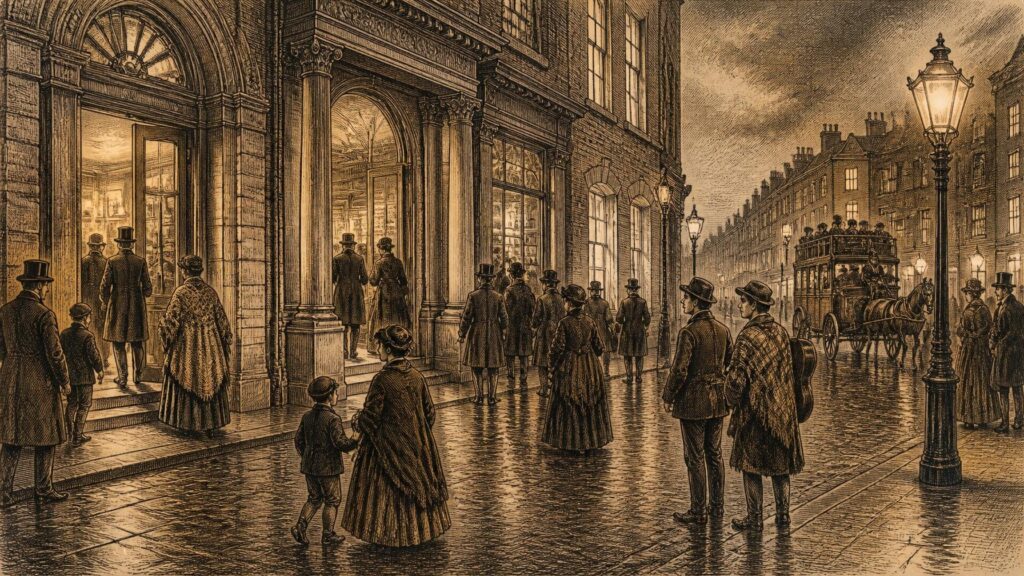
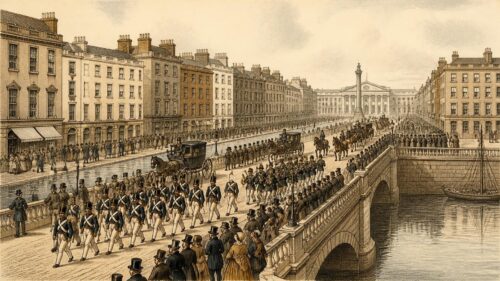
AI generated historical illustration, not a contemporary photograph.
At a Glance
Culture Night, or Oíche Chultúir, is a recent institution rather than an ancient custom, yet its history already reveals much about Irish public life. Begun in Dublin in 2006 as a single evening of free, late opening by forty cultural venues, it became a recurring national occasion in which museums, theatres, libraries, archives, heritage sites, streets, studios and community spaces invite people to enter, look, listen and take part. Its success was not inevitable. It depended upon civic partnerships, public subsidy, voluntary labour, a changing urban night-time economy and a persistent belief that culture should be encountered as a common good rather than as a preserve for specialists.
Modern Origins
Culture Night belongs to the history of twenty-first-century Ireland, but it was shaped by longer arguments about who culture is for and where it should be experienced. Irish cultural institutions had long offered public exhibitions, concerts, lectures and festivals. What was novel in the 2006 initiative was the concentration of activity into one evening, the deliberate suspension of ordinary admission barriers, and the invitation to move between very different forms of cultural work. A visitor might enter a national museum, a small gallery, an artist’s studio, a church, a public square or a theatre in a single walk through the city.
The founding setting was Dublin’s Temple Bar. By the early 2000s, Temple Bar was already identified with cultural regeneration, tourism, nightlife and, sometimes uneasily, drinking culture. The Temple Bar Cultural Trust had worked for years with resident arts organisations and had staged open days and an open night. The later account by Gráinne Millar, associated with the Trust, identifies a visit to Copenhagen’s Kulturnatten as the decisive inspiration. Her recollection matters because early publicity sometimes described Culture Night more broadly as modelled on continental events in Paris, Rome or Amsterdam. The documentary evidence supports the wider European family resemblance, while Millar’s account makes Copenhagen the clearest direct institutional influence. The Irish Times, “Culture Night’s humble beginnings” records that distinction, and the Irish Museums Association preserved a contemporary retrospective on the networked origins of the scheme.
It would be misleading, however, to call Culture Night a mere import. The transferable idea was simple: cultural organisations opening together at unusual hours can turn a city into a route of discovery. Its Irish form arose from local conditions. Temple Bar had a dense concentration of venues; Dublin possessed national collections and municipal spaces within reach of one another; public transport and a planned cultural bus could help connect them; and the language of access resonated in a country where formal cultural institutions could still appear distant from ordinary routines.
That founding principle remains legible in the name. “Culture Night” is plain English, public-facing and practical. “Oíche Chultúir” gives the programme an Irish-language identity which is not an afterthought but part of its official presentation. The bilingual form does not mean that every event is Irish-language programming, nor does it settle wider questions about linguistic equality. It does show that the initiative developed within an Irish cultural field in which English and Irish are both public languages, and in which culture may include professional arts, vernacular practice, local memory, heritage and contemporary creative work.
First Evening
The first Culture Night took place on Friday 22 September 2006. It was organised by Temple Bar Cultural Trust and the Council of National Cultural Institutions, with support from the Department of Arts, Sport and Tourism. Contemporary reporting is valuable here because it fixes the initiative before later anniversary narratives simplified its beginnings. The proposed programme included free entry at up to forty venues, among them the Hugh Lane Gallery, the National Museum of Ireland, the National Gallery of Ireland, the National Library of Ireland, the Chester Beatty Library, the Irish Museum of Modern Art, Project Arts Centre and Temple Bar organisations. RTÉ’s 2006 notice lists the participating institutions and confirms the organisers.
The event was consciously designed as a practical invitation rather than a single spectacle. Extended hours mattered. Many potential visitors worked during normal opening times, associated museums with school trips, or had simply never crossed a particular threshold. Free admission removed one obvious obstacle. Cultural trails and shuttle transport attempted to solve another: the city’s offerings were dispersed, and the chance of moving between venues was central to the evening’s appeal. The purpose was not only to enlarge an audience for one night but to make the existing cultural map more visible.
Press accounts capture both the modesty and the ambition of the first experiment. One report described it as Dublin’s “first, tentative experiment” and observed people entering galleries in Temple Bar on a Friday night when the district’s public image was usually dominated by pubs. Another reported ministerial hopes that Dublin residents would explore cultural riches “on their doorstep”. Such language should be read as promotion, not neutral measurement, but it accurately identifies the policy problem: public institutions existed, yet familiarity and habitual use could not be assumed. The Irish Times, “The night the city turned towards culture” provides a near-contemporary account of the evening.
The first night also contained a tension which would remain important. A cultural event can animate a city centre without transforming the underlying distribution of cultural resources. Dublin’s national institutions had exceptional collections, buildings, publicity and organisational capacity. Smaller organisations could gain exposure by appearing in the same programme, but they could also face the considerable labour of late opening, programming, stewarding and promotion. Culture Night’s later history is therefore not simply a story of growth. It is also a record of efforts to make a collective event workable for bodies with very unequal resources.
Temple Networks
The institutional architecture of Culture Night was collaborative from the beginning. Temple Bar Cultural Trust brought experience in area-based cultural development. Dublin City Council offered civic reach and, later, a mechanism for local authority participation. National institutions brought collections and recognisable venues. The Department supplied support and political visibility. Individual artists, smaller galleries and voluntary groups supplied much of the variety that distinguished an open cultural night from a conventional museum late opening.
This was a network rather than a centrally curated festival in the narrow sense. A national festival with one artistic director may choose a limited programme and commission it directly. Culture Night instead created a shared date, identity and expectation, within which many hosts offered their own events. Its strength was breadth: a public might meet a poet in a library, hear traditional music in a historic building, attend a behind-the-scenes tour, watch dance in a street, or encounter work made by a local community group. Its weakness was the difficulty of ensuring consistent quality, accessibility and communication across a large number of autonomous contributors.
Contemporary descriptions were careful to frame the venture as a way of attracting people who would not normally visit galleries or museums. That phrase is important because it identifies audience development, rather than tourism alone, as the founding rationale. The visitor was imagined as a resident, commuter, family, student or curious passer-by as much as an arts specialist. In historical terms, Culture Night belongs to a wider international movement in which museums and arts venues tried to dissolve the psychological threshold between institution and public.
The early programme made use of the city after normal office hours. This was more than a matter of convenience. Buildings change character at night: façades are lit, streets become routes rather than workplaces, and spaces normally experienced quietly can become social. The night itself was part of the offer. Yet it is important not to romanticise this point. Evening participation depends on safe travel, childcare, disability access, weather, confidence and local transport. The invitation to stay out late is more easily accepted by some people than by others. Culture Night’s democratic aspiration has always had to contend with those unequal conditions.
Rapid Expansion
The pace of expansion was striking. The official history records forty venues in Temple Bar in 2006 and eighty-seven cultural institutions across Dublin in 2007. In 2008, Cork, Galway, Limerick and Waterford joined. By 2009, programmes had extended to Tralee, Roscommon, Mayo, Wexford, Sligo and Belfast. In 2010 the initiative reached twenty locations in the Republic, including Tory Island, Inis Meáin and Gaeltacht areas; Derry joined Belfast in the North. These milestones demonstrate that Culture Night moved quickly from a city-centre experiment to a dispersed island-wide framework. Culture Night, “About” sets out this chronology.
Numbers alone do not explain the transition. The expansion worked because it did not demand that every place replicate Dublin. A county town could devise a trail of library, music and heritage events. A rural area could concentrate on a community hall, local archive, church, school or landscape walk. Islands and Gaeltacht areas could make local language, music and place-based history central. The branded national occasion allowed local organisers to present distinct identities without being isolated from national publicity.
There was also a significant administrative shift. Local authorities, especially arts offices, became essential organisers. This connected Culture Night to the geography of local government: municipal and county officials knew local venues, voluntary groups, transport constraints and community calendars. The result was neither wholly centralised nor wholly spontaneous. National coordination offered a date, brand, promotional framework and support; local organisers selected partners and translated the idea into particular places.
The expansion into Northern Ireland gives the initiative a distinct historical importance. Culture Night’s organisers describe it as an all-island event, but that phrase should be used with care. Cultural cooperation across the island does not erase separate jurisdictions, funding systems, histories or political identities. What it does indicate is that the framework enabled parallel and connected public cultural activity in places north and south of the border. Belfast entered the programme in 2009 and Derry in 2010; an Oireachtas written reply later recorded that the 2012 programme included six Northern Ireland regions. Dáil Éireann Written Answers, 30 January 2013 is a useful primary governmental record of that scale.
That all-island reach should not be confused with a seamless constitutional or cultural unity. Belfast’s own Culture Night developed distinctive urban circumstances and later faced uncertainty about its continuation. The broader Irish initiative is therefore best understood as a flexible cultural network, not as one uniform event imposed across the island. Its historical achievement was to make a shared annual cultural moment possible while leaving substantial local variation.
Public Culture
Culture Night emerged during a period when Irish cultural policy increasingly used the language of participation, access, creativity and public value. These terms can sound abstract, but the event turned them into simple practices: doors opened, tickets were free, staff spoke to visitors, artists demonstrated work, and unfamiliar buildings became temporarily welcoming. The effectiveness of that formula lay partly in its lack of ceremony. It asked people not to become experts before entering; it asked them to arrive.
Free admission was especially important. A charge is not the only barrier to cultural participation, but removing it changes the social calculation. A person can try a performance, exhibition or tour without deciding whether it will justify expenditure. Families can sample several things. Young people can enter formal institutions without feeling that they have made an expensive mistake. Organisations can attract visitors who may later return for paid programming. This is a classic audience-development proposition: subsidise the first encounter in the hope that it creates confidence and habit.
The historical evidence does not permit a simple claim that one free evening converts non-attenders into lifelong audiences. The Arts Council’s later research expressly treated that question as something requiring evidence rather than assumption. Its review combined programme analysis, surveys, interviews, workshops, case studies and a comparator study; its stated scope was Culture Night in the Republic of Ireland. That limitation matters. Findings from the Republic should not automatically be projected onto Northern Ireland or overseas events. Arts Council, Informing the Future of Culture Night is the most substantial published evaluation of the initiative’s first fifteen years.
The report nevertheless confirms why the proposition has endured. Surveyed audiences were much more likely than general arts attenders to say that discovery, learning, wellbeing and inspiration motivated them. That does not prove permanent behavioural change, but it identifies a distinctive kind of participation. Culture Night’s public is not merely seeking an established favourite. It is unusually receptive to trying an event, place or artform for the first time. The same research also warned that organisers could experience the scheme as demanding and insufficiently supported. Celebration, in other words, rests on organisational work that may be invisible to the audience.
Changing Ireland
The event’s expansion coincided with major changes in Irish society. The first Culture Night occurred during the final years of the economic boom commonly called the Celtic Tiger. By the time it had spread widely, Ireland was in severe recession. The initiative survived that transition because its core offer—free access, local partnership and concentrated publicity—could be especially compelling when household budgets were constrained. It also offered cultural organisations a means of demonstrating relevance at a time when public expenditure and institutional funding faced pressure.
It would be too neat to portray Culture Night as a direct response to recession. Its origins plainly predate the crash, and the 2006 planners were responding primarily to visibility and access. Yet the later scale of the event was shaped by a public environment in which inexpensive local activity carried real value. The free model became not merely a marketing device but a statement about cultural citizenship: public funding could create moments in which a person’s ability to participate did not depend upon the price at the door.
Changing migration patterns also altered the cultural Ireland represented on the night. A programme that initially foregrounded established galleries, national institutions and familiar arts organisations increasingly included intercultural music, food, dance, oral history, community media and events made by newer communities. This development should not be treated as evidence that inclusion had been completed. A programme can display diversity without redistributing decision-making power or overcoming unequal access to resources. Still, Culture Night supplied a nationally recognised platform on which more varied accounts of Irish life could be visible.
The broader definition of culture was one source of its popularity. “Culture” could mean painting, theatre, literature and classical music, but also craft, digital work, circus, local folklore, architecture, archives, Gaeilge, street performance, dance traditions and living heritage. This breadth sometimes produces debate. If everything is culture, critics may ask, does the term lose precision? The more generous interpretation is that Culture Night made room for the fact that cultural life is not confined to a canon or a building. Irish history is held in national collections, but it is also remembered in neighbourhoods, family stories, languages, practices and shared places.
Heritage Places
Heritage bodies became important participants because Culture Night provided a new way to encounter old places. A historic house, national monument, archive or museum is usually visited in daylight and often by tourists. Night opening changes its social meaning. It can become an event for residents, a setting for performance, or a place in which a familiar monument is viewed afresh. The Office of Public Works has repeatedly used Culture Night to open heritage sites late and to pair them with talks, music, tours and performances. OPW, “Culture Night – Uncover Ireland’s culture and history” describes this role.
This use of heritage deserves historical attention. The event does not simply put entertainment into old buildings. At its best, it interprets the relationship between site, community and memory. An archive may show documents otherwise unseen; a library may open a local history collection; a heritage tour may draw attention to streets whose past is obscured by later development; a performance may invite reflection on the people excluded from official commemoration. At its weakest, heritage can be reduced to atmospheric backdrop. The distinction depends on the quality of research, interpretation and local collaboration.
Culture Night has also made visible the practical limits of heritage access. Many historic buildings are difficult to enter, hard to heat, constrained by conservation requirements or distant from public transport. Extended opening can require security, insurance, trained guides and disability planning. The ideal of open doors does not abolish those costs. Indeed, the event’s history helps explain why public heritage requires continuing investment: access is not produced by a slogan, but by staff, maintenance, interpretation and careful preparation.
For archives, the occasion is particularly useful because the archive is often perceived as closed, technical or available only to researchers. A display of letters, maps, photographs, plans or recordings can create an immediate connection between a collection and a community. Yet the historian must remain alert to selection. What appears on Culture Night is chosen; silences in the record remain silences unless institutions actively address them. The event can invite inquiry, but it cannot substitute for sustained archival access and scholarship.
Island Reach
The inclusion of islands, rural areas and Gaeltacht communities complicated the metropolitan story. Official accounts note the participation of Tory Island and Inis Meáin in 2010. These details are not decorative. They indicate an effort to make Culture Night a national framework capable of accommodating places where cultural life is not organised around a large city’s concentration of institutions. The official history identifies these expansions alongside the growth of the wider programme.
Rural participation also exposed a productive difference between institutional and community culture. A large museum might offer an exhibition and curatorial talk. A small town might offer a historical walk, a storytelling night, a local choir, a craft demonstration, a school project, a screening, or a gathering around a library. Neither model is inherently superior. They serve different publics and depend on different infrastructures. The national event was successful partly because it permitted that difference rather than insisting on a standard format.
The Irish-language dimension was particularly meaningful in Gaeltacht areas, where language is not only a programme theme but part of everyday social life. Elsewhere, Irish-language events may offer learners or speakers an occasion to use the language in cultural settings. It would be inappropriate to claim that Culture Night transformed the status of Irish. It did, however, provide recurring public opportunities in which Irish appeared naturally within a broad cultural programme, rather than solely as a ceremonial emblem.
There is an interpretative temptation to describe the spread across islands and regions as proof that culture was equally available everywhere. The evidence does not support that conclusion. A single annual evening cannot equalise uneven provision of theatres, galleries, libraries, arts officers, broadband, transport or accessible venues. The more defensible conclusion is narrower: Culture Night created a shared platform through which places with very different cultural infrastructures could participate and be publicly recognised.
Border Connections
Culture Night’s presence on both sides of the border is among its most significant features. Public cultural activity can offer contact without demanding political agreement. A concert, exhibition, archive display or street event may create ordinary encounters among people whose constitutional aspirations differ. That possibility should not be overstated. Culture is not a substitute for political settlement, social justice or investment. But it can create settings in which shared interests are visible and local histories can be discussed.
The 2012 Dáil record stated that Culture Night involved thirty-four locations, including six regions in Northern Ireland, and more than nine hundred venues. This was official political testimony, though its figures should be read as programme reporting rather than an independently audited census. It shows that by its eighth year the event was already being understood by government as a significant national undertaking with cross-border participation.
Belfast’s experience requires a separate note. It has had its own distinct Culture Night history and organisational challenges. A Northern Ireland Assembly answer in 2025 referred to efforts to consider the restoration of Belfast Culture Night, demonstrating that participation and continuity cannot be assumed simply because a national or all-island label exists. Northern Ireland Assembly, AQW 21971/22-27 is a useful reminder that local arrangements and funding matter.
For this reason, “all-island” should be treated as a description of aspiration and participation, not a claim of administrative uniformity. The phrase is historically meaningful because it marks a cultural geography broader than the Republic. It becomes misleading when it conceals the independence of local programmes or the unequal capacity of places to sustain them.
National Stewardship
As Culture Night grew, stewardship moved beyond its Temple Bar origins. The official history records that responsibility transferred from the Department of Culture, Heritage and the Gaeltacht to the Arts Council in 2019. This change placed the programme more explicitly within Ireland’s principal public arts-development body, while retaining delivery through local authorities and cultural organisations. Arts Council, “Culture Night | Oíche Chultúir” describes the partnership model and the event’s annual timing on the second-last Friday of September.
Institutional transfer should not be understood as a simple replacement of one organiser by another. The programme had always depended upon multiple bodies. What changed was the national framework of responsibility and the potential to link Culture Night more firmly to Arts Council objectives concerning public engagement, artists and local authority partnerships. The Arts Council’s role also brought a stronger expectation of evaluation. A major public event can be visibly popular while still raising difficult questions: Who attends? Who does not? Who bears costs? Does participation lead to sustained engagement? Which kinds of events receive attention?
The 2021 research report addressed these questions directly. It asked how Culture Night could avoid becoming merely “Arts Night”, how local arts offices could be enabled, how programme quality and openness could coexist, and how organisers, artists and audiences might be diversified. Those questions reveal the maturity of the initiative. At the beginning, the challenge was to persuade venues to open. After national expansion, the challenge became how to sustain purpose without allowing scale, brand recognition or annual routine to substitute for reflection.
Such scrutiny is not evidence of failure. It is evidence that Culture Night has become substantial enough to deserve serious assessment. An event that brings large crowds to a city centre may be successful as celebration while remaining incomplete as cultural policy. The distinction is important. Historical accounts should acknowledge public enthusiasm, but should not confuse attendance with equality, artistic quality, local benefit or long-term audience development.
Pandemic Adaptation
The COVID-19 pandemic forced a decisive break in the programme’s ordinary form. Culture Night depends on movement, crowded rooms, live performance, casual encounters and open doors—precisely the conditions public-health restrictions made difficult or impossible. In 2020 it became a hybrid of digital and in-person activity, with broadcast programming, online commissions and limited physical events. The official history records RTÉ broadcasts and international activity through the Department of Foreign Affairs cultural network. Culture Night’s official account summarises this adaptation.
The shift was not simply a technical solution. It exposed what was essential about the event. Digital programming could reach people unable or unwilling to travel; broadcasts could give artists a platform; online material could remain available after the night itself. But screens could not entirely reproduce the pleasure of accidental discovery, the sociability of a queue, the physical encounter with a collection, or the altered atmosphere of a city after dark. The pandemic therefore clarified that Culture Night was both a programme of content and a civic ritual of being present together.
The Arts Council’s research recorded a preference for in-person events among respondents, as well as concern about online quality, booking difficulties and information arriving too late. These findings are specific to the survey and period examined; they should not be treated as a universal verdict on digital culture. They do, however, show why the return of live participation mattered. Hybrid delivery widened some forms of access but introduced new barriers of devices, connection, digital confidence and competing demands at home.
The pandemic also made cultural labour more visible. An online event requires recording, rights management, editing, platform knowledge and technical support. A socially distanced physical event requires capacity management, cleaning, stewarding and clear communication. The apparent simplicity of a free night out rests, in every format, on extensive planning. This is one of the quieter historical lessons of Culture Night: public culture is made by people, and its accessibility depends upon their working conditions.
Late Evenings
The evening setting has always been central, and recent policy has returned to it through discussion of the night-time economy. This connection can be productive but also requires caution. Culture Night offers an alternative account of the city after dark: museums, libraries, public spaces and heritage sites can be active alongside restaurants, pubs and entertainment districts. It suggests that late urban life need not be defined only by commercial consumption.
In 2023, the Arts Council reported that 1,205,834 people engaged with 1,700 Culture Night events, and noted nineteen flagship late-night events in a range of towns and cities. These figures show considerable reach, though “engaged” is a broader term than a count of unique individuals physically attending venues. Such distinctions matter in historical writing: headline totals are informative, but they do not by themselves reveal repeat attendance, demographic spread or the depth of a person’s encounter.
Late opening can encourage a more relaxed cultural encounter. It can make participation possible after work, enable friends to attend together, and animate streets that might otherwise empty. Yet a late programme can disadvantage people who rely on infrequent public transport, have caring responsibilities, avoid travelling after dark, or need predictable quiet access. The strongest interpretation of Culture Night is therefore not that “night” is inherently inclusive, but that varied times, formats and venues can broaden opportunity when organisers plan carefully.
The contemporary emphasis on accessibility reflects this understanding. Local authority guidance for participants now commonly asks organisers to consider equality, diversity, inclusion and access. These are welcome commitments, but the historian should distinguish aspirations from demonstrated outcomes. Accessible culture requires more than free entry: it may require step-free routes, interpretation, sensory planning, captioning, clear advance information, quiet spaces, transport awareness and payment for artists and access workers. The history of Culture Night shows increasing recognition of these issues, not their final resolution.
Evidence Limits
Culture Night has generated impressive participation figures and warm public testimony, but the evidence has limits. Counts can combine attendance at numerous events, online viewing, passers-by and participation in ways that make comparison difficult. Popularity in a city centre may receive more media attention than a smaller but meaningful rural event. A successful one-off encounter may not become a continuing relationship with an institution. Conversely, the value of a short event may be real even if it cannot be measured by a later ticket purchase.
The Arts Council’s evaluation is especially useful because it does not treat the event as beyond criticism. It found audiences enthusiastic about discovery and organisers appreciative of visibility, while also recording operational frustration. More than one-third of surveyed organisers were unlikely to recommend involvement to another organisation, notwithstanding generally positive top-of-mind impressions; reported reasons included workload, insufficient recognition and lack of support to make participation strategic. That is a serious finding. A national celebration can depend upon goodwill to an unsustainable degree if its local contributors are expected to do too much with too little.
There is also a representational question. The broad word “culture” can invite many communities in, but selection still occurs. Who proposes events? Who has a venue? Who can afford preparation time? Whose heritage is considered suitable for presentation? Whose language is heard? These questions are not accusations against individual organisers; they are ordinary questions of cultural history and public policy. The archive of programmes can tell historians what was offered, but not automatically what was absent or why.
Folklore surrounding Culture Night should similarly be separated from record. It is common to hear that a particular event was the busiest ever, that a whole town “came out”, or that an annual tradition began spontaneously from local enthusiasm. Such memories are valuable evidence of feeling and local meaning. They are not, without corroborating documentation, precise evidence of numbers, priority or causation. A responsible history preserves the warmth of recollection while identifying its limits.
Living Tradition
By its twentieth anniversary in 2025, Culture Night could reasonably be called a tradition, though a young one. RTÉ described that year’s programme as the twentieth Culture Night, with more than 1,700 events across Ireland. The anniversary confirmed how swiftly an invented civic occasion can become expected: institutions plan for it, families recognise it, towns build local programmes around it, and people use it to try something unfamiliar. RTÉ, “1,700 Culture Night events taking place across Ireland” records the anniversary scale.
Tradition, however, does not mean immobility. Culture Night has altered from its Dublin pilot through its national growth, cross-border participation, overseas Irish events, stewardship by the Arts Council and pandemic adaptation. Its future value will depend upon retaining the original invitation—come in, discover something—while responding to the conditions that have changed around it. Those conditions include climate responsibility, transport, digital access, disability inclusion, the cost of living, the changing make-up of Irish communities and the need to support artists and organisers fairly.
The event’s most durable achievement may be modest but profound: it has helped establish the expectation that cultural buildings and organisations should periodically make themselves unusually available to the public. This expectation reaches beyond one Friday in September. When a museum, archive, theatre or local arts group opens its doors, explains its work plainly and welcomes a first-time visitor, it performs the civic principle from which Culture Night grew.
Culture Night is therefore best understood not as a substitute for sustained cultural provision, but as a gateway to it. It cannot replace year-round libraries, museums, arts education, local venues, funding or equitable access. Nor can a celebratory evening by itself resolve historic exclusions. What it can do—and what its documented history shows it has repeatedly attempted—is gather a dispersed cultural landscape into a shared public moment. In that moment, Ireland’s culture is not presented as a sealed inheritance. It is encountered as work in progress: made, remembered, debated and enjoyed by the people who enter the open door.