Pearse Transformed
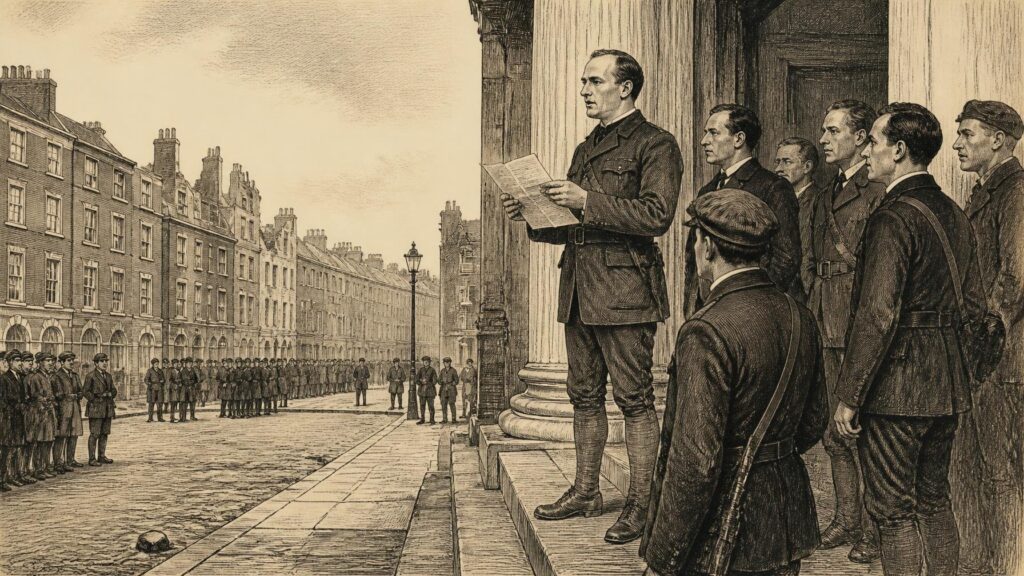
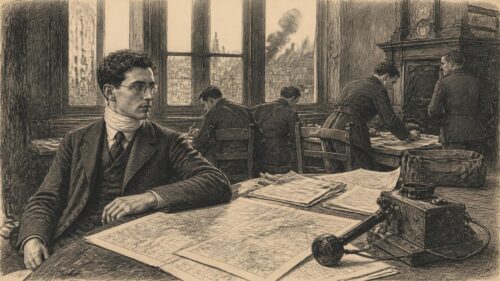
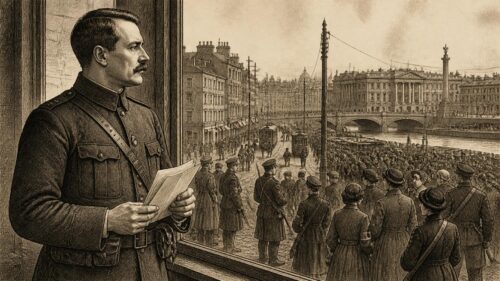
AI generated historical illustration, not a contemporary photograph.
At a Glance
Patrick Pearse was neither merely the solemn figure who read the Proclamation outside Dublin’s General Post Office nor simply the martyr later fashioned by commemoration. He was a writer, teacher, lawyer, organiser and Irish-language campaigner whose increasingly revolutionary politics emerged from a larger attempt to remake Irish cultural life. His career was brief, ending before his thirty-seventh birthday, but its parts—schooling, publishing, public oratory, nationalist organisation and rebellion—cannot be understood separately.
Origins Formed
Patrick Henry Pearse, more commonly known in Irish as Pádraig Mac Piarais, was born on 10 November 1879 at 27 Great Brunswick Street in Dublin, the street later renamed Pearse Street. He was the second of four children of James Pearse, a stone-carver and monumental sculptor born in England, and Margaret Brady Pearse, who came from a Dublin Catholic family. The mixed family background is worth stating plainly because later nationalist imagery could make Pearse seem the uncomplicated embodiment of an ancient and unbroken Irish lineage. The documentary record instead places him in an urban, artisan, Catholic household whose business made memorials for the dead and religious sculpture for churches and cemeteries.
James Pearse’s workshop gave the family a modest degree of security and exposed its children to craftsmanship, religious imagery and the practical demands of a small business. Patrick’s younger brother, William, became a sculptor and an art teacher at St Enda’s; both brothers would be executed after the Easter Rising. Their mother became an important guardian of the family memory, and her later public role helped to sustain a reverential image of her sons. Such memory was emotionally understandable, but historians must distinguish it from evidence about Patrick’s own early development.
Pearse attended Mrs Murphy’s private school and then the Christian Brothers’ school in Westland Row. He emerged from an educational system that was heavily examination-centred and which, in his later writing, he represented as alien to Irish children. That judgement was an argument, not an objective description of every classroom he knew. Yet it became central to his educational philosophy. He believed that schooling should cultivate character, imagination, language and attachment to place rather than train pupils solely for examinations and employment.
By his teens he had acquired a serious interest in the Irish language. He joined the Gaelic League in 1896, the year of its foundation, and the organisation supplied the institutional setting in which a Dublin-born learner could become part of a widening national movement. The League’s programme was cultural rather than formally party-political: it promoted Irish speech, classes, publications and a renewed public valuation of the language. Nevertheless, its networks brought together people who held sharply different political views, from constitutional nationalists to future revolutionaries. Pearse’s early commitments therefore belonged first to a language revival, though they later acquired political force.
He studied Irish, English and French, receiving a Bachelor of Arts from the Royal University of Ireland in 1900 after study at University College Dublin. He also trained in law through King’s Inns and Trinity College Dublin and was called to the bar in 1901. His legal career was never the main work of his life. The qualification nevertheless mattered: it gave him professional standing, disciplined habits of argument and an awareness of institutions whose legitimacy he would ultimately reject. Pearse did not become a revolutionary because he lacked conventional attainments. He moved away from a respectable professional path through a deliberate intellectual and political choice.
Language Revival
The Gaelic League was the making of Pearse’s public career. He wrote articles, reviews, fiction and verse, participated in committees and helped to enlarge the imaginative territory of the revival. His Irish was learned rather than inherited, but he devoted great energy to mastering it and to experiencing communities where it remained an everyday language. The distinction mattered to him. He admired the Irish-speaking west not as a museum of survivals but as evidence that Irish life could possess a cultural integrity absent from the anglicised habits of the capital.
From 1903 until 1909 he edited An Claidheamh Soluis, the Gaelic League newspaper. Under Pearse the paper became a venue for literary discussion as well as a practical organ of language activism. It enabled him to write on education, literature, public affairs and the cultural consequences of emigration. The editorship also brought controversy. Pearse could be combative, particularly where he believed clerical or official authorities had impeded the language movement. His early writings show a forceful advocate but not yet a finished apostle of armed revolt. He could be liberal in social tone, hostile to sectarian narrowness and keen to present Irish culture as intellectually modern.
His summers in Rosmuc, Connemara, were especially important. He first visited the area in 1903 in connection with Gaelic League work and subsequently built a cottage there. The landscape, Irish-speaking neighbours and rhythms of local life fed both his prose and his conception of education. It would be wrong to treat Rosmuc as a simple conversion scene, or to suppose that rural communities existed only to furnish his nationalist imagination. The place had its own social realities, including poverty and emigration. But Pearse found there a language community that challenged his belief that progress had to mean cultural absorption into Britain.
Pearse wrote in both Irish and English. His stories, poems and plays frequently turn upon childhood, loyalty, sacrifice, moral choice and the relationship between personal affection and national duty. Literary interpretation remains contestable. Some readers have detected in his work an intense idealisation of boyhood and heroic purity; others stress his attempt to create a modern Irish literature and readership. The evidence supports the importance of both themes. It does not support reducing all of his writing to a coded political programme, still less using literary imagery alone as a clinical diagnosis of its author.
His contribution to Irish-language literature included short fiction such as Íosagán and An Bhean Chaointe, alongside essays that argued for an Irish literary tradition responsive to contemporary needs. He also translated and adapted material, treating language revival as a creative activity rather than a merely antiquarian enterprise. Pearse wanted Irish to become a living medium for modern education, journalism and literature. His emphasis upon authenticity could be romantic, but his publishing work was practical: it addressed readers, pupils and voluntary organisations operating in the ordinary public world.
Language, for Pearse, was not an isolated subject. It carried habits of thought, historical memory and a claim to national distinctiveness. His premise—that a people without its own language was culturally diminished—was shared by many revivalists, though not by all Irish nationalists. Constitutional politicians could support Irish while regarding self-government within the United Kingdom as adequate. Pearse gradually came to believe that cultural renewal required political freedom. That development was neither automatic nor inevitable. It was shaped by the disappointments and confrontations of the years before 1916.
Educational Vision
Pearse’s most sustained constructive achievement was educational. In 1908 he founded St Enda’s School, Scoil Éanna, in Cullenswood House, Ranelagh. The school was intended for Catholic boys and advertised a bilingual education “distinctively Irish in complexion” while remaining modern in method. In 1910 it moved to the Hermitage at Rathfarnham, a substantial house set in extensive grounds now associated with the Pearse Museum and St Enda’s Park. Pearse also founded St Ita’s, a school for girls and younger children, although St Enda’s became the better-known institution.
The school’s prospectus and surviving material make clear that Pearse did not propose a narrow retreat from the modern world. He looked to European educational models, including practices he had encountered or studied in Belgium, and criticised passive learning by rote. Irish was to be taught through use and conversation as well as formal grammar. Art, drama, field activity, physical exercise and contact with landscape had prominent places. He envisaged an education capable of producing self-respecting Irish citizens rather than merely successful candidates for examinations.
The language of his educational writing could be sweeping. In The Murder Machine, published in January 1916, he denounced the prevailing system for suppressing individuality and for disconnecting children from their own country. Its title was polemical, and its account of English-administered education was deliberately severe. It should be read as a manifesto rather than a neutral survey. Yet the pamphlet expresses a coherent conviction: education must help a child become his or her “true and best self”, not simply serve bureaucracy, examination systems or imperial conformity.
At St Enda’s that principle was expressed through daily practice as well as rhetoric. Pupils encountered Irish history and legend; plays and pageants were staged; local landscape was made part of the school’s imaginative geography. Teachers included Thomas MacDonagh, later a Proclamation signatory, Con Colbert, later executed for his role in the Rising, and William Pearse. Their later revolutionary careers have understandably coloured memory of the school, but St Enda’s was not simply a barracks in disguise. It was an educational institution with lessons, fees, parents, boarders, financial pressures and a staff pursuing literary and artistic ambitions.
The school’s setting possessed symbolic force. Pearse cherished an association between the Hermitage and Robert Emmet, the United Irishman executed after the failed rebellion of 1803. In school writing he described the grounds through Emmet’s imagined presence. Here evidence and tradition need separation. The estate’s associations with Emmet were part of the local and national memory that Pearse deliberately employed; they cannot all be treated as securely verifiable episodes in Emmet’s life. What is beyond doubt is Pearse’s use of the association. He wanted pupils to feel history physically, through rooms, trees, paths and mountains as well as through books.
This was a generous vision, but it was difficult to finance. St Enda’s never became a large, stable national model. Fees did not consistently meet costs, and Pearse depended on fundraising, family resources and sympathetic supporters. His American lectures in 1914 were partly intended to assist the school. The strain is important because it qualifies the familiar image of a school that effortlessly embodied a new Ireland. St Enda’s was imaginative and influential, but precarious. Its relative smallness did not lessen its significance; rather, it reveals the practical obstacles facing cultural nationalism when it attempted to create institutions independently of the state.
Pearse’s educational work also complicates the claim that he was driven only by destruction or death. For eight years he built an institution intended to endure, gave sustained thought to curriculum and pedagogy, and attracted colleagues of considerable talent. The later choice for insurrection cannot erase that work. Conversely, admiration for the school should not make its founder politically harmless. His idea of formation linked beauty, discipline, sacrifice and national service. Those values could enrich school life, but they could also prepare the symbolic language through which political violence came to appear morally redemptive.
Political Turning
Until the crisis over Home Rule, Pearse’s public activity was more cultural than conspiratorial. He did not begin as an Irish Republican Brotherhood organiser, and he could support Home Rule as a step towards greater national autonomy. The political atmosphere altered after 1912. The third Home Rule Bill was introduced at Westminster, while unionist resistance hardened and the Ulster Volunteer Force armed openly. The creation of the Irish Volunteers in November 1913 was a nationalist answer to that militarisation. Pearse joined its provisional leadership and became director of organisation, later director of military organisation.
The Volunteers were not initially a revolutionary body in a simple sense. Many members wished to secure Home Rule; John Redmond’s Irish Parliamentary Party sought influence over the movement; others envisaged defence against unionist coercion. Pearse’s own speeches increasingly adopted a more uncompromising register. In “The Coming Revolution”, delivered in 1913, he argued that a nation could renew itself through a revolution in values as well as institutions. His language had spiritual and historical dimensions. Ireland, as he imagined it, was more than territory or administration: it was a moral community whose freedom demanded active commitment.
The outbreak of the First World War in August 1914 transformed the context. Implementation of Home Rule was suspended. Redmond urged the Volunteers to support the British war effort, producing a split between the larger National Volunteers and the smaller Irish Volunteers who rejected his call. Pearse remained with the latter. The split did not itself predetermine an Easter Rising, but it placed the separatist minority in a more distinct organisational setting. European war also encouraged the Irish Republican Brotherhood to consider an uprising while Britain was preoccupied elsewhere.
Pearse travelled to the United States in 1914 to raise funds for St Enda’s and met influential Irish-American republicans, including John Devoy and Joseph McGarrity. Accounts of this journey sometimes describe it as the decisive moment of his radicalisation. It was certainly significant, since Irish-American networks offered money, contacts and an explicitly separatist political culture. Yet it is better understood as part of a process. Pearse’s speeches before and after the journey show an intensifying rejection of constitutional dependence, while the European war, Volunteer politics and IRB planning supplied the means through which sentiment could become action.
He was sworn into the IRB in December 1914, although precise accounts of dates and organisational roles have sometimes varied in popular retelling. By 1915 he sat on its Supreme Council and was involved in the secret Military Council that planned a rising. Secrecy was crucial. The Council did not represent the whole body of Irish Volunteers, and its plans were concealed from many who might have expected to be consulted. Pearse’s later public fame must not obscure the collective character of the conspiracy: Tom Clarke, Seán Mac Diarmada, Joseph Plunkett, Éamonn Ceannt, Thomas MacDonagh, James Connolly and others all shaped the insurrection.
At the graveside of the Fenian veteran Jeremiah O’Donovan Rossa in August 1915, Pearse delivered the speech for which he is most remembered before Easter Week. Its closing declaration that Ireland “unfree shall never be at peace” became a defining nationalist phrase. The oration was theatrical, deliberate and historically literate. It invoked the dead not merely to mourn them but to press the living towards action. It also showed Pearse’s exceptional capacity to turn commemoration into political mobilisation. Oratory was one of his real powers, and the Rossa funeral demonstrated how ceremonial could create a sense that history imposed obligations upon the present.
Martyrdom Debated
No aspect of Pearse’s thought has attracted more argument than his language of sacrifice. His speeches, plays and poems repeatedly link national freedom with suffering, and he often framed political duty in Christian and redemptive terms. This rhetoric has led to the influential portrait of Pearse as an enthusiast for “blood sacrifice”: a man who desired a doomed rising because the deaths of rebels would awaken Ireland. There is evidence for the prominence of sacrificial imagery. There is not, however, a single uncomplicated doctrine which explains every decision of 1916.
The phrase itself can flatten different meanings. Pearse drew upon Catholic symbolism, the memory of earlier Irish rebellions and a European romantic tradition in which death for a nation could confer moral authority. He could describe sacrifice as purifying or regenerative. In this respect, his writing is disturbing to many modern readers, especially given the civilian casualties and destruction that followed the Rising. But historical interpretation must keep rhetoric, strategy and experience in view together. Pearse also planned for an armed seizure of key points, anticipated a national mobilisation and helped issue a proclamation that envisaged a republic with civic and social promises.
The Proclamation’s language cannot be assigned to Pearse alone. He drafted much of it, but James Connolly and Thomas MacDonagh, among others, contributed to its composition and final form. Its appeal to “Irishmen and Irishwomen”, its promise of religious and civil liberty, equal rights and equal opportunities, and its assertion of popular ownership of Ireland belong to the political statement of a collective leadership. Pearse’s voice is detectable in its historical cadence and invocation of “dead generations”, but the text should not be used as a transparent autobiography.
Interpretations also need to reckon with contingency. The planned German arms landing failed when Roger Casement was arrested and the Aud was scuttled. Eoin MacNeill, chief of staff of the Irish Volunteers and not part of the secret IRB Military Council, sought to cancel Volunteer manoeuvres after learning of the plans. The resulting countermand reduced participation outside Dublin and contributed to confusion. A rebellion that Pearse and his comrades had hoped might have wider effect began under grave disadvantages. Their action was not simply a ceremonial suicide; neither was it a realistically likely military victory.
Some later admirers converted Pearse’s sacrificial vocabulary into an uncomplicated national creed. Some critics, reacting against that cult, have treated it as proof of irrationality or pathology. Both approaches can evade the historical problem. Pearse did hold ideas about redemptive death that were politically consequential. He also possessed organisational ability, literary intelligence, a concrete educational project and a keen sense of symbolic politics. The tragedy is not resolved by choosing one Pearse and discarding the other. His imaginative gifts helped create the language through which an insurrection could be presented as necessary, even when its immediate prospects were bleak.
Rising Command
On Easter Monday, 24 April 1916, the insurgents seized strategic buildings in Dublin. Pearse was at the General Post Office, which became the headquarters of the Provisional Government. There he read the Proclamation of the Irish Republic, though later reconstructions of the exact moment and audience understandably differ in detail. The published document, rather than any embellished tableau, is the firm evidence: it announced a republic, named the Provisional Government and called upon Irish people to support it.
Pearse was designated President of the Provisional Government and commander-in-chief of the forces of the Irish Republic. These titles conveyed political legitimacy and military authority, but the practical command structure was shared and complicated. James Connolly, the Irish Citizen Army leader and a signatory, exercised major authority over military operations in Dublin. Pearse was not an experienced field commander in the professional sense. His importance lay in his status among the Volunteers, his ability to articulate the rebellion’s claim, and his role in the secret leadership that had brought it about.
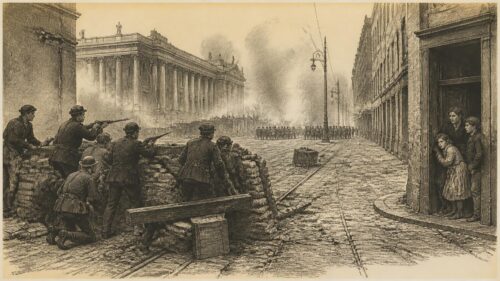
The GPO garrison included Volunteers, Citizen Army members and others drawn into a confused and dangerous urban battle. British military forces rapidly deployed artillery and incendiary shells against rebel positions. Central Dublin suffered devastating damage, and civilians were killed amid crossfire, shelling and the hazards of street fighting. Any account that celebrates the Rising without acknowledging these consequences is incomplete. Pearse’s own final decision to surrender arose from recognition that further resistance would bring further loss of life, particularly among Dublin civilians.
The headquarters abandoned the burning GPO on Friday, 28 April, moving through surrounding streets before reaching 16 Moore Street. On Saturday, 29 April, Pearse agreed to an unconditional surrender. He issued an order directing the forces under his command to lay down arms. This was not a triumph in conventional military terms. It was the end of a rising that had failed to dislodge British power and had not triggered the nationwide mobilisation its planners hoped for. Its political significance developed afterwards, through British policy, public reaction, imprisonment, propaganda and the changing course of Irish nationalism.
Pearse’s surrender has sometimes been treated as evidence that he pursued death regardless of others. The surviving sequence suggests a more complex position. By the final day the military situation was hopeless, headquarters was destroyed, communications were fragmented and civilians were suffering. He told those around him that surrender was required to prevent further slaughter. This does not absolve the leadership of responsibility for beginning an armed rebellion in a crowded city. It does show that Pearse’s last operational judgement was directed towards ending the fighting rather than prolonging a symbolic last stand.
Trial Execution
After surrender Pearse was held by British military authorities and tried by field general court-martial. The proceedings were swift, conducted under wartime emergency powers, and did not provide the safeguards expected in ordinary civilian criminal trial. His trial took place on 2 May 1916. He did not deny responsibility. In the statement commonly associated with the proceedings, he affirmed that he had sought to free Ireland and expressed confidence that the rebels’ actions would ultimately be understood. Its rhetorical quality fits Pearse’s public character, but it must also be read as the words of a condemned prisoner facing an almost certain death sentence.
He was executed by firing squad at Kilmainham Gaol on 3 May 1916. William Pearse was executed there the following day. The executions of the Rising leaders continued until 12 May, while Roger Casement was later hanged in London. The Military Archives records Pearse’s address as St Enda’s College, his occupations as teacher, journalist and author, and his recorded rank as President of the Irish Republic. Such administrative entries are stark reminders that the famous icon was also a particular prisoner whose death was recorded by the state that had defeated him.
British officials initially believed that firm punishment would restore order. The sequence of executions instead helped alter public feeling. This change was not instantaneous or universal. Many Dubliners had been angered by disruption, feared for relatives, or resented the destruction of the city. The wider population also lived with the losses and pressures of a world war. Yet the executions, followed by mass arrests and internment, enabled the dead leaders to be presented as martyrs and weakened the political authority of constitutional nationalism. Pearse’s own language of sacrifice now acquired a terrible retrospective power.
It is important not to turn that outcome into inevitability. Public attitudes shifted through many causes: the severity and duration of the executions, reports from prisons, the changing war situation, the threat of conscription in 1918, electoral organisation and the failures of Home Rule settlement. Pearse became central to the emerging republican story because he had read the Proclamation, spoken memorably, died early in the executions and left a large body of literary writing. But he was one of a wider generation, not the sole author of revolutionary Ireland.
Public Memory
After 1916 Pearse’s image travelled rapidly through photographs, portraits, schoolbooks, speeches, memorial services, plays and political argument. His youth at death, grave demeanour and literary language made him unusually adaptable to commemoration. The man of St Enda’s could be remembered as a teacher; the editor as a language revivalist; the signatory as a founder of the republic; the executed prisoner as a Christian martyr. Each image had documentary foundations, yet the combination often produced a figure smoother and more unified than the historical person.
His mother, Margaret Pearse, became a prominent keeper of that memory, preserving the family home and the school’s legacy. St Enda’s itself closed in 1935 after long financial difficulty, but the building and grounds became an important place of remembrance. The Pearse Museum now presents the school, family life, artistic collections and revolutionary context together. This is valuable because it returns attention to the years before Easter Week. A visitor can see that Pearse’s political life was rooted in rooms where pupils worked, slept, studied and performed, not solely in the GPO or Kilmainham.
Post-independence commemoration sometimes elevated Pearse into a near-sacred national founder. His writings were widely circulated, his name given to streets and institutions, and his speeches used to frame ideas of national independence. Such commemoration reflected genuine public respect, but it could leave little room for ambivalence. Pearse’s criticism of compromise appealed to later republicans, while his school and cultural work appealed to those who wished to detach him from violence. These competing appropriations show how historical figures are used to answer later political needs.
Academic scholarship has complicated the older devotional portrait. Biographers and historians have studied his family, educational writings, literary output, sexuality, religious imagination, political networks and the practical failures of the Rising. Not every interpretation commands consensus. Claims about private desire or psychological motive, for example, often depend upon reading literary texts and relationships rather than direct testimony; they should be presented cautiously. The strongest evidence concerns his published work, surviving correspondence, school records, contemporary press, organisational documents and official military files.
The phrase “blood sacrifice” remains a useful warning if it draws attention to Pearse’s unsettling willingness to make death politically meaningful. It becomes misleading if it pretends that the Rising can be explained by one phrase, or that every participant shared identical motives. Connolly’s socialism, Clarke’s Fenian conspiratorial tradition, Plunkett’s strategic planning, MacDonagh’s literary nationalism and the experiences of ordinary Volunteers each require separate attention. Pearse’s role was distinctive because he fused cultural nationalism with a rhetoric of moral redemption and was able to give that fusion extraordinary public expression.
Historical Balance
Pearse’s life leaves a demanding historical legacy. He deserves neither uncritical veneration nor casual dismissal. He was a significant Irish writer, an inventive if financially unsuccessful educationalist, an energetic language activist and a revolutionary leader who accepted responsibility for an uprising that brought death to combatants and civilians alike. The evidence shows all these things. Any account that depicts him solely as a saint, a fanatic, a poet or a military commander loses the relationship between them.
His Ireland was imagined through language, children, landscape, graves, heroes and sacrifice. That imaginative world helped him identify profound injuries in a society marked by colonial rule, cultural loss and limited political power. It also encouraged an absolutist political temper in which compromise could appear cowardly and death could acquire public value. The qualities were connected. Pearse’s insistence that education should liberate the whole person is difficult to separate from his belief that a nation might be morally reborn through a dramatic act of defiance.
For historians, the task is not to resolve that contradiction but to make it visible. Pearse did not arise from folklore, although legend has accumulated around him. He can be studied through rich surviving sources: his essays and speeches, school materials, letters, photographs, official records and the recollections of contemporaries. These reveal an ambitious and often restless man who made culture political and politics cultural. They also reveal the limits of certainty. His inner motives cannot always be recovered, and later generations have repeatedly reshaped his meaning.
The enduring importance of Patrick Pearse lies partly in that instability. He remains a figure through whom Ireland has argued about language and modernity, violence and legitimacy, education and citizenship, mourning and national memory. To see him clearly is not to settle those arguments. It is to recognise that the man who spoke outside the GPO on Easter Monday had spent two decades trying to create an Ireland in classrooms, newspapers, stories and ceremonies before he attempted to proclaim it by force.
Contested Afterlives
Public commemoration did not simply preserve Pearse; it remade him. The executed leader could be fitted readily into the visual language of the independent state: solemn, youthful, purposeful and detached from the uncertainty that had surrounded the Rising itself. A bronze bust by Oliver Sheppard, commissioned by the government in 1935 and installed in the Dáil chamber in 1937, presented him in heroic style with a laurel garland. Such official recognition placed the revolutionary within the institutions of parliamentary Ireland. It also encouraged an image of Pearse as a settled national founder, rather than a writer and activist whose ideas had developed unevenly and whose rebellion had divided opinion.
That transformation was aided by the nature of Pearse’s surviving work. He had left poems, stories, speeches, educational essays, school prospectuses and political statements, as well as the overwhelming fact of his execution. Different audiences could therefore select a different Pearse. Language revivalists could recall the editor of An Claidheamh Soluis; teachers could emphasise the educationalist who wanted children to develop as individuals; republicans could invoke the Proclamation reader and commander-in-chief. The resulting portraits were not necessarily false, but each became misleading when detached from the others. The schoolmaster could be made harmless; the martyr could be made uncomplicated; the political leader could be made to eclipse the cultural worker.
St Enda’s is particularly important in resisting that narrowing. The school continued under Margaret Pearse and her daughter until 1935, although much of its original momentum did not survive the founders’ deaths. Its later conversion into a museum returned the Hermitage to public view as more than a revolutionary shrine. The rooms, grounds and surviving educational material direct attention to school life: art, drama, Irish conversation, gardening, nature study, games and the attempt to create an environment in which learning was connected to place. They show that Pearse’s nationalism involved construction as well as resistance. He hoped to form pupils who could imagine a culturally self-confident Ireland, not merely remember its defeats.
Yet St Enda’s also prevents an easy separation between culture and politics. Pearse treated landscape, legend, physical training and historical memory as forces capable of forming character. The school’s pageants and its association with Robert Emmet gave the past an immediate presence. That imaginative education could foster curiosity and confidence; it could also make heroic sacrifice seem a natural part of national citizenship. Pearse’s educational ideals thus remain inseparable from the moral vocabulary that later informed his revolutionary politics. To acknowledge the school’s originality is not to deny the danger contained in its founder’s increasingly absolute language.
Modern interpretation has consequently moved away from both veneration and caricature. Pearse was neither solely the architect of a cult of death nor merely a misunderstood idealist destroyed by circumstances. He was a gifted public communicator whose language could move between tenderness towards children and nature, confidence in modern educational methods, reverence for Ireland’s past, and a willingness to justify insurrection. His prominence in the story of 1916 derived partly from his practical roles in the Volunteers and the Provisional Government, but also from his extraordinary capacity to give political action a dramatic and moral meaning.
The most revealing legacy may therefore be the continuing difficulty of fixing him in a single form. Pearse Street, memorial sculpture, the GPO and Kilmainham recall the leader who died in 1916. Rosmuc and St Enda’s recall the writer, Irish-language campaigner and teacher who spent years pursuing a different future through cultural work. Taken together, these sites do not resolve the contradictions in his life. They make them visible. Pearse remains historically important not because he supplies a simple national lesson, but because his career exposes the powerful, and sometimes perilous, connections between education, cultural renewal, political imagination and revolution.