Rebel Poet
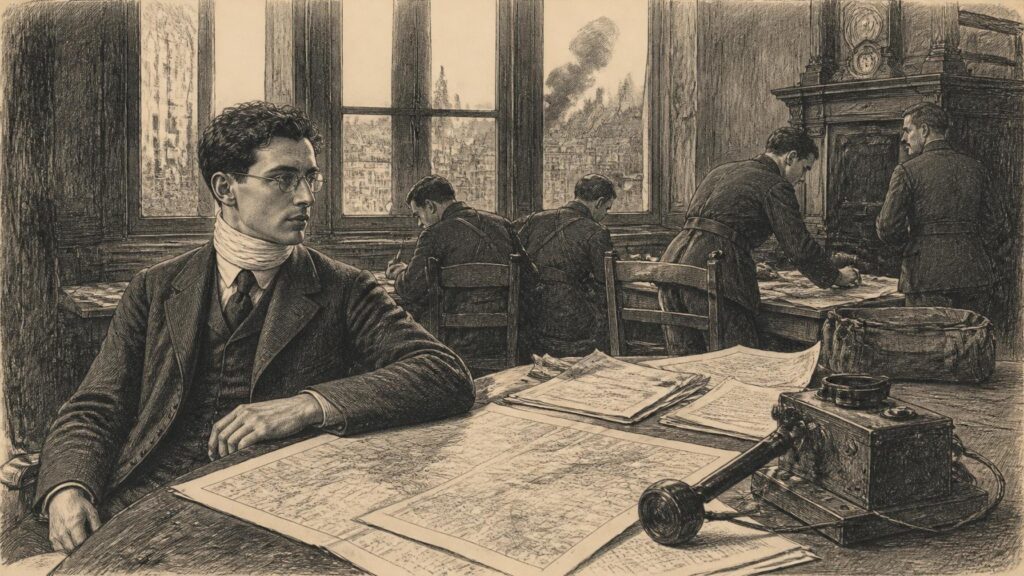
AI generated historical illustration, not a contemporary photograph.
At a Glance
Joseph Mary Plunkett was a Dublin poet, editor, Irish republican and revolutionary organiser whose life joined cultural nationalism, Catholic spirituality, international wartime intrigue and armed insurrection. He was only twenty-eight when a British military court sentenced him to death for his role in the Easter Rising. Yet the scale of his influence on the Rising’s planning, together with his marriage to Grace Gifford in Kilmainham Gaol hours before his execution, has made him one of the most enduring and often romanticised figures of 1916.
Early Years
Plunkett was born on 21 November 1887 in Dublin, the second child and eldest son of George Noble Plunkett and Mary Josephine Cranny Plunkett. He grew up amid considerable comfort. His father was a barrister, art historian, museum curator and papal count; his mother came from another successful building family. The Plunketts’ wealth, social connections and intellectual interests distinguished Joseph from many fellow revolutionaries. He was neither a product of urban poverty nor an outsider seeking entry to educated Dublin society. He belonged to a well-established Catholic family with a long consciousness of lineage, religion and public standing.
Even the apparently simple question of his birthplace illustrates the need for care with commemorative biography. The Dictionary of Irish Biography gives 26 Upper Fitzwilliam Street, while an older National Library of Ireland exhibition identifies 42 Upper Mount Street. Both addresses lie in prosperous south Dublin. The discrepancy does not alter the broad picture, but it is a useful reminder that familiar accounts of the Rising are not always identical in their particulars. What is secure is that Plunkett’s childhood was shaped by privilege, a dense Catholic culture and a family accustomed to intellectual pursuits.
His extended family supplied symbols which later biographers have found difficult to resist. He was related to Oliver Plunkett, the seventeenth-century Catholic archbishop executed in England, as well as to Sir Horace Plunkett and Lord Dunsany. Such connections should not be treated as a predestined path to rebellion. They did, however, place the young Joseph within a family tradition where Irish history, Catholic memory and public service could be discussed as living inheritances rather than distant abstractions.
Plunkett’s health was poor from an early age. Tuberculosis, or what contemporaries often loosely described as consumption, repeatedly interrupted his education and adult activity. He spent time abroad in Italy, Algeria and Egypt in 1910–12, seeking a better climate. Illness made his later physical exertions during the Rising remarkable, but it should not turn him into a passive invalid in retrospect. He continued to write, edit, travel clandestinely and plan politically. His frailty was real; so was his capacity for sustained work.
Schooling Influences
Plunkett was educated at the Catholic University School, Belvedere College and Stonyhurst College in Lancashire. These were institutions that combined disciplined Catholic education with literary and historical formation. At Stonyhurst he wrote poetry and encountered mystical writers including Teresa of Ávila and John of the Cross. The mystical strand in his reading was not an incidental youthful enthusiasm. It remained important to the language, imagery and religious seriousness of his poetry, and it helps explain why later observers often found his political imagination inseparable from spiritual aspiration.
He later prepared for University College Dublin examinations with Thomas MacDonagh as his Irish tutor. Their friendship was consequential. MacDonagh was a teacher, poet and literary organiser who moved easily between cultural revivalism and political nationalism. Plunkett shared his interest in poetry and religion, while also bringing money, family influence and a restless organisational energy. Their connection demonstrates that the cultural and political worlds of early twentieth-century Dublin overlapped deeply. Writers, language activists, theatre advocates and militants could belong to the same circles without believing that literature was merely propaganda.
Plunkett’s youthful exposure to military drill has also received attention. At Stonyhurst he took part in the officers’ training corps, and later accounts suggest that this helped nourish his amateur interest in tactics and strategy. It would be misleading to call him a professional soldier. He had no conventional military career and no experience commanding an army in war. Nevertheless, he read and thought seriously about military questions, and the small revolutionary network around him came to rely on that interest when planning an insurrection.
Literary Beginnings
Before he became publicly known as a revolutionary, Plunkett was a poet and editor. His first collection, The Circle and the Sword, appeared in 1911 under MacDonagh’s editorial guidance. The title itself conveys a characteristic mixture: the enclosed, contemplative world of mystical symbol and the sharpened, worldly image of conflict. His verse belongs to the ferment of the Irish literary revival, though it has never occupied the same place in the canon as the work of W. B. Yeats or MacDonagh.
That judgement should not obscure Plunkett’s seriousness as a writer. The National Library of Ireland preserves papers containing poetry drafts, correspondence and political prose, allowing his literary activity to be approached as more than a decorative prelude to martyrdom. His poems show a preoccupation with sacrifice, faith, love, death and transcendence. Such themes later seemed prophetic after 1916, but historians should resist reading every line as a forecast of execution. They were part of a wider religious and symbolist vocabulary available to many writers of the period.
Plunkett was associated with The Irish Review, the literary journal founded in 1911. MacDonagh published his early poetry there, and Plunkett became involved in the journal’s direction. It brought together writers and thinkers concerned with Ireland’s cultural distinctiveness, language, politics and artistic future. The journal was not a secret revolutionary organ, but its milieu mattered. It cultivated an educated nationalism in which the recovery of Irish culture could be imagined alongside constitutional reform, social criticism or eventual political separation.
His literary friendships also reveal an important feature of Plunkett’s character. He was not simply a conspirator who happened to write poems. He seems to have understood art and politics as mutually illuminating forms of national renewal. That interpretation is supported by his life, though it should be described as interpretation rather than a direct statement of doctrine. The evidence shows poetry, religious reading, journal work and political organisation proceeding side by side; it does not prove that every cultural activity was conceived as preparation for armed revolt.
Nationalist Politics
The crisis over Home Rule transformed the political landscape in which Plunkett came of age. The Irish Volunteers were founded in November 1913 against the background of unionist resistance to Home Rule and the formation of the Ulster Volunteer Force. Plunkett attended the inaugural Volunteers meeting, joined its provisional committee and used his journalistic position to support the organisation. The Volunteers were publicly presented as a national defence force; within them, however, Irish Republican Brotherhood members saw an opportunity to create a force capable of more radical action.
In June 1914, John Redmond secured the addition of nominees from the Irish Parliamentary Party to the Volunteers’ provisional committee. Plunkett accepted the arrangement in the interest of unity, but the outbreak of the First World War soon exposed irreconcilable divisions. Redmond’s Woodenbridge speech in September 1914 encouraged Volunteers to support Britain and the Allies. Most followed Redmond into the National Volunteers. Plunkett remained with the smaller body that retained the name Irish Volunteers and opposed participation in Britain’s war.
This decision placed him in the camp of advanced nationalism, but his politics were not reducible to a simple rejection of parliamentary self-government. Plunkett and his associates believed the war might create an opportunity to secure an Irish republic by force. They also believed that British military commitments abroad could weaken the state’s ability to suppress a domestic rising. That calculation was dangerous, morally contested and strategically uncertain. Yet it was not an improvised gesture in Easter Week; it had been developing within a secret revolutionary network since 1914.
Plunkett was inducted into the Irish Republican Brotherhood, the secret oath-bound organisation that supplied much of the Rising’s inner direction. At the clandestine meeting convened by Thomas Clarke and Seán Mac Diarmada on 9 September 1914, advanced nationalists resolved to prepare for a rebellion during the war. By December, Plunkett held the Volunteers’ headquarters post of director of military operations, with the rank of commandant. The title should not be inflated into command over all Irish nationalism. It did, however, signal the trust placed in him by the movement’s militant leadership.
German Mission
Plunkett’s importance increased because he became an intermediary between Irish revolutionaries and Germany. In 1915 he travelled by an indirect route to Berlin, using his previous health-related travel as plausible cover. There he encountered Roger Casement, who was trying to obtain German assistance and to recruit Irish prisoners of war into an Irish Brigade. The association with Germany later made the Rising vulnerable to charges of disloyalty during wartime, but the revolutionary leaders regarded foreign help as a practical necessity against a vastly stronger imperial power.
Plunkett and Casement differed in emphasis. Casement placed great hope in an Irish Brigade drawn from prisoners and in a more substantial German intervention. Plunkett was more willing to plan around an Irish rising supported by arms and ammunition rather than a large invading army. Accounts of their discussions point to an ambitious memorandum, commonly called the Ireland Report, envisioning coordinated operations and German assistance. Germany did not accept the most expansive plan. It did, however, promise an arms shipment intended to coincide with a rising in 1916.
The mission makes clear that Plunkett was not merely a Dublin organiser. He worked in a transnational network involving the Irish Republican Brotherhood, Irish-American supporters associated with Clan na Gael, Casement and German officials. In autumn 1915 he travelled to New York to brief John Devoy on negotiations and preparations. Such journeys were hazardous in wartime and depended upon discretion, false names, trusted couriers and incomplete information. The surviving record is fragmentary, so specific claims about every conversation should be treated cautiously. The broad outline of his travel and purpose, however, is well established.
One should also avoid assuming that foreign assistance made the planned rising a German operation. Plunkett sought German material support for an Irish republican purpose; German policy, meanwhile, sought advantage against Britain during the First World War. These interests overlapped without being identical. The revolutionary leaders did not control German calculations, and Germany did not supply the intervention upon which their larger hopes had depended. The tension between Irish ambition and German self-interest would become painfully evident in April 1916.
Military Planning
Within the secret Military Council, Plunkett became a principal planner of the Rising. The Dictionary of Irish Biography judges it probable that he originated the strategy of concentrating the Dublin action on the seizure and defence of substantial city-centre buildings. This is a carefully qualified historical conclusion, not a certainty that can be attributed to one individual alone. Patrick Pearse, Éamonn Ceannt, Clarke, Mac Diarmada, James Connolly and others all contributed to leadership and planning. Still, Plunkett’s role as director of military operations was genuine and substantial.
The basic logic was to seize prominent positions, proclaim a republic, disrupt British authority and hold out long enough for the event to acquire national and international significance. In Dublin, this meant occupying the General Post Office and a number of outlying garrisons. Such a plan could not defeat the British Empire conventionally. It depended on surprise, mobilisation beyond Dublin, weapons deliveries, public response and the possibility that a dramatic declaration would alter political conditions. The plan’s political purpose was therefore at least as important as its immediate battlefield prospects.
That does not mean that the leaders intended only symbolic sacrifice. Later debate has sometimes contrasted a supposedly calculated blood sacrifice with an earnest attempt at military success. The surviving planning evidence points to genuine operational thought: arms were sought, targets considered, communications organised and nationwide mobilisation contemplated. But the plan rested on assumptions that proved unsound, and the insurgents faced overwhelming military disadvantages. A more balanced conclusion is that Plunkett and his colleagues hoped to make a military event produce political consequences, while accepting risks that were extreme and, in some respects, poorly controlled.
Criticism of Plunkett’s military ability has a long history. J. J. O’Connell, writing in memoir form, complained that Pearse, MacDonagh and Plunkett believed warfare could be mastered from books without adequate regard for practical realities. This is valuable testimony from a participant, but it is also retrospective criticism and should not be treated as an objective final verdict. What can be said firmly is that Plunkett was an intelligent amateur strategist facing a task for which neither he nor the Volunteers possessed the resources, training or unified command structure of a regular army.
April Crisis
The weeks before the Rising exposed the fragility of the conspiracy. The expected arms shipment was carried aboard the Aud, a German vessel disguised as a Norwegian freighter. It was to bring 20,000 captured Russian rifles, machine guns and ammunition, not the major expeditionary support imagined in earlier plans. Casement, increasingly dissatisfied with German assistance and worried about the proposed rising, returned by submarine intending to prevent it. The arms operation failed: the Aud did not make its rendezvous and was intercepted, while Casement was arrested in Kerry.
At the same time, Eoin MacNeill, chief of staff of the Irish Volunteers and not fully informed of the secret Military Council’s intentions, discovered enough to oppose mobilisation. He issued a countermanding order after learning of the arms debacle and the intended operation. The effect outside Dublin was severe. It reduced turnout, confused local commanders and helped turn a hoped-for national rising into an action concentrated chiefly in the capital.
Plunkett was physically unwell throughout this crisis. In early April he underwent surgery for tubercular glands in his neck and convalesced in a nursing home at Mountjoy Square. He nevertheless continued to attend to Military Council business, making daytime visits to Larkfield, the Plunkett property at Kimmage used for Volunteer training, weapons storage and explosives work. The image of the sick planner directing events from a bed has often been heightened in popular retelling. The documented fact is serious enough: he was recovering from surgery while participating in preparations for armed rebellion.
Plunkett was also connected with the so-called Castle Document, an apparent Dublin Castle order suggesting sweeping arrests of nationalist leaders. It helped persuade some Volunteers that British repression was imminent. Earlier accounts often treated it as a straightforward forgery by Plunkett’s circle. The Dictionary of Irish Biography instead suggests that an authentic contingency document may have been leaked and then altered to make its implications appear broader and more immediate. This uncertainty matters. The document had political effect, but its precise origin and alteration remain subjects requiring cautious phrasing.
Rebellion Week
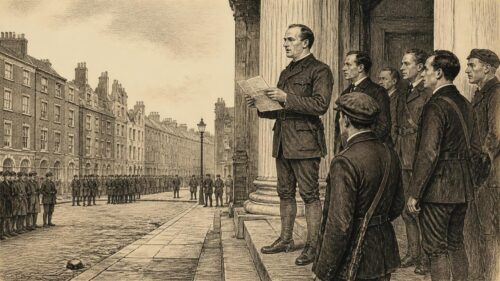
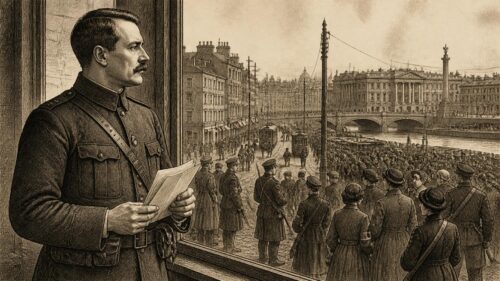
On Easter Monday, 24 April 1916, the insurgents seized the General Post Office on Sackville Street, now O’Connell Street, and Patrick Pearse read the Proclamation of the Irish Republic outside. Plunkett was one of its seven signatories and a member of the proclaimed Provisional Government. He was stationed at the GPO, the headquarters of the Dublin forces. His signature ensured that he would be remembered not simply as an organiser behind the scenes, but as one of the men who publicly assumed responsibility for the new republic claimed in the document.
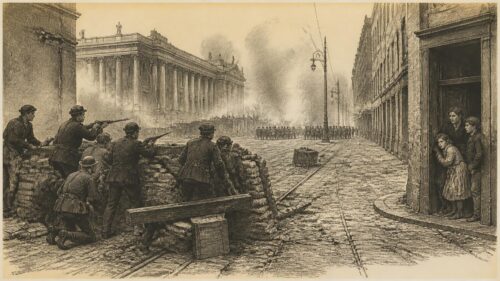
The Rising lasted six days. British forces brought artillery, machine guns, additional troops and overwhelming firepower into Dublin. Civilians endured terrible danger, especially as shells and fires devastated parts of the city centre. The GPO became untenable, and the leaders evacuated it on Friday, 28 April. Pearse surrendered the following day in an effort to prevent further civilian deaths. Plunkett was arrested with the other headquarters leaders.
Accounts sometimes describe Plunkett as the mastermind of every military decision during the week. That is too simple. The Rising was conducted by several independent garrisons; communications broke down; leadership was collective but uneven; and local circumstances often dictated action. Plunkett’s planning role was central before the Rising and he was present at its headquarters, but the fighting cannot be reduced to the will of a single strategist. His historical importance lies in the architecture of the conspiracy and its operational conception, not in a mythical omnipotence over events.
The human cost is indispensable to any account of his life. The rebellion was neither a pageant nor a private drama of leaders. Combatants, British soldiers, police and civilians died, while Dubliners lost homes and businesses in the destruction. Plunkett’s decision to participate implicated him in an insurrection that brought violence into a densely inhabited city. Historical understanding requires recognition of his courage and conviction, but it also requires acknowledgement of the grave consequences borne by others.
Prison Trial
After surrender, Plunkett was held in Richmond Barracks and tried by field general court martial on 3 May 1916. The surviving National Archives of Ireland file is especially important because it provides contemporary documentary evidence rather than later recollection. He was charged with taking part in armed rebellion and waging war against the King, with the intention of assisting the enemy. He pleaded not guilty, was found guilty and sentenced to death; General John Maxwell confirmed the sentence.
The prosecution evidence was brief. Major Philip Holmes identified Plunkett as having surrendered from the GPO in a green uniform with captain’s badges. Sergeant John Bruto of the Dublin Metropolitan Police said Plunkett’s name appeared on the Proclamation. Lieutenant Colonel H. S. Hodgkins testified that Plunkett had worn a sword and pistol at surrender. In response, Plunkett said he had nothing to offer in defence, but maintained that the Proclamation’s signatories were not connected with the Irish Volunteers and that the Proclamation had not been issued by the Volunteers.
That statement has invited interpretation. It may have been an attempt to shield the broader Volunteer body by distinguishing it from the Provisional Government, whose members had launched the rebellion through a secret inner circle. It was not a repudiation of his own role: the court records, the Proclamation and the circumstances of surrender made that impossible. Rather, it reflects the complicated relationship between the nominally open Volunteers and the clandestine decision-makers who had set the Rising in motion.
The court martial was rapid and conducted under martial law. It should not be mistaken for a full civilian trial with the procedural safeguards expected in later democratic practice. The executions that followed became politically explosive. The British authorities initially believed that swift punishment would restore order; instead, the executions, deportations and severity of the response contributed to a major shift in Irish public opinion. Plunkett’s case, because of his youth, illness and impending marriage, became one of the most emotive examples.
Final Marriage
Grace Gifford was an artist and caricaturist from a politically engaged Dublin family. She and Plunkett had become engaged before the Rising, and the National Library of Ireland catalogues a letter he wrote to her from Richmond Barracks on 23 April 1916, asking her to marry him and setting down a draft will on the reverse. This is valuable evidence that their intention to marry predated the final prison hours, even though the wedding itself became inseparable from the drama of execution.
They married in Kilmainham Gaol late on 3 May 1916, only hours before Plunkett was shot. Kilmainham Gaol Museum identifies Father Eugene McCarthy as the priest and records that two British soldiers served as witnesses. The ceremony was constrained by prison discipline: the couple had little privacy and no normal wedding celebration. Its power lies precisely in that stark contrast between the sacrament of marriage and the machinery of state execution waiting outside the chapel.
Grace later provided a Bureau of Military History witness statement, recorded decades after the events. Such testimony is indispensable but must be read as memory shaped by elapsed time, grief and later public commemoration. It confirms the central event without requiring historians to accept every detail that has accumulated around it in songs, films and anecdotes. The Bureau itself gathered testimony from 1947 to 1957, long after independence, and its records preserve both invaluable recollections and the interpretative pressures of the period in which they were collected.
The marriage has inspired the celebrated ballad “Grace”, written in 1985, and countless visual representations. These works have introduced Plunkett to generations who may know little else about him. They are part of cultural memory, not neutral evidence. Folklore and sentimental retelling sometimes add speeches, gestures or intimate scenes for which documentation is uncertain. The known facts need no embellishment: two engaged people were married in a prison chapel under military custody on the night before one of them was executed.
Execution Morning
Joseph Plunkett was executed by firing squad at Kilmainham Gaol on 4 May 1916. He died with Edward Daly, Michael O’Hanrahan and William Pearse. The Irish Military Archives’ list of executed leaders records his death there and identifies him as an Irish Volunteers commandant attached to General Headquarters. Kilmainham’s historical account places him among the fourteen men executed in the Stonebreakers’ Yard between 3 and 12 May.
He was twenty-eight. His ill health, recent operation and short marriage have encouraged depictions of him as a saintly victim, while his role in planning the Rising has encouraged depictions of him as a cold conspirator. Neither extreme is adequate. He was a committed revolutionary who took responsibility for violence against British rule; he was also a seriously ill young man, a poet with powerful religious interests, a fiancé and son, and a prisoner subjected to a compressed military process whose outcome was death.
British official policy turned Plunkett and the other executed leaders into symbols. General Maxwell judged that exemplary punishment was necessary, but the sequence of executions caused alarm even in Britain and alienated many in Ireland who had not supported the Rising. The symbolism was intensified because all seven Proclamation signatories were eventually executed. Plunkett’s death therefore became part of a wider transformation: a failed rebellion gained posthumous political force through the state response to it.
Historical Legacy
Plunkett’s legacy rests on several overlapping identities. He was a signatory of the Proclamation, a Military Council planner, an Irish Volunteers officer, a poet, an editor, a Catholic mystic and the husband of Grace Gifford. Public memory has often elevated the final identity above the others. The prison wedding gives his story an immediate emotional clarity, whereas military planning, secret organisations and German diplomacy are harder to compress into commemoration.
Yet separating these elements too sharply would distort him. His religious imagination informed his poetry; his literary life introduced him to networks of cultural nationalism; his social position gave him resources and mobility; his revolutionary work led him into secrecy and international negotiation; and his imprisonment made the marriage possible only in its tragic form. The unity of his life does not lie in a simple legend of sacrifice, but in the way several currents of late cultural revival Ireland converged in one person.
There is also an uncomfortable question of class. Plunkett had advantages unavailable to most Volunteers: money, education, travel, family space at Larkfield and access to influential circles. Those advantages assisted the movement materially. They also challenge any simplified image of Irish republicanism as the expression of one social class. The Rising brought together schoolteachers, labour organisers, clerks, artisans, writers, women activists, former soldiers and members of wealthy families. Plunkett’s background is evidence of that diversity, not an exception that negates it.
His poetry continues to receive attention, particularly “I See His Blood Upon the Rose”, which is often read through the lens of 1916. The poem’s religious imagery makes such reading understandable, but chronology and genre should be respected. Poems are not court records, operational orders or confessions of political intent. They reveal habits of imagination and language; they should not be forced to supply certainty where biographical evidence is absent. The National Library’s preservation of his drafts allows readers to encounter a writer whose work deserves attention apart from the legend of his death.
Measured Judgement
Who, then, was Joseph Plunkett? He was not solely the doomed bridegroom of popular balladry, nor solely the author of a flawed military plan. He was a young Irish republican intellectual who helped convert a clandestine political decision into an organised, though badly compromised, armed rising. He believed Britain’s war created an opportunity for Irish independence; he pursued German assistance; he helped devise operations in Dublin; and he accepted the responsibilities that followed by signing the Proclamation and remaining at headquarters during the fighting.
The evidence supports describing him as one of the Rising’s key planners, but it does not support treating him as its isolated mastermind. It supports acknowledging his devout Catholic and literary sensibility, but not assuming that death was his desired artistic destiny. It supports the reality of his wedding to Grace Gifford and the depth of its later cultural resonance, but not every romantic detail attached to it. Most of all, it shows a life whose brevity should not obscure its complexity.
Plunkett died before he could explain, revise or live with the consequences of his choices. That fact has left later generations to construct competing versions of him: patriot, poet, conspirator, martyr, strategist, dreamer. A historical account need not choose one image and discard the rest. It should instead hold them against the surviving record. In that record Joseph Mary Plunkett appears as a gifted, privileged, sickly and determined man whose contribution to 1916 was profound, whose plans were vulnerable, and whose death became larger than the life from which it came.