Irish Arms
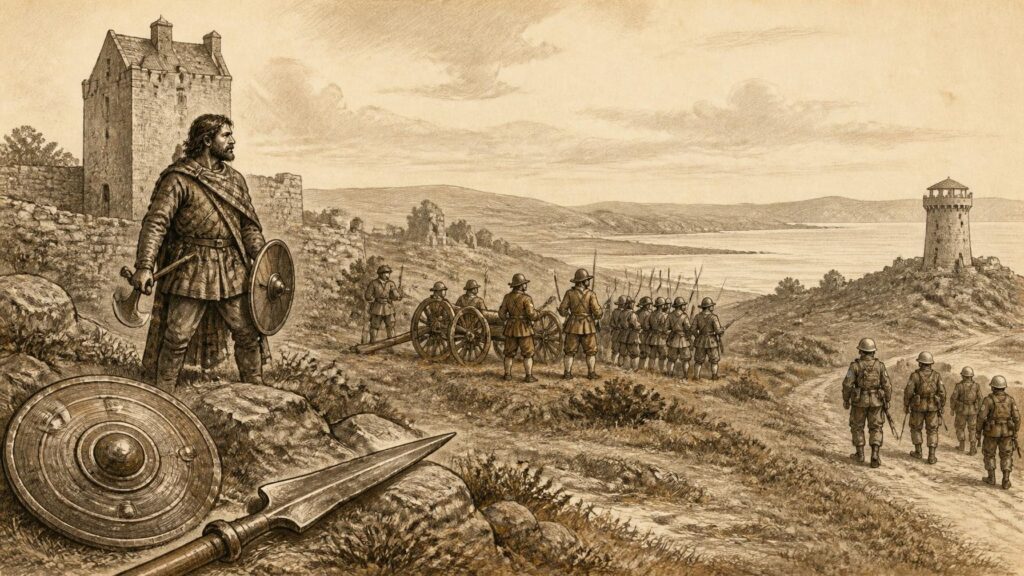
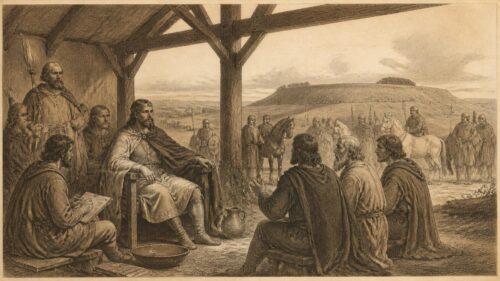
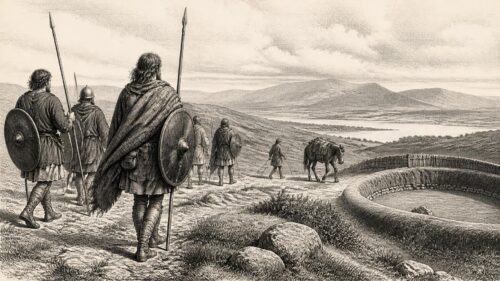
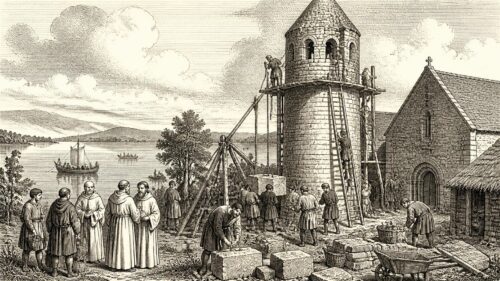
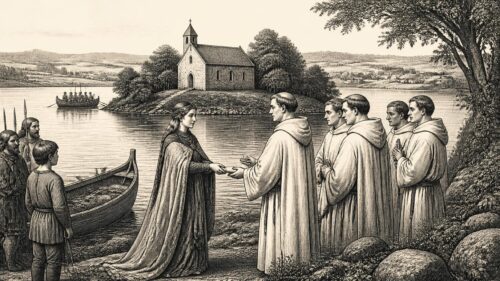
AI generated historical illustration, not a contemporary photograph.
At a Glance
Ireland’s military past is neither a simple tale of resistance nor a continuous national tradition. It is a long, contested history of armed communities, foreign and domestic armies, local lordships, imperial institutions, revolutions and state forces. Its evidence lies in bronze weapons, ruined fortifications, annals, government papers, regimental records, oral testimony and graves. These sources reveal changing methods of war, but also a constant truth: military power repeatedly altered landholding, political authority, migration, memory and civilian life.
Evidence Limits
“Military” is an especially broad subject in Irish history. It can mean the organised violence of early communities, the household forces of medieval kings, English royal armies, Gaelic mercenaries, British imperial regiments, revolutionary volunteers, police auxiliaries, state forces, paramilitaries, or the modern Defence Forces. These bodies did not represent one uninterrupted institution or one shared political purpose. They belonged to different societies and fought for different loyalties: kin, lord, church, crown, empire, republic, union, locality or international peacekeeping.
The available evidence also changes dramatically across time. For prehistoric Ireland there are weapons, defensive sites and occasional traces of injury, but no contemporary written accounts explaining who fought, why they fought or how a specific battle unfolded. Medieval Irish annals preserve names, raids and deaths, but their survival is uneven and their language is shaped by clerical and political concerns. English administrative records are exceptionally rich from the later Middle Ages onward, yet often describe Ireland through the priorities of conquest and government. Modern conflicts generate abundant documents, but these too require care: official reports may justify policy, memoirs can compress events into personal narratives, and later commemorations may favour heroism over ambiguity.
For that reason, military history should not be treated as a gallery of famous battles. It is more useful to ask who could mobilise armed people, how they were fed and paid, where they moved, what happened to civilians, and how violence reshaped authority. Archaeological collections held by the National Museum of Ireland, the statutory archaeological record maintained by the National Monuments Service, and the extensive holdings of the Military Archives make it possible to pursue those questions with a firmer evidential base than folklore alone permits.
Folklore and literature nevertheless matter. Tales of Cú Chulainn, the Fenian cycle and later rebel ballads helped generations imagine Irish courage, loss and resistance. They are historical sources for memory and identity, not straightforward reports of events. The distinction is essential. A literary hero may preserve old ideas about honour, cattle raiding or kingship, but does not provide a battlefield diary. Equally, a pension application or witness statement may contain valuable recollection without being free from later political purpose. Irish military history is strongest when material evidence, contemporary records and remembered experience are allowed to illuminate one another without being confused.
Early Violence
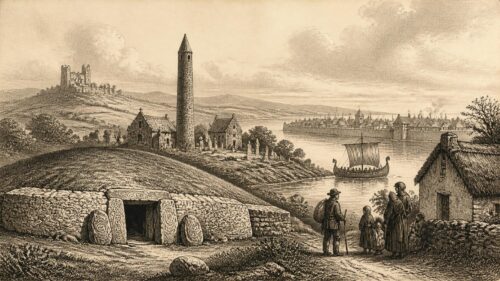
The earliest military past of Ireland must be approached through archaeology. Stone axes, flint arrowheads and blades had practical uses in clearing woodland, hunting and farming, and cannot automatically be classed as weapons. Yet objects may have had several purposes, and the National Monuments Service notes that edged stone tools and projectile points could be used in warfare as well as everyday labour. The presence of weapons therefore suggests a capacity for violence, but not the scale or frequency of organised war.
By the Bronze Age, the archaeological picture becomes more compelling. Ireland has produced substantial numbers of bronze swords, spearheads, axes, shields and other martial objects. Some were recovered from rivers, lakes and bogs, while others came from dry land or hoards. Their deposition is not always evidence of a lost battle. Many may have been offerings, displays of prestige or deliberate acts of ritual removal. The survival of a weapon tells us that it existed; it does not by itself establish that it killed anyone.
Research on Irish Bronze Age arms nevertheless indicates major changes in the technology and social practice of violence. The development of swords, shields and specialised spearheads made close combat and coordinated fighting more practicable than before. Scholars have proposed that some hillforts and defended places required collective labour and potentially substantial bodies of defenders. Such arguments remain interpretations, not direct proof of armies in the modern sense. It would be unsafe to claim precise troop numbers or to imagine a single island-wide military system. The evidence supports local conflict, social hierarchy and the increasing importance of weapons; it does not support confident narratives of named prehistoric campaigns.
Defended sites are equally difficult to interpret. Enclosures, promontory forts and hilltop earthworks may have offered refuge, status, control over movement or a measure of security in conflict. Not all were permanently occupied or built solely for war. Their meanings probably shifted across generations. What can be said is that the Irish landscape preserves physical signs of communities that invested labour in boundaries, visibility and defence. These places remind us that military organisation begins not only with weapons, but with the capacity to summon work, direct resources and define who belongs inside a protected space.
Early Irish literature later transformed violence into a heroic world of single combat, cattle raiding and exceptional warriors. The Táin Bó Cúailnge, whose surviving texts were written down centuries after the period they purport to evoke, is invaluable for the study of medieval literary culture. It should not be read as a literal account of an Iron Age war. Its landscape and martial language may preserve older traditions, but it is an artistic and ideological work shaped by scribes and audiences. Cú Chulainn belongs to Ireland’s military imagination; he cannot be enrolled as a documented historical soldier.
Medieval Orders
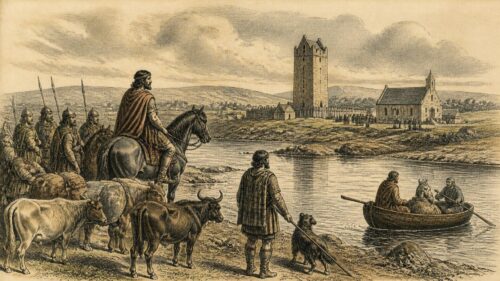
In the early medieval period, Ireland was divided among numerous kingships and lordships rather than governed by a single stable state. Warfare was embedded in politics, cattle wealth, tribute, succession and regional rivalry. Raiding could seize livestock, destroy crops, carry off captives and demonstrate a ruler’s authority. The annals record deaths of kings, burnings, battles and expeditions, but their compressed notices rarely give the full experience of combatants or civilians.
Military service rested on personal dependency and lordship. Kings and important nobles commanded followers, while ecclesiastical settlements, river crossings, forts and routes through difficult terrain could become strategic assets. Naval activity on rivers and coasts also mattered. Ireland’s shores connected it to Britain, Scandinavia, the Isle of Man and continental Europe. Sea power did not mean fleets in the later imperial sense, but control of vessels and landing places could determine whether raiders, traders, settlers or allies arrived.
Viking activity from the late eighth century altered these connections. Raids struck monasteries and settlements, while Norse and Hiberno-Norse towns developed as commercial and political centres. Dublin was especially important. The traditional image of Vikings as permanent outsiders obscures a more complex reality: Scandinavian settlers intermarried, traded, formed alliances with Irish rulers and became part of Ireland’s political world. Warfare involved conflict between groups conventionally labelled Irish and Viking, but also alliances crossing those labels.
The arrival of Anglo-Norman forces in 1169 marked another profound military and political turning point. Their initial contingents were limited in number and were drawn into local Irish struggles before royal intervention widened the consequences. They brought military experience from Wales and the Marches, including mounted knights, archers, castles and systems of lordship that could secure territory. These advantages did not produce instant control of the whole island. Conquest advanced unevenly, depending on alliances, supply, settlement and the capacity to hold strongpoints.
Castles became visible symbols of this changing order. Motte-and-bailey works, stone castles, walled towns and later tower houses were military structures, but they were also administrative residences, storehouses and centres of lordly power. A castle did not merely defend land already possessed; it helped make a claim to command credible. Yet castles were never exclusively English or Anglo-Norman instruments. Irish rulers adopted, adapted and contested new architectural forms, just as families of settler descent became culturally and politically entangled with Gaelic society.
Later medieval Ireland was not a simple division between conqueror and conquered. The effective reach of English government contracted and expanded, while Gaelic and Gaelicised lordships retained great strength. The National Museum of Ireland’s collection of swords, axes, arrowheads, armour fragments and artillery pieces gives material form to this plural military world. Its late medieval holdings include around four hundred weapons, with arrowheads especially numerous. These objects show that conflict was sustained by skilled manufacture, imported goods, mounted activity and increasingly by gunpowder weapons.
Gallowglass soldiers occupy a prominent place in popular accounts of medieval Irish warfare. The term referred originally to heavily armed mercenaries of Hebridean and Norse-Gaelic background, though by the sixteenth century it had become associated with Irish families as well. Their axes are among the most recognisable surviving weapons of the period. Their importance should not obscure other military labour: kerns, horsemen, retainers, boat crews, castle garrisons and the people who transported food, repaired fortifications and supplied animals all made warfare possible.
Tudor Conquest
The sixteenth century changed the scale and character of war in Ireland. The Tudor monarchy sought to extend direct royal authority over lordships that had previously been autonomous or only loosely connected to Dublin administration. This was not a single uninterrupted campaign. It was a sequence of political crises, rebellions, negotiated submissions, plantations and military expeditions. English power depended on garrisons, commanders, finance and the ability to maintain supply lines in difficult country.
Contemporary observers often described a patchwork of lordships, both Gaelic and of Anglo-Irish origin, capable of making war and peace on their own terms. That description contains an important truth, though it came from writers invested in the expansion of crown rule. The Tudor state increasingly treated local military autonomy as a problem to be overcome. Surrender and regrant sought to convert lordly power into tenure recognised by the crown; where negotiation failed, military force and confiscation followed.
War in this period involved more than formal battles. Armies destroyed crops, seized cattle, burned settlements and sought to deny opponents shelter and subsistence. Such practices were not incidental. In a society where forces often depended on local resources and could not easily sustain long supply chains, the destruction of food and shelter was a means of political control. Civilians bore the consequences through hunger, displacement, disease and the loss of household wealth.
Firearms and artillery grew in importance, but older methods endured. Mounted troops, infantry armed with pikes, swords, bows and firearms, fortification building, ambush and rapid raiding all remained relevant. Terrain favoured local knowledge. Woods, bogs, mountain passes and narrow roads could hamper a larger force while assisting defenders or raiders who knew the ground. The military outcome of a campaign therefore depended as much on logistics and alliances as on weaponry.
The Nine Years War at the end of the century brought these tensions to a climax. Hugh O’Neill, earl of Tyrone, and his allies created a formidable coalition against English rule. Their forces combined older Irish military traditions with firearms, drill and efforts at more sustained organisation. The conflict drew in Spain, whose attempted intervention ended in defeat at Kinsale in 1601. Kinsale was militarily decisive, but it should not be treated as a simple final battle between an eternal Ireland and an eternal England. Gaelic leaders, Old English Catholics, crown officers, settlers and continental powers pursued overlapping and shifting interests.
The settlement that followed did not end violence. It made further transformation possible: new plantations, the flight of leading Ulster nobles, a more extensive system of English law and a growing military infrastructure. Forts, roads, garrisons and mapped territory became tools through which the state attempted to make authority permanent. The conquest was therefore administrative as well as military, and its effects were felt most sharply in landholding and religious power.
Stuart Upheaval
The wars of the seventeenth century were among the most destructive episodes in Irish history. They cannot be reduced to one conflict or one set of motives. The rising of 1641, the establishment of Confederate Catholic government, wars involving royalist and parliamentarian forces, Scottish intervention, and the Cromwellian conquest formed part of the wider Wars of the Three Kingdoms. Ireland was not a peripheral theatre. Its ports, food supplies, religious divisions and military manpower mattered to struggles across the archipelago.
Accounts of 1641 were immediately politicised. Protestant depositions described killings, dispossession and fear; Catholic communities experienced reprisals, displacement and warfare of their own. The depositions are indispensable primary evidence, but they must be read critically. Some accounts were based on direct experience, others on report; many were shaped by trauma and by the legal and political conditions under which testimony was gathered. They document suffering and atrocity, but cannot simply be added together as an unquestioned tally of deaths.
The Confederate Catholics established institutions capable of diplomacy, taxation and military mobilisation. Their armies faced recurrent problems of command, resources, regional rivalry and relations with royalist allies. The conflict moved through sieges, field operations and coastal warfare. Wexford, Waterford, Dublin and other ports had importance far beyond their localities because they connected Irish combatants to England, Scotland, Wales and continental Europe.
Oliver Cromwell’s campaign in Ireland from 1649 has acquired an exceptional place in public memory. The sieges of Drogheda and Wexford are central to that memory because of the killings that followed their capture. There is no serious basis for denying their brutality. At the same time, a historical account must resist both euphemism and slogan. Cromwellian warfare included massacres, forced movement, confiscation, siege, disease and famine, but it unfolded within a wider sequence of conflicts that had already devastated the country. The responsibility for violence cannot be understood by isolating a single commander from the broader military and political systems that enabled it.
The Cromwellian settlement reorganised ownership on an enormous scale. Land was confiscated from many Catholic proprietors and redistributed to soldiers, creditors and Protestant settlers. Military service was linked directly to property. The army became not merely an instrument that won territory but a body whose claims were satisfied through territory. This connection between war, debt and land remained a defining feature of seventeenth-century state building.
The Williamite War of 1689–91 was another archipelagic conflict with profound Irish consequences. James II, supported by many Irish Catholics, fought William of Orange and his allies. The battle of the Boyne, the siege of Derry, Aughrim and the Treaty of Limerick became enduring symbols in Protestant, Catholic, unionist and nationalist memory. Their later meanings often exceed the immediate military circumstances. The Boyne, for example, was not simply a battle between Irish and foreign forces; both armies were multinational, and Irish people fought on different sides.
The Treaty of Limerick has been remembered through the phrase “the Wild Geese”, referring to the departure of Irish Jacobite soldiers for service in continental armies. The migration was real and historically significant, though later romantic memory sometimes makes it appear more uniform than it was. Irish soldiers served in French, Spanish and other European forces, while many people who remained in Ireland navigated the restrictions and opportunities of the new Protestant political order.
Imperial Service
From the eighteenth century until the early twentieth century, Ireland was deeply integrated into British military structures. This history can be uncomfortable for later national narratives because it resists a simple opposition between Ireland and Britain. Large numbers of Irish men served in the British Army, Royal Navy and imperial forces, while Ireland itself contained barracks, depots, forts, training grounds and military roads. Their service was shaped by poverty, occupation, family tradition, local recruitment networks, career ambition and coercive circumstances, not by a single shared imperial loyalty.
After the Williamite settlement, the Irish military establishment performed several functions. It was a force for internal security, a guard against external invasion and a source of manpower for wars overseas. Garrisons affected the economies of towns. Soldiers rented lodgings, bought food and drink, employed tradespeople and sometimes clashed with local inhabitants. Barracks also made military authority visible across the countryside. Their sites survive in buildings, street plans and place names.
The eighteenth century saw the formation of volunteer and militia traditions alongside the regular army. The Volunteers of the later eighteenth century were not a modern national army, but a movement of locally raised, largely Protestant armed associations created during a period of international danger. They combined defence with political pressure, demonstrating that armed organisation could become a language of constitutional claim. Their legacy was complex: later nationalists could celebrate volunteerism, while the movement’s social limits remained evident.
The United Irishmen, formed in the 1790s, drew inspiration from the American and French revolutions and recruited among Catholics and Presbyterians. The rebellion of 1798 was not a conventional war between equal armies. It involved secret organisation, local rising, insurgency, severe repression and an abortive French landing. Wexford became the best-known theatre, but conflict also affected Ulster, Leinster and Connacht. The violence of 1798 included killings by rebels and by crown forces, loyalist militias and yeomanry. Simplified commemorations often neglect the sectarian fear and local vendettas that intensified its brutality.
After the Act of Union in 1801, Ireland formed part of the United Kingdom. Irish recruitment into the British armed forces continued on a large scale. Irish soldiers served across Europe, the Americas, Africa and Asia. Their participation made Ireland materially connected to imperial expansion, even though many recruits had little power over imperial policy. Service abroad could offer wages, food, travel, advancement and comradeship; it could also bring injury, disease, discipline, long separation and death in wars with no direct relation to local Irish concerns.
The nineteenth century generated multiple military cultures. Some Irish people identified with British regiments and imperial service. Others joined nationalist secret societies or supported constitutional politics. Still others moved between identities according to circumstance. The Fenian movement, which sought an independent Irish republic, attempted a rising in 1867 and maintained transnational links, particularly in the United States. Its military ambitions exceeded its operational capacity, but Fenian organisation influenced later revolutionary thought.
The British Army’s Irish regiments were themselves complicated institutions. They recruited in Ireland but served a British state and empire. Their names, uniforms and local associations could create powerful regional loyalties. Following partition and the establishment of the Irish Free State, several southern Irish regiments were disbanded in 1922. The material remnants of this history, preserved in museums and family collections, demonstrate that service under the crown was a major part of Irish experience rather than an incidental exception.
Volunteer Politics
The years before the First World War saw military organisation become central to constitutional crisis. The prospect of Home Rule produced the Ulster Volunteer Force in 1913, committed to resisting an Irish parliament if necessary. Irish nationalists responded with the formation of the Irish Volunteers later that year. Both movements adopted uniforms, drill, arms procurement, public displays and military vocabulary. They were political bodies before they became fighting forces, and their existence showed how quickly constitutional debate could take an armed form.
The outbreak of the First World War divided the Irish Volunteers. John Redmond encouraged participation in the British war effort, and many Volunteers joined the National Volunteers. Tens of thousands of Irish men served in British forces during the war, including in the 36th Ulster Division and the 16th Irish Division. Their motives varied widely: support for Britain, belief that service would advance Home Rule, economic necessity, local pressure, adventure, comradeship or a sense of duty. Their experience should not be absorbed into either unionist or nationalist memory alone.
A smaller body retained the Irish Volunteers name and opposed participation in the British war effort. Members of the Irish Republican Brotherhood’s Military Council planned the Easter Rising of 1916. The rising was militarily limited and geographically concentrated, though fighting occurred outside Dublin as well. The rebels lacked the numbers, arms and coordination required to defeat British forces. Eoin MacNeill’s countermanding order, preserved among archival sources, reduced Volunteer mobilisation shortly before the rising began. That episode is a reminder that revolutionary military history turns on communication, organisation and contingency, not solely on resolve.
The Rising’s military failure became politically transformative after the executions of many leaders and the handling of arrests and internment. Its legacy is often narrated through the Proclamation and the sacrifice of its leaders. Yet the civilian experience was equally important. Dublin streets were damaged by artillery and fire; residents endured danger, disruption and loss. The rising also raised difficult questions about armed action in a city inhabited by people who had not all consented to it.
Military service in the Great War and the Rising existed simultaneously, not as separate universes. Irish soldiers fought in British uniform on the Western Front, at Gallipoli and elsewhere while other Irish men and women prepared or supported rebellion at home. Their memories were later commemorated unevenly. A fuller historical view recognises both without requiring one to cancel the other.
Revolutionary War
The War of Independence, commonly dated from 1919 to 1921, was fought principally between the Irish Republican Army and British Crown forces, including the Royal Irish Constabulary, the British Army, the Auxiliary Division and the Black and Tans. It was not fought as a sequence of large conventional battles. It was a guerrilla conflict of ambushes, intelligence work, raids, arrests, reprisals, intimidation, propaganda and efforts to control local administration.
The IRA’s strength lay in its dispersed organisation, local knowledge and ability to operate among supportive networks. Its weaknesses included shortages of arms and ammunition, uneven training, fragile communications and substantial variation between regions. Some brigades were highly active; others were less capable or faced different local conditions. The term IRA can therefore obscure important differences of experience between counties and even between neighbouring districts.
British forces enjoyed superior numbers, equipment and control of major urban centres, but they faced a conflict in which conventional military advantage did not ensure political success. Intelligence became crucial. The struggle over information involved police records, informers, surveillance, coded messages, raids on documents and attacks on intelligence personnel. Michael Collins became associated with intelligence and urban operations, but later popular narratives can make revolutionary warfare seem the work of a few famous figures. It depended more broadly on couriers, safe houses, scouts, organisers, printers, women in Cumann na mBan, railway workers, local officials and many others.
The war brought severe violence to civilians. Crown reprisals included the burning of property, while republican forces killed members of the police, military and people suspected of informing. Sectarian and political killings occurred in several places, particularly in areas where national, religious and local identities were tense. A historical account must acknowledge these patterns without assuming a single motive for every death. The surviving record is incomplete, and later political language often assigns clear meanings to events that were locally confused and traumatising.
The Truce of July 1921 ended the main armed phase without resolving the constitutional conflict. Negotiations produced the Anglo-Irish Treaty, which established the Irish Free State but confirmed partition and required an oath with reference to the crown. The agreement created a new political order, yet it also divided the movement that had fought the war. Military structures that had been built against British rule were now drawn into a struggle over the legitimacy of the new state.
Civil Conflict
The Irish Civil War of 1922–23 was fought between forces supporting the Treaty and opponents who rejected it. It was a conflict among people who had often shared service in the revolutionary movement. The National Army, formed around the pro-Treaty government, developed rapidly from units of the former IRA and gained access to barracks, arms and administrative resources transferred from British authority. Anti-Treaty forces retained significant support and arms but lacked a unified strategy capable of defeating the new state.
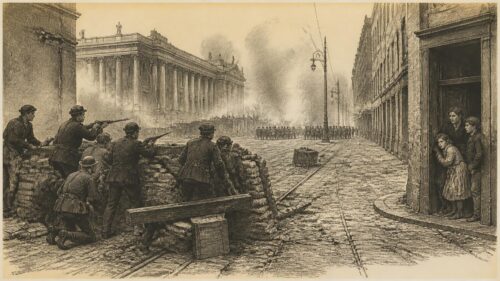
The opening bombardment of the Four Courts in Dublin in June 1922 symbolised the final collapse of uneasy coexistence. The National Army’s use of artillery supplied through British channels demonstrated the new state’s military advantage and its difficult dependence on resources connected to the power it had recently opposed. Fighting spread quickly. Towns changed hands, railways and bridges were targeted, and both sides sought to control communications and supplies.
The pro-Treaty side captured major urban centres during the summer, including through seaborne landings in Munster. Anti-Treaty forces then relied increasingly on guerrilla methods. The war became bitterer as executions, reprisals, arrests, destruction of property and attacks on infrastructure accumulated. The state authorised executions of captured anti-Treaty prisoners, while anti-Treaty units killed politicians and attacked homes associated with supporters of the government. The death of Michael Collins in August 1922 and the deaths of other leading figures gave the conflict an enduring tragic cast, but the suffering was far wider than its famous names.
The Military Archives preserve exceptionally important records for this period, including operational reports, intelligence files, captured documents, radio reports, internment material, court-martial records and the 1922 Irish Army Census. These sources make clear that civil war was also an administrative conflict. A functioning army required pay, transport, food, communications, discipline, medical care, records and chains of command. The Free State’s ability to establish such systems helped it prevail.
The conflict ended in 1923 without a negotiated political settlement between the military sides. Its memory remained divisive for decades. Families could preserve silence because former comrades had fought one another, and political parties inherited opposing traditions. The lesson is not that the Civil War was inevitable. Rather, it shows how revolutionary coalitions can fracture when a settlement leaves fundamental questions of sovereignty, partition and legitimacy unresolved.
Border Violence
Partition created two political entities on the island with distinct security systems: the Irish Free State, later Ireland, and Northern Ireland within the United Kingdom. Violence did not disappear with the treaty. Northern Ireland experienced serious unrest in the early 1920s, including attacks, expulsions and communal fear. The boundary itself became a focus of anxiety, military planning and smuggling. The new Irish state faced the difficult task of securing its territory while recovering from civil war.
In the decades that followed, the Defence Forces developed as the armed service of the independent state. Their role differed fundamentally from that of the revolutionary forces from which many early members came. They were subject to government authority, legislation, professional administration and a permanent chain of command. This transition from movement to state force was neither automatic nor uncomplicated. It required demobilisation, reorganisation and the subordination of military identity to civilian government.
Northern Ireland’s later conflict, widely known as the Troubles, demands careful language. It involved republican and loyalist paramilitary organisations, the Royal Ulster Constabulary, the British Army, political parties, civil rights activists and communities subjected to intimidation, displacement and bereavement. It was not a straightforward continuation of the War of Independence, though participants frequently drew on earlier memories. Nor was it reducible to ancient religious hatred. Political inequality, constitutional allegiance, state response, policing, social conditions and competing national identities all shaped the conflict.
The Republic’s military forces were not principal combatants in Northern Ireland, but the border affected defence planning, intelligence and public order. The Irish government also faced grave challenges from paramilitary activity within its jurisdiction. The constitutional and diplomatic settlement represented by the Good Friday Agreement of 1998 changed the political context, although historical memory remains sensitive. Military history here must make room for victims and avoid language that turns death into theatre.
Neutral Defence
Irish neutrality during the Second World War, known in Ireland as the Emergency, did not mean the absence of military preparation. The state expanded its Defence Forces, developed coastal and anti-invasion plans, created reserve organisations and maintained censorship and security measures. The danger was real: Ireland lay beside the Atlantic theatre, British forces remained in Northern Ireland, German invasion planning existed, and the state lacked the resources of larger belligerents.
Neutrality was a policy of state survival rather than passivity. Irish authorities had to monitor coasts, protect infrastructure, manage airspace, respond to shipping losses and consider the possibility of invasion from either side. Military Archives collections preserve emergency defence plans, operational journals, lookout-post records and material concerning contacts with Britain. These sources show a state trying to prepare for contingencies that it could not fully control.
At the same time, many people from Ireland served in British forces during the war, while Northern Ireland was directly integrated into the United Kingdom’s war effort. This again demonstrates why “Irish military history” cannot be confined to one army or one allegiance. The island’s people experienced the war through different constitutional positions, personal choices and degrees of exposure.
The Emergency also strengthened the institutional identity of the Defence Forces. Expansion required training, uniforms, equipment, camps, staff work and public cooperation. Not every plan was realistic, and equipment shortages were serious. Nevertheless, the period established habits of national defence planning that outlasted the immediate crisis. It also left a documentary legacy that allows historians to distinguish actual policy from later assumptions that neutrality meant indifference or helplessness.
Overseas Service
After the Second World War, the most distinctive international role of the Irish Defence Forces became peacekeeping. This service should not be romanticised as warfare without violence. United Nations operations have exposed Irish personnel to danger, armed confrontation, difficult political mandates and the limits of international authority. Yet overseas deployments marked a significant departure from the older association of Irish soldiers with British imperial service or domestic revolutionary conflict.
Ireland first contributed officers to United Nations observer missions in the Middle East in 1958. The major turning point came with the United Nations operation in the Congo. In July 1960, following Congolese independence and an appeal for international assistance, the Irish government authorised the dispatch of the 32nd Infantry Battalion. Over the following four years, more than six thousand Irish personnel served in the Congo.
The Congo mission demonstrated that peacekeeping could involve combat. The Niemba ambush of November 1960 killed nine Irish soldiers. Irish troops later took part in difficult operations during the Katanga crisis, including the defence at Jadotville and fighting associated with the capture of the tunnel near Elisabethville. Military Archives records identify twenty-six Irish deaths during the overall deployment. The loss of life and the experiences of those who served gave overseas duty a powerful place in the modern memory of the Defence Forces.
The language of peacekeeping can obscure the political complexity of such missions. United Nations troops operate under mandates shaped by international diplomacy, host-state consent, competing powers and changing conditions on the ground. Their role may include observation, patrol, protection, humanitarian support, deterrence or the use of force under specified rules. Irish participation therefore belongs both to a national military history and to the larger, often troubled history of decolonisation and international intervention.
Subsequent deployments, including service in Cyprus, Lebanon and other missions, made overseas operations central to the Defence Forces’ public identity. Women increasingly became part of this history as the armed services opened and changed. The modern force comprises the Army, Air Corps and Naval Service, and operates under civilian democratic control. Its history is still being written, but the archival record already makes clear that peacekeeping has become a major lens through which Ireland understands the military role of the state.
Remembered Wars
Military history in Ireland remains politically charged because commemoration has often been selective. For much of the twentieth century, the memory of the revolutionary generation was central to the independent state’s public culture, while service in British uniform could be neglected or treated uneasily. In Northern Ireland, the Williamite tradition, the Ulster Volunteer Force, the Somme and British military service carried their own powerful commemorative meanings. No single ceremony could contain these different inheritances.
Recent scholarship, museum work and archival digitisation have made a broader history easier to recover. The Military Archives provide access to collections on the Irish Volunteers, the Bureau of Military History, military service pensions, the Civil War, the Emergency and United Nations operations. UCD Archives and Library preserve personal papers, contemporary documents and research collections. The National Museum of Ireland connects weapons and artefacts to long-term material history. These institutions do not eliminate disagreement, but they allow claims to be tested against evidence.
There is also an ethical reason to widen the lens. Military history has traditionally concentrated on commanders, weapons and decisive actions. Such a focus can make violence appear cleaner than it was. Civilians supplied armies, fled them, endured them and mourned their consequences. Women organised, carried intelligence, nursed, protested, sheltered people and experienced bereavement, imprisonment and displacement; they were not merely observers at the edge of military events. Children, labourers, farmers, prisoners and refugees also belong to the history.
The most useful approach is therefore neither celebration nor condemnation alone. Ireland’s military past includes bravery, discipline, sacrifice and international service. It also includes conquest, coercion, massacre, sectarian killing, reprisal and political division. To acknowledge one without the other is to replace history with reassurance.
Irish arms have never belonged to one people, one tradition or one moral story. They have been carried for kingship and cattle, for crown and empire, for union and republic, for local defence and international peace. Their history is inseparable from the history of power on the island: who governed, who owned land, who claimed loyalty, who was protected, and who paid the cost when political arguments became armed ones.