

Making Ireland
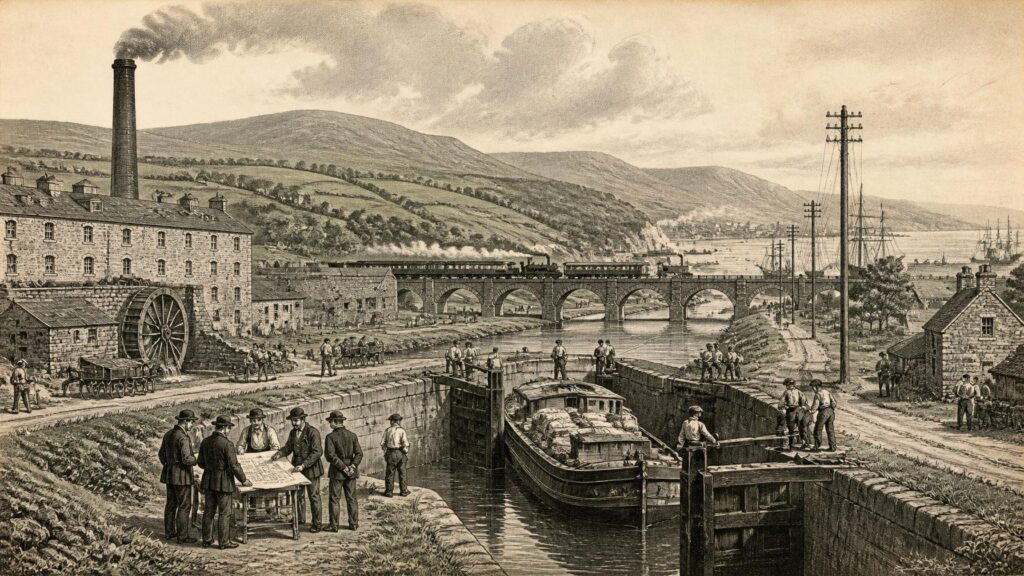
AI generated historical illustration, not a contemporary photograph.
At a Glance
Technology in Ireland has never meant merely the arrival of ingenious machines. It has meant practical knowledge: the learned ability to quarry, mine, smelt, build, weave, navigate, drain, generate, calculate and communicate. Its history is therefore a history of people and materials as much as of inventions. Across the island, technical change was shaped by local resources, external trade, political power, education and labour. It was uneven, often contested, and rarely a simple story of continuous progress.
Defining Technology
The phrase “Irish technology” can mislead if it suggests a single national tradition, a fixed territory or a procession of famous inventors. For most of the past, people did not use the modern word technology for their skills. They spoke of crafts, arts, trades, husbandry, engineering, manufacture or science. A fuller historical meaning includes tools and machines, but also techniques, systems of work, infrastructures, institutions and the transmission of knowledge. A watermill was a machine, for example, but it depended equally on a managed stream, masonry, timber, millstones, grain production, a workforce and rules governing access to flour.
Ireland’s position at Europe’s western edge mattered, though it did not make the island isolated. Sea routes linked coastal communities to Britain and continental Europe from prehistory onwards. Metals, styles, skills and ideas crossed the Irish Sea and the Atlantic-facing coasts. Later, imperial and commercial networks connected Ireland to Britain, North America, the Caribbean, continental Europe and beyond. Technology arrived through exchange, migration, conquest, investment, education and necessity; it was also altered by Irish users, workers and makers.
The evidence is not evenly distributed. Prehistoric technology is usually reconstructed from excavated objects, production debris, preserved timber and chemical or microscopic analysis. It can show that a process occurred, but often not exactly who performed it, how knowledge was taught or what a finished object meant to its owner. Medieval documentary records can identify mills, fisheries, bridges, ships and workshops, yet they frequently preserve the concerns of landlords, churches and governments rather than the voices of craftspeople. By the industrial era, drawings, company papers, newspapers, photographs and official reports become more abundant, although they too may celebrate promoters and overlook labourers.
That imbalance requires caution. The impressive survival of a sword, gold ornament, turbine hall or early computer may tempt historians to concentrate on exceptional objects. Everyday techniques were equally consequential: keeping a roof weatherproof, making a cart wheel, spinning yarn, repairing a net, maintaining a road, controlling water or operating a telephone exchange. The history of technology is not simply a gallery of firsts. It is a record of accumulated competence and of the social arrangements that enabled, restricted or directed its use.
Early Ingenuity
Long before metalworking, communities in Ireland worked stone, wood, bone, hide and plant fibre with considerable skill. The archaeological record preserves stone axes, flint tools, pottery, timber trackways and boats, while organic materials usually survive only in exceptional wet conditions. Such finds establish technical ability without licensing romantic claims that prehistoric Ireland possessed secret lost sciences. What they reveal is more interesting: repeated experimentation with available materials, careful observation of landscapes and durable traditions of skilled making.
Neolithic monument building required planning, quarrying, transport and collective labour. Passage tombs, court tombs and other monumental structures remain powerful evidence of social organisation, but their construction methods and meanings should not be collapsed into one explanation. The alignment of certain monuments with celestial events is demonstrable in particular cases; it does not prove that every decorative motif was a coded astronomical diagram. Likewise, the ability to move immense stones says much about co-operation and logistical knowledge, but not necessarily about centralised states in the modern sense.
Water presented both obstacle and opportunity. Dugout boats, made by hollowing tree trunks, demonstrate woodworking methods and coastal or inland mobility. The National Museum of Ireland preserves the evidence of a substantial logboat from Addergoole Bog in County Galway, dated to around 2500 BC. Its survival in peat is unusual. It should not be mistaken for the first boat used in Ireland, only for the oldest intact vessel presently identified in the Museum’s account. The wider lesson is that waterways were routes through the landscape, not margins beyond it.
Wooden trackways across bogs offer similarly striking evidence. They were engineered responses to ground that could swallow feet, animals and wheeled vehicles. Their construction demanded selection of timber, assembly, maintenance and an understanding of local terrain. Because bogs can preserve wood, such structures sometimes survive where ordinary roads do not. Yet a surviving trackway is not an entire transport system. It records one route, at one place, during a particular phase of use. Archaeologists must combine it with environmental evidence and surrounding settlement patterns before drawing larger conclusions.
Material Evidence
The transition to metalworking transformed both the practical and symbolic worlds of later prehistoric Ireland. The National Museum dates the Irish Bronze Age broadly from around 2500 BC to 500 BC, a useful framework rather than an invitation to attach false precision to every regional change. Copper and gold were worked early; bronze, an alloy chiefly of copper and tin, eventually permitted a wider and often more durable range of tools and weapons. Stone tools did not disappear at once. Technologies overlap, because older materials remain useful even when new ones become available.
Mining was itself a complex technical achievement. At Mount Gabriel in County Cork, archaeologists have recovered equipment associated with Early Bronze Age mining, including wooden and stone tools and resinous wooden tapers used for light. This is direct evidence for work underground or in confined mineral workings, not a literary image of heroic miners. It indicates the practical problems that miners confronted: breaking ore-bearing rock, providing illumination, carrying materials and organising labour in difficult conditions. Copper deposits in the south-west gave Ireland an important material resource, although metalworking also relied on long-distance exchange, especially where tin was required.
Metal objects preserve traces of processes that are easily overlooked when they are displayed as beautiful finished things. A copper axe could be cast in a stone mould and strengthened through hammering. Two-piece moulds made more complicated forms possible. Bronze demanded knowledge of alloying, melting, casting, finishing and repair. Goldworking depended on collecting or acquiring metal, melting it, making ingots and repeatedly hammering and shaping thin sheets. The familiar lunulae of early Irish goldwork are technical as well as artistic achievements. Their form reveals control of a soft but valuable material; their rarity and deposition suggest that technical skill was tied to status and ceremony.
Late Bronze Age hoards provide a particularly rich but difficult source. Collections of swords, spearheads, axes, tools, ornaments, cauldrons and horns show the range of production and the capacity to accumulate metal. The Castlederg cauldron from County Tyrone, fashioned from numerous sheets of bronze and secured with hundreds of rivets, is a compelling example of fabrication rather than simple casting. Its complexity should not lead to assumptions about factories or mass production. It points instead to specialised craft knowledge, access to metal and a social world in which feasting, display and ritual could justify elaborate objects.
Why so many objects entered bogs, rivers and lakes is not always known. Some deposits may have been storage, loss, disposal or concealment; others are widely interpreted as deliberate offerings. The archaeological contexts support the view that watery places were significant, but the exact beliefs of the people involved cannot be recovered. Here the boundary between evidence and interpretation matters. A weapon placed in a wetland is material fact. A precise reconstruction of the ceremony, deity or spoken words belongs to speculation unless independently supported.
Iron Skills
Ironworking altered the technical landscape again, although its development in Ireland remains harder to chart than popular narratives imply. Iron ore was more widely available than the ingredients required for bronze, but turning ore into usable iron required different and demanding processes. Smelting produced a bloom containing iron and slag; subsequent smithing consolidated and shaped the metal. Furnaces, hearths, charcoal, clay structures, bellows and skilled control of heat all formed part of the process. The end product was inseparable from the social organisation that sustained fuel gathering, ore collection and specialist labour.
Brian Dolan’s University College Dublin study of iron production brings together evidence from more than two hundred sites and challenges an older tendency to regard Ireland’s Iron Age chiefly through spectacular objects or later literary tradition. The evidence includes furnaces, smithing hearths, slag and associated features. It indicates that iron production occurred in varied settings and that the scale, distribution and social role of work changed over time. The archaeology is especially valuable because it brings ordinary productive activity into view, even when settlements themselves are sparse or difficult to identify.
For the earlier part of the period, evidence from the Midlands suggests dispersed and relatively small-scale smelting sites. Dolan argues that ironworkers may have held a dual practical and ritual role in a mobile, pastoral society. That is an interpretation grounded in site distribution and association, not a certainty about individual identity. It is plausible precisely because smithing combines technical knowledge with a visually powerful transformation of earth, fire and metal. But modern readers should resist projecting later images of the Celtic smith backwards without qualification.
Early medieval Ireland offers fuller evidence of craft specialisation. Iron was essential for agricultural tools, woodworking implements, weapons, fittings and domestic equipment. Smiths appear in legal and literary traditions, while excavations provide the physical residue of their work. Christianity and the growth of ecclesiastical centres also influenced production. Monasteries were places of worship and learning, but they were economic communities requiring food processing, building, metalwork, book production and connections to exchange networks. The presence of skilled craftwork at religious sites should not be romanticised as proof that monasteries alone drove innovation; secular settlements and households remained fundamental.
Medieval Work
Medieval technology in Ireland was principally practical and local, but it was not stagnant. Farming relied on tools, animal power, drainage, storage and seasonal knowledge. Boats and ships connected islands, river mouths and trading ports. Buildings combined timber, earth, stone, lime and thatch in forms adjusted to resources and status. The surviving record seldom permits a neat island-wide chronology, and regional differences were marked. Gaelic lordships, Hiberno-Norse towns, Anglo-Norman settlements, ecclesiastical estates and later colonial administrations all created different technical demands.
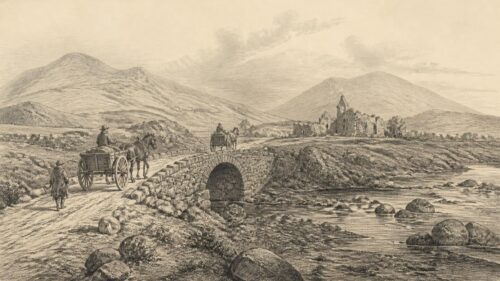
Watermills were among the most important installations. They converted the movement of water into rotary power for grinding grain and, in some contexts, other processes. A mill was not merely an appliance on a stream. It required a dam, leat or millrace, wheel, gears, stones, a building and continuing repair. Its placement could alter water rights and local routines. Milling also concentrated economic power: control of a mill could oblige tenants or neighbours to pay for grinding. Thus a modest-looking ruin can illuminate technology, landholding and social hierarchy together.
Textile work was widespread, much of it domestic and poorly documented. Spinning, weaving, dyeing and fulling depended on accumulated craft knowledge and on the labour of women as well as men. Linen later became synonymous with industrial Ulster, but flax processing and textile production have older roots. The distinction is important. Domestic or workshop production, however skilled, differed materially from the capital-intensive, mechanised factory systems of the eighteenth and nineteenth centuries.
Manuscript production provides another window onto technical culture. The making of vellum, inks, pigments, quills and bindings depended on specialist processes, while script itself was a trained technology of memory and administration. Illuminated manuscripts are often discussed as art, but their manufacture entailed material procurement and disciplined craft. Their survival is selective, favouring elite religious works; it should not obscure the many perishable practical texts, measurements and records that have vanished.
Medieval Irish and Norse towns, especially Dublin, Waterford, Wexford, Cork and Limerick, concentrated trades and maritime expertise. Archaeology has revealed woodworking, leatherworking, metalworking and trade goods in urban deposits. The technologies of ports included ship repair, quays, warehouses, rope, barrels, navigation and commercial accounting. None of this makes medieval Ireland an industrial society. It does show a technically capable economy in which local production and external exchange were closely interwoven.
Atlantic Connections
From the sixteenth century, political conquest, plantation, commercial regulation and military conflict reshaped technical life. New estates demanded surveying, improved roads, mills, fortified buildings and market towns. Knowledge travelled with settlers, soldiers, engineers, miners and merchants, while Irish labourers and craftspeople adapted to altered conditions. It would be misleading to call every imported technique an improvement: technologies served power as well as productivity, and the benefits of new infrastructure were distributed unequally.
Mining and metallurgy expanded in particular districts where capital, mineral deposits and transport converged. Ironworks, glassmaking, brewing, distilling and milling each depended on fuel, water, labour and markets. Woodland depletion could constrain charcoal-based industries. The availability of coal, especially through maritime supply and the developing industrial economy of Britain, changed possibilities but also reinforced dependency on external sources. Irish industrial development must therefore be understood within an archipelagic and imperial economy rather than as an entirely separate national path.
Surveying became increasingly important to administration, taxation, estate management and military strategy. Maps appear objective, yet they were instruments of power: they defined boundaries, represented resources and made land more legible to landlords and governments. The technical work of measuring was real and demanding, but its outcomes were political. A road, drainage scheme or estate map could ease movement and commerce for some people while facilitating eviction, enclosure or control for others.
Harbours and lighthouses likewise linked safety, trade and authority. Coastal engineering involved stonework, dredging, navigation marks and the maintenance of channels. Dublin’s Great South Wall, begun in the early eighteenth century, was a major intervention designed to improve access to the port by addressing the shifting sands of Dublin Bay. Such works demonstrated civil engineering capacity, but their scale also reflects the commercial primacy of particular ports. Infrastructure never spread evenly across the island.
Mechanical Change
The eighteenth and nineteenth centuries brought more conspicuous mechanisation, new energy sources and large transport systems. Ireland participated in the industrial revolution, but unevenly. Belfast developed into a major industrial city through linen manufacturing, engineering and shipbuilding. Other places possessed mills, breweries, distilleries, mines, rail workshops, ports and food-processing enterprises, yet much of the island remained dependent on agriculture. The contrast between industrial districts and rural regions was central to Irish social history.
Canals were among the first great modern civil-engineering networks. The Newry Canal opened in the eighteenth century, while the Grand and Royal Canals sought to connect Dublin with the Shannon system. Locks allowed boats to negotiate changing levels; embankments, aqueducts, bridges, warehouses and towpaths made the system more than a waterway. Canal construction mobilised capital and labour on a considerable scale. Its achievements endure in the landscape, even though railways later outcompeted canals for speed and flexibility on many routes.
Railways introduced a different technical logic. Tracks required controlled gradients, which in turn demanded cuttings, embankments, tunnels, bridges and viaducts. The first Irish railway line opened in 1832, and networks subsequently linked major towns and ports. Railway companies also built stations, sheds, water towers, signals, workshops and telegraph lines. The system altered timekeeping, travel, freight, tourism and patterns of trade. It did not simply erase distance: it privileged places on the network and could deepen the relative isolation of those left beyond it.
Engineering institutions and professional training grew with these demands. Civil engineers in Ireland designed or supervised harbours, drainage works, water supplies, railways, gasworks and public buildings. Their work often crossed political boundaries. Irish-born engineers contributed to projects in Britain and elsewhere, while engineers born outside Ireland worked extensively on Irish schemes. National labels are therefore less useful than attention to the practical networks of apprenticeship, contracts, professional bodies and capital through which expertise moved.
Factory Landscapes
Industrial technology was never solely a matter of engines. It reorganised work. The linen industry in Ulster demonstrates this clearly. Flax had long been cultivated and processed, but factory spinning and weaving concentrated machinery and wage labour in new settings. Steam power, mechanised preparation, spinning frames and power looms changed the relationship between household production and industrial employment. Belfast’s mills, warehouses and associated housing remade the city. The wealth they generated coexisted with dangerous work, long hours, insecure employment and sharp divisions of class and gender.
Newmills Corn and Flax Mills in County Donegal survives as a valuable reminder that industrial heritage was not confined to Belfast. Its waterwheel, corn-milling machinery, flax-processing context, forge and ancillary buildings show the interdependence of agriculture, local industry and mechanical power. A preserved site should not be treated as a complete social picture, however. It gives exceptional access to equipment and buildings, while the ordinary routines, fatigue and skill of workers must be reconstructed from wider evidence.
Shipbuilding became a defining industry in Belfast. The city’s yards depended on iron and steel, drawing offices, cranes, engines, rivets, specialised trades, docks and global contracts. The scale of the industry made Belfast internationally significant, but its output was part of the British imperial economy and subject to its booms, competition and military demands. To present shipbuilding simply as a triumph of local genius would conceal the labour of thousands and the structures of finance, trade and empire that made the yards possible.
Industrialisation also produced environmental consequences. Mines transformed hillsides and watercourses; mills polluted rivers; urban growth strained water supply and sanitation; peat cutting and drainage altered bog landscapes. Contemporary advocates generally described such interventions as improvement. That word needs scrutiny. Improved transport, lighting or output could be genuinely valuable, while the same processes damaged habitats, exposed workers to hazards or displaced older livelihoods. A historical account must hold those outcomes together.
Wired Society
The telegraph made information travel at a speed detached from the movement of people or goods. Nineteenth-century lines required poles, wires, stations, batteries, operators and maintenance, as well as legal rights of way and public administration. In Ireland, telegraphic networks became part of the wider United Kingdom’s communications system before independence. They served commerce, government, newspapers, railways and private messages. Their importance lay not only in invention but in regularity: communication became more immediate because a system of trained people and maintained equipment made it dependable.
Telephony extended this transformation, though access was unequal and the network remained inadequate in many places for much of the twentieth century. The modernisation of the Irish telephone system during the 1980s was significant precisely because telecommunications had become essential to business, public administration and international investment. Digital exchanges and improved connections did not create economic change by themselves; they formed one necessary part of a larger combination that included education, industrial policy, international markets and the decisions of firms.
Radio created a different kind of technical and cultural infrastructure. The Irish station 2RN began broadcasting in January 1926, in the unsettled early years of the Free State. It was small by later standards, but broadcasting made sound, language, music, news and official messages available simultaneously across distance. A wireless set was a domestic technology, yet radio was organised through licences, transmitters, studios, engineers, performers and state policy. Its history complicates any assumption that technology is neutral: broadcasting could foster shared cultural experience, but it also involved choices about language, authority and representation.
Aviation had an early Irish pioneer in Harry Ferguson, who built and flew a monoplane at Hillsborough, County Down, in 1909. The documented achievement deserves recognition, but it is best understood as one episode in a transnational era of experimental flying rather than as an isolated national breakthrough. Ferguson later became far more widely associated with agricultural machinery and the tractor. His career illustrates how technical innovation often proceeds through adaptation, business partnerships, patents, manufacturing and marketing, not only through a dramatic first demonstration.
National Power
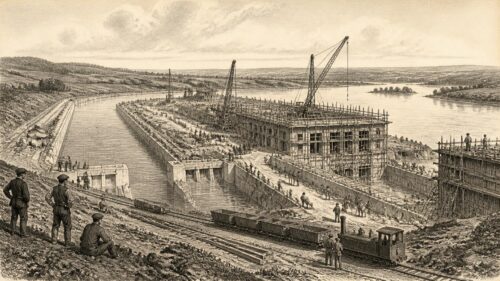
The creation of the Irish Free State raised acute questions about infrastructure, economic capacity and national self-confidence. The Shannon Scheme at Ardnacrusha became the most powerful technological symbol of the new state. Begun in 1925 and completed in 1929, it diverted water from the Shannon through a major hydroelectric installation in County Clare and was constructed alongside a national transmission network. The project’s magnitude made it unmistakably more than a power station. It was a declaration that a new state could undertake complex modern engineering.
Its technical characteristics remain impressive. A weir and headrace canal directed water to the power station; large penstocks carried it to turbines; a tailrace returned it to the river. ESB archival material records an original generating capacity of 86 megawatts, sufficient at the time to meet the country’s electricity demand. The scheme involved thousands of Irish and German workers and drew heavily on Siemens expertise. That international participation matters. Ardnacrusha was a national project, but not an autarkic one. Its creation depended on imported equipment, foreign specialists, state finance and Irish labour.
The project also had costs and consequences. Large hydraulic schemes alter rivers, fisheries, landscapes and local access. Construction exposed workers to dangerous conditions and brought temporary camps and intense disruption to the area. Official publicity presented electrification as a modernising triumph, which it undeniably was in many respects, but historical interpretation should include the human and environmental adjustments that such a vast intervention required. National symbolism can obscure these complexities if it becomes celebratory ritual.
Electrification proceeded gradually. Generating capacity alone did not put power into homes, farms and workshops. Transmission lines, local distribution, wiring, appliances, pricing, demonstrations and consumer confidence were all necessary. ESB showrooms and advertising encouraged the use of electric cooking, lighting and heating. The Rural Electrification Scheme, developed after the Second World War, extended the transformation more widely. For many households, electricity changed daily life through lighting, pumps, radios, refrigeration and labour-saving appliances. Yet access, affordability and adoption varied by place and income.
The Irish state’s relationship with technology was consequently both practical and ideological. It used semi-state bodies and public investment to build networks that private capital had not provided comprehensively. But it also sought industrial development through foreign investment and imported expertise. Neither state action nor external investment alone explains later change. Ireland’s twentieth-century technical history is better understood as the interaction of public infrastructure, education, enterprise, international capital and social demand.
Digital Foundations
Computing entered Ireland first through universities, research, government and larger organisations rather than through household devices. Trinity College Dublin’s acquisition of an IBM 1620 in 1962 gave the institution an early digital computer. The machine was physically imposing, dependent on specialist accommodation and operated within an engineering environment. It was not a personal tool in the later sense. Its significance lay in opening a space for programming, mathematical calculation and formal teaching at a time when computing was still scarce and expensive.
John Gabriel Byrne played a central role in that development. At Trinity, he helped build computer science as an academic field, encouraged programmes aimed at industry and public service, and became the first chair of computer science in 1973. The Master of Science in Computer Applications began in 1963, and a computer-engineering stream followed in 1966. These dates matter because they show that Ireland’s later reputation in software and information technology rested partly on institutional preparation over decades, rather than appearing suddenly with the economic expansion of the 1990s.
Educational history is often told through distinguished professors, and Byrne’s contribution was substantial. Yet the making of a computing culture also depended on students, technicians, administrators, part-time teachers and employers willing to use new skills. Courses in systems analysis, computer applications and later information and communications technology did more than train programmers. They helped organisations understand computers as tools for records, modelling, communications and decision-making. The spread of digital competence was therefore social as well as technical.
The expansion of electronics, software and information services in late twentieth-century Ireland arose from several converging factors. Industrial policy agencies sought international investment; membership of the European Economic Community widened economic horizons; telecommunications improved; higher education expanded; and multinational companies found a young, English-speaking workforce with growing technical training. This was not an inevitable “Celtic Tiger” destiny. It depended on policy choices, global corporate strategies and conditions that could change. It also created vulnerabilities, including dependence on internationally mobile capital and pressure on housing, energy and infrastructure.
Technology companies became especially visible in Dublin, Cork, Galway, Limerick and other centres, but digital work was never confined to foreign firms. Indigenous software businesses, university research groups and public-sector systems also mattered. The distinction between an Irish technology sector and technology in Ireland is useful here. The first refers to locally based firms and workers; the second includes the broader infrastructure, multinational presence, education and regulation that shaped technical life on the island. Both belong in the history, but they are not the same thing.
Critical Legacies
The long history of technology in Ireland resists a triumphal conclusion. Prehistoric metalworking, medieval mills, nineteenth-century railways, electrification and computing each expanded what people could make or do. They also redistributed power. A canal could connect markets while bypassing communities; a factory could create wages while imposing discipline; a power line could illuminate homes while transforming a landscape; a computer network could create opportunity while concentrating valuable infrastructure and data in particular places.
Folklore and national memory have often attached grand claims to technology. Ancient monuments are said to contain lost engineering secrets, individual inventors are made sole creators of complex systems, and major projects become proof that a people was either uniquely ingenious or chronically denied modernity. Such stories can be emotionally powerful, but history should distinguish them from documented evidence. Ireland’s technological past is compelling without exaggeration. It contains sophisticated craft, adaptation, institutional ambition, imported knowledge, local labour and repeated efforts to overcome geographical and economic constraints.
It also requires an all-island perspective. Political jurisdictions changed, particularly after partition, while technical networks often crossed or were affected by the border. Belfast’s industrial history cannot be detached from the history of Ireland, nor can the Free State’s electrification be understood without its international suppliers and neighbours. The same applies to transport, communication, energy and education. Technologies create connections that do not always match political maps.
The most durable lesson is that technology has always been made collectively. The miners at Mount Gabriel, smiths whose names are lost, millwrights, canal navvies, linen workers, shipyard riveters, telephone operators, engineers, electricians, programmers and students all form part of the record. Famous inventors and flagship projects matter, but they were sustained by communities of practice. To make Ireland, in the technological sense, was to organise materials, skills and labour into working systems.
That perspective offers a more honest inheritance. It recognises accomplishment without treating every intervention as progress, accepts uncertainty where evidence is incomplete, and places technical knowledge within the social worlds that produced it. Ireland’s history of technology is not a peripheral appendix to political history. It is one of the means by which people travelled, worked, communicated, acquired power, imagined improvement and negotiated the changing conditions of life.
Computing Foundations
The history of computing in Ireland is not reducible to the arrival of a single machine, any more than electrification was reducible to Ardnacrusha. Computers depended on rooms, power supplies, technical staff, programmers, teachers and institutions prepared to treat calculation and information processing as durable public and professional concerns. Trinity College Dublin’s acquisition of an IBM 1620 in 1962 is therefore significant both as an event in equipment history and as evidence of an emerging commitment to computing. Delivered on 16 June that year, the machine had to be lifted by crane through a window at 21 Lincoln Place. The logistical detail is revealing: early computers were physical installations whose size, cost and maintenance set them apart from the later familiarity of personal devices.
John Byrne played a central part in making computing an academic field in Ireland. He helped propose the purchase of Trinity’s first computer and, after beginning his career in engineering, became the university’s first Chair of Computer Science in 1973. The sequence matters. Computing did not simply emerge as a separate, self-contained discipline; it grew from connections with mathematics, engineering, administration and scientific research. In 1966, Trinity added a Computer Engineering stream to the Bachelor of Arts in Engineering. Four years later it introduced an evening BSc in Computer Science. These courses widened access beyond the conventional full-time undergraduate route and helped establish a trained cohort able to work across public bodies and private firms.
The Department of Computer Science itself had been established in 1969, with Byrne as head. Its growth from three academic staff that year to twenty-two a decade later illustrates the labour behind a new technical field. Computing required lecturers, laboratories, curricula and sustained institutional support, not merely enthusiasm for new equipment. It also required students to acquire habits that are easily made invisible in retrospective accounts of innovation: writing programs, testing systems, interpreting results, documenting work and learning to collaborate. Such skills turned machines into useful systems.
This educational infrastructure had consequences beyond the university. Trinity’s account credits Byrne’s programmes with helping to supply skilled professionals for the public sector, foreign investment and indigenous information and communications technology enterprises. That formulation should be read carefully. Education alone did not determine economic development, and a university department cannot explain the later technology sector by itself. Yet it identifies a necessary connection between technical training and wider capacity. Computing became socially important when knowledge travelled from classrooms and laboratories into offices, services, companies and government.
The later emergence of companies associated with the department demonstrates both continuity and change. Iona Technologies, created by Chris Horn and colleagues in 1991, and Havok, founded by Hugh Reynolds and Steven Collins in 1998, belonged to a world of software, international markets and intellectual property rather than to the heavy machinery of earlier industrialisation. Even so, they rested on familiar historical foundations: specialised education, collaborative work, finance, management and links beyond Ireland. The movement from crane-delivered mainframe to software enterprise was not a clean break with the island’s technical past. It was another example of technology being made through institutions, skilled people and networks of exchange.
Making Ireland presents technology as a social system rather than a sequence of celebrated machines. The discussion of watermills is revealing: a mill required engineering skill, environmental management, labour and rules over access, while potentially concentrating power in landlords’ hands. This perspective complicates accounts of progress, because the same infrastructure could improve production yet deepen dependency. Similar tensions appear in canals, electrification and telecommunications, whose benefits were unevenly distributed. How might historians compare the social consequences of these infrastructures across periods, and what kinds of evidence could best recover the experiences of workers, tenants and households absent from official records?