

Pension Promises
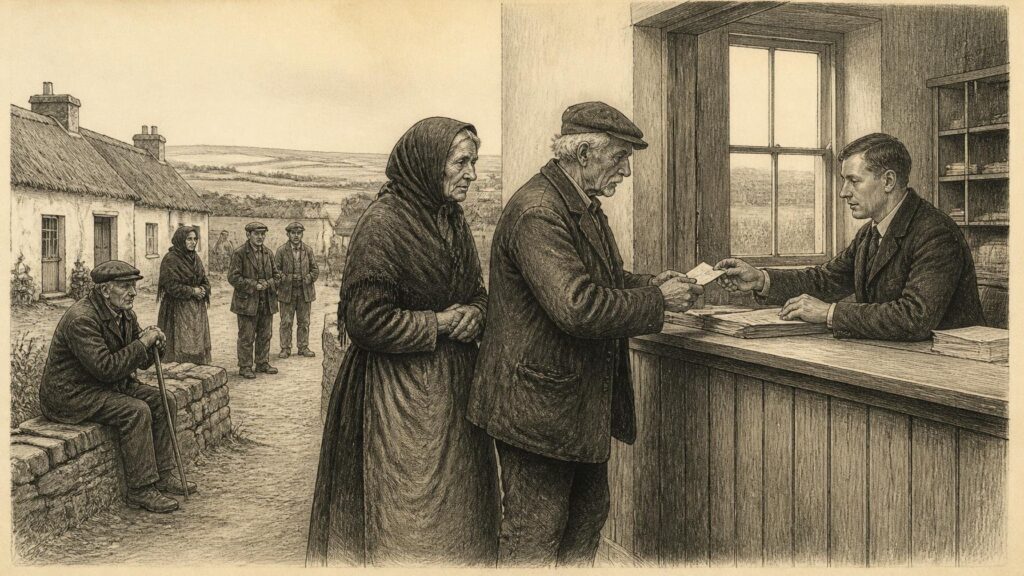
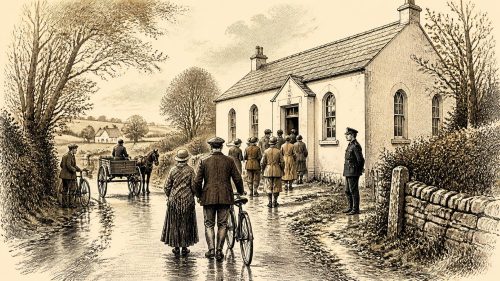
AI generated historical illustration, not a contemporary photograph.
At a Glance
For more than a century, pensions have stood at the meeting point of poverty, family obligation, work, political calculation and citizenship in Ireland. The old-age payment introduced before independence did not end insecurity in later life, but it fundamentally altered what older people could expect from public authority. Its history is therefore not merely one of rates and rules. It is a history of contested dignity: of applicants proving their ages, households negotiating control of a small income, ministers balancing budgets, and communities remembering a cut long after its immediate financial effect had passed.
Poor Relief
Before the old-age pension, security in later life depended principally upon resources accumulated outside the state. These might include ownership or use of land, savings, a trade, continuing wages, the support of children, remittances from emigrant relatives, charity or admission to the workhouse. None was certain. For many labourers, domestic servants, small farmers, urban casual workers and people impaired by illness or disability, old age could mean a sharp decline in earning power without a corresponding right to income.
The Irish Poor Law, introduced in 1838, supplied an institutional response to destitution. Its workhouse system was designed around deterrence as much as relief. Conditions were deliberately austere, families could be separated on entry, and the stigma associated with the workhouse was profound. Outdoor relief later became more important, especially after changes in the nineteenth century, but assistance remained locally administered, conditional and often inadequate. It was relief for poverty rather than an entitlement earned through age, labour or citizenship.
This distinction matters. A pension is not simply money paid to an older person. In political language and personal experience it suggests a claim of a different kind: a regular payment received as of right when conditions have been met, rather than a discretionary concession to an acknowledged pauper. The boundary was never wholly clean. Early old-age pensions retained means tests, moral exclusions and intrusive enquiries. Yet the new language of pension carried a dignity that poor relief rarely possessed.
There were, of course, pensions in Ireland before old-age pensions. Civil servants, soldiers, police officers, judges, clergy and holders of offices could receive retirement or service payments under a variety of arrangements. Eighteenth-century Irish pension lists were also notorious in political controversy because they could reward patronage, influence and absentee interests. Such pensions were neither a general provision for ageing nor a precursor in any straightforward social sense to the twentieth-century welfare state. They demonstrate instead that the word “pension” had long been associated with power and public expenditure before it became associated with ordinary older people.
By the late nineteenth century, Ireland’s social circumstances sharpened the question of provision in later life. Emigration had altered family structures and could deprive elderly parents of daily support even when remittances arrived. Agricultural households might support parents through informal arrangements involving land transfer, residence and labour, but these arrangements could be fragile. In towns, low and intermittent wages made saving difficult. The familiar picture of an Irish extended family sustaining every elderly person should therefore be treated with care. Family care was real and important, but it was neither universal nor sufficient.
Historians also caution against treating “the aged poor” as a single group. Older women were especially exposed where they had little independent property, had spent years in unpaid domestic work, or had been dependent upon a husband’s earnings. Older men could lose status as well as wages when physical capacity declined. Religious, local and voluntary organisations offered relief, but their support varied by place and circumstance. The problem was not that Ireland lacked neighbourliness; it was that neighbourliness could not reliably insure every person against the risks created by age, illness, widowhood and an unstable labour market.
In this setting, the demand for an old-age pension grew as part of a wider British and Irish debate about social reform. It was not inevitable. Critics worried about cost, dependency and fraud, while supporters argued that a civilised state should prevent respectable workers ending their lives in the workhouse. Those arguments travelled across the Irish Sea, but they acquired particular force in Ireland because old-age poverty was visible, family resources were often stretched, and the Poor Law was so widely resented.
Liberal Reform
The Old Age Pensions Act of 1908 was enacted by the Parliament of the United Kingdom and applied to Ireland as well as to Great Britain. Payments began in January 1909. It was a landmark measure, though its scope should not be overstated. The scheme was non-contributory: eligibility did not depend upon a lifetime of insurance payments. It was means tested, however, and initially confined to people aged seventy or over whose yearly means fell below the statutory limit. The maximum pension was five shillings a week, with lower payments for those assessed as having higher means.
The pension was introduced during the Liberal government’s wider programme of social reform. That programme is often compressed into a simple story in which David Lloyd George gave Britain and Ireland a welfare state. The reality was more complicated. Political pressure from organised labour, reforming administrators, social investigators and the fear of poverty in industrial society all mattered. The old-age pension preceded National Insurance, and it did not abolish the Poor Law. Still, it recognised a new public responsibility: age itself, combined with limited means, could create a legitimate claim upon national revenue.
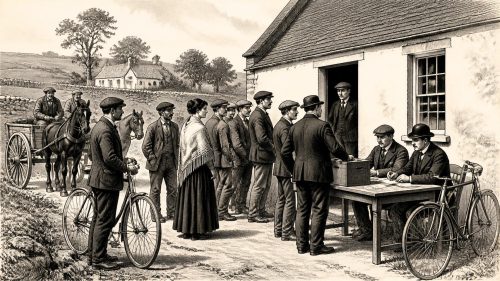
For Ireland the measure had immediate practical importance. The pension was deliberately administered outside the ordinary poor-relief machinery. Pension officers investigated claims, local pension committees considered them, and payment was made through the Post Office. This arrangement was intended to distinguish the payment from pauper relief and reduce the humiliation associated with approaching the workhouse or local relieving officer. The Post Office counter became, in that sense, an everyday site of the emerging welfare state.
Eligibility rested on more than age and means. The legislation excluded certain people, including those who had recently received poor relief in specified circumstances, people convicted of serious offences, habitual drunkards and those judged not to have worked to the best of their ability. Such provisions reveal the moral assumptions embedded in early welfare. The pension was presented as a reward or protection for deserving old people, not as an unconditional guarantee. Administrators had to decide not only what a claimant possessed but, at times, how the claimant had lived.
The age threshold of seventy was high even by contemporary standards. It limited cost, but it also meant that many people who were already unable to support themselves received nothing. Average life expectancy figures can mislead here, because infant and childhood mortality reduced averages dramatically. Some people certainly lived into their seventies and beyond; the pension’s popularity showed that the eligible population was substantial. Yet reaching seventy was itself an achievement unequally distributed by class, occupation, sex, place and health.
The rate was modest. Five shillings did not make a household prosperous, and the pension usually had to be combined with family assistance, occasional work, charity or savings. Its importance cannot be measured only in purchasing power. A predictable weekly payment could buy food, fuel or clothing; it could reduce debt; it could mean that an older person had money under his or her own control. For people who had relied on uncertain support, even a small independent income could change domestic relationships.
The introduction was also politically revealing. Far from viewing the pension merely as a British import with little local consequence, Irish communities engaged intensely with it. Applicants sought evidence, local committees heard cases and disputes became matters of public concern. The pension helped draw many people into direct dealings with the state. In doing so, it created expectations that outlasted the United Kingdom of Great Britain and Ireland itself.
Age Evidence
The most famous administrative difficulty of the early Irish pension was proving age. Civil registration of births had not existed throughout the claimants’ lives: registration began for non-Catholic marriages in 1845 and for all births, deaths and marriages in 1864. A person claiming in 1909 to be seventy may therefore have had no civil birth certificate. Parish registers varied in survival and accessibility, family Bibles could be absent, and many older people had little reason previously to know their precise date of birth.
The 1841 and 1851 census returns became especially important because they were the principal surviving official sources capable of identifying many people born before civil registration. Claimants and officials searched them for evidence of age. The task was difficult even before the destruction of most nineteenth-century census returns in the fire at the Public Record Office of Ireland in 1922. It involved uncertain spellings, changes of residence, common names, incomplete information and ages that had often been rounded or estimated when first recorded.
A vivid strand of popular memory attached age claims to the Night of the Big Wind, the severe storm of 6 January 1839. Applicants who could not provide a document sometimes remembered whether they had been born before, during or after that event. The story is frequently retold as though everybody in Ireland suddenly acquired decades in order to obtain a pension. That is folklore when expressed as a universal claim. The documented reality is more interesting: a major shared event could be used as a chronological marker by people whose lives had not generated the records demanded by the modern state.
The pension therefore exposed a mismatch between administrative requirements and ordinary historical memory. Officials needed a date or an age that could be converted into a statutory decision. Claimants might possess a life history remembered through storms, marriages, harvests, deaths, places and kin rather than through written certificates. Neither form of knowledge was inherently irrational. The conflict arose because the state required one form to decide entitlement and often doubted the other.
Contemporary critics alleged extensive exaggeration of age in Ireland. The number of applicants and the number found eligible exceeded official expectations. It is tempting to treat this simply as evidence of fraud. That conclusion is too easy. Ireland had a relatively old population in part because many younger people had emigrated; record keeping was uneven; and the pension gave older people a powerful reason to investigate an age which had previously carried little administrative value. The 1911 census itself was influenced by this new incentive to report age carefully, although it cannot be assumed that every reported age became exact.
Recent scholarship has stressed the agency of claimants in this process. An applicant was not merely an object of investigation. He or she could marshal neighbours, relatives, clergy, memories and documents in support of a claim. That did not remove the unequal power between claimant and official, nor did it guarantee a successful result. It does, however, correct the image of passive poor people waiting to be classified by the state.
The surviving traces of these searches now have another value. Pension-related enquiries into parish records, including Church of Ireland material, form part of the archival landscape used by family historians. Their survival is accidental in one sense: they were produced to decide welfare claims, not to preserve family history. Yet they show how a social policy could generate records that later illuminate everyday lives otherwise faintly represented in official archives.
Local Judgement
The old-age pension was national in funding and statutory origin, but its early operation was highly local. Pension committees, often linked to local government structures, considered claims after investigation by pension officers. This created opportunities for practical knowledge: neighbours might know whether a claimant had resources, family members could be consulted, and local conditions could be understood. It also created room for inconsistency, embarrassment and conflict.
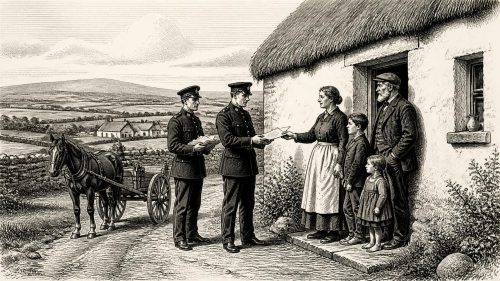
Means testing was central to that experience. Officials had to estimate income and property where formal accounts were rare. A claimant’s holding, livestock, savings, support from children, room rental, casual earnings or rights in a farm might all become relevant. The process could require elderly people to disclose the details of their households to local figures they knew. The line between reasonable verification and humiliating intrusion was therefore difficult to police.
The pension’s impact on family relations was similarly mixed. It could make an older person less dependent upon adult children and reduce pressure on a household budget. In other cases, relatives may have regarded the pension as a contribution expected from the recipient. There is no single Irish household story. The payment could enlarge personal autonomy, reinforce reciprocal obligations or become a point of domestic bargaining. Its consequences depended on housing, health, gender, landholding, family composition and local custom.
Women were prominent among recipients from the beginning. This reflected demographic facts, including women’s greater survival at older ages, but also economic histories. Many women had performed lifelong work for which no wages, formal insurance record or independent savings existed. A non-contributory pension could therefore reach people whom an employment-based scheme would have missed. Yet it did not erase gender inequality. Means tests could take account of household resources over which women did not necessarily exercise control, and the state’s later social-insurance model often reproduced assumptions about male breadwinning.
The pension was sometimes described in affectionate popular language as a blessing, and many accounts stress the welcome created by the first payments. Such language should not conceal its limits. A pension at seventy left a long period of vulnerability for people whose health or earning capacity failed earlier. Disqualifications and investigations remained real. Nor did a weekly payment solve overcrowding, poor housing, illness or isolation. Still, contemporary evidence and later historical research support the judgement that the scheme was materially meaningful for many recipients.
Research on Limerick City has suggested that the introduction of the pension may have contributed to improved survival among older people, particularly through a modest but dependable income that improved access to necessities. This is an interpretation based on burial records and contextual evidence, not a claim that one payment alone caused longer lives. Public health improvements, changing living conditions and other welfare measures also mattered. The value of the research lies in showing how social policy can be studied not only through legislation but through the lived outcomes visible in local records.
By transforming old age into an administratively recognised category, the scheme also altered political expectations. People who had never imagined the state as a source of ordinary income now had experience of claiming, receiving, appealing and comparing entitlement. This did not make them uniformly loyal to government. It gave them, rather, a concrete basis on which to judge it.
Revolutionary Years
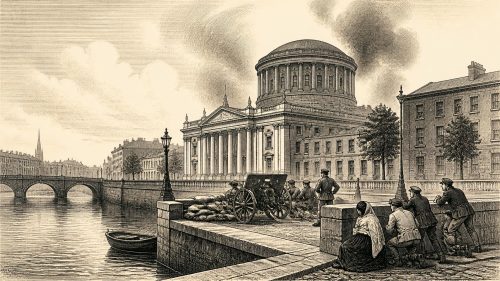
The pension survived the upheavals that remade Ireland between 1916 and 1923. This continuity is historically significant. The years of revolution, war, partition and state formation are often narrated through military and constitutional events, but older people continued to collect pensions and officials continued to decide claims. Social administration did not cease when political sovereignty changed; it had to be carried through the disruption.
Partition produced two distinct political jurisdictions after 1921. Northern Ireland remained within the United Kingdom and developed within the British social-security framework. The Irish Free State inherited responsibility for administering old-age pensions in the twenty-six counties. A history of “Irish pensions” must therefore be geographically careful. The early scheme was island-wide because Ireland was then part of the United Kingdom; after partition, pension histories increasingly diverged, even where shared origins and family connections remained important.
The Free State faced severe financial pressures. The Civil War had imposed extraordinary costs, state institutions were being built, and ministers were anxious to establish fiscal credibility. In that setting, pensions were not protected from retrenchment simply because they were popular. The Old Age Pensions Act of 1924 reduced payments and tightened the means position. The maximum weekly pension was cut by one shilling, from ten shillings to nine shillings, alongside changes designed to reduce eligibility or payment levels for people with other means.
The reduction became one of the most enduring episodes in the political memory of the Free State. Ernest Blythe, minister for finance, was associated with it so closely that “Blythe’s shilling” entered public recollection. Later politicians repeatedly invoked the phrase when opposing cuts to welfare payments. The persistence of that memory should not be mistaken for a complete explanation of the 1920s budgetary crisis. It is, however, evidence that a small reduction in a payment to poor older people could acquire exceptional symbolic force.
Why did it endure? Partly because the pension was already regarded as an earned moral claim, notwithstanding its non-contributory character. A cut could be represented as a taking from those least able to bear it. Partly because the new state was judged by a higher standard than the old: independence had raised hopes that government would be closer to the people and more responsive to hardship. Fiscal prudence may have been the stated rationale, but it did not neutralise the emotional and political meaning of the decision.
The episode illustrates a larger truth about pension politics. Public debate does not weigh expenditure only against revenue. It weighs policy against ideas of reciprocity, sacrifice and national obligation. Governments may believe that a cut is technically modest or fiscally unavoidable. Recipients and their families may experience it as a statement about whose security can be sacrificed. The disparity between those viewpoints explains why pension reductions are remembered so intensely.
It is important not to romanticise the pre-cut scheme as generous. Even before 1924, payments were limited and conditional. Nor was every hardship caused by government policy; inflation, employment conditions, housing and family circumstances all shaped living standards. Yet the cut became a shorthand for a harsh aspect of early Free State governance. It demonstrated that social welfare could be central to political legitimacy, not an administrative matter at the margins of national history.
Welfare Expansion
During the decades after independence, the old-age pension remained a key element of social provision, but it formed part of an increasingly complex system. The state addressed risks through a mixture of non-contributory payments, insurance-based benefits, family payments, health arrangements and local assistance. Progress was uneven, and means testing continued to shape access to support. Nonetheless, the principle that the state bore a continuing responsibility for income security became more deeply established.
The 1930s and 1940s saw persistent political debate over pension rates and the means test. Inflation could erode the value of nominal increases, while living costs did not affect all households equally. A pensioner living with family, one paying rent in a town, and one maintaining a rural dwelling could experience the same rate very differently. Public arguments over a few shillings might sound small in retrospect, but they concerned food, turf or coal, clothing, medicine and the ability to avoid debt.
The first inter-party government, formed in 1948, increased old-age pension rates substantially. William Norton, Labour leader and minister for social welfare, became strongly associated with this expansion. Such changes were not simply acts of generosity. They responded to political pressure, post-war expectations and a recognition that older people had borne the strain of long economic stagnation. The rate remained modest, but the increase signalled that pensions were a prominent measure of social policy.
The Social Welfare Act of 1952 was another major turning point. It established a co-ordinated system of social insurance and brought together or reshaped earlier schemes relating to health insurance, unemployment insurance, pensions, widows and orphans, unemployment assistance and related matters. The Act also provided the statutory basis for the Social Insurance Fund. In institutional terms, this was a move away from isolated measures towards a more integrated social-security framework.
Contributory old-age pensions emerged within this new order. Their significance lay in the principle that social insurance contributions could establish entitlement without the ordinary means test associated with non-contributory old-age provision. The distinction was powerful. A contributory pension was linked to insured employment and payment into a collective fund; a non-contributory pension remained a safety-net payment assessed through means. Both were state pensions, but they expressed different ideas about how entitlement should be justified.
The new system did not instantly cover everyone equally. Insurance followed the structure of employment, and employment itself was divided by occupation, income, sex and legal status. Agricultural workers, domestic workers, part-time workers, the self-employed and public servants did not all enter coverage on the same terms or at the same time. Nor did contribution records necessarily map neatly onto real working lives. Interruptions caused by care, marriage, illness, migration or precarious work could later affect pension outcomes.
For that reason, the non-contributory pension did not become obsolete. It remained essential for people with inadequate insurance histories, including many women and people whose work had been outside standard insured employment. Irish pension history should not be told as a simple march from “welfare” to “insurance”. The two traditions coexisted because each addressed needs the other left unresolved.
Insurance Rights
The growth of contributory pensions changed the language of later-life security. Instead of claiming because one was poor at seventy, an insured worker could claim because statutory contributions had been paid over time. This could reduce the stigma attached to receiving a pension and offered a clearer relationship between work, contribution and benefit. It also strengthened the political appeal of social insurance: people could see themselves as participants in a system rather than merely beneficiaries of assistance.
Yet contribution-based entitlement contains its own exclusions. The model most readily fits a stable, continuous, waged career. Many actual lives do not fit that pattern. Women who left paid employment to care for children or relatives, migrants who moved between countries, workers with seasonal employment and people in low-paid or informal jobs could have patchy records. The administrative challenge was not merely technical. It involved deciding which forms of labour and care the state would recognise when calculating security in old age.
Irish reforms gradually extended social-insurance coverage to groups previously outside or only partly inside the system. Part-time workers, self-employed people and many public-sector workers became more comprehensively included over time. The detailed rules changed repeatedly, and the effect of each change depended on dates of birth, insurance entry and individual contribution records. This is why pension history is full of apparently anomalous cases: people born only a few years apart, or who worked under different classifications, could face markedly different outcomes.
The social-insurance system was financed on a pay-as-you-go basis. Current contributions supported current benefits, with the Exchequer able to make good shortfalls in the Social Insurance Fund. This is not a personal savings account in which each worker simply withdraws accumulated deposits. It is a collective arrangement connecting generations, employment levels and public finance. Its sustainability therefore depends on demography, wages, labour-force participation, contribution rules and political willingness to support it from taxation when necessary.
That collective character complicates familiar political language. Calling a contributory pension “earned” captures something important: people do contribute through employment-related insurance, and that contribution supports an expectation of entitlement. But it can also imply a misleading one-to-one account between an individual’s payments and later receipt. In practice, the scheme embodies social pooling. The same is true, in another way, of non-contributory pensions funded from general taxation. Both rest on collective decisions about who should be protected from poverty in later life.
Private occupational pensions developed alongside the public system, particularly among employees with more secure and better-paid work. They could provide additional retirement income, but access was uneven. Coverage depended on occupation, employer practice, earnings and continuity of service. Consequently, private pensions often reflected the inequalities of the labour market rather than correcting them. Public pensions remained the foundation of retirement income for many people.
The gendered consequences were especially important. The state’s gradual recognition of homemaking and caring periods within contribution arrangements acknowledged that unpaid work could otherwise produce a pension penalty. Such measures mitigated rather than eliminated longstanding disparities. The history of Irish pensions thus includes a slow broadening of the official definition of a working life: from paid employment alone towards a more qualified recognition that care sustains families and the economy.
Changing Language
By the early twenty-first century, the terms “Old Age Contributory Pension” and “Old Age Non-Contributory Pension” were increasingly regarded as outdated. In 2006 the official scheme names changed to State Pension (Contributory) and State Pension (Non-Contributory). This was more than cosmetic, though it did not alter the underlying distinction between insurance-based entitlement and a means-tested payment. The change reflected a recognition that people reaching pension age were not necessarily best described as old or inactive.
Names matter because welfare categories shape public imagination. “Old age pension” retained the history of the 1908 scheme, with its age of seventy and its associations with poverty. “State pension” placed the payment in a broader framework of citizenship, insurance and retirement. It also acknowledged changes in longevity, health and patterns of work. Many people at pension age remained active in paid employment, voluntary activity, family care or community life.
The renaming did not settle the deeper questions. Ireland continued to have a two-pillar public structure: a contributory pension based on social-insurance conditions and a non-contributory pension subject to a means test. That arrangement preserves a balance between recognising contributions and preventing poverty among those without sufficient contributions. It also ensures recurrent argument about fairness. Some see means testing as properly directing resources towards those who need them most; others view it as intrusive, unfair to people with modest savings, or inconsistent with universal social citizenship.
Pension age has likewise remained politically sensitive. An age threshold is often presented as a neutral number, but it affects people with very different health, occupations and expectations. A professional able to continue working in comfort does not experience a higher pension age in the same way as a manual worker whose body has been worn down by labour. Conversely, a fixed age can understate the capacities and wishes of people who want to continue working. Historical debate has repeatedly exposed this tension between uniform rules and unequal lives.
Modern pension policy also has to account for migration. Ireland’s long history of emigration means that many people have worked in more than one jurisdiction. European coordination rules and bilateral social-security arrangements can allow insurance periods in different countries to be combined for certain purposes, subject to conditions. Such arrangements are a modern administrative response to a very old Irish reality: working lives have often crossed borders.
The language of crisis sometimes obscures continuity. Concerns about ageing populations, affordability and the relation between work and retirement are not wholly new. What has changed is the scale of actuarial information, the complexity of financial products and the extent to which retirement security is debated as a long-term national fiscal issue. What remains familiar is the political difficulty of changing a payment that people understand as a promise.
Public Memory
Pensions possess unusual political resonance because they connect private life to public authority in a regular, visible way. A road scheme may be distant from daily experience; a pension payment enters household budgeting week after week. It becomes entangled with rent, food, heating, family gifts, medical costs and the wish not to ask children for money. That intimacy helps explain why changes in rates, qualifying rules or pension age attract intense attention.
The memory of Blythe’s shilling demonstrates how policy becomes folklore without ceasing to be history. The documented event was a statutory reduction in 1924 under particular fiscal conditions. The later phrase carried far more: it became a warning against economies imposed on vulnerable people and a symbol of governmental hardness. It circulated through family stories and political rhetoric. Its endurance does not prove that every later account of the measure is exact; it proves that the episode acquired a moral meaning strong enough to be transmitted.
Other pension stories require similar discrimination. It is supportable to say that claimants sometimes used the Night of the Big Wind as an aid to recalling age. It is not supportable to claim, without evidence for each case, that older Irish people generally fabricated ages en masse. It is supportable to say that pensions reduced some dependency and gave recipients more control over money. It is not supportable to assume that every family welcomed a pensioner’s new independence or that every recipient controlled the payment freely.
Documented evidence is strongest where legislation, official returns, administrative files, parliamentary debates and contemporary records survive. Interpretation begins when historians connect those materials to wider social change: for example, when they assess whether pensions improved health, changed household authority or contributed to state formation. Folklore enters where memorable events, sayings and family narratives preserve experience in condensed form. None of these categories is worthless. They answer different questions and should not be confused.
The historical significance of Irish pensions lies partly in this overlap. A pension is a legal entitlement defined by statutes and regulations. It is also a social relationship experienced at a post-office counter, during a means inquiry, within a household and in arguments at election time. Its meaning cannot be recovered from a rate table alone. Equally, memory needs to be checked against chronology and records if it is to become reliable history.
From the Poor Law to the State Pension, the central issue has remained remarkably consistent: how should a society distribute the risks of ageing? Ireland’s answers have shifted from deterrent relief towards a combination of taxation, social insurance and private provision. No arrangement has been free of exclusions or controversy. But the direction of travel is clear. Older people acquired a stronger public claim to income, and governments acquired a lasting obligation that cannot easily be reduced to an item of expenditure.
That is the enduring promise in pension history. It is not a guarantee that every person will enjoy comfort, nor proof that every reform has been fair. It is the recognition that poverty in later life is a public concern, and that dignity should not depend entirely upon charity, family fortune or the remaining strength of an ageing body. The promise has repeatedly been qualified, disputed and renegotiated. Its persistence is nevertheless one of the most consequential achievements of modern Irish social history.


One striking theme is the pension’s ambiguous effect on independence. Although the 1909 non-contributory payment offered older people a recognised claim beyond poor relief, its means test and local scrutiny could expose household resources, moral judgement and family arrangements. For women especially, a modest personal income might increase control, yet assessments based on shared means could preserve dependence. The article also shows how memories, such as the Free State cut, may shape welfare politics differently from legislation or records. How should we assess whether early Irish pensions strengthened older people’s autonomy, reshaped family obligations, or extended state oversight into life?