

Hazel Ridge
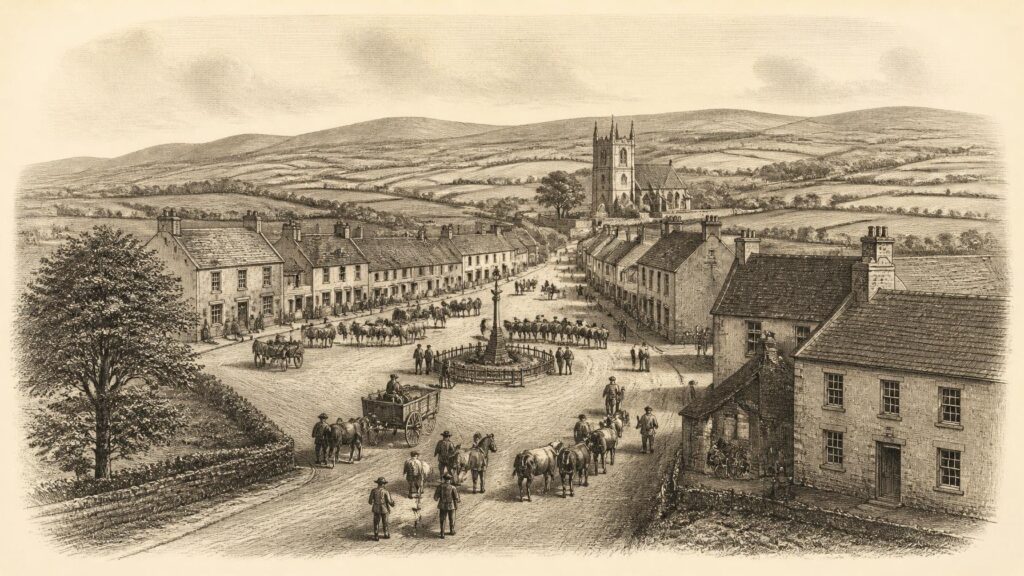
AI generated historical illustration, not a contemporary photograph.
At a Glance
Dromcollogher is a small County Limerick town whose history is unusually concentrated: a medievally significant crossing-place, an estate-shaped market centre, an early home of agricultural co-operation, a locality marked by revolutionary violence, and the setting of one of the gravest civilian disasters in the early Irish Free State. Its best-known story is the cinema fire of 5 September 1926, remembered locally as “the Burning”, but the catastrophe can only properly be understood against the longer history of a rural service town which drew people together for fairs, worship, trade, work and entertainment.
Place Names
The town is commonly called Dromcollogher, although Dromcolliher and Drumcollogher have also appeared in official and local usage. Such variation is not unusual in Irish place-names, especially where Irish forms, English administrative spellings and local speech have met over centuries. The Placenames Database of Ireland records Drom Collachair as the Irish form associated with Dromcolliher. It is generally interpreted as the ridge of the hazel wood, or hazel ridge. The name is itself a useful reminder that the landscape preceded the town: a ridge, woodland and routeway were already sufficiently distinctive to supply a name before the present settlement acquired its streets and buildings.
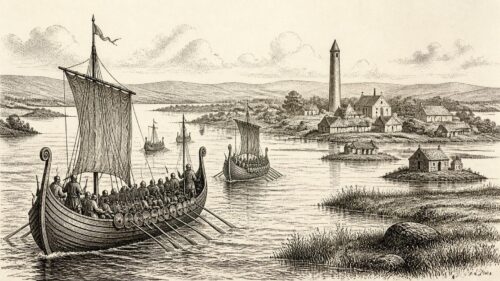
Claims for a very early documentary reference need to be handled cautiously. Local historical accounts connect the name with material in the twelfth-century Book of Leinster, while another cited early form, Drumcollechaellor, is dated to 1201. These references are evidence that a place bearing a recognisably related name was known in medieval records, but they do not permit a simple conclusion that the modern town existed in its present form at that date. Medieval settlement names can denote wider territories, ecclesiastical units, townlands or landscape features rather than a nucleated town. The more defensible conclusion is that the locality was old, named and strategically intelligible long before its later planned centre emerged.
The several English spellings are more than a curiosity. They show the way administrative practice can standardise only imperfectly. The local historian Liam Irwin notes that road signs historically displayed differing forms, while local preference frequently favoured Dromcollogher. In this article that familiar form is used, while acknowledging the official Irish nomenclature and the persistence of alternatives. A place-name is not merely a label: in Dromcollogher’s case it preserves a trace of the wooded ridge in a landscape later dominated by roads, fields, shops, fairs and public buildings.
Medieval Crossroads
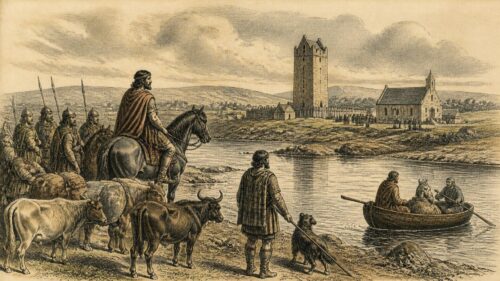
Dromcollogher lies in west County Limerick, close to the Cork border and within a countryside whose productive farmland helped sustain its later commercial role. Its position matters historically. Roads radiate from the town towards settlements including Charleville, Buttevant, Newcastle West, Broadford and Tullylease. That pattern made it a natural meeting place between the farming districts of west Limerick and north Cork. The town’s familiar central space is often called the Square, though it is more accurately described as diamond-shaped. The radiating roads and central open space express the logic of a place formed around exchange, movement and local authority.
It would be misleading to treat this route network as proof of a fully urban medieval borough. The surviving evidence supports strategic importance, not an uninterrupted municipal history of the kind associated with Ireland’s larger walled or chartered towns. Yet routes bring recurring traffic: livestock, agricultural produce, travelling traders, officials, worshippers and eventually motor vehicles. They also encourage services. Dromcollogher’s later fairs, public houses, shops, smithies, carriers and accommodation were all functions suited to a settlement serving a broad rural hinterland.
Medieval and early modern Irish history is often described through major lordships and towns, but places such as Dromcollogher show how local geography shaped ordinary economic life. A ridge at a road junction could become a point where agricultural landscapes met. The town did not need a cathedral, castle or port to matter. Its importance lay in repeated use: people came to buy, sell, seek services, attend court, meet neighbours and travel onwards. The later tragedy of 1926 was consequently not an isolated event in an obscure hamlet. It occurred in a settlement accustomed to drawing in people from surrounding townlands.
Estate Expansion
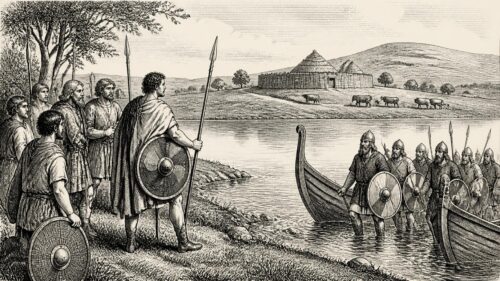
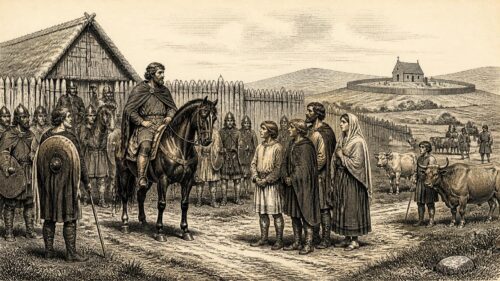
The town’s visible layout owes much to the upheavals and land transfers of the early modern period. Local historical accounts identify the Courtenay family, earls of Devon, as important patrons of Dromcollogher’s development in the early seventeenth century. The family acquired extensive interests in the area in the aftermath of the Desmond rebellion and the Munster plantation. Such acquisitions formed part of a wider reordering of landholding in southern Ireland, in which confiscation, plantation, survey and new tenurial arrangements altered the relationship between communities and land.
To say that the town developed under estate patronage does not mean that all local life was directed from above. Towns depend upon the work of tenants, labourers, craftspeople, shopkeepers and farmers as much as upon landlords or estate plans. Nevertheless, estate influence could determine the shape of a settlement: where plots were laid out, how roads met, where leases encouraged building, and where markets were permitted or promoted. The diamond-shaped centre and radial routes are consistent with a consciously expanded service settlement. In this sense Dromcollogher’s form is evidence of early modern planning, although the exact sequence of every building and road requires more detailed cartographic study than the surviving summaries allow.
The Courtenay connection also places Dromcollogher within the history of absentee landownership. The earls of Devon were major proprietors in Munster, and the town stood at the edge of a wider estate world rather than outside it. Estate towns could be simultaneously dependent and dynamic. Landlords sought rents and orderly improvement; inhabitants made the place work through commerce, family networks and labour. The result was neither a wholly imposed settlement nor an autonomous one, but a community shaped by unequal power and practical local adaptation.
By the nineteenth century, the built environment had become recognisably that of a small Irish market town: two-storey terraced houses, shops facing the footpaths, yards and workspaces behind, and civic or commercial institutions around the centre. Buildings changed hands and uses. A store could become a hall; a hall could host concerts, dances, courts or films. This flexibility made rural towns resilient, but, as the events of 1926 would show with devastating clarity, it could also expose people to grave dangers when premises designed for one purpose were pressed into another without adequate safety provision.
Market Community
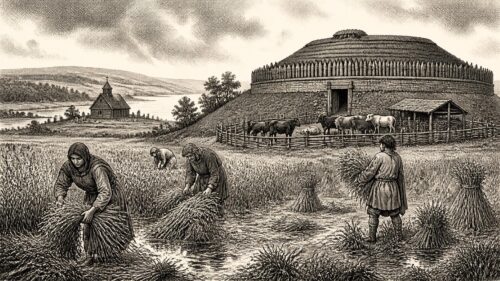
Dromcollogher’s nineteenth-century history was anchored in farming and trade. Monthly fairs served the surrounding agricultural district, while a considerable number of licensed premises reflected the custom generated by market days and passing traffic. The concentration of public houses recorded in local accounts should not be read simply as an indication of drinking culture. In a pre-motorway rural economy, licensed houses could function as meeting places, lodgings, sites of informal business, venues for political discussion and points of refreshment for people travelling with stock or goods.
The nineteenth-century streetscape developed through stone-built, slated, two-storey premises, combining domestic and commercial functions. A bank and post office appeared in the 1830s, signs of the town’s growing role in the circulation of money, correspondence and credit. The opening of such services did not remove economic insecurity, but it demonstrates that Dromcollogher was tied into systems far beyond its own streets. Farmers and dealers needed credit; emigrants and their families depended on letters and remittances; shopkeepers purchased stock through regional and national networks.
The Great Famine transformed every part of rural Irish society, but the available local material does not support a detailed numerical reconstruction of mortality, eviction or emigration specifically for Dromcollogher. That limitation matters. It is tempting to place every Irish locality into a ready-made Famine narrative, yet responsible local history must distinguish national patterns from evidence particular to place. What can be said is that the post-Famine decades saw an expanding retail and licensed trade in the town, alongside continuing emigration. Dromcollogher, like many Irish service centres, adapted to a countryside reshaped by demographic loss, changes in farm structure and the departure of generations overseas.
This was not a story of uninterrupted prosperity. Small towns were vulnerable to declining population, competition from larger centres and the changing geography of transport. Yet they also retained an advantage: they were close to the people who used them. A farmer did not require a city bank every day; a family did not need a large urban shop for every purchase. Dromcollogher’s commercial life survived because it served practical local needs. Its fairs gave rhythm to the month, its shops and trades supplied everyday requirements, and its central streets enabled repeated encounters among people who might otherwise have lived dispersed across the countryside.
Cooperative Beginnings
In June 1889 Dromcollogher gained a notable place in the history of Irish agricultural co-operation when the first co-operative creamery in Ireland opened there. The distinction is important, though the story is sometimes simplified by attaching it too directly to Sir Horace Plunkett. Plunkett became the movement’s most famous advocate and organiser, but local research identifies W. L. Stokes of the British Co-operative Wholesale Society and Robert Gibson, a butter buyer, as central to the Dromcollogher initiative. The correction is useful because it restores the practical, commercial origins of the undertaking.
Co-operative creameries sought to improve the position of dairy farmers by pooling milk supplies, processing butter more systematically and marketing produce through collective organisation. At a local level, the creamery represented technology, discipline and shared economic interest. It brought farmers into a common system of delivery, measurement and payment. It also represented a different vision of rural progress from one centred only on estate improvement or private middlemen. The town’s selection as a site reflected its position within a fertile farming district and its capacity to act as a service centre.
The creamery’s wider significance lies in what followed. The Irish co-operative movement became a major force in rural economic and social life, influencing dairy production, local employment, community organisation and political thought. Dromcollogher was not responsible for the whole movement, but it was one of its formative places. That association demonstrates how a seemingly modest Limerick town could participate in national change. Local initiatives often become historically important precisely because they solve immediate problems in a way others can copy.
Co-operation should not be romanticised. It required agreement among people with differing resources, and its benefits were not necessarily shared evenly between landholders, labourers, women working within farm households and town tradespeople. Still, the opening of the creamery marked Dromcollogher as a place prepared to engage with new forms of organisation. By the early twentieth century, its economic life combined traditional fairs and craft trades with newer institutions of banking, postal communication, dairying and collective enterprise.
Popular Culture
Dromcollogher entered popular culture through Percy French’s comic song commonly known by its refrain, “There’s Only One Street in Drumcolliher”. Written in 1894 after French stayed locally while visiting his brother, the song gave the town a national familiarity that many residents found only partly flattering. The title itself is inaccurate in a literal sense: Dromcollogher had several streets and a central diamond. Its humour depended upon the comic exaggeration of small-town life, a genre in which rural communities could be both affectionately observed and patronised.
French’s song has endured because it is catchy and because it captures an external image of an Irish village as sociable, self-contained and slightly absurd. But it should not become the principal lens through which the town is viewed. Dromcollogher was not merely the imagined one-street place of comic song. It had a market hinterland, commercial connections, a co-operative creamery, church, court, schools, trades and links to migration. The song is evidence of cultural reputation, not a reliable social survey.
Its afterlife nonetheless matters. Humorous representations can stick more readily than economic facts. For many people outside County Limerick, the name Dromcollogher was first encountered in song rather than in a map or historical record. The town thus occupied two spaces at once: the real settlement of roads and businesses, and a stylised place in the national imagination. After the fire of 1926, that popular familiarity may also have intensified the shock felt across Ireland when newspapers reported that so many people had died in a village known by name to audiences far beyond Munster.
Revolutionary Years
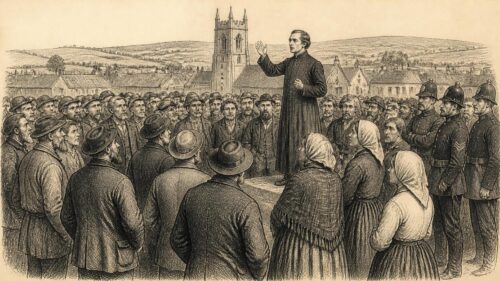
The years of revolution and conflict left a direct mark on Dromcollogher. In June 1920 three Irish Republican Army volunteers died after becoming trapped in the local courthouse while attempting to burn it. The episode belongs to the wider campaign against the British administration during the War of Independence, in which courthouses, barracks and other state-associated buildings were targeted. Such attacks were intended to disrupt government, deny usable facilities to the police and courts, and demonstrate the reach of republican organisation. Yet the local cost could be terrible, as the deaths at the courthouse showed.
A second incident, generally known as the Drumcollogher Ambush, resulted in the killing of a young Royal Irish Constabulary constable. Local summaries describe him as having been shot while coming from the barracks to shop in the square. The contrast between strategic conflict and ordinary routine is striking. A square used for shopping, fairs and neighbourly contact was also a site where political violence could erupt. In a small town, the participants and witnesses were not abstractions; they were people whose names, families and homes were known.
The courthouse fire later acquired an unexpected connection with the cinema disaster. The hall used for the film show had hosted district court sittings while the courthouse was being rebuilt. This demonstrates the improvised character of local civic life in the aftermath of conflict. A partly floored storehouse, reached by an exterior ladder, could be treated at different moments as a hall, theatre, dance venue, courtroom and cinema. Its various uses made practical sense in a town with limited public accommodation. But neither customary use nor official necessity made the structure safe for a crowded film exhibition.
There is also a strand of local memory concerning the barred rear windows of the hall. One version holds that bars had been altered during the Black and Tan period to permit rapid escape by IRA men meeting there; another survivor recalled having removed bars for practical purposes connected with bringing in benches. The evidence is contradictory, and it is best not to turn either account into certain fact. What is certain is that the rear windows became an inadequate and dangerous alternative exit on the night of the fire. Revolutionary memory later became entangled with disaster memory, illustrating how communities make sense of physical features through the stories already attached to them.
Village Portrait
The first census taken after independence, conducted in April 1926, offers an unusually close view of Dromcollogher only months before the cinema fire. Limerick Local Studies records a population of 442: 208 men and 234 women. The town was recorded as entirely Catholic, and its parish priest, Canon John Begley, was already a significant local figure and historian of the Diocese of Limerick. The figures need context. They describe the settlement as defined for census purposes, not every person in the wider parish or market hinterland. Yet they provide a useful scale for understanding the subsequent loss of forty-eight lives.
Agriculture underpinned the economy. The recorded workforce included farmers, farm labourers, cattle dealers, butchers and creamery managers, as well as shopkeepers who were also farmers or publicans. Retail formed another important group, including shopkeepers, publicans, assistants and milliners. There were carpenters, blacksmiths, tailors, coach builders, dressmakers, a bootmaker, a thatcher and a saddler. The range of occupations shows that Dromcollogher was not a purely agricultural village, even though farming gave it economic purpose. It was a compact service economy where businesses, homes and trades were interwoven.
The census also reveals domestic servants, schoolteachers, postmen, a sub-postmaster, lodging-house keepers and households taking lodgers. This was a town of mixed occupations, modest property and close social proximity. People could know one another across several relationships: customer and shopkeeper, neighbour and workmate, parishioner and teacher, farmer and publican. That intimacy helps explain both the rapid spread of information about the cinema show and the devastating social reach of the fire. The victims were not confined to one occupational group or one family network.
Dromcollogher’s population rose to 457 by the 1936 census despite the loss of 1926. That numerical recovery must not be mistaken for emotional recovery or for replacement of those who died. Population figures can show continuity, but they cannot measure bereavement, altered households or silences within families. The statistic is significant because it demonstrates that the town endured. The community continued to trade, worship, educate children and make use of its public spaces, even as the disaster remained a defining wound.
New Amusements
Motion pictures reached rural Ireland through a mixture of permanent cinemas, travelling exhibitors and temporary venues. By the 1920s, cinema was an increasingly popular form of entertainment. In a town such as Dromcollogher, where people were accustomed to concerts, dances and theatrical performances in shared halls, a film show was a compelling novelty but not an unimaginable one. The historian Liam Irwin identified several earlier screenings in the village, including shows associated with travelling operators. These events had attracted audiences and created an expectation that the hall could host cinema.
That expectation was dangerous because films of the period depended on nitrate stock. Nitrate film was highly flammable and, once ignited, could burn with extraordinary speed and intensity. The legal framework was also stricter than local practice sometimes suggests. The Cinematograph Act 1909 required licensing and safety precautions for film exhibitions. In rural areas, however, the distinction between a formally licensed cinema and an occasional performance in a hall could be blurred in practice. Dromcollogher’s earlier shows may have normalised an arrangement that should instead have prompted scrutiny of exits, lighting and fire precautions.
William “Babe” Forde, a local garage and hackney-car operator, recognised a commercial opportunity in 1926. He had physical disabilities and was the subject of local comment because of his birth outside marriage; these facts appear in the historical record but should not be used to make crude explanations for his conduct. What is documented is his entrepreneurial interest in film exhibition. He obtained a second-hand cinematograph machine with the help of Patrick Downing, an assistant projectionist working at the Assembly Rooms cinema in Cork, and the pair held a successful trial performance in late August.
A piece of folklore subsequently attached itself to Forde: that he had boasted he would “set Dromcollogher on fire”. Irwin explicitly identifies the saying as possibly apocryphal. It should therefore be treated as later, grimly fitting folklore rather than evidence of something actually said. The story survived because catastrophic events invite retrospective omens. Historians should resist giving such tales explanatory force. The causes of the fire lay not in prophecy but in combustible material, improvised lighting, an unsuitable building, inadequate exits and a failure of regulation and precaution.
Fatal Evening
On Sunday 5 September 1926, approximately 150 people assembled in the upstairs portion of Patrick Brennan’s hardware-store building on Church Street. The venue was a large store with a partially floored upper level adapted as a hall. Its front wall was timber and corrugated zinc; the other walls were stone; its roof was timber and felt. The upper room was narrow, divided by a wooden partition, and reached by a fixed external wooden ladder with a banister. The upstairs door, about three and a half feet wide, was the sole ordinary means of entrance and exit.
The building had long been used for public purposes, which may have made its defects seem familiar rather than alarming. It had held entertainments and, during rebuilding after the courthouse fire, district court sessions. Yet its adaptation for a packed cinema audience was profoundly unsafe. Rear windows were barred. There was no adequate alternative escape route, no electric lighting throughout the hall, no effective fire-fighting provision, and no insurance. The presence of people of all ages in a confined upper room magnified every risk.
Downing brought films and electrical equipment from Cork. The best-supported identification of the films is the short feature False Alarm and the main feature The Decoy, though contemporary reports and later recollections created confusion. Some newspapers claimed that The Ten Commandments was being screened; research cited by Irwin indicates that this was impossible because the available copies were elsewhere. Other researchers proposed different titles after consulting cinema listings. The uncertainty is a useful warning about disaster reporting: early reports often combine genuine testimony with rumour, assumptions and the understandable confusion of witnesses.
Only one of the electric lamps intended to light the hall was working. A candle was therefore placed near the projector area and film reels. The precise immediate mechanism by which the candle fell is not conclusively established in the surviving accounts. The National Library of Ireland’s summary states that a candle fell and ignited exposed nitrate film; the essential point is undisputed. The film caught fire, flames spread rapidly through combustible materials, and smoke and fumes turned the upstairs hall into a trap. A crowd rushed towards the narrow ladder and door, while others attempted escape through the rear windows.
The fire’s speed overwhelmed rescue. Witness evidence and subsequent reconstruction indicate that people were caught in the crush at the exits and windows. Some individuals did escape; others returned or remained to assist relatives and neighbours. Accounts record acts of courage by people who tried to help others, including men who re-entered the building. Such actions should not be embellished into a simple heroic narrative, for panic, confusion and terror also shaped what happened. Both can be true: desperate self-preservation and remarkable acts of aid occurred within minutes of one another.
The floor and roof collapsed within a short time. Forty-six people died immediately; two injured survivors, Thomas Noonan and James Kirwan, later died. The final death toll was forty-eight. Nearly fifty others were injured to varying degrees. More than half of those killed were under twenty-five, and fifteen were children. The youngest victims were two seven-year-olds. In a town with a census population of 442 only months earlier, the loss amounted to roughly eleven per cent of the recorded population. This is the scale behind the enduring local name, the Burning: not simply a fire in a hall, but a disaster that reached across households, generations and streets.
Public Mourning
The immediate aftermath confronted the town with tasks almost beyond comprehension. Bodies had to be recovered, identified where possible and prepared for burial. Identification was difficult because many remains were badly burned. Relatives used watches, jewellery, clothing and other personal objects to recognise some victims. The difficulties of identification help explain why a communal burial became necessary. The churchyard of St Bartholomew’s became the chosen site after contact with the Bishop of Limerick, and a large common grave was prepared.
Coffins were brought from Newcastle West, but there were not enough. Contemporary reporting, discussed in the local historical research, records that large timber boxes which had carried imported bacon were used for some victims. The detail is stark, but it should not be repeated merely for horror. It reveals the practical challenge created by mass death in a small town with limited local resources. The coffins were placed in the churchyard overnight before the funeral. The scene was one in which private grief had become unavoidably public.
The funeral on Tuesday 7 September drew national attention. W. T. Cosgrave, President of the Executive Council of the Irish Free State, attended. The funeral Mass included an especially painful family dimension: Fr Daniel O’Callaghan, whose mother Mary Anne O’Callaghan had died, celebrated the Mass, while another son, Fr Patrick O’Callaghan, assisted as deacon. More than fifty clergy were present. The attendance of the head of government, church leaders, officials and press demonstrated that Dromcollogher’s bereavement had become a national event.
At the entrance to St Bartholomew’s churchyard stands a tall limestone Celtic cross marking the communal grave. Forty-six victims lie there, while the names of the two who later died are also commemorated. The grave is a crucial historical source in its own right. It preserves names and ages, resisting the tendency for a catastrophe to be reduced to a number. The list includes children, young adults, parents, older residents, labourers, shop-connected families and people whose lives cannot be recovered fully through official narrative. Memorials do not tell every story, but they restore individuality against the anonymity imposed by disaster.
Legal Reckoning
Public mourning was accompanied by an urgent search for responsibility. Forde and Downing were arrested and charged with manslaughter; Patrick Brennan, owner of the hall, was subsequently arrested. The proceedings exposed the unsafe arrangements surrounding the show. Evidence concerned the lack of a licence, the absence of adequate exits and fire-fighting equipment, the use of a candle close to film, the broken or unavailable electric lamps, and the respective duties of organiser, operator and property owner.
Sergeant James Long had warned Forde about the need for additional exits and fire precautions, including buckets of sand and water. Forde maintained that he believed the owner should provide such measures, while Brennan’s position was that no formal arrangement had been made with him. Downing argued that he had warned of nitrate film’s dangers and had proposed safer arrangements for the lighting and the positioning of the projector. The accounts conflicted sharply. That conflict does not make the causes unknowable; rather, it shows how participants in a fatal enterprise explained their own conduct once the consequences were clear.
The case was heard at the Central Criminal Court in Dublin in November 1926. Brennan was found not guilty. The jury failed to agree in the cases of Forde and Downing. In February 1927 the prosecution entered a nolle prosequi, ending proceedings against them. The stated reasoning, as reported in the contemporary legal record used by Irwin, was that the public warning supplied by the steps already taken had attained the prosecution’s object. No one was therefore convicted in relation to the deaths.
The absence of a conviction did not mean the absence of culpability in a broader historical sense. The evidence showed a chain of failures: a makeshift venue, insufficient exits, combustible construction, exposed nitrate film, poor lighting, inadequate fire precautions and lax enforcement of cinema regulations. Yet legal responsibility for manslaughter required proof of criminal negligence to a particular standard. The distinction between moral outrage, administrative failure and criminal liability is central to understanding the outcome. It is also why the case remains unsettling. The disaster was plainly preventable, but the criminal courts did not produce a final verdict assigning individual guilt.
Relief Effort
The Irish Free State responded by establishing the Dromcollogher Relief Fund. Cosgrave announced its committee on 9 September 1926. The fund dealt with funeral costs, injury, bereavement and dependency, recognising that the effects of the fire would continue long after the funeral. The surviving material is unusually rich. Limerick Local Studies has published digitised files supplied by the National Archives of Ireland, including trustees’ minutes, condolence messages and correspondence accompanying contributions. These documents make it possible to see the disaster not only as a local tragedy but as an event that prompted organised assistance across Ireland and beyond.
Donations came from individuals, businesses, trade unions, local authorities and organisations in Ireland, Britain, Europe and North America. Large gifts sat alongside small subscriptions, including contributions from children. The range of donors indicates how mass tragedy created public sympathy in the young State. It also demonstrates the reach of Irish networks: communities connected by migration, commerce, religion, labour and press coverage could respond quickly to an event in a small Limerick town.
Relief was not merely charitable sentiment. It was an administrative undertaking requiring investigation of need, decisions about dependants and long-term management of funds. A local committee had already prepared information on funeral expenses, fatalities and seriously injured people. John Healy, a retired Office of Public Works civil servant, was appointed executive secretary and visited bereaved families. Such procedures show the early Free State acting through a combination of government initiative, public subscription and local clerical and civic knowledge.
The fund continued to make payments for decades, with final payments reportedly made in 1958. That duration is historically revealing. It indicates that the consequences of the Burning were not limited to the night itself. Children lost parents, households lost earners, survivors bore injuries, and family circumstances changed over time. Financial assistance could not restore what had been lost, but it recognised an obligation extending beyond immediate emergency relief. The files, therefore, are records of both generosity and the long shadow cast by a few minutes of fire.
Silent Memory
Although the disaster received extraordinary publicity in 1926, local memory afterwards was often marked by silence. Irwin’s research records that people from Dromcollogher sometimes avoided naming their home place when travelling, because it invited painful questions. Within families, the event could be known but not discussed in detail. This should not be interpreted as forgetting. Silence can be a form of memory: a way of protecting oneself, respecting the dead or avoiding the reopening of grief in a community where victims’ relatives were everywhere present.
The anniversary was for some years observed informally as a church holiday, with Mass, flowers and prayers at the communal grave. When the formal practice ended, private remembrance continued. The transformation from public mourning to quieter commemoration is familiar in communities affected by disaster. Rituals change; grief does not necessarily diminish in proportion. The absence of extensive folklore in the Schools’ Collection is also significant, though not conclusive. It may reflect reticence rather than lack of knowledge.
Stories did survive, but their status varies. The supposed boast attributed to Forde is one example of a tale that may be retrospective. So too are some confident versions of the film titles, exact causes and escape attempts. Oral testimony is indispensable because it preserves experience overlooked by official records, but it must be weighed alongside contemporary reports, court evidence, photographs and archival files. The historical task is not to dismiss memory but to identify its character: firsthand recollection, family transmission, local legend, inference or later reconstruction.
Interest revived with the eightieth anniversary in 2006, subsequent radio and television programmes, local research and, later, the centenary commemorations of 2026. The death of Mary O’Flynn, née O’Donnell, on New Year’s Day 2012 ended the last known direct link to the audience present in the hall. That passing marked a transition from living testimony to inherited memory and documentary history. Yet the story remains locally owned as well as nationally significant, because the names on the grave still belong to families and a place.
Living Memorial
The site of the fire stood boarded up and derelict for more than two decades. Its eventual transformation was a deliberate act of civic memory. A local committee raised funds to purchase the site and offered it to Limerick County Council in 1950 for the construction of a library that would also serve as a memorial. The council accepted. Architect Patrick J. Sheehan designed an unusual circular building with a flat roof and tall narrow windows, fitting the constrained site. It opened in May 1953 at a cost of about £2,000.
Dromcollogher Memorial Library is a particularly eloquent response to catastrophe. It neither erases the site nor turns it into a static monument alone. A library is a working public institution: a place of reading, learning, local access and community use. Its purpose therefore contrasts sharply with the unsafe improvised entertainment hall it replaced. The building makes remembrance part of ordinary civic life. A cross placed on the rear boundary wall marks the area close to where many victims’ bodies were found, while the communal grave remains the principal burial memorial.
The town’s history should not end with the fire, nor should the fire be treated as a detached episode. Dromcollogher’s identity rests upon overlapping histories: the hazel-ridge place-name, medieval routes, estate expansion, market activity, the creamery, popular song, revolution, disaster and memorialisation. Each layer informs the others. The cinema audience gathered because the town was a social and commercial centre. The scale of mourning was intensified because its networks were close. The relief fund reached widely because Dromcollogher was connected to a wider Ireland and diaspora. The memorial library emerged because the community chose to make a useful public future from a devastated site.
For historians, Dromcollogher is a reminder that small places can illuminate large themes. It speaks to the remaking of Munster after plantation, the endurance of rural market centres, co-operative modernisation, the intimate geography of revolutionary conflict, the hazards of early cinema, the capacities of a new state and the difficult work of collective remembrance. Its documentary record is strong enough to sustain careful history, while its folklore warns against easy certainty. Above all, the town’s past asks that forty-eight victims be remembered not as a statistic alone, but as people whose deaths altered an entire community.
Dromcollogher’s history shows how a small rural service town could participate in national developments while retaining a local character. The article’s most compelling tension concerns the multi-purpose hall: its adaptability made it valuable for courts, dances and cinema, yet this same improvisation contributed to catastrophic danger in 1926. Equally significant is the conversion of a site of trauma into a memorial, alongside memories of co-operation, commerce and revolutionary conflict. This suggests that public remembrance can both focus and narrow local identity. How might Dromcollogher’s memorial landscape acknowledge the Burning while also conveying the town’s history of connection, enterprise and change?