

Shannon Transformation
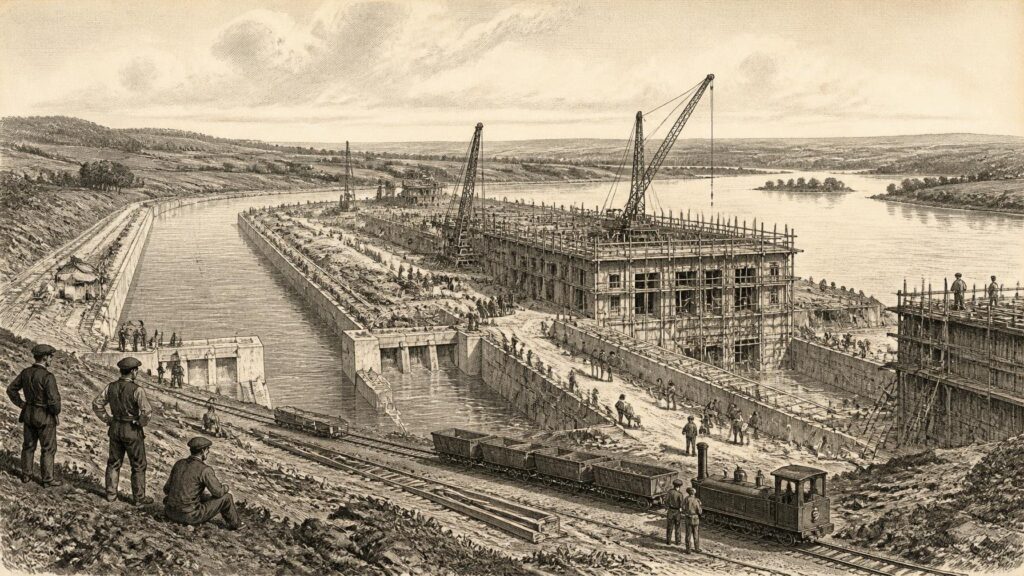
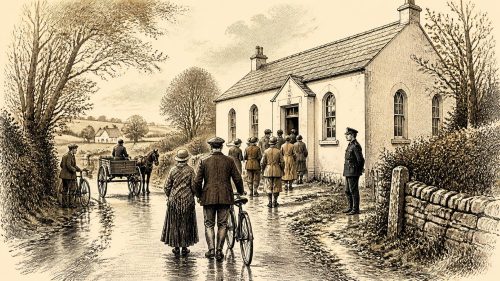
AI generated historical illustration, not a contemporary photograph.
At a Glance
Ardnacrusha was far more than a power station. Built beside the lower Shannon in County Clare between 1925 and 1929, it was the physical centre of an attempt by the young Irish Free State to make electricity a national utility, modern engineering a public language and state action a visible force in everyday life. The Shannon Scheme was ambitious in scale, international in execution and uneven in its consequences. Its turbines, canals and pylons became symbols of confidence; its construction also exposed hard realities of labour, displacement, environmental intervention and the limits of immediate rural electrification.
National Ambition
The story of Ardnacrusha belongs to the unsettled first decade of the Irish Free State. The state created in 1922 inherited a country whose electrical supply was fragmented, expensive and overwhelmingly urban. Small private and municipal undertakings served selected towns and industrial concerns, while much of the countryside remained beyond their reach. Electricity was not simply a technical convenience. It was increasingly understood across Europe as an instrument of industrial productivity, domestic reform, public health and national prestige. For a state emerging from revolutionary conflict and civil war, a large electricity scheme therefore carried political as well as economic meaning.
The Free State’s leaders faced severe constraints. Public finances were limited, emigration remained a persistent fact of life and industrial development was modest. The government led by W. T. Cosgrave nevertheless accepted that a durable state required more than balanced books and restored order. It needed institutions and works that could bind territories together. Railways, roads, postal services and education already supplied parts of that framework. A national electricity system promised a new and particularly conspicuous form of connection: power generated in one region, carried by high-voltage lines and supplied to towns, workshops and eventually homes across much of the country.
Earlier proposals had considered the Shannon’s potential. The river’s scale, its lakes and tributaries, and the fall available in its lower reaches had made it an obvious subject for engineers and promoters long before independence. Yet the Free State scheme differed from isolated local projects or speculative suggestions. It joined generation, transmission, distribution and public administration in one undertaking. The aim was not merely to produce electricity at a favourable site. It was to establish a national system able to replace a patchwork of suppliers and create demand on a scale large enough to support itself.
Thomas A. McLaughlin was the principal advocate of this approach. Born in Drogheda in 1896, educated in Dublin and Galway, he had acquired advanced training in physics and electrical engineering before joining Siemens-Schuckert in Germany after 1922. Work in Germany acquainted him with a rapidly developing electrical economy and with the organisational scale of major engineering firms. His subsequent importance should not obscure the work of civil engineers, officials, technicians, contractors, legislators and labourers. Nonetheless, the surviving ESB historical material is clear that McLaughlin supplied the unifying conception: exploit the Shannon’s available fall at one major location and combine it with a national grid.
That proposition was bold partly because it ran against a narrower logic. Dublin contained the country’s largest concentration of potential consumers, and development of the Liffey might have appeared more immediately commercial. McLaughlin’s proposal required the state to think beyond the existing market. It assumed that demand could be created, that the cost of transmission could be justified and that the economic future of Ireland should not be confined to the capital. The decision was therefore a geographical statement. The Shannon, crossing and draining a great part of the island, could be imagined as the backbone of a system intended to serve the nation.
Legislation gave that ambition legal force. The Shannon Electricity Act of 1925 authorised the Minister for Industry and Commerce to generate, distribute and supply electricity derived from the waters of the Shannon. Its provisions also gave wide powers concerning land, diversion and alteration of waterways, drainage, navigation, roads, accommodation and the protection of fisheries and monuments. Such breadth demonstrates that electrification was never only about wires and generators. It was an intervention in landholding, transport, river management and local life. The statute’s references to protection are important historical evidence: legislators knew that the undertaking could affect older structures, river users and fisheries, even if formal acknowledgement did not remove the eventual pressures upon them.
The scheme’s cost made its commitment especially striking. ESB’s archival account gives a budget of roughly £5.1 million, a sum described as about one fifth of the state’s revenue at the time. Exact comparisons with later public spending can mislead, because the economy, currency and functions of government have changed profoundly. The more useful point is proportion. A state only a few years old committed a very large share of its available resources to an infrastructure project whose commercial outcome could not be guaranteed. Contemporary observers recognised both the scale of the gamble and the technical seriousness of the achievement.
River Design
Ardnacrusha is often called a dam, but that shorthand can obscure the form of the Shannon Scheme. It was a linked landscape of hydraulic works. The project did not simply place a high barrier across the river and build a station immediately below it. The local topography did not readily permit that familiar arrangement. Instead, water was controlled at Parteen Weir, north of Limerick and downstream from Killaloe, then led along an artificial headrace canal towards Ardnacrusha. There it descended through large steel penstocks to turbines in the power station. A tailrace returned the water to the Shannon downstream of the station.
This arrangement captured a substantial fall across a carefully chosen route. The scheme’s technical design made use of the relationship between river flow, stored water, available head and the demand for power. The Shannon catchment was extensive but variable. Water levels and flows changed seasonally and during floods or droughts. The engineering response was not the conquest of a uniformly obedient river, but the construction of controls, channels, weirs and operating routines intended to make a fluctuating natural system serve a national electrical load.
The headrace canal was itself a major work, crossing a modified landscape of embankments, bridges and drainage arrangements. It carried water towards the station while separating the hydraulic route from much of the former river course. At Ardnacrusha, four penstocks brought water down from the intake works to the generating machinery. The original installation included three vertical-shaft Francis turbine-generators commissioned in 1929. A fourth unit, using a Kaplan turbine, followed in 1934. The later addition is a useful reminder that the scheme was not a frozen monument on its opening day; it was designed and developed as a working electrical system.
At full early capacity, the station’s installed generating capacity was about 86 megawatts. In the context of late 1920s Ireland, this was extraordinary. ESB has described it as enough to meet the country’s contemporary electricity demand. That does not mean that every household or farm could immediately receive power, nor that capacity translated directly into a universal supply. Generation was only one part of electrification. Transmission lines, substations, local distribution networks, appliances, tariffs and willing consumers were equally necessary. But the station did create a supply base much larger than the dispersed systems it was meant to supersede.
The national grid was constructed alongside the generating works. The 110-kilovolt transmission network was among the scheme’s most consequential features, yet it is often less visually remembered than the power house. Pylons and wires carried the project far from County Clare, turning an engineering work on the Shannon into a national physical presence. Towns received connections; older local undertakings increasingly had to coexist with, or give way to, a central authority. From the outset, Ardnacrusha was thus a compound system: hydraulic, electrical, administrative and commercial.
Its design also reshaped movement on the river. Navigation works and locks formed part of the complex, reflecting the fact that the Shannon was not an empty resource awaiting technical use. It was a waterway with established users and meanings. The project’s planners had to consider bridges, roads, fisheries and navigation because each belonged to an existing social and economic landscape. To describe the scheme as the harnessing of nature is therefore only partly accurate. It was also the reorganisation of a lived riverine world in which some uses were facilitated, some transformed and some made more difficult.
German Partnership
The Shannon Scheme was an Irish state project carried out through a major German partnership. Siemens-Schuckertwerke and associated Siemens construction interests brought experience, equipment, finance-related capacity and specialist personnel. McLaughlin’s connection with Siemens was essential to the proposal’s credibility. The company could offer not merely an idea but a technical organisation capable of delivering an integrated project at a scale beyond the capacity of any indigenous firm then available.
This international dimension complicates simple nationalist readings. Ardnacrusha became an emblem of Irish independence, but it was not produced by national self-sufficiency. Its achievement depended on transnational transfers of capital equipment, design practice, technical expertise and labour. German engineers and workers were highly visible at the site. Thousands of Irish men also supplied the bulk of manual labour and filled skilled, supervisory and professional roles. The collaboration demonstrated the Free State’s willingness to use foreign technical capability in pursuit of domestic state-building.
The timing gave the association a particular resonance. Germany after the First World War had endured defeat, revolution, inflation and political uncertainty, but German electrical engineering remained internationally important. Ireland’s new government could see in Siemens a firm with modern expertise and in its engineers a route to technologies already developed elsewhere. The relationship was practical rather than sentimental. Contracts, specifications, timetables and state oversight mattered more than vague rhetoric of international friendship.
The project also relied on Irish engineering leadership. Frank Sharman Rishworth, appointed chief engineer for the Free State, had an important role in connecting government oversight to the civil works. McLaughlin later became the first managing director of the Electricity Supply Board. Their careers illustrate an important feature of the scheme: it helped create an Irish cadre able to administer and extend the new electricity system after the foreign contractors had completed their principal work.
Contemporary photographs and surviving Siemens material show a site organised with a high degree of technical discipline. Workshops, railway sidings, cranes, concrete operations, temporary buildings and machinery were components of a construction system rather than isolated scenes. The company publicised progress through its illustrated publication Progress on the Shannon. Such material must be read carefully. It was produced by interests invested in the project and naturally presented efficiency, scale and technological mastery. Yet it remains valuable evidence of what the contractors wished to record and how they wanted the undertaking to be seen.
The architecture of the power station also carries the marks of that connection. The building is neither a traditional Irish vernacular structure nor a purely abstract machine. Its massing, steel windows, ordered elevations and industrial character belong to interwar European engineering architecture. The National Inventory of Architectural Heritage recognises the complex for architectural, historical, scientific, social and technical interest. The station’s form conveyed permanence. It made the electrical system visible as a public institution, not simply as hidden machinery.
Interpretations of this architecture vary. One view treats it as an imposing expression of a new state’s confidence, a modern landmark set in a rural landscape. Another stresses its German industrial lineage and the corporate character of Siemens design. These readings need not conflict. Its visual power came precisely from the meeting of Irish political aspiration with continental engineering modernity. Ardnacrusha was national in purpose, but international in material culture.
Building Works
Construction began in 1925, after the enabling legislation had been secured. The ceremonial cutting of the first sod and the extensive press attention that followed helped turn the site into a national spectacle. Photographs preserved by the National Library of Ireland show a landscape in rapid transformation: excavation, concrete structures, rail lines, scaffolding and machinery rising amid the lower Shannon country. These images are not neutral windows onto the past, but they establish the exceptional scale of the works and the intensity of public interest.
Building the scheme required an immense logistical operation. Materials had to be delivered, processed and placed in large quantities. Concrete was central to the canals, intake works, dams, bridges and station. Machinery had to be installed with precision. Temporary railways and transport systems moved men and supplies around a site spread across several miles. The task involved not a single dramatic structure but a sequence of interdependent operations. Delays in one part could affect the whole.
The construction period altered nearby communities. Ardnacrusha and surrounding districts received an influx of workers, contractors, traders and visitors. Accommodation, food supply, transport and policing became practical concerns. Places that had not been built to sustain such a population suddenly had to absorb it. Some local people found new opportunities in work, lodging and commerce. Others encountered rising pressure on housing and services. The broader historical pattern is familiar from large infrastructure projects, but it should not be reduced to a universal story: local experience differed according to occupation, property, gender, family circumstances and proximity to the works.
Official accounts often concentrate on the technical achievement, as one might expect. The scale of the concrete structures, the difficult water management and the commissioning of the turbine hall were genuine accomplishments. A 1929 article in Nature called the undertaking a notable enterprise for a country of the Free State’s size and resources, while also noting contemporary doubts about its financial prospects. That duality is revealing. Ardnacrusha was admired precisely because it was audacious; its boldness also made it controversial.
The work proceeded within a country still marked by recent conflict. The Civil War had ended only a short time before planning advanced. Government ministers were conscious that the scheme would be judged not simply by its output but by whether it could be delivered without administrative collapse or political embarrassment. Successful completion would strengthen the claim that the Free State could govern, contract, regulate and build. Failure would have fed arguments that its institutions lacked capacity.
The pace of work created a dramatic temporal contrast. A rural river landscape that had evolved over generations was altered within a few years. This compression was part of the scheme’s visual and emotional force. Visitors saw large-scale construction that many had previously encountered only in illustrated newspapers, foreign films or accounts of industrial Britain and continental Europe. Ardnacrusha made modern infrastructure tangible. It transformed abstraction—kilovolts, turbines, transmission—into concrete, steel, water and noise.
Completion did not mean the end of engineering attention. Plant required maintenance, river conditions required management and the national grid required continual expansion. The replacement of three turbines in the 1990s demonstrates that the station has always been an operating industrial site rather than merely a preserved 1920s object. Its continued operation also means that historical interpretation must take account of change: the physical complex visible today is rooted in the original scheme but incorporates later technical interventions.
Labour Worlds
The human history of Ardnacrusha cannot be told solely through engineers, ministers and ceremonial visitors. ESB’s archive states that around 5,000 men worked and lived on the site at the height of construction, including approximately 4,000 Irish and 1,000 German workers. The figures convey scale, but they do not describe the unequal conditions within the workforce. Employment ranged from professional engineering and technical supervision to skilled trades and demanding unskilled labour. Pay, security, accommodation, status and prospects varied sharply.
Workers travelled to County Clare and the Limerick area in search of employment at a time when secure work was scarce. The scheme was a magnet for hope. It was also governed by short-term contracts, shifting labour demand and the discipline of a vast building site. Mark Maguire’s historical anthropological study, drawing on archival and local material, records serious problems surrounding accommodation and insecurity. It warns against a celebratory account in which national development automatically improved the condition of those who physically created it.
Evidence from the period indicates that some men seeking or undertaking work endured very poor housing. Reports of people sleeping in sheds, barns and other inadequate spaces became a public issue. Local services struggled with the influx. Such evidence should be handled with care: sensational reports can simplify complex circumstances, while later recollection can sharpen particular scenes into emblematic stories. Nevertheless, parliamentary discussion, local concern and scholarly research make the broad conclusion secure. The construction boom did not provide adequate accommodation or protection for every worker drawn to it.
Labour relations also reveal tensions between the nationalist symbolism of the undertaking and the realities of employer power. The Irish Free State had authorised the scheme in the public interest, but much construction labour remained exposed to dismissal and weak bargaining power. The project was managed through a private foreign contractor within a state-sponsored framework. That arrangement could leave responsibility blurred in practice. Workers petitioned, unions intervened and politicians debated conditions, but the available safeguards were limited by later standards.
Accounts of conflict between Irish and German workers need particular caution. National categories could become shorthand for differences in skill, authority and pay, but individual relations were more complicated than a simple opposition between foreign supervisors and Irish labourers. German workers were themselves employees, often living away from home in demanding conditions. Irish workers were not a uniform group either; men came from different counties, trades and social backgrounds. Tensions did occur, yet any claim that the site was defined by one permanent national antagonism would overstate the evidence.
The labour history also complicates the word electrification. Electricity became a promise of ease, cleanliness and improved domestic life. The men who built the system often worked long hours amid mud, noise, heavy materials and insecure housing. This contrast is not incidental. It exposes the social unevenness that can lie beneath projects later remembered as national triumphs. The Free State’s capacity to construct monumental infrastructure was real; its capacity or willingness to ensure equal welfare for the workforce was more limited.
There is no need to replace one simplification with another. Ardnacrusha created employment at a difficult moment and gave many workers wages, skills and experiences that mattered in later life. It also produced hardship, disappointment and grievance. Historical seriousness requires both propositions to be held together. The people in construction photographs were not merely anonymous symbols of progress. They were workers whose lives could be improved, unsettled or endangered by the rhythms of the project.
Public Opening
The Shannon Scheme was officially opened on 22 July 1929. W. T. Cosgrave’s ceremonial operation of the gates at Parteen has become the defining public image of the occasion. The gesture was carefully chosen. By opening the intake, the head of government appeared to set water, turbines, wires and national progress in motion. Like many public ceremonies, it condensed a lengthy and collective process into a single symbolic act.
The opening mattered because the project had already become a test of state competence. It showed that the government could bring a major work from legislation to operation. The new Electricity Supply Board, established in 1927 under the Electricity (Supply) Act, supplied an institutional structure for the undertaking. McLaughlin became its first managing director. The ESB was among the most important of the early semi-state bodies, and its creation signalled a distinctive Irish model: public ownership and national coordination operating through a commercial and technical organisation.
Publicity was central to the scheme’s reception. Visitors were encouraged to see the works. Newspapers carried images and reports. The site became a destination for people curious about a scale of engineering unfamiliar in Ireland. This was not merely popular entertainment. It was a means of building acceptance for a costly public enterprise and educating potential customers about a commodity that many had never used. Electricity had to be sold in the cultural as well as the commercial sense.
Visual culture helped give the project wider meaning. Seán Keating’s painting Night’s Candles Are Burnt Out, completed in 1929, famously places a family and older forms of illumination beside the rising industrial landscape of the scheme. The image has often been read as an allegory of modern Ireland, with electrical power displacing candle and gaslight. That interpretation is persuasive, but it should not be treated as a literal record. Keating created a symbolic work shaped by artistic choice, nationalist imagination and the visual drama of construction.
Such images made Ardnacrusha appear to announce a clean break between darkness and light, past and future. Reality was slower. Electric supply expanded over years, and many rural households did not receive a connection until the later Rural Electrification Scheme. Even in connected areas, people needed money for wiring and appliances before electricity could remake domestic routines. The opening was therefore a beginning, not a completed transformation.
Still, the ceremony had lasting importance. It presented the Irish Free State as a maker of modern systems rather than merely a successor to inherited institutions. The project’s symbolism travelled well because it had a clear material basis. There really was a vast new station, a new grid and a new public board. The rhetoric of national progress was not invented from nothing; it attached itself to an extraordinary physical achievement.
Grid Expansion
Ardnacrusha’s immediate purpose was to generate power, but its historical significance rests equally on the network built around it. A power station without lines is a local machine. Ardnacrusha was conceived as the core of an interconnected national supply. Transmission infrastructure carried electricity towards demand centres; substations changed voltage; local systems distributed supply to consumers. The scheme transformed electricity from a municipal service or industrial privilege into a matter of national planning.
The ESB inherited and acquired responsibilities that extended beyond the Shannon works. It had to coordinate supply, negotiate with local interests, standardise equipment, set prices, encourage consumption and persuade users to connect. Centralisation brought advantages of scale and consistency, but it also created friction. Existing suppliers and local authorities had interests of their own. A national utility had to make its authority real through contracts, acquisitions, construction and administrative expertise.
Standardisation was one of the quieter consequences of the scheme. Electrical systems depend on common voltages, frequencies, equipment and safety practices. Ardnacrusha helped establish the technical basis for a modern national network. The results reached into ordinary life through fittings, switches, meters, street lighting, industrial motors and domestic appliances. A large generating station could appear remote from a kitchen or workshop, but the grid linked them materially.
The project also altered economic expectations. Cheap and dependable power was expected to assist industry, commerce and agriculture. Some claims made for electrification were necessarily aspirational. Electricity could enable mechanisation and extend working hours, but it could not by itself solve problems of capital, markets, transport, skills or rural poverty. It is therefore misleading to describe Ardnacrusha as the single cause of later Irish development. It was better understood as enabling infrastructure: a condition that expanded possibilities rather than a guarantee of social transformation.
Its national grid was exceptionally forward-looking for a state of Ireland’s size. Engineers abroad took notice, and later accounts have presented the scheme as a model for large-scale electrification. Comparisons must be made carefully. Every country had different geography, demand patterns, politics and resources. Yet the integration of a major hydro station with high-voltage national transmission was undoubtedly ambitious. It placed Ireland within wider international discussions about publicly organised electrical modernity.
The system’s limits became evident as demand grew and as the country’s energy economy diversified. Hydroelectricity depended on river conditions and could not indefinitely meet all industrial, urban and domestic requirements. Later thermal stations, further hydro developments and other generating technologies reduced Ardnacrusha’s relative share. That development does not diminish its original importance. Rather, it shows that the Shannon Scheme succeeded in establishing a system that had to evolve beyond its founding source.
Rural Promise
One of the strongest claims made for the Shannon Scheme concerned rural Ireland. McLaughlin and his collaborators understood electricity as a means of reducing hardship on farms and improving homes, barns and yards. The language was practical and persuasive: electric lighting could extend useful hours, motors could reduce physical labour and appliances could alter domestic work. In a predominantly rural country, such arguments were essential to the political case for a national scheme.
Yet Ardnacrusha should not be confused with the full achievement of rural electrification. The station and grid made later expansion possible, but the widespread connection of farms and rural houses required the separate Rural Electrification Scheme, launched after the Second World War. Its arrival was gradual and often transformative, but it came later than the glowing imagery associated with the 1920s project might suggest.
This distinction matters because it restores time to the story. A national grid could pass near a community without bringing an affordable domestic connection to every household. Rural consumers needed branch lines, internal wiring, meters and the confidence that regular bills could be paid. Women’s domestic labour, farm work, household income and local patterns of settlement all affected the meaning of electrical connection. Electricity entered homes not as an abstract national good but through particular decisions, costs and routines.
The promise was nevertheless real. Later rural electrification changed lighting, food storage, washing, entertainment, communications and farm operations. It helped diminish the isolation associated with evening darkness and limited access to mechanical power. It should not be romanticised: electrification did not end rural inequality, emigration or economic vulnerability. But its effects on everyday life were substantial. Ardnacrusha occupies a foundational place in that longer history because it provided both an institutional model and an early generating base.
Popular memory often telescopes this chronology. It is common to hear that Ardnacrusha ‘brought electricity to Ireland’. As a concise tribute, the phrase captures something true. As literal history, it needs qualification. Electricity existed in Ireland before the Shannon Scheme; the scheme did not instantly electrify every place; later programmes did much of the work of rural connection. Its distinctive achievement was to make national electrification a practical state project rather than a distant aspiration.
Visual Politics
Ardnacrusha acquired unusual cultural power because it was highly visible and easily represented. The buildings, canal, penstocks and moving water supplied dramatic subjects for photographers, painters, journalists and visitors. In a country often represented through ruins, pastoral scenes and political struggle, the scheme offered another image: large-scale industry situated within the Irish landscape.
The public language around the project frequently drew on metaphors of awakening, light and renewal. These were not accidental. Electricity itself lends readily to symbolic interpretation, while the Free State needed images of a future distinct from colonial dependency and civil conflict. The station’s scale allowed political aspirations to be pictured as concrete fact. A towering industrial complex could stand as evidence that the state was capable of more than rhetoric.
There was also a tension in this imagery. The scheme celebrated an engineered landscape, but it did so by placing industrial modernity in a setting conventionally associated with rural authenticity. That contrast made Ardnacrusha compelling. It did not look like a factory concealed in an established city; it appeared as a new industrial order emerging beside a historic river. The visual drama encouraged a narrative in which modern technology and national landscape were reconciled.
That narrative remains influential, but historians should separate evidence from sentiment. The surviving photographs demonstrate construction methods, people, materials and altered terrain. Paintings and publicity material demonstrate contemporary ways of seeing. Neither automatically proves that the population shared one response or that the scheme transformed attitudes uniformly. Enthusiasm, scepticism, anxiety about expense and concern over local consequences all coexisted.
Folklore and later anecdote have also gathered around Ardnacrusha. Stories of extraordinary engineering feats, harsh site conditions, dangerous water and dramatic encounters between local people and foreign workers are part of the project’s social afterlife. They can be historically valuable as evidence of memory, identity and local meaning. They should not, however, be treated as verified fact unless supported by contemporary records or dependable later testimony. The distinction is especially important where stories attach exact numbers, heroic individual actions or unrecorded disasters to a site already surrounded by national myth.
Ecological Costs
The Shannon Scheme was conceived before modern environmental assessment, but its environmental implications were apparent from the beginning. The 1925 Act included provisions concerning fisheries, navigation and drainage, evidence that lawmakers understood the river to have multiple uses. Diverting a large volume of water through an artificial canal and turbine complex inevitably changed flows, habitats and access along sections of the lower Shannon.
Fish migration has remained among the most significant concerns. Salmon, eel and other species move through river systems in ways that can be disrupted by barriers, altered currents and turbines. Later regulatory and conservation frameworks have made these issues more explicit. Inland Fisheries Ireland has documented the risks to eels passing through hydroelectric turbines and the mitigation measures associated with Shannon operations. Present-day management cannot erase earlier ecological change, but it demonstrates that the consequences of 1920s engineering continue to require attention.
It would be anachronistic to judge every decision of the 1920s solely by current ecological standards. At the same time, historic context should not become an excuse for silence. The scheme redistributed water and power between places and users. Some gains were national and long-term; some burdens were local and enduring. The proper historical question is not whether the builders should have anticipated every later environmental concern. It is how their priorities, knowledge and institutional powers shaped a river that was already economically and ecologically complex.
The project therefore belongs to the history of environmental governance as well as energy history. It created an enduring obligation to manage a working river system. Flood conditions, fisheries, navigation, maintenance and electricity generation remain connected. Ardnacrusha’s legacy is not only the electricity produced at its turbines; it is the continuing administrative labour required to reconcile competing demands on the Shannon.
Enduring Legacy
Ardnacrusha remains operational, though its contribution is now small relative to Ireland’s total electricity system. ESB identifies it as the country’s largest river hydroelectric scheme and records its 86-megawatt capacity. Its proportion of national installed capacity has declined as electricity demand and generation have expanded beyond anything imagined in the 1920s. This relative reduction is not evidence of failure. It is the normal fate of a pioneering plant in a larger, more diversified network.
The station’s historical importance lies in what it established. It helped create the ESB, demonstrated the capacity of the Free State to undertake large public works and provided the technical and institutional foundation for wider electrification. It also placed a semi-state body at the centre of national development. Later Irish public enterprises would operate under different conditions, but Ardnacrusha supplied an early and powerful example of how infrastructure, public authority and national identity could be joined.
Architecturally, the complex endures as a rare interwar industrial landscape of national significance. Its protected status recognises that heritage can include power stations, canals, weirs and control structures as well as churches, houses and monuments. This is an important corrective to narrow notions of the historic environment. Industrial structures record the social choices, technical knowledge and labour that made modern life possible.
Its legacy is also argumentative. Some accounts treat the Shannon Scheme as an uncomplicated triumph of a young nation. Others emphasise its cost, dependence on foreign expertise, worker hardship or environmental disruption. Each perspective identifies part of the truth but becomes inadequate if made exclusive. The project was genuinely remarkable; it was also unequal in its social experience and consequential in its intervention in the Shannon. Its national symbolism was earned through material achievement, yet symbolism could conceal those who paid particular costs.
The most convincing interpretation sees Ardnacrusha as a formative experiment in Irish modernity. It was an experiment because its financial and technical assumptions were not guaranteed to succeed. It was formative because later electricity policy, public enterprise, rural connection and infrastructural imagination all developed in its shadow. Its story does not begin or end at the power house. It extends through legislation, engineering, work camps, pylons, kitchens, farms, fisheries, paintings and memories.
Nearly a century after its opening, the site retains the force of a question as well as an answer. What should a state build, for whom, with whose labour, at what cost and with what obligations to landscape and community? Ardnacrusha did not settle those questions. It made them impossible to ignore. That is why the Shannon Scheme remains one of the defining works of modern Irish history.
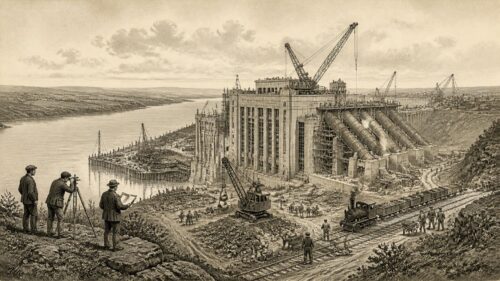


Ardnacrusha’s most compelling tension lies between its role as a symbol of Irish state-building and the uneven experience of those whose river, labour and access to electricity were reorganised by the scheme. The project joined ambitious national planning to German expertise, extensive hydraulic alteration and a grid whose benefits did not immediately reach every rural household. This suggests that infrastructure can create public confidence while redistributing opportunity and disruption unequally. When assessing Ardnacrusha’s long-term legacy, how should we weigh its technical and administrative achievements against the changing experiences of workers, river users and rural communities during early electrification and beyond?