

Fleadh Belfast
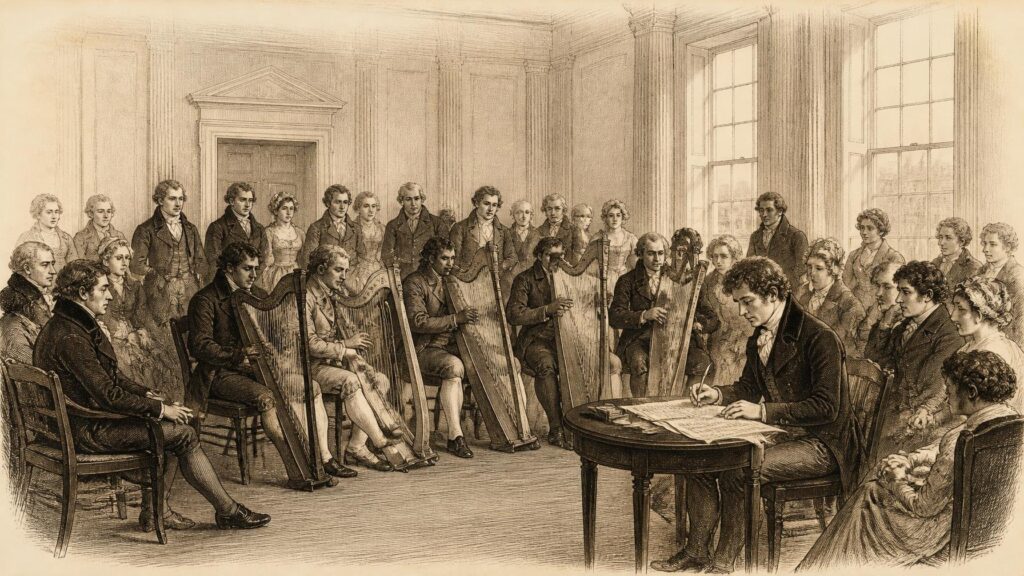
AI generated historical illustration, not a contemporary photograph.
At a Glance
When Fleadh Cheoil na hÉireann came to Belfast between 2 and 9 August 2026, it was more than a large summer festival. It placed a national institution of Irish traditional culture in a city whose musical life has long crossed, complicated and sometimes challenged the political boundaries of the island. The event was contemporary, carefully planned and commercially consequential; but its importance lay equally in the older histories it brought into view: the Belfast harp meeting of 1792, the collecting of Edward Bunting, the survival of music through family and local networks, the postwar revival of traditional arts, and the difficult public negotiation of cultural identity in Northern Ireland.
Festival Arrival
Fleadh Cheoil na hÉireann, usually shortened to the Fleadh, is the principal all-island competitive festival organised by Comhaltas Ceoltóirí Éireann. In Belfast in 2026 it combined formal competitions with concerts, céilithe, sessions, talks, exhibitions, street performances and a broad programme of associated activity. The city council described it as Belfast’s first hosting of the event, while Comhaltas presented the week as a landmark in the organisation’s seventy-fifth anniversary year. The distinction matters. Belfast had, of course, hosted Irish music, Irish-language activity, folk revival events and community festivals before 2026. What had not previously happened was the arrival of the national Fleadh itself in the city.
The scale of the event made the claim of historical significance understandable. Belfast City Council later reported 1.65 million attendances or movements during the festival period, considerably above its earlier visitor estimate. Such figures should be treated cautiously. They are not a census of 1.65 million separate people, and large-event totals commonly measure footfall, repeat visits and activity within a defined area. Even so, they indicate an exceptional concentration of people and public activity in the central city. Comhaltas’s official material records that competitors had first qualified through county and provincial fleadhanna before reaching the all-Ireland stage. The Belfast programme therefore joined local urban spectatorship to a much wider network of musicians, dancers, singers and Irish speakers from across Ireland and overseas.
There was an obvious symbolic charge in the location. Belfast is the capital of Northern Ireland, a place where cultural practices have often been read as declarations of constitutional and communal allegiance. Irish traditional music has never belonged to a single political outlook, nor has every Belfast resident experienced it in the same way. Yet it can carry associations with Irish nationalism, Gaelic revivalism and Catholic communal life, particularly when displayed in civic space. A festival explicitly titled Fleadh Cheoil na hÉireann could consequently not be understood merely as neutral entertainment. Its arrival raised questions about belonging, historical memory and the changing civic culture of Belfast.
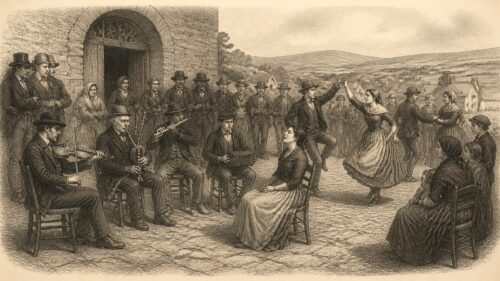
Those questions should not obscure the ordinary substance of the Fleadh. At its centre were performances and competitions in arts transmitted by ear, learned in homes and classes, rehearsed in branches and schools, and renewed in pubs, halls and festival settings. Fiddle tunes, flute playing, uilleann piping, button accordion, harp, concertina, singing, set dancing and Irish-language conversation were not museum pieces brought briefly into a city without musical traditions. They were living practices, shaped by different local repertoires and by a modern international circulation of recordings, teaching and travel. Belfast 2026 was an event in that continuing life, rather than a final destination in an uncomplicated story of cultural recovery.
Institutional Beginnings
The immediate institutional history begins with Comhaltas Ceoltóirí Éireann, founded in 1951. Its name is usually translated as the association, fellowship or society of musicians of Ireland. The organisation emerged at a time when many advocates of Irish traditional culture feared that older repertoires, instruments and modes of social music-making were losing ground. That concern was not simply a matter of nostalgia. Population movement, economic change, new mass media, altered patterns of leisure and the prestige of commercial popular music all affected how music was learned and heard. The response of Comhaltas was to create branches, encourage tuition, establish competitions and give traditional music an organised national framework.
The first Fleadh Cheoil na hÉireann took place in Mullingar in 1951. From that beginning, the Fleadh became both a competition and a gathering point. It did not invent Irish traditional music, which was far older and far more various than any single institution. Nor did it preserve a wholly fixed inheritance. Its importance was different: it made transmission visible, offered public recognition to performers, created reasons for communities to organise and gave young musicians a route from local activity to all-Ireland competition. As Comhaltas expanded, branches also appeared among Irish communities in Britain, North America, continental Europe and further afield. The Fleadh’s national title consequently came to include a sizeable diaspora.
Competition can appear at odds with an oral tradition in which tunes are shared informally and variation is expected. In practice, the relationship has been productive as well as uneasy. Competitions reward preparation, technical command and knowledge of styles; sessions reward listening, adaptability and sociability. A musician may move between both worlds. The formal competition platform can create a standardising pressure, especially when adjudication must compare performers from different places. Yet it can also provide a public incentive for learners to acquire demanding repertoires and seek out older players. The Fleadh has survived because it has never consisted only of adjudicated performance. Its surrounding sessions, encounters and chance conversations are central to its social meaning.
By the twenty-first century, the Fleadh had become a major visitor event as well as an artistic institution. Recent host towns had demonstrated how a week of music could reshape streets and public venues, draw families and returning emigrants, and generate substantial trade for accommodation, food and hospitality businesses. This success created opportunities but also altered expectations. Hosts needed transport planning, crowd management, licensing arrangements, volunteers, accessible spaces and a broad range of venues. Belfast’s bid was consequently a civic undertaking as much as a cultural invitation. It was advanced by Belfast City Council in partnership with Ards Comhaltas, whose local knowledge and organisational involvement were essential.
The announcement that Belfast would host the 2026 Fleadh was made at Belfast City Hall on 8 March 2025. It was a consciously public declaration that connected the organisation’s anniversary to a city with a complex place in Irish cultural history. Comhaltas’s publicity described the occasion as historic, but that description should be read in a precise sense. The novelty was not that Irish music had finally reached Belfast. Its older presence is well attested. Rather, a national all-Ireland cultural institution, founded in the early years of the Irish state but active throughout the island and diaspora, had chosen Belfast as its principal host city. That decision would have seemed improbable to many people during the worst decades of conflict.
Harp Gathering
Belfast’s claim upon the history of Irish traditional music reaches much further back than Comhaltas. The best-known early episode is the Belfast Harp Festival of 1792, held in the Assembly Rooms. It brought together a small group of surviving Irish harpers at a time when the older wire-strung harp tradition was under severe pressure. Edward Bunting, then a young musician from Belfast, attended in order to take down their music. His later publications helped secure the survival of a substantial body of melodies associated with the Irish harp tradition. The event has become an enduring foundation stone in accounts of music collecting in Ireland.
It is important, however, not to turn the 1792 gathering into a simple rescue scene. The harpers were bearers of living traditions, not relics who had stepped unchanged out of an ancient past. Their repertories had been shaped by patronage, travel, memory, contemporary taste and changing audiences. Bunting himself was not a transparent recorder. He transcribed what he heard, made field notes, arranged material for publication and presented Irish airs to readers whose domestic instruments and musical expectations differed from those of the older harpers. Later scholarship has emphasised the value of his manuscripts while also warning against treating published piano arrangements as direct replicas of historical performance.
The distinction between evidence and legend is especially necessary here. The Belfast harp meeting is documented, as are Bunting’s collecting activities and publications. The broader story that it single-handedly saved all Irish music belongs to a more romantic tradition. No one event could do that. Music survived through performers, households, teachers, dancing, religious and secular occasions, printed collections, later recordings and countless acts of remembering. Yet the meeting remains genuinely important. It linked Belfast to the recording and reinterpretation of a repertory that became central to later ideas of Irish musical heritage.
The city’s place in that history is revealing. Belfast in the late eighteenth century was a growing commercial town shaped by trade, Presbyterian dissent, print culture and political argument. It was not outside Irish cultural life because of its links to Scotland, Britain or the Atlantic world. Those links were part of its Irish history. The Assembly Rooms gathering demonstrates that Irish music could be collected, discussed and patronised in an urban environment often described through industrial or political categories. It also reminds us that cultural transmission has rarely respected the neat boundaries later ideologies seek to impose upon it.
For the 2026 Fleadh, the Bunting connection was more than a decorative historical reference. Comhaltas’s opening material explicitly invoked the fact that tunes were played in Belfast because Bunting had written them down there more than two centuries earlier. PRONI marked the festival with displays relating to music, including material concerning the Donegal fiddler John Doherty and an early version of the melody later known as the Londonderry Air. These were not claims that the Fleadh recreated 1792. They instead placed the contemporary gathering within an archive-conscious culture of collecting, preserving and re-performing. The point was continuity, but a continuity made through change.
Urban Soundscapes
Belfast’s musical history cannot be reduced to one tradition. Throughout the nineteenth and twentieth centuries, its streets, churches, theatres, factories, Orange halls, dance halls, public houses, working-class districts and concert rooms supported overlapping sound worlds. Classical music, sacred repertoire, marching music, ballads, brass bands, pipe bands, Scottish forms, English popular songs, Ulster-Scots traditions and styles identified as Irish all had places in the city. Some were institutionally supported; others depended upon informal networks. This diversity does not mean that cultural differences were insignificant. It means that the historical soundscape was more entangled than a two-community account can capture.
Music was often a means of making a group audible to itself. Marching bands could mark routes, seasons and political traditions. Hymns and gospel songs attached communities to congregational life. Dance music could be local, mobile and responsive to changing fashion. Street cries, children’s rhymes and workers’ songs belonged to everyday oral culture. The BBC Northern Ireland’s later recollections of programmes such as As I Roved Out describe the impact of broadcasting singers and instrumentalists from Ulster townlands into domestic homes. Such broadcasts did not create the music they recorded, but they changed its reach and status by allowing ordinary performers to be heard as carriers of cultural knowledge.
The folk collector Sam Henry offers another route into this complexity. Between 1923 and 1939, his newspaper series Songs of the People assembled material from across Ulster. The collection is particularly valuable not because it supplies a pure or homogeneous local voice, but because it reveals a region where song travelled among places, languages, denominations and social settings. Some items can be connected to broad Irish or Scottish repertoires; others show local wording, place references or remembered variants. Such collections preserve evidence, but they also reflect the interests, methods and editorial decisions of their collectors. Historians must read them as records of interaction, not simply as sealed containers of ancient authenticity.
Belfast’s industrial expansion brought further changes. A city of shipbuilding, linen manufacture, engineering and port trade drew people from rural Ulster and beyond. Migration brought tunes and songs into new settings, while dense urban life created different forms of association. Local halls and social clubs could sustain music, but the pressures of work, housing and sectarian segregation also limited encounters. The idea that rural tradition and industrial city were opposites is therefore misleading. Belfast was one of the places where rural cultural material was adapted to urban circumstances, where performers found audiences and where commercial or broadcast media offered new channels of circulation.
This layered musical past helps explain why Belfast could plausibly host the Fleadh. The festival did not impose culture upon a blank civic stage. It entered a city that had long contained Irish traditions alongside numerous other traditions. The challenge was not to establish that only one inheritance was authentic. It was to present Irish music and dance in a manner that acknowledged their importance without demanding cultural uniformity. In that respect, the success or failure of the event depended less on ceremonial statements than on the quality of its welcome, the range of its performers, and the willingness of citizens to occupy shared spaces together.
Revival Networks
The decades after the Second World War were crucial for the reshaping of traditional music in Ireland. Radio, records, touring, festivals and educational initiatives enabled old repertoires to travel in new ways. This was not an uncomplicated recovery of a culture that had temporarily disappeared. Musicians made choices about instruments, arrangements, tempos, accompaniment and presentation. New audiences often encountered traditional music through broadcasts, staged concerts and commercial recordings rather than through the local social settings that earlier generations had known. The resulting revival was creative, contested and international.
Comhaltas was a central part of this development, especially through its branch structure and its commitment to teaching. Its role was not exclusive. Individual musicians, local teachers, collectors, radio producers, record companies, schools and families all contributed. In Northern Ireland, the work of performers and broadcasters was especially important because traditional music sometimes operated in a divided cultural field. BBC radio programmes brought songs and tunes from areas such as south Armagh, Tyrone, Antrim and Donegal into homes across the region. The medium could make a local performer nationally familiar, while also editing and framing what listeners understood as folk culture.
The uilleann pipes, fiddle, flute and harp all acquired new public visibility in this era, while singing traditions were documented and reinterpreted by performers with very different backgrounds. Sean-nós song, dance tunes, ballads and instrumental pieces moved across county boundaries and beyond Ireland. Musicians in London, Glasgow, Boston, New York and other centres of Irish migration influenced the direction of the tradition as much as those who remained in rural districts. This transnational element is important to any understanding of the Fleadh. Its all-Ireland competitions are rooted in the island, but the organisation’s social world has long extended through emigrant communities.
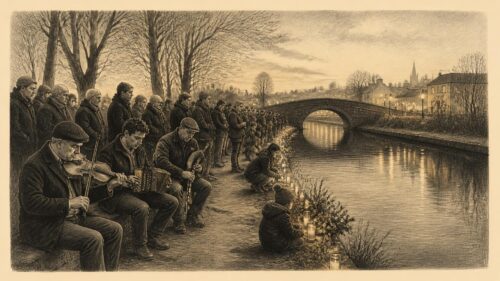
The modern session became one of the revival’s defining spaces. It can appear spontaneous to visitors, but it depends upon conventions: shared tune sets, etiquette about joining in, attention to rhythm, respect for singers, tacit understandings about repertoire and an acceptance that different instruments have different roles. Sessions are at once social and musical institutions. They have enabled young players to learn quickly, visitors to meet local musicians and repertoires to circulate widely. They have also prompted arguments about volume, authenticity, commercialisation and whether a pub session is principally for participants or an audience. Such tensions are signs of a tradition actively being lived rather than simply preserved.
Belfast developed important revival networks of its own. Irish-language cultural centres, music schools, festivals, specialist venues and local branches created spaces for tuition and performance. Musicians from Belfast and surrounding counties became significant figures in the wider traditional scene, and audiences in the city supported concerts that brought performers from all parts of Ireland. The relationship between Belfast and the rest of the island was never only political. Students travelled for lessons and competitions; families visited relatives; recordings crossed borders; artists collaborated; and urban venues became meeting places for music whose local roots lay in many counties.
By 2026, the Fleadh was able to draw upon this established infrastructure. The presence of local organisers did not mean that every Belfast community felt represented by the festival. Nor would that be a realistic standard for any single event. It did mean, however, that the Fleadh had partners familiar with the city’s geography, its cultural sensitivities and its practical needs. Its arrival was the product of decades of groundwork, rather than a sudden discovery that traditional Irish arts existed north of the border.
Divided City
No account of Belfast can avoid the political violence and segregation that marked much of the late twentieth century. From the late 1960s, the conflict commonly called the Troubles reshaped public life. Security barriers, military presence, paramilitary violence, displacement, bereavement and contested territory affected where people went, which venues flourished and what forms of public gathering seemed possible. Culture did not cease during those years, but it was often interpreted through the lens of identity. A song, flag, language or commemorative practice could acquire meanings that were far larger than the immediate activity itself.
Irish traditional music was not immune from this atmosphere. For some, it formed a valued part of an all-Ireland cultural inheritance; for others, it was viewed with suspicion because of assumed political associations. Such assumptions could flatten a diverse musical practice into a badge of communal allegiance. They also ignored the fact that tunes, instruments and dance forms moved historically between Ulster, Scotland, Britain and Ireland, and that musicians have often collaborated across inherited boundaries. Still, historical complexity does not remove the reality of exclusion. People who felt culturally unwelcome in particular spaces could not be reassured merely by being told that music transcended politics.
The peace process and the Good Friday Agreement of 1998 created new conditions, though not a complete end to division. Belfast gained more opportunities for tourism, cultural investment and civic events that brought people into the city centre. At the same time, residential separation, competing narratives of the past and periodic political tension remained significant. The cultural transformation of Belfast should therefore be described carefully. It is neither accurate to picture the city as frozen in conflict nor convincing to claim that a successful festival dissolved long-standing differences. Public cultural life can widen contact and reduce unfamiliarity; it cannot by itself resolve questions of power, memory or constitutional aspiration.
The previous Northern Ireland Fleadh in Derry in 2013 provides useful context. It was held during the city’s year as UK City of Culture and was widely described as a notable occasion for the north-west. Belfast 2026 was only the second time the all-Ireland Fleadh had been staged in Northern Ireland and the first time in Belfast. That interval is historically meaningful. It reflects both the weight of the past and the gradual emergence of a civic confidence in which an all-Ireland cultural event could be sought openly by the capital city’s council.
Organisers repeatedly used the language of welcome and shared celebration. Such language can be promotional, and historians should not mistake it for proof of social consensus. But the very choice of language reveals what the event hoped to achieve. The Fleadh was framed not as a test of political allegiance but as an opportunity for people to encounter music, dance, language and hospitality. Its public staging in commercial streets, civic spaces and established venues encouraged a form of visibility that would have been more difficult to imagine in earlier decades. The evidence supports an interpretation of Belfast 2026 as a significant civic opening; it does not support the stronger claim that the city’s cultural divisions were thereby overcome.
Competitive Culture
The championships remained the formal heart of the Fleadh. Competitors who reached Belfast had progressed through local and provincial levels, a structure that joins the national event to year-round community activity. This system gives the festival its depth. A child playing a first competition at county level is not merely entering an annual spectacle; he or she is participating in an educational and social ladder developed over generations. Teachers, parents, branch volunteers and accompanists make that participation possible. The public sees the final performances, but the work behind them is dispersed through countless rehearsals, lifts to classes, fundraising events and weekend gatherings.
Competitive traditional music has attracted criticism, including concern that adjudication encourages uniformity or rewards display over regional character. The criticism has force. A judge’s preference can influence repertoire and style, while formal categories may not always accommodate the fluidity of local practice. Yet competition also produces archives of achievement and encourages young musicians to take their art seriously. It gives singers and instrumentalists a reason to learn difficult material, to listen closely to earlier recordings and to meet peers from outside their home districts. Many leading performers have experienced the Fleadh as both demanding and formative.
The key is to resist a false choice between competition and tradition. Tradition is not the absence of discipline; many older musicians possessed formidable technique and distinctive standards. Nor is competition necessarily the enemy of sociability. A Fleadh week creates occasions in which a formal competitor may later join an informal session, hear an unfamiliar regional tune, meet an older player or discover an instrument not taught in a school syllabus. The festival’s educational value lies partly in these unplanned encounters. Its competitive structures bring people together; the surrounding culture gives those meetings durable meaning.
Language was also part of the festival’s remit. Comhaltas includes comhrá, Irish-language conversation, among the activities represented at its Fleadh. This is historically important because Irish music and Irish language have often been intertwined without being identical. A tune may travel without words; a singer may use English, Irish or both; an instrumental tradition may be strong in communities where Irish is no longer spoken daily. The Fleadh’s inclusion of language acknowledges a wider cultural field while avoiding the assumption that all participants share the same linguistic history. In Belfast, where Irish has often been politically debated, this visibility carried particular resonance.
Dance provides another corrective to narrow understandings of the Fleadh. Step dancing, céilí dancing and set dancing turn music into shared movement. Their histories include local variations, changing teaching methods and influences from across the Irish Sea and beyond. Public céilithe are especially valuable because they make participation possible for people who are neither virtuoso musicians nor specialist dancers. In a city-centre festival, they can transform a viewing public into a temporary social body. The historical significance of such occasions cannot be measured only through ticket numbers. It lies in the memories produced when people take part, however imperfectly, in a form of collective recreation.
Public Week
The Belfast Fleadh of 2026 was designed as a city-wide experience rather than an event confined to a single hall. That approach reflected the scale of contemporary Fleadh hosting, but it also suited Belfast’s urban geography. Performances and sessions could animate streets, pubs, theatres, civic buildings and temporary outdoor areas. Pedestrianisation and altered traffic arrangements made the central city more available to walkers. For a week, areas usually associated with shopping, work, transport and nightlife became stages for music and encounter. The transformation was temporary, but temporary transformations can alter how residents imagine a familiar place.
Public claims about economic benefit require restraint. Festival organisers and local authorities are entitled to measure visitor activity, hotel demand and commercial impact, but headline figures are often estimates based on modelling. They should not be repeated as if they were exact accounts of profit shared equally across a city. The more secure conclusion is that an event of this size created substantial demand for venues, food, accommodation, transport and local services. It also demanded public expenditure and imposed inconvenience, including altered routes, crowding and pressure on hospitality workers. A historical account should recognise both sides of the equation.
The city council’s post-event statement described more than 1.65 million people being welcomed to Belfast during the festival week, while the Belfast Fleadh digital guide reported extensive use by visitors seeking sessions, venues and ticketed events. These records show how digital tools now form part of festival history. Earlier Fleadh visitors relied on printed programmes, local knowledge, noticeboards, newspapers and word of mouth. In 2026, maps, schedules and venue information could be revised and circulated immediately through phones. This increased accessibility, though it also made the experience dependent on platforms, analytics and data systems that future historians may find difficult to preserve.
PRONI’s participation demonstrated another dimension of the week. An archive is not ordinarily thought of as a festival venue, yet its themed display linked present performance to preserved documents and recordings. The inclusion of material related to John Doherty was particularly apt. Doherty, a Donegal fiddler whose music was recorded extensively in the twentieth century, has become an emblematic figure in discussions of oral transmission and archival preservation. The presence of such material during the Fleadh invited visitors to see traditional music not only as entertainment but as evidence: something remembered, documented, catalogued and continually reinterpreted.
There is also a democratic quality in a festival spread across public and semi-public spaces. A formal concert can require money, advance booking and confidence in an unfamiliar venue. A street performance or open session allows a passer-by to pause, listen and decide whether to remain. This does not make participation equal; barriers of cost, mobility, language, confidence and local knowledge persist. But it broadens the potential audience. The Fleadh’s public week gave Belfast residents who might never enter an all-Ireland competition an opportunity to hear the music on their own streets. That visibility was among its most consequential achievements.
Shared Traditions
The phrase “shared traditions” can be useful, but it needs careful handling. It should not mean that all traditions are identical, that their histories are free from power or that differences can be politely ignored. In Ulster, music has been shaped by Irish, Scottish, English, British, Atlantic and local influences. Reels, jigs, hornpipes, ballads, pipe music, flute-band repertories, hymnody and dance forms have travelled through overlapping communities. Sometimes these exchanges have been acknowledged; sometimes they have been obscured by rival claims to ownership. The historical task is not to award exclusive possession but to trace movement, adaptation and meaning.
Fiddle music offers a clear example. The fiddle has a prominent place in Irish traditional music, in Scottish traditions and in Ulster repertoires that cannot be cleanly placed on one side of a political border. Technique, ornamentation, bowing and tune choice may reveal local affiliations, but players also borrow continuously. A Belfast audience can hear a tune as Irish, Scottish, Ulster-Scots, family inherited, recently learned online or simply enjoyable to play. These meanings can coexist, though they do not always carry equal public recognition. Festivals are valuable when they make room for complexity rather than forcing performers into simplified labels.
The 2026 Fleadh included gestures towards broad participation, and commentary around the event noted the presence of cultural traditions not normally foregrounded in descriptions of Irish music. It would be unwise to exaggerate these gestures into a settled new consensus. Inclusion must be repeated in programming, education, funding and local relationships if it is to have lasting substance. Nevertheless, the event made an important proposition visible: traditional Irish music can be presented in Belfast as part of the city’s shared public life, without requiring people to abandon other inheritances or suspend critical awareness of the past.
There is a related danger in treating traditional culture as inherently conciliatory. Music can make people feel welcome, but it can also exclude through unfamiliar codes, language or claims of authenticity. A session in which established players ignore newcomers is not automatically democratic because the tunes are old. Conversely, a performance that includes varied audiences is not superficial simply because it occurs on a sponsored stage. Historical interpretation must attend to practice. Who was invited? Who performed? Who had access to lessons and venues? Which forms were funded? How did different residents describe their experience? These questions matter more than abstract assurances that art brings everyone together.
The Belfast Fleadh’s strongest historical lesson may therefore be modest but durable. It demonstrated that a major expression of Irish traditional culture could occupy the city centre openly and attract broad curiosity. That does not erase the city’s divided history. It does, however, enlarge the range of things that can be publicly normal in Belfast. Cultural normalisation is not a dramatic settlement; it is the repeated experience of seeing, hearing and joining activities that were previously imagined as belonging elsewhere or to someone else.
Historical Meaning
How should Belfast Fleadh 2026 be remembered? First, as a particular event with dates, organisers, venues, competitors, volunteers and practical consequences. It took place from 2 to 9 August 2026, was organised through Comhaltas with local and civic partners, and represented the first Belfast staging of Fleadh Cheoil na hÉireann. Those are documentary facts. Second, it should be remembered as an episode in the history of Comhaltas, whose seventy-fifth anniversary supplied an institutional frame for the decision. Third, it belongs to Belfast’s longer musical history, especially the city’s association with Edward Bunting and the recording of Irish harp repertory.
Beyond those facts lies interpretation. The Fleadh can reasonably be understood as a sign of changed conditions in Belfast after the peace process: a city authority could bid for, and successfully host, a large all-Ireland cultural event. It can also be understood as evidence of the strength of contemporary traditional music, which now sustains major festivals, teaching networks and international participation. Neither interpretation requires a claim that history has been transcended. The festival’s success depended precisely on historical structures: community branches, accumulated repertoire, archival memory, civic planning and the hard-won possibility of more open public space.
Folklore and festival rhetoric will inevitably gather around such an occasion. Visitors will recall the best session they stumbled upon, the crowded street that seemed to sing, the unexpected conversation or the performance that changed their sense of the city. These memories are historically valuable as testimony, but they are not statistical proof. A person’s “whole Belfast was there” may express genuine emotional intensity while remaining literally impossible. The task of the historian is not to dismiss such memories. It is to distinguish their experiential truth from demonstrable fact, and to place both alongside official records and contemporary reporting.
The archive of the Fleadh will be unusually rich. It will include council reports, programmes, publicity, photographs, recordings, social-media posts, venue schedules, licensing documents, press coverage and the results of competitions. Yet some of the most important material will be harder to capture: a tune learned from a stranger, a child’s first experience of live pipes, a family decision to take lessons, or a sense that an unfamiliar part of the city became briefly approachable. These are the ways festivals enter cultural history. Their legacy does not reside only in the economic report or official photograph, but in the practices people continue afterwards.
Belfast’s musical past offers one final caution against easy conclusions. The city has repeatedly been described through binaries: Irish or British, nationalist or unionist, modern or traditional, industrial or cultural. Its music has never obeyed those divisions perfectly. The 1792 harp gathering, nineteenth-century concert life, twentieth-century broadcasting, folk collecting, local tuition and the 2026 Fleadh all show a city connected to many musical worlds. The historical value of the Belfast Fleadh lies not in proving that distinctions no longer exist. It lies in revealing that Irish traditional culture has always had a more substantial and more complicated place in Belfast than simplified narratives allow.
The 2026 festival was therefore both arrival and continuation. It arrived as the first Belfast edition of the All-Ireland Fleadh, a new landmark in the city’s public calendar. It continued a much older story of performance, collecting, migration, adaptation and contested belonging. If its organisers’ hope for a lasting legacy is realised, that legacy will not be a monument to one triumphant version of the past. It will be a strengthened habit of musical participation: more learners, more sessions, better access to archives, fuller recognition of Ulster’s varied traditions and a civic confidence capable of accommodating the many histories that sound through Belfast.
Belfast’s Fleadh suggests that a major cultural festival can create shared public encounters without pretending that historical divisions have disappeared. The article’s distinction between archival evidence, promotional language and popular memory is particularly useful, especially around the 1792 harp gathering and claims of cultural continuity. It also shows how competitions, informal sessions, broadcasting and diaspora networks preserve tradition differently, sometimes balancing standardisation against variation. Rather than treating Irish music as a fixed emblem of one community, the festival frames it as a living, overlapping inheritance within a diverse city. How might cultural events in Belfast honour histories while encouraging participation?