

Irish Legislation
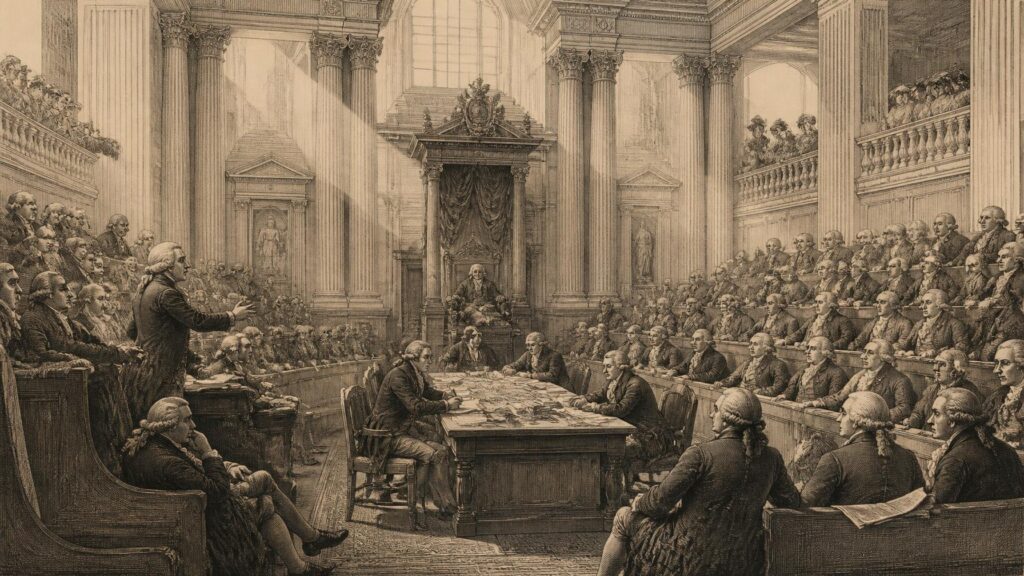
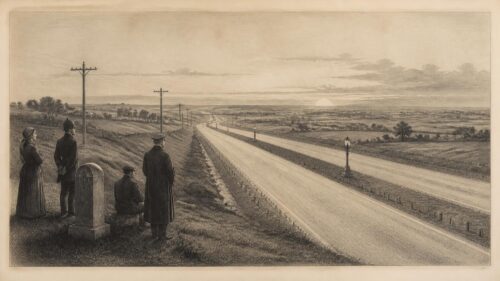
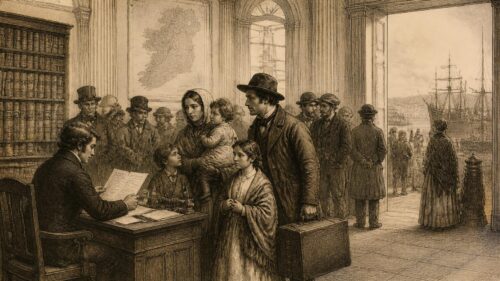
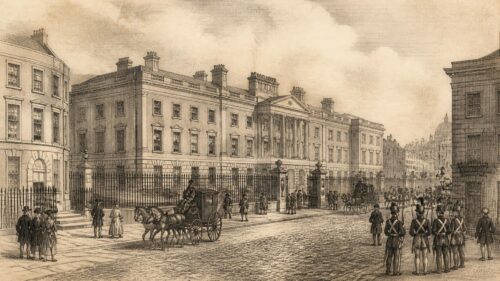
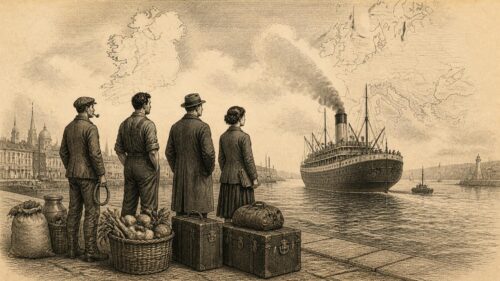
AI generated historical illustration, not a contemporary photograph.
At a Glance
Legislation in Ireland has never been merely a technical record of rules. It has been a continuing argument about authority: who may declare law, whose interests law protects, which communities are represented, and whether power lies in Ireland, in Britain, or in institutions shared across these islands. The surviving record begins unevenly, is strongest for governments and elites, and frequently reveals exclusion as clearly as participation. Yet the history of Irish legislation also shows durable efforts to make public authority answerable to popular consent, constitutional restraint and changing ideas of equality.
Legal Meanings
In its narrow modern sense, legislation means law made by a recognised legislature through a prescribed public process. That definition is useful for understanding the Oireachtas, the Parliament of Northern Ireland, and Westminster. It is less satisfactory for earlier Ireland. Before a central parliament claimed a general law-making role, rules could be maintained through kinship, local authority, church institutions, lordship, custom and judgement. Written enactments are therefore only one part of the island’s legal past. A history confined to statutes would mistake the survival of particular documents for the totality of law as it was experienced.
It is equally necessary to distinguish legislation from law itself. A statute is an enacted rule. Law also includes judicial decisions, constitutional principles, administrative regulations, customary practices and, in some periods, rules carried in memory and professional learning rather than in an official printed collection. In Ireland, as elsewhere, people often encountered authority through rent, tithes, local courts, policing, taxation, property disputes, poor relief, schooling, religious regulation or criminal prosecution. The statute book supplied an important framework, but it did not automatically determine how that framework operated on the ground.
The central historical question is thus not simply when a particular Act was passed. It is how a measure was authorised, translated into practice and received by those affected. An enactment might be drafted in Dublin or London, debated by men who held a narrow property qualification, administered by officials with limited local knowledge, and resisted or adapted in communities that possessed their own expectations of justice. The gap between legal language and lived reality is not an accidental complication. It is one of the main subjects of Irish legislative history.
Customary Orders
Long before the Norman settlement, Ireland possessed sophisticated indigenous legal traditions normally described as brehon law. The term is a convenient modern label, but it should not imply a single national code imposed by one state. The evidence points instead to learned legal culture, transmitted and elaborated by jurists, operating across a society organised around kin groups, clientship, lordship and status. Texts later written down in manuscripts preserve legal material concerning land, injury, fosterage, contracts, honour, compensation and social obligation. They illuminate ideals and categories, although they do not allow historians to reconstruct every local hearing or to assume uniform enforcement throughout the island.
These legal traditions were not legislation in the parliamentary sense. Their authority rested on learning, precedent, social relationships and accepted procedures of arbitration rather than on a representative assembly voting a Bill into law. Compensation, surety and kin responsibility were important features. That does not make the system either primitive or harmonious. Legal status mattered profoundly, and the protections available to a powerful person were not identical to those available to a dependent person, a woman, a stranger or an enslaved individual. Modern admiration for the antiquity of Irish law should not erase those hierarchies.
Popular accounts sometimes describe ancient Irish law as uniquely democratic, environmentally enlightened or wholly egalitarian. Such claims are generally interpretations or folklore rather than conclusions that the evidence can bear without qualification. The manuscripts are precious evidence of legal thought, but they are mediated records, copied and preserved under changing political and ecclesiastical conditions. They cannot by themselves demonstrate a timeless national constitution. What they do demonstrate is that Ireland had elaborate legal cultures before the development of the English parliamentary institutions that later came to dominate formal legislation.
Christian churches also shaped legal authority. Ecclesiastical reform, monastic networks and connections with wider Latin Christendom affected marriage, inheritance, morality, sanctuary and the relationship between secular rulers and religious institutions. This was not a simple replacement of one system by another. Different legal traditions overlapped, competed and influenced each other. The history of legislation in Ireland begins, therefore, with plural sources of authority rather than with a clean transition from custom to statute.
Norman Institutions
The arrival and expansion of Anglo Norman power from the late twelfth century introduced a new political geography and new legal institutions. The English Crown claimed lordship in Ireland, while actual authority varied considerably between regions. Royal officials, magnates, boroughs, churchmen and settlers developed courts and administrative practices connected to those of England. The reach of those institutions was neither immediate nor complete. Beyond areas of effective lordship, Gaelic polities continued to employ their own forms of governance and legal learning. Ireland was consequently a place of legal plurality, not an island uniformly remade by conquest.
The Houses of the Oireachtas identify a meeting at Castledermot in County Kildare on 18 June 1264 as the first Irish Parliament for which there is definitive record. It was not a parliament in the present democratic sense. Its participants were landholding knights and jurors, called in connection with an inquiry concerning the authority of Archbishop Fulk Basset de Sandeford to hold courts. Nevertheless, the record is important. It shows the emergence in Ireland of a central forum at which matters understood as public governance could be considered through institutions introduced under the lordship.
Medieval parliaments were episodic rather than permanently sitting legislatures. They could advise, consent to taxation, hear petitions, confirm arrangements and enact measures. Their membership was restricted and their constituency narrow. The political community represented in such gatherings was largely the community of the English lordship: magnates, prelates, officials, borough interests and landholders. The great majority of inhabitants had no direct electoral voice. To call this an Irish parliament is historically correct if it denotes a parliament sitting in Ireland, but misleading if it suggests a national body representative of all Irish people.
Even so, statutory records from the medieval Irish Parliament are of exceptional value. Their survival enables historians to see the practical concerns of government: defence, taxation, administration, trade, urban regulation and the maintenance of royal authority. The publication of the Statute Rolls of the Parliament of Ireland has made this evidence more accessible and has also exposed its limits. A statute roll records what authorities declared. It rarely offers a full account of local compliance, evasion or contest. A law demanding obedience may reveal insecurity as much as control.
Colonial Boundaries
Medieval legislation repeatedly marked social and cultural boundaries. The best known example is the Statutes of Kilkenny of 1366. These measures sought to reinforce separation between the English settler population and the Irish population in areas under the authority of the Crown. They addressed marriage, fosterage, language, dress, pastimes, appointments and other aspects of social life. Their notoriety has encouraged a simplified view of a permanently rigid division. The statutes were certainly discriminatory and coercive, but their very breadth also suggests official anxiety about cultural interchange and political accommodation.
It is unwise to treat the Statutes of Kilkenny as a complete description of medieval life. They are evidence of governmental intention, not a census of human behaviour. Intermarriage, bilingualism, fosterage and alliance were realities against which such provisions were directed. Historians therefore read the statutes both for what they attempted and for what their attempts imply. They reveal an administration trying to define an English political community in a society where the boundaries it wished to police were often porous.
Colonial legislation also had a geographical limit. The later phrase ‘the Pale’ came to describe the diminishing area in which English governmental power was most effective, particularly around Dublin. Outside it, English law might be known, claimed or selectively invoked, but it could not simply be assumed to govern everyday life. This unevenness matters because legislation has force only where institutions can interpret, enforce and legitimate it. A statute may be printed for a kingdom while remaining distant from many of its inhabitants.
The medieval record therefore resists two opposite myths: that Ireland lacked law before English intervention, and that English statute immediately replaced all other norms after the intervention. Both propositions flatten a far more complicated history. The island contained overlapping jurisdictions and communities, each capable of generating obligations. Later constitutional conflicts would occur within a framework largely shaped by English and then British institutions, but that framework was never the sole source from which Irish people drew their ideas of right.
Tudor Control
The Tudor period altered the constitutional relationship between the Irish Parliament and the English Crown. Sir Edward Poynings, sent as Lord Deputy, summoned a parliament at Drogheda in 1494 and 1495. The legislation associated with that parliament, conventionally known as Poynings’ Law, required proposed Irish legislation to be certified under the great seal of Ireland and approved by the English Crown and council before an Irish parliament could be summoned to consider it. In practical terms, it constrained the initiative of the Dublin legislature and tied its business to English executive approval.
Poynings’ Law became an enduring symbol of dependency. It was not, however, a simple declaration that the English Parliament possessed an unlimited right to legislate for Ireland. The constitutional position was disputed across later centuries. What the measure clearly did was make the calling and legislative agenda of the Irish Parliament subject to a stringent prior process. It reduced the capacity of members in Ireland to introduce or amend measures freely and enhanced the influence of the Crown’s administration. The distinction between executive control and parliamentary supremacy is important, even though both could diminish Irish legislative autonomy.
The statute must be understood in its immediate political setting. The Crown sought to restrain the power of the Fitzgerald earls of Kildare and to strengthen royal administration. It was an instrument of consolidation after a period in which magnate authority had been formidable. Its legacy was larger than the circumstances of its enactment because it created a procedure that endured, with modifications, into the eighteenth century. Later critics treated it as a constitutional wound; officials could regard it as a safeguard against an unreliable parliament. Both views disclose the political stakes attached to legislative initiative.
The Tudor Crown also pursued a wider programme of centralisation and conquest. The Irish Parliament, though restricted, became a vehicle for measures extending royal institutions, religious change and the legal categories of the expanding kingdom. The Crown of Ireland Act 1541, passed by the Irish Parliament, changed the English monarch’s title from Lord of Ireland to King of Ireland. That enactment was constitutionally significant because it expressed a claim to island-wide kingship, although the reality of authority still varied sharply between regions.
Religious Reformation
The Reformation illustrates the power and limitation of legislation. Acts passed through the Irish Parliament under Henry VIII and his successors addressed royal supremacy, ecclesiastical governance and religious observance. The legal position of the established church was transformed through statute, but religious belief and practice could not be remade by enactment alone. Local conditions, clerical networks, political loyalties and the uneven capacity of government all shaped the outcome. Legislative history must therefore distinguish the formal establishment of policy from the social history of religious change.
Under Elizabeth I, further statutes strengthened the Church of Ireland settlement and the English governmental presence. Yet Ireland did not become religiously uniform. The majority Catholic population retained religious attachments which the state could regulate and penalise but not extinguish. In this sense, legislation helped produce a long-running political vocabulary of conformity, loyalty and dissent. It also contributed to the association of state institutions with a Protestant ascendancy, an association that would become still more consequential after the seventeenth-century wars.
There is a temptation to interpret every religious Act solely as a weapon of ethnic or national oppression. That interpretation identifies a real dimension of power but can obscure other factors: dynastic politics, European confessional conflict, property, fears of rebellion and competing visions of ecclesiastical order. Conversely, to describe the measures merely as administrative reform would ignore their unequal effects. The strongest historical account holds these elements together. Laws were framed in a wider British and European context, but in Ireland they acted upon a society marked by conquest, land transfer and profound religious division.
Confiscation Regimes
The seventeenth century made legislation inseparable from war, settlement and property. The upheavals beginning with the rebellion of 1641, the Confederate period, Cromwellian conquest, Restoration settlements and Williamite war repeatedly changed the legal basis of landholding and political participation. Parliamentary enactments, proclamations, commissions and courts did not simply follow violence; they organised its consequences. Land confiscation, transplantation, forfeiture and settlement were expressed through legal instruments that gave durable form to changes achieved or defended by force.
The Confederate Catholics assembled at Kilkenny from 1642 and developed councils, courts and administrative structures. Their constitutional status was contested from the outset. They did not constitute a parliament recognised by the English Crown, yet they exercised a form of organised government over substantial territory during wartime. Their existence is a reminder that law-making authority can be claimed as well as conceded. Different participants grounded that claim in religion, defence, loyalty to the king, association and necessity. No simple label captures the full character of Confederate government.
After Cromwell’s campaign, the Act for the Settlement of Ireland 1652 and related measures provided legal structures for confiscation and redistribution. The human consequences were immense, but the common shorthand that every Catholic was literally driven ‘to hell or to Connacht’ oversimplifies a complex and varied process. The phrase is memorable and has become part of popular historical memory; it should not be used as a complete account of policy or experience. Documentary evidence shows extensive dispossession and transplantation, while also revealing exceptions, administrative negotiation and local variation.
Restoration legislation did not restore pre-war arrangements. The Acts of Settlement and Explanation attempted to resolve competing claims among royalists, Cromwellian grantees, soldiers, adventurers and dispossessed proprietors. Their detail demonstrates a fundamental feature of legislation: it creates classifications. Who counted as innocent, forfeiting, restored or confirmed could determine a family’s future. Such categories were legal terms, but they were also instruments through which political victory entered property records and landscapes.
Penal Statutes
Following the Williamite victory, the Irish Parliament became associated with the Protestant Ascendancy. Its membership and electoral basis excluded most of the population. Catholic political power was curtailed, while Presbyterians also faced disabilities under the established church system. The Penal Laws were not one coherent code enacted at a single moment; they were a succession of statutes and administrative practices affecting religion, property, education, officeholding, arms and inheritance. Their severity, enforcement and local operation varied over time, but their cumulative effect was to institutionalise unequal civic status.
It is important not to repeat a crude story in which every provision was uniformly enforced in every place for every year. Some laws were modified, evaded, unevenly applied or softened by private arrangements. Catholics continued to own property in certain circumstances, conduct business, practise religion and develop educational networks despite legal restrictions. None of this removes the discriminatory character of the system. Rather, it clarifies how oppressive law can work through uncertainty as well as absolute enforcement. A person need not be prosecuted under every possible disability for the legal order to shape choices and opportunities.
The eighteenth-century Irish Parliament possessed considerable practical importance despite its restricted electorate and constitutional subordination. It legislated on taxation, trade, local administration, property, roads and many other matters. It also embodied a contradiction that later generations would confront: a demand for greater autonomy from Britain could coexist with resistance to broadening political rights within Ireland. Legislative independence for a Protestant property-owning elite was not the same thing as democratic self-government.
Patriot Claims
Constitutional conflict intensified in the later eighteenth century. Writers and politicians challenged the extent of British legislative authority over Ireland, while the American Revolution and the mobilisation of the Irish Volunteers transformed the political atmosphere. The Declaratory Act of 1719 had asserted the power of the British Parliament to make laws binding Ireland and had curtailed the appellate jurisdiction claimed by the Irish House of Lords. It became a focal point for those who argued that Ireland’s parliament should possess legislative independence.
The settlement commonly called the Constitution of 1782 resulted from a combination of political pressure, international circumstance and governmental concession. British legislation repealed the 1719 Declaratory Act, and Poynings’ Law was modified in a way that gave the Irish Parliament greater freedom over the initiation of Bills. In 1783, further British legislation declared that the right of the Irish people to be bound only by laws enacted by their own parliament had been established and should not be questioned. Henry Grattan became the best-known parliamentary voice of this achievement, though the movement involved many interests and cannot be reduced to one man.
Later nationalist memory often treated 1782 as a recovered national parliament. That is an interpretation with emotional and political force, but it requires qualification. The electorate was small, Catholics remained excluded from parliamentary membership, and the legislature was dominated by Protestant landowners and borough interests. The Irish Parliament could defend Irish commercial or constitutional interests while failing to represent most Irish inhabitants. Its increased autonomy was real, but its popular basis was restricted.
The era nevertheless mattered greatly. It showed that the constitutional relationship between Ireland and Britain was not fixed by nature. It could be contested through public pressure, volunteer organisation, parliamentary argument and statutory revision. The resulting legislative independence also made the later Union more traumatic for those who saw the Dublin parliament as an indispensable, if imperfect, centre of political life.
Union Settlement
The rebellion of 1798, the continuing fear of French intervention and the British government’s determination to secure a more integrated state led to the Acts of Union. The Irish Parliament passed the Irish Act of Union in 1800, while the Parliament at Westminster passed corresponding legislation. From 1 January 1801, the Kingdom of Great Britain and the Kingdom of Ireland became the United Kingdom of Great Britain and Ireland. The separate parliament in Dublin ceased to exist, and Irish representatives took seats at Westminster.
The Union was a legislative act of enormous constitutional consequence, but it was not secured in a political vacuum. Its passage followed an initial defeat in the Irish House of Commons and a subsequent campaign of patronage, office, peerages and intense governmental pressure. Contemporary opponents, including Grattan, condemned the measure as the destruction of Ireland’s legislature. Supporters argued that it would provide security, stability and a wider imperial framework. The parliamentary votes are documented; the moral judgement to place upon the methods used remains a matter of historical interpretation.
The Union did not remove legislation from Irish life. On the contrary, Ireland became subject to a growing volume of United Kingdom law, much of it directed specifically at Irish conditions. But the centre of legislative decision-making moved to London, where Irish representation was numerically limited and where the political priorities of Ireland competed with those of Britain and empire. The physical fate of Parliament House in Dublin, later occupied by the Bank of Ireland, became a potent symbol of this transfer of authority.
One promised accompaniment to Union, Catholic emancipation, was not immediately delivered. This delay deepened distrust and helped make emancipation a central campaign of the early nineteenth century. Daniel O’Connell’s movement demonstrated that mass political organisation could press upon Westminster, even within a constitutional system that denied most people the vote. The Roman Catholic Relief Act 1829 removed important disabilities, including the bar on Catholics sitting in Parliament, but it was paired with a sharp increase in the property qualification for Irish county voters. Expansion and restriction were thus enacted together.
Imperial Governance
Nineteenth-century Irish legislation ranged across policing, local government, education, land, public health, religion and poverty. It was frequently presented as remedial administration, yet it operated within unequal structures of ownership and political power. The Irish Poor Law of 1838 created a system of poor law unions, boards of guardians and workhouses. The workhouse became one of the most enduring symbols of the Great Famine, though the law pre-dated the catastrophe. Its institutional assumptions, particularly its emphasis on indoor relief and local rating, proved devastatingly inadequate to a crisis of mass hunger, disease and eviction.
The Famine cannot be explained by a single statute, nor can legislative history substitute for the experiences of those who died, emigrated or struggled to survive. Still, policy was made through law. Rules governing relief, rates, food imports, labour, tenancy and public works shaped the resources and choices available to officials and households. Historians debate the degree to which ideology, fiscal caution, administrative failure and deliberate political calculation explain British governmental responses. The documentary record supports no comforting view that legal procedure alone ensured humane outcomes.
Land legislation became a central arena of conflict later in the century. The Land Acts gradually altered the relationship between landlords and tenants, recognising protections and facilitating transfer of ownership. These measures were not simply gifts from Westminster. They emerged from agrarian agitation, electoral pressure, parliamentary manoeuvre and changing assumptions about property. The Land League and related movements showed again that legislation often follows mobilisation. Law may contain a conflict, but it also records the pressure that made containment necessary.
Home Rule brought the constitutional question to the foreground. Bills introduced under William Gladstone in 1886 and 1893 failed, while the Parliament Act 1911 changed the balance between the House of Commons and the House of Lords. The Third Home Rule Act received Royal Assent in 1914, but its operation was suspended because of the First World War. By then, unionist resistance, especially in Ulster, had made plain that no legislative settlement could be understood simply as a contest between Ireland and Britain. It also involved deeply divided political allegiances within Ireland.
Revolutionary Assemblies
The general election of December 1918 produced a decisive Sinn Féin victory in most Irish constituencies. Rather than take their seats at Westminster, Sinn Féin representatives convened Dáil Éireann in Dublin on 21 January 1919. The First Dáil adopted a Declaration of Independence and a short constitution. Its claim was unequivocal: the elected representatives of the Irish people alone possessed authority to make laws binding on Ireland. This was a revolutionary assertion, not one accepted by the British government, but it created an alternative source of legislative legitimacy.
The Dáil’s importance lies not only in its declaration. It developed departments, issued decrees, supported republican courts and sought to establish practical authority during the War of Independence. Its capacity was constrained by conflict, repression and limited resources. Its jurisdiction was contested, and its legal acts were not universally obeyed. Nonetheless, it helped shift the meaning of Irish self-government from a demand for devolved authority within the United Kingdom towards a claim of popular sovereignty.
In 1920 Westminster passed the Government of Ireland Act. It created separate parliaments for Northern Ireland and Southern Ireland, as well as providing for a Council of Ireland. The Parliament of Northern Ireland began functioning in Belfast. The Parliament of Southern Ireland, however, failed to become an effective representative institution, because Sinn Féin members refused to participate. The Act is therefore central to the legal creation of partition, but its southern machinery was overtaken by political events and the Anglo Irish Treaty.
The Treaty of December 1921 led to the Irish Free State, established in December 1922 with jurisdiction over twenty-six counties. Its constitution created an Oireachtas comprising the King, Dáil Éireann and Seanad Éireann. This settlement was both a major transfer of legislative authority and a compromise that divided the independence movement. The Civil War showed with terrible clarity that constitutional text cannot by itself settle competing claims to national legitimacy.
Partition Frameworks
Partition produced two distinct legislative histories. In Northern Ireland, the Parliament at Stormont exercised devolved authority within the United Kingdom from 1921 until 1972. Its powers were limited by Westminster, which retained responsibility for reserved matters, but Stormont possessed extensive authority over domestic affairs. Its record includes major legislation on local government, housing, education, public order and electoral arrangements. The unionist dominance of the institution meant that nationalist confidence in its impartiality was weak, particularly where laws and administrative practices affected representation and local power.
It is too simple to say that all political inequality in Northern Ireland was created by legislation alone. Employment patterns, local administration, party organisation, policing and social geography all mattered. Yet statutory arrangements and legal powers provided the framework within which discrimination could be perpetuated or challenged. The civil rights movement of the late 1960s placed questions of voting rights, housing allocation, policing and equal citizenship at the centre of public debate. Legislative reform became inseparable from the wider crisis of government.
The suspension of the Northern Ireland Parliament in 1972 and its subsequent abolition ended the first Stormont regime. Direct rule legislation transferred much authority to Westminster. The later constitutional history of Northern Ireland involved repeated attempts to create institutions capable of commanding support across unionist and nationalist communities. These arrangements were not merely administrative devices. They reflected a recognition that ordinary majority rule, without protections and consent mechanisms, had failed to secure legitimacy in a divided society.
In the south, the Free State legislature increasingly asserted autonomy within the constitutional limits of the Treaty settlement. The Statute of Westminster 1931 altered the wider constitutional environment of the Dominions. Governments led by Éamon de Valera removed or reduced constitutional links with the Crown during the 1930s. The abolition of the first Seanad in 1936, after disagreements including its opposition to constitutional changes, illustrated the capacity of a determined Dáil majority to reshape institutions under the Free State constitution.
Constitutional Renewal
Bunreacht na hÉireann was approved by referendum in 1937 and came into operation on 29 December that year. It established the constitutional structure of the modern Irish state. Article 15 names the national parliament the Oireachtas and provides that it consists of the President, Dáil Éireann and Seanad Éireann. It also states that the sole and exclusive power of making laws for the state is vested in the Oireachtas, subject to provisions allowing for subordinate legislatures. The wording links legislative authority to a written constitution rather than to an unrestricted parliamentary sovereignty.
This constitutional settlement placed limits upon legislation. The Oireachtas may not enact a law repugnant to the Constitution, and the courts may assess whether legislation complies with constitutional requirements. The President has a defined role in the enactment of Bills and may, after consultation with the Council of State, refer a Bill to the Supreme Court under Article 26 before signing it. The people also retain a special role because constitutional amendment requires referendum approval. In this structure, legislation is authoritative but not supreme over the constitutional order.
The Constitution did not create a perfectly balanced legislature. The Dáil, as the directly elected house, has predominance. Money Bills originate there, while the Seanad’s powers are principally delaying and revising rather than permanently vetoing. That arrangement has prompted recurring debate about whether the upper house is an essential forum for scrutiny or an insufficiently democratic obstacle. Such debate belongs to the history of legislation itself, for every legislature also legislates about its own composition and procedure.
Constitutional language is not self-executing. Rights, duties and institutional powers acquire meaning through political practice, judicial decisions and legislation. The historical significance of the 1937 Constitution is therefore not that it ended argument, but that it supplied a durable framework in which argument could proceed. It has been amended repeatedly by the people, demonstrating that constitutional continuity in Ireland has involved structured change rather than immobility.
European Dimensions
Ireland’s accession to the European Economic Community was approved through a constitutional referendum in 1972, and membership began in 1973. This marked another important qualification to an exclusively domestic account of legislation. European law and obligations arising from membership required Irish institutions to implement measures and recognise legal effects shaped beyond the Oireachtas. The constitutional amendment was significant precisely because Article 15’s description of exclusive law-making authority needed to be read alongside participation in a supranational legal order.
This did not mean that the Oireachtas ceased to matter. It remained the national legislature, enacted implementing measures, scrutinised government and retained broad authority over domestic law. But legislative sovereignty became more layered. Ministers, European institutions, courts and national parliament all participated in processes through which binding rules emerged. The history of Irish legislation had long involved external influence from England and Britain; European membership created a different relationship, one entered through constitutional procedure and sustained through representation in shared institutions.
European influence has sometimes been portrayed either as a loss of independence or as a straightforward modernisation of Irish law. Neither formula is sufficient. Specific measures have had different origins and consequences. The better historical conclusion is that legislation in Ireland has increasingly been made within overlapping constitutional spaces: local, national, north south, British Irish and European. The crucial issue remains accountability—who makes decisions, through what procedures, and with what opportunity for democratic review.
Peace Institutions
The Belfast or Good Friday Agreement of 1998 reshaped the constitutional setting of Northern Ireland. The subsequent Northern Ireland Act 1998 established devolved institutions including the Assembly and Executive, with safeguards designed for power sharing. It also placed the constitutional status of Northern Ireland on the principle of consent: Northern Ireland remains within the United Kingdom unless a majority voting in a poll chooses otherwise, in which case the Secretary of State must bring forward proposals to give effect to the agreed outcome. This was legislation implementing a political agreement, but it was also an attempt to replace zero-sum constitutional claims with procedures of consent.
The Agreement’s institutions demonstrate that legislation can distribute authority as well as impose rules. The Assembly legislates in transferred fields, while Westminster retains powers over excepted and reserved matters. North South bodies exercise defined functions across the island. The British Irish dimension supplies further mechanisms for cooperation. These arrangements are not evidence that political disagreement disappeared. They are evidence that law was used to create channels through which disagreement might be managed without abandoning either identity or constitutional aspiration.
Devolution has not proceeded without interruption. Periods in which the Northern Ireland institutions have been suspended or unable to operate have shown the fragility of arrangements dependent on cross-community confidence. Yet the legislative architecture remains historically important because it recognises that legitimacy in Northern Ireland requires more than a simple numerical majority. Consent, parity of esteem, rights protections and shared decision-making form part of the constitutional vocabulary through which legislation is now assessed.
Living Statutes
Modern legislation is often experienced through procedures that receive less public attention than landmark constitutional Acts. A Bill may be introduced by a Minister, a private member or, subject to constitutional limits, a Senator. It is debated through stages in the Houses, may be amended, and requires presidential signature before becoming law. The Seanad can revise and delay ordinary Bills but cannot finally override the Dáil’s will. Committees, civil servants, interest groups, legal advisers and public consultation increasingly shape the process before a Bill reaches a final vote.
That process can appear remote, but it is part of a long historical struggle to make law public rather than personal. Parliamentary debate, publication, recorded votes and judicial review create forms of accountability unavailable in earlier systems of secret counsel or executive decree. They are not guarantees of wisdom or justice. Majorities may enact flawed laws, governments may dominate parliamentary time, and technical drafting can make public understanding difficult. Still, the procedures allow legislation to be examined, challenged and changed by methods other than force.
The survival of very old enactments on the statute book also reveals the accumulated nature of Irish law. Statute law revision has sought to identify and repeal obsolete provisions inherited from Irish, English, British and United Kingdom legislatures. The task is painstaking because legal effect may depend on later amendments, saving clauses and judicial interpretation. The formal repeal of Poynings’ Law in the twenty first century was symbolically resonant, but it did not erase the historical consequences of centuries in which legislative initiative had been constrained.
For historians, legislation is therefore both source and subject. A statute may provide unusually precise wording, a date and a named authority. It may also conceal the conflict, bargaining and human cost behind its polished language. Reading Irish legislation historically means asking what the law said, who enacted it, what institutions enforced it, who could contest it, and how far its declared purpose was realised. Those questions connect the brehon jurist, the medieval parliamentarian, the eighteenth-century Volunteer, the Westminster reformer, the revolutionary deputy, the Stormont member and the modern legislator.
Historical Judgement
The broad story is not a straight march from ancient freedom to modern democracy. Indigenous legal learning coexisted with hierarchy; medieval parliaments introduced formal enactment while excluding most inhabitants; eighteenth-century legislative autonomy did not deliver political equality; independence did not end constitutional controversy; and modern rights-based systems remain dependent on political vigilance. Folklore and commemorative memory often simplify these contradictions by imagining a lost golden age or a single uninterrupted national legislature. The documentary record supports a more demanding account.
That account recognises discontinuity. The Parliament of medieval and early modern Ireland, the Westminster legislature after 1801, Dáil Éireann during revolution, the Free State Oireachtas, the institutions of the 1937 Constitution, the Parliament of Northern Ireland, and the Assembly created after 1998 are not interchangeable bodies. They arose from different claims of sovereignty, electorates, territories and constitutional constraints. Their histories overlap, but none should be used carelessly to validate the others.
It also recognises continuity. Across the centuries, law has been used to assert authority over land, labour, belief, public order, welfare and identity. People affected by it have petitioned, litigated, organised, resisted and voted. Legislation has sometimes imposed exclusion and sometimes opened routes towards equality. Its history in Ireland is thus inseparable from the history of power itself: not only power exercised from above, but power challenged by those who insisted that the laws governing them should be made with their consent and judged by their consequences.
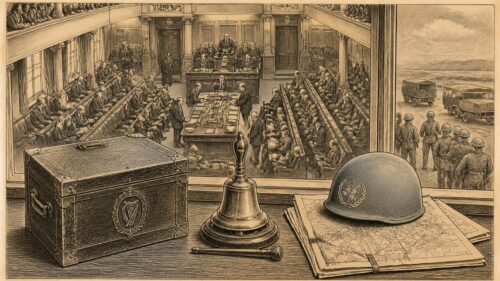


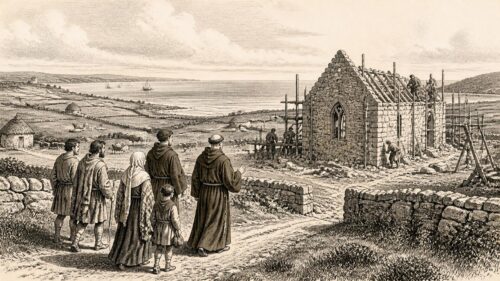
The article’s emphasis on the gap between enacted law and lived experience is especially thought-provoking. Across brehon traditions, medieval statutes and Tudor centralisation, authority depended not only on formal rules but also on local institutions, custom and the capacity to enforce decisions. This suggests that legislation can expose governmental insecurity as readily as control, particularly where surviving records chiefly reflect elite perspectives. It also complicates patriotic narratives that treat constitutional change as a straightforward expression of national will. When examining Ireland’s legislative history, how should historians weigh statutes against everyday compliance, negotiation and resistance when assessing whose authority was recognised?