

Vacant Voices
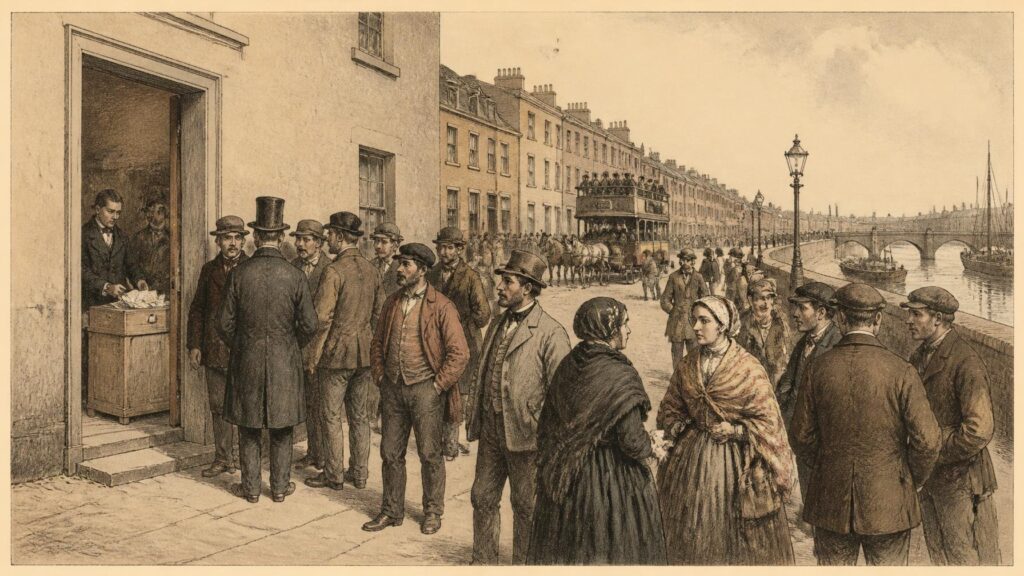
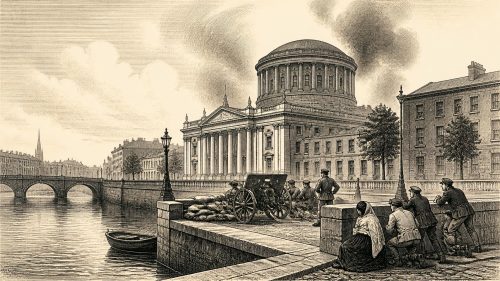
AI generated historical illustration, not a contemporary photograph.
At a Glance
Dublin Central’s three Dáil bye-elections, held in 1983, 2009 and 2026, offer unusually revealing snapshots of modern Irish democracy. Each arose from a different kind of vacancy: the death of a senior Fianna Fáil statesman, the death of an independent community campaigner, and the resignation of a cabinet minister for an international post. Yet each contest was shaped by the same local fact: Dublin Central has long combined intensely settled neighbourhood loyalties with rapid social change, making personal reputation, community organisation and transfers under proportional representation as important as party labels.
Electoral Setting
A Dáil bye-election is not simply a miniature general election. It fills one empty seat between general elections, in the constituency where the vacancy has occurred. The vacancy may follow death, resignation, retirement or disqualification, and the formal mechanism is a writ issued to the relevant returning officer after direction by Dáil Éireann. The procedure has constitutional and statutory seriousness, but it also leaves room for political calculation. For much of the State’s history, governments could delay the issuing of writs. Since 2011, legislation has required that, if the Dáil has not directed the issue of a writ within six months, the Chair must act as soon as practicable after that period.
This framework matters in Dublin Central because all three contests became arguments about representation as well as elections. In 1983, the vacancy left by George Colley concerned the survival of a Fianna Fáil seat associated with one of the party’s most substantial figures. In 2009, the death of Tony Gregory raised the more difficult question of whether a personal, independent radical tradition could outlive its founder. In 2026, Paschal Donohoe’s departure presented voters with the opportunity to judge a long-established Fine Gael presence in a constituency whose party balance had altered sharply during the preceding decade.
Counting Rules
The Irish system gives these contests a distinctive character. Dáil elections use proportional representation by the single transferable vote, usually abbreviated to PR-STV. A voter may rank candidates in order of preference. At a general election, several seats are filled; in a bye-election there is only one vacancy. The practical result is a contest conducted through transfers and eliminations until one candidate has a decisive lead or is the last candidate remaining. The winner does not necessarily begin with a majority of first preferences.
That distinction is crucial. Newspaper headlines and party statements frequently privilege the first count, because it offers the quickest apparent verdict. The final result, however, depends on the movement of preferences from eliminated candidates. In Dublin Central this has regularly rewarded candidates capable of appealing beyond a single party base. It has also made the constituency a poor fit for crude claims that a bye-election result represents a simple public verdict on the government of the day. Voters can use rankings to express support for a local candidate, dissatisfaction with one party, affinity with a wider political tradition, or more than one of these at once.
Political scientist Michael Gallagher has observed that Irish bye-elections occupy an unusual place in comparative electoral practice because they are held within multi-member constituencies but fill a single vacancy. The arrangement produces contests that are geographically familiar to voters but electorally different from the general election contests they know. Dublin Central’s history demonstrates that peculiarity particularly well. The constituency’s general elections can elect several contrasting representatives; its bye-elections have forced voters to decide which one person should speak for the vacant place.
Constituency Origins
The modern Dáil constituency called Dublin Central was created under the Electoral (Amendment) Act 1969. Its first boundaries took in historic central-city wards including Inns Quay, Rotunda, Usher’s and Wood Quay, as well as specified portions of neighbouring wards. The detailed language of the Act, tracing boundaries street by street through places such as Suffolk Street, Andrew Street and South Great George’s Street, is a reminder that parliamentary geography is made by legislation rather than inherited whole from the city’s social map.
Its boundaries have changed more than once. Dublin’s population growth, suburban expansion and repeated reviews of representation have altered the territory and number of seats associated with Dublin Central. The name therefore does not describe an unchanging district, nor should results from different decades be treated as though they arose from precisely the same electorate. Nevertheless, a recognisable political core has endured: north inner-city communities, areas close to the docks and the Liffey, older working-class districts, and later a mixture of regenerated neighbourhoods, student areas and more affluent residential streets.
Urban Boundaries
Boundary changes are more than an administrative footnote. They affect which local networks are contained within a constituency, which councillors possess established recognition, and which issues have immediate force. In Dublin Central, housing, public services, dereliction, drugs, policing, regeneration and the pressure placed on long-standing communities by development have all been recurrent matters of political concern. No single issue explains every election, but the constituency’s compact geography has encouraged highly local campaigning. Candidates must be able to move between city-wide arguments and the particular experience of streets, estates, schools and voluntary organisations.
The constituency has also contained strong party traditions. Fianna Fáil was for many years electorally formidable there, associated in particular with Bertie Ahern as well as George Colley and other figures. Fine Gael maintained important pockets of support and supplied notable candidates. Labour, the Workers’ Party and later parties of the left competed for urban progressive voters. Sinn Féin developed a significant presence over time. Independents, however, have had a special importance because the constituency has repeatedly shown that a candidate rooted in community work can command support outside the conventional party hierarchy.
That is an interpretation drawn from the sequence of contests rather than a claim that Dublin Central is naturally or permanently anti-party. The 1983 result retained a major-party seat convincingly; the 2009 result preserved an independent tradition; and the 2026 contest elected a Social Democrats candidate. The pattern is not ideological consistency. It is a record of electorate and candidate meeting at particular moments of vacancy.
Colley Vacancy
The first Dublin Central bye-election was held on 23 November 1983 after the death, on 17 September, of George Colley. Colley was no ordinary constituency representative. Born in Dublin in 1925, he had served in a succession of senior ministerial offices and as Tánaiste. His career was deeply interwoven with Fianna Fáil’s post-war development, the internal rivalries of the party and the changing public life of the State. The Dictionary of Irish Biography records that he represented Dublin Central at the 1981 election and at both general elections held in 1982.
Colley’s death created a vacancy in the 24th Dáil at a politically volatile time. Ireland had experienced three general elections between June 1981 and November 1982. The government formed after the latter election was a Fine Gael–Labour coalition led by Garret FitzGerald, while Fianna Fáil was in opposition. In that setting, a by-election in a capital-city constituency could be represented by each side as a measure of national confidence. But the local circumstances were equally important. Colley’s longstanding stature gave Fianna Fáil a seat to defend, while his death brought a personal dimension to the campaign that cannot be reduced to party arithmetic.
Party Contest
The Dáil agreed the writ in early November. Fianna Fáil selected Tom Leonard, who won the seat. Leonard received 15,236 first-preference votes, or 46.6 per cent of valid votes, and was elected on the eighth count with 16,439 votes. Fine Gael’s Mary Banotti was runner-up, ultimately reaching 8,623. The Workers’ Party candidate Michael White began with 13.3 per cent; Sinn Féin’s Christy Burke, Labour’s Jimmy Somers and several independents also contested the election. Turnout was 46.5 per cent, a figure that cautions against treating the result as an exact replica of a general-election electorate.
Leonard’s result gave Fianna Fáil something more useful than a narrow retention: it allowed the party to demonstrate organisational resilience in a constituency where a prominent deceased TD might otherwise have left a difficult legacy. It would nevertheless be too easy to call the outcome a straightforward endorsement of Fianna Fáil nationally. Bye-elections compress several motives into one ballot. The party had a large first-preference lead, but the campaign occurred in a constituency where the Colley name and the political memory surrounding the vacancy were necessarily present.
Banotti’s second place should likewise not be understood merely as defeat. She would be elected to the European Parliament in 1984. Her performance showed Fine Gael’s ability to assemble a substantial urban vote even where Fianna Fáil possessed stronger local organisation. The Workers’ Party’s vote was also historically significant. It belonged to a period in which that party’s urban presence, its local activism and its appeal to some working-class and left-wing voters were serious elements in Dublin politics. The result captures a political field more varied than the headline contest between the two largest parties suggests.
Gregory Legacy
The 2009 bye-election emerged from a different political inheritance. Tony Gregory died on 2 January 2009, aged sixty-one, after a long career as a republican socialist, independent TD and community activist. He had first entered Dáil Éireann in 1982 and became nationally famous for the agreement reached with Charles Haughey during the formation of the 1982 Fianna Fáil government. That agreement, widely called the Gregory Deal, secured commitments concerning the north inner city in return for Gregory’s support. It has often been invoked in political folklore as proof that a single independent can compel government action.
The documentary record requires a more careful reading. Gregory was not influential only because of one parliamentary bargain. His biography shows a political life rooted in north inner-city Dublin, housing concerns, street traders, anti-drugs campaigning and a persistent concern with inequality. He combined electoral independence with a developed ideological background in the Official republican and socialist tradition. His reputation was therefore more substantial than that of a merely transactional local representative, although practical constituency work was central to his appeal.
Independent Succession
Gregory’s death posed a difficult question: could anyone inherit a political relationship that was personal as well as organisational? Maureen O’Sullivan, a Dublin city councillor and a close political associate of Gregory, became the independent candidate. Her campaign did not simply claim a surname-based succession; it appealed to continuity in community representation and to her own record of local work. This was an important distinction. In Irish electoral politics, personal followings can be powerful, but they are neither automatic nor permanently transferable.
The contest occurred during the early months of the international financial crisis as it affected Ireland. The scale of public concern about banking, employment, fiscal policy and the credibility of the Fianna Fáil-led government was unmistakable. The bye-election was also held on 5 June 2009, the same day as local and European elections. That decision made it part of a broader day of electoral activity, increasing its political visibility while complicating comparisons with stand-alone contests. Official later evidence on election expenditure confirms that the simultaneous polls created shared costs and facilities.
O’Sullivan led on the first count with 7,639 votes, or 26.9 per cent. Fine Gael’s Paschal Donohoe followed with 6,439 votes, or 22.7 per cent, and Labour’s Ivana Bacik had 4,926, or 17.3 per cent. When Bacik was eliminated, her transfers were decisive in the final contest. O’Sullivan was elected with 13,739 votes to Donohoe’s 10,198. The result retained the seat outside the major parties, but it did not settle all questions about the independent tradition. It demonstrated enough continuity to elect Gregory’s ally, while also revealing the importance of transfers from progressive and centre-left voters.
The election is sometimes described as an anti-government protest, and there is evidence for that interpretation in the wider political circumstances of 2009. Yet it is incomplete. Donohoe’s strong second-place showing established him as a serious local figure; Bacik’s vote made Labour preferences pivotal; and O’Sullivan’s victory depended upon her credibility in a constituency shaped by Gregory’s long service. A more defensible historical judgement is that national discontent, candidate reputation and a local tradition of independent representation reinforced one another.
Delayed Writs
The process by which the 2009 poll was called is itself revealing. Debate in the Dáil exposed opposition frustration over the timing of the writs for the Dublin Central and Dublin South vacancies. The dispute was not a minor procedural quarrel. It concerned whether the government should permit voters to fill vacancies promptly and whether scheduling decisions could be made for partisan advantage. In the end, the writ was moved and the Dublin Central contest proceeded alongside the other elections on 5 June.
Irish history contains a longer background to such disputes. Gallagher’s study of bye-elections notes periods when vacancies remained open for extended periods, most notably during the Emergency. The State’s modern legal framework grew partly from criticism of delay. The 2011 reform was intended to ensure that a vacancy could not be left indefinitely unfilled simply because the government lacked political enthusiasm for a contest. The rule does not remove every question about campaign timing, but it places a clearer outer limit on delay.
For Dublin Central, the 2009 argument helps explain why bye-elections deserve study as institutions, not merely as colourful contests. A vacancy changes the numerical composition of the Dáil, but it also raises a democratic question about how swiftly constituents should recover full representation. The death of a well-known TD sharpened the moral force of that question. O’Sullivan’s eventual victory restored the number of Dublin Central TDs, but only after public controversy about when voters would be allowed to choose.
Donohoe Resignation
The third contest took place on 22 May 2026. It followed the resignation of Paschal Donohoe, the Fine Gael TD who had finished second in the 2009 bye-election and later won a Dublin Central seat at general elections. Donohoe’s departure for a position at the World Bank created a vacancy in the 34th Dáil. On 22 April 2026, the Dáil agreed the motion directing the issue of the writ. The Electoral Commission records that the Dublin Central and Galway West bye-elections were held on the same day, and that Daniel Ennis and Seán Kyne took their seats on 26 May.
The electoral landscape of 2026 differed substantially from that of 1983 and 2009. The old dominance of Fianna Fáil and Fine Gael in Dublin had been challenged by Sinn Féin, the Social Democrats, the Greens, Labour, smaller parties and independents. Dublin Central itself returned an unusually diverse set of representatives after the 2024 general election. The bye-election therefore occurred in a constituency where no assumption of inherited party ownership was safe.
New Alignment
Daniel Ennis of the Social Democrats won after nine counts. He received 4,903 first-preference votes, or 19.7 per cent, ahead of Sinn Féin’s Janice Boylan on 4,348 and Green Party candidate Janet Horner on 2,907. The count ended with Ennis on 12,050 votes and Boylan on 7,787. The final margin was a product of transfers and eliminations rather than a first-count majority. It was, in that narrow but important sense, an especially clear illustration of the bye-election form under PR-STV.
Fine Gael’s loss of the seat was symbolically striking because Donohoe had been one of the party’s most recognisable Dublin representatives. Yet a historian should avoid implying that the contest erased his earlier career or converted a single result into a permanent national realignment. Bye-elections are contingent. Candidate selections, turnout, the absence of a general-election slate, campaign intensity and the availability of transfer-friendly alternatives all matter. The contest did, however, show the Social Democrats’ ability to convert a city-council and community base into Dáil representation in an intensely competitive constituency.
The result also placed renewed emphasis on the constituency’s social diversity. It is common for commentators to describe Dublin Central in shorthand as working-class, inner-city or progressive. Each description contains part of the truth, but none is sufficient. The constituency includes long-established communities and recently changing neighbourhoods; tenants, homeowners, students, workers in a changing city-centre economy and residents whose political priorities differ sharply. Its elections consequently reward parties and candidates who can connect particular local concerns to a broader account of public services, housing and social equality.
Changing Patterns
Viewed together, the three bye-elections reveal both continuity and change. Continuity lies in the importance of personal standing. Tom Leonard benefited from Fianna Fáil’s organisation after George Colley’s death; Maureen O’Sullivan was able to represent continuity with Tony Gregory’s independent politics; Daniel Ennis entered the Dáil with a profile grounded in local political activity. In all three cases, party names mattered greatly, but no result can be properly understood without considering the candidate who carried that name or stood independently of it.
Change appears in the party system. The 1983 field reflected a Dublin in which Fianna Fáil, Fine Gael, Labour and the Workers’ Party were the principal organised alternatives, alongside smaller republican, communist and independent candidacies. By 2009, the contest was shaped by the collapse in confidence surrounding the economic crisis and by the capacity of an independent campaign to draw on left and progressive transfers. By 2026, the Social Democrats, Sinn Féin and Greens were major forces in a contest where the traditional parties could no longer assume dominance.
There is also a change in how political memory operates. The Colley contest followed the death of a national political figure whose ministerial career was inseparable from the history of Fianna Fáil. Gregory’s death brought a different kind of memory into the polling booth: community campaigning and an independent left tradition. Donohoe’s resignation did not involve bereavement, but it invited voters to measure the meaning of a vacant ministerial seat against a changing local political environment. These are not equivalent circumstances, and treating them as equivalent would flatten the history.
Evidence Limits
The surviving official material is strongest for formal procedure, dates, parliamentary motions and declared results. The Electoral Acts define the machinery; Oireachtas debates preserve the wording of motions and the political arguments made in the chamber; election result tables record the counts. Biographical sources help establish the careers and public contexts of figures such as Colley and Gregory. These documents support firm statements about who stood, how votes transferred and who was elected.
They support interpretation less directly. It is reasonable to infer, for example, that Tony Gregory’s local legacy assisted Maureen O’Sullivan in 2009, because of their political association and her subsequent result. It is not possible to calculate precisely how many individual voters cast their ballots for that reason. Similarly, the 2026 outcome can be read as evidence of a changed party landscape, but it cannot by itself prove a settled long-term realignment. A later general election, held under different conditions and with several seats available, could produce a different pattern.
Folklore has a place in Dublin political history, especially around the Gregory Deal, local machines and the supposed ability of particular streets or organisations to determine outcomes. Such stories can illuminate how politics is remembered. They should not be presented as evidence unless corroborated by contemporary records, electoral data or credible testimony. Dublin Central has often generated vivid anecdote because its politics are close to the ground. The historian’s task is not to eliminate that colour, but to separate recollection from proof.
Historical Meaning
Dublin Central’s bye-elections show the value of studying elections that are sometimes dismissed as interruptions between general elections. A vacant seat concentrates political attention. It exposes the relationship between party organisation and personal reputation, tests the practical effect of electoral rules, and gives local concerns a national audience. In this constituency, those qualities have been particularly pronounced because the area has repeatedly produced representatives whose significance reached beyond its boundaries.
The 1983 contest preserved Fianna Fáil representation after the death of George Colley, while recording the vitality of competing urban political currents. The 2009 election carried forward Tony Gregory’s community-centred independent tradition through Maureen O’Sullivan, at a moment of severe national economic anxiety. The 2026 poll gave the Social Democrats a notable gain through Daniel Ennis and underlined the fragmentation and renewal of Dublin party politics. None was a perfect forecast of the next general election. Each was, however, a historically specific judgement delivered by Dublin Central voters.
That is the enduring lesson of these contests. Their meaning lies neither wholly in national swings nor wholly in local personalities. Dublin Central bye-elections have been occasions where national political change entered neighbourhood life, and where neighbourhood organisation altered the national parliamentary story. The empty seat mattered because it was not abstract. It belonged, in turn, to a cabinet minister, an independent campaigner and a serving minister; its replacement depended on citizens ranking the candidates they believed could best speak for a changing part of Dublin.


Dublin Central’s three bye-elections show that representation is shaped by personal credibility, community organisation and transfer patterns, not simply party strength. The 2009 succession from Tony Gregory to Maureen O’Sullivan is particularly revealing: her victory combined an established local record with decisive Labour preferences. By contrast, Daniel Ennis’s 2026 Social Democrats gain illustrates how a candidate can prevail without leading on first preferences. Yet boundary changes and differing national contexts make direct comparison uncertain. To what extent do these contests indicate a durable Dublin Central preference for locally rooted representation, and how far do they instead reflect each vacancy’s circumstances?