

Dunluce, Kildare and Flodden1513 CE
In 1513, Ireland experienced interconnected struggles over lordship, succession and regional power. Gearóid Mór FitzGerald’s death weakened his extensive political system, although his son Gerald succeeded as earl and deputy governor. In Tír Eógain, Art Óg O’Neill secured inauguration with local and Kildare support amid contested succession. Aodh Dubh O’Donnell besieged Sligo, influenced control of Dunluce and visited James IV of Scotland before Flodden ended Scottish royal intervention. Raiding, burning and maritime violence affected coastal and rural communities. Meanwhile, Franciscan scholarship, ecclesiastical deaths and aristocratic patronage demonstrated enduring religious, learned and charitable networks across a politically fragmented yet connected Ireland.
Dateline
In 1513, Irish politics was shaped less by a single national event than by simultaneous struggles for lordship, territory and legitimacy. The death of Gearóid Mór FitzGerald, eighth earl of Kildare, removed the most powerful magnate in the English lordship. In Ulster, the O’Neill succession was contested and then settled through a mixture of inauguration, force and outside support. Aodh Dubh O’Donnell campaigned from Sligo to Scotland, while the death of James IV at Flodden abruptly altered the political weather across the North Channel. Yet the annals also preserve a different Ireland: Franciscan scholarship, aristocratic patronage, coastal raiding, local vengeance and the deaths of people whose importance lay in their household, church or learned community.
The Death of Gearóid Mór
The year’s clearest dated turning-point came on 3 September. Gearóid Mór FitzGerald died at Kildare after being wounded during a campaign against the O’Carrolls and O’Mores in the midlands. The immediate operation had included an unsuccessful attempt against Leap Castle: Kildare’s artillery could not reduce it, and, while returning to gather more forces, he was shot. His body was taken for burial in Christ Church Cathedral, Dublin, in the chapel he had founded only two years earlier.
His death mattered because Kildare had combined offices granted under the English crown with the resources of a vast dynastic lordship. He was lord deputy or justiciar in the language of different sources, but neither title alone explains his authority. He commanded affinities among the English of the Pale, married and fostered alliances across lordship boundaries, and repeatedly led armies far beyond the area under regular Dublin administration. Campaigns to Carrickfergus, Galway and Limerick during his career illustrate the reach he sought to exercise. The annals’ obituary is unusually generous: an Irish-language record described him as pre-eminent among the ‘Galls’, praised his rule and munificence, but also remembered that he had seized Gaelic land, built castles for settlers and destroyed Gaelic castles. That combination is more revealing than either admiration or condemnation alone.
Gerald FitzGerald, his son, succeeded as ninth earl and was elected deputy governor by the Irish council after his father’s death. This was an important continuity, but not a guarantee of stability. The younger Gerald inherited a formidable network and a dangerous political situation: the senior earl’s death opened room for rivals, while local wars continued without waiting on decisions at Dublin Castle. Later in the year, MacMurroughs and O’Carrolls accompanied Piers Butler in burning Desmond territory in Connello, Co. Limerick. Such action shows that the political consequences of Kildare’s death were felt beyond his own estates and beyond the Pale.
Succession and War in Ulster
In Tír Eógain, the annals place the death of Art, son of Aodh O’Neill, during 1513. He died at Dungannon after receiving the last rites. Art Óg, son of Conn O’Neill, was then made O’Neill at Tulach Óg, the ceremonial centre now known as Tullaghoge. The choice was not a simple inheritance. Gaelic lordship rested on dynastic eligibility, the consent or coercion of leading kinsmen and the support of allied powers. The Annals of Ulster say that O’Cathain and a large part of Cenél nÉogain backed Art Óg; he secured Dungannon Castle from the dead lord’s sons, and Kildare arrived with an army to assist him.
That episode shows how closely Gaelic and Anglo-Irish politics could intersect. Kildare’s intervention did not turn Tír Eógain into a securely governed province of the English lordship. Rather, it supported one claimant within an Ulster political order whose institutions, territories and military followings remained locally rooted. The timing should nevertheless be handled with care. The Annals of Ulster and Annála Connacht record the succession under 1513, while the later Annals of the Four Masters place Art’s death and Art Óg’s inauguration under 1514. The former contemporary annalistic tradition makes 1513 the responsible year in which to discuss the transition, but it does not justify inventing a precise day or sequence for every stage of it.
Elsewhere in east Ulster, war was direct and destructive. Art, son of Aodh O’Neill, led a hosting into Trian Congail, burning Magh Line, modern Moylinny, and raiding the Glens. Opponents led by a Clandeboye O’Neill and the MacQuillins intercepted part of his force; Art’s son Aodh was killed. The next day brought another encounter in which Richard MacQuillin and a body of Scots were slain. The notices expose an Irish Sea frontier where the Glens, Clandeboye, MacQuillin territory and Scottish fighting men were connected by sea routes as much as separated by political boundaries.
O’Donnell’s Northern Ambition
Aodh Dubh O’Donnell, lord of Tír Chonaill, was the other great protagonist of the year. His forces maintained a leaguer around Sligo from St Brigid’s Day, 1 February, until Whitsuntide. The annals are plain about the result: he did not take the town. The duration alone demonstrates why Sligo mattered. It was a strategically placed settlement and commercial centre on the Connacht coast, capable of resisting a major lord’s pressure through an entire campaigning season. An unsuccessful siege was not therefore an insignificant event; it represented the sustained expenditure of food, labour, weapons and political credit.
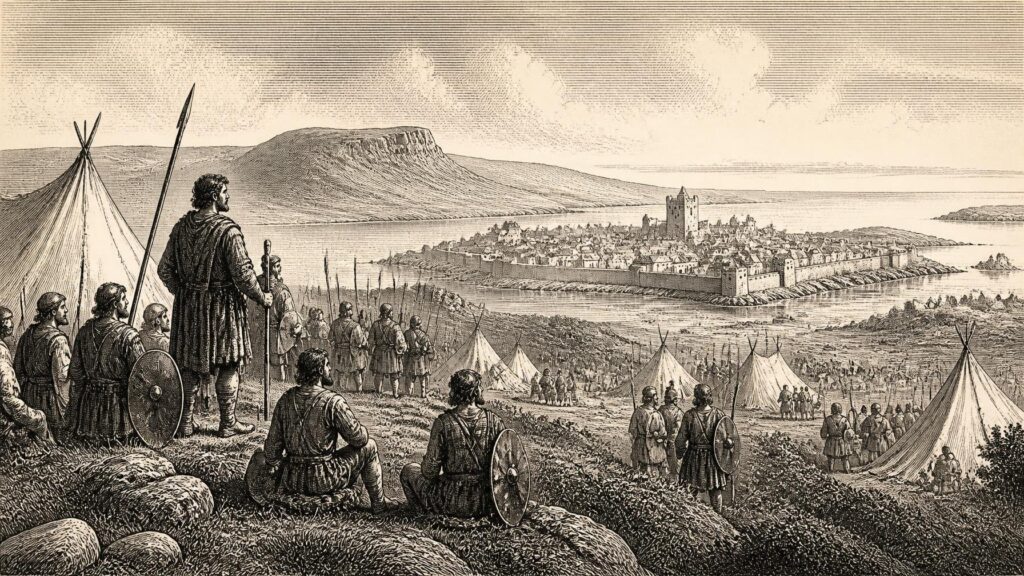
O’Donnell achieved more to the north. Dunluce Castle was taken from the sons of Gerald MacQuillin and transferred to the sons of Walter MacQuillin. The record should not be read as a permanent settlement of Antrim’s complicated politics, but it demonstrates that castles were prizes within kin-group competition as well as barriers between supposedly separate peoples. Control of such a stronghold offered prestige, a defensible residence and a commanding position on maritime routes between Ulster and western Scotland.
Most strikingly, O’Donnell travelled to Scotland with a small following after receiving letters from James IV. He was honoured with gifts and remained at the Scottish court for about a quarter of a year. The Annals of Ulster state that he changed James’s intention to come to Ireland; recent scholarship connects the visit to wider planning around Scotland’s war with England and argues that O’Donnell may instead have undertaken to create a diversion in Ireland. The precise terms cannot be recovered with certainty, but the journey confirms that an Ulster lord could participate in high politics across the Irish Sea.
That diplomacy acquired a grim new context when James IV was killed at Flodden on 9 September 1513. The defeat ended the king’s personal capacity to intervene and left Scotland governed for the infant James V. Irish annalists recorded the king’s death alongside their own domestic events, underlining that Flodden was not merely a Scottish or English battle. For O’Donnell and other coastal rulers, it removed a living partner in an active political relationship and narrowed one possible route to military support.
Sea, Lordship and Local Society
War also reached communities that did not stand at the centre of dynastic succession. Eóghan O’Malley sailed with the crews of three ships into Killybegs by night while local chiefs were absent in O’Donnell’s army. His men burned and plundered the town and carried away prisoners. A storm compelled them to wait on the coast, where local opponents—described as including young men, farmers and herdsmen—attacked. O’Malley and perhaps 100 or 120 companions were killed; two ships and the captives were taken back. The story is a rare, vivid reminder that coastal population centres could be exposed to sudden maritime violence, and that local resistance could be decisive.
In Munster, Piers Butler led raids into Uí Mhic Caille and, with O’Carroll and MacMurrough allies, burned Baile an Ghargha in Uí Chonaill and surrounding country. The annals use the language of burning and prey because warfare was in large part a contest over movable wealth, food supplies, animals and obedience. In Desmond, a treacherous attack by Tadhg na Leamhna MacCarthy on Cormac Ladhrach MacCarthy failed when Cormac escaped a burning house; the annalist says that Desmond was divided between the two rivals. These entries should not be mistaken for a complete picture of everyday life, but they make clear how ordinary cultivators and households bore the material cost of elite rivalry.
Learning, Patronage and Faith
The year was not defined only by force. Maurice O’Fihely, Franciscan friar, theologian and archbishop of Tuam, arrived in Galway after a long career in Italy. He had lectured and written on scripture, promoted the theology of Duns Scotus, served as minister provincial of the Irish Franciscans and attended the Fifth Lateran Council. He planned a first Mass at Tuam for which a plenary indulgence had been obtained, attracting people from many parts of Ireland. He died in Galway before that occasion could take place, and was buried in the Franciscan church there. His career demonstrates that learned Irish religious life remained tied to universities, printing and ecclesiastical reform on the Continent.
Other ecclesiastical deaths included Octavian de Spinelli, primate of Armagh. The Annals of Connacht also commemorate Mairgrec O’Brien, wife of O’Rourke, who was buried at the Franciscan house of Creevelea, said to have been built by her. The annalist praised her wealth, hospitality and charitable provision for scholars, ollams, the weak and the poor. Such praise is conventional in form, but it identifies real expectations of aristocratic women: patronage of religious institutions, maintenance of learned people and the distribution of food or support to dependants. In a society unsettled by raids and succession conflicts, generosity was political, devotional and social capital at once.
Thus 1513 was a year of transition rather than settlement. Kildare’s death weakened a personal system of lordly government; Art Óg’s inauguration demonstrated both the durability and contested character of Gaelic political custom; O’Donnell’s Scottish diplomacy revealed Ireland’s place in a wider archipelagic world, before Flodden closed that particular opening. The annals preserve these large shifts beside sieges, ship-borne raids, household patronage and scholarly loss. Together they show an Ireland whose regional worlds were intensely connected, but never easily commanded from one centre.
Primary Sources
- The Annals of Ulster: Year U1513
- Annála Connacht: Annal 1513
- Annals of the Four Masters: Annals M1512–M1515
- FitzGerald, Gerald (Gearóid Mór) | Dictionary of Irish Biography
- FitzGerald, Gerald (Gearóid Óg, Garrett McAlison) | Dictionary of Irish Biography
- O'Donnell (Ó Domhnaill), Sir Aodh Dubh | Dictionary of Irish Biography
- O'Fihely, Maurice | Dictionary of Irish Biography
- O'Carroll (Ó Cearbhaill), Maolruanaidh | Dictionary of Irish Biography
- Cowley, Robert | Dictionary of Irish Biography
- Butler, James | Dictionary of Irish Biography
- English Lordship of Ireland and the Irish Sea World: Re-assessing the Origins of the Kildare Ascendancy, c.1390–c.1513
- An Irish Context to a Scottish Disaster: James IV, the O'Donnells of Tyrconnell and the Road to Flodden
- James IV, the O’Donnells of Tyrconnell and the Road to Flodden
- Tullaghoge Fort | Department for Communities
- Inventory of Historic Battlefields | Historic Environment Scotland
- Margaret Tudor: My Lady, The King’s ‘Defiant’ Mother | Historic Environment Scotland
- Fitzgerald, Gerald (d.1513) | Dictionary of National Biography, 1885–1900
- Gerald FitzGerald, 8th Earl of Kildare | A Compendium of Irish Biography
- Maurice O'Fihely | A Compendium of Irish Biography
- The Annals of the Four Masters | Corpus of Electronic Texts, University College Cork