

Cork Compact
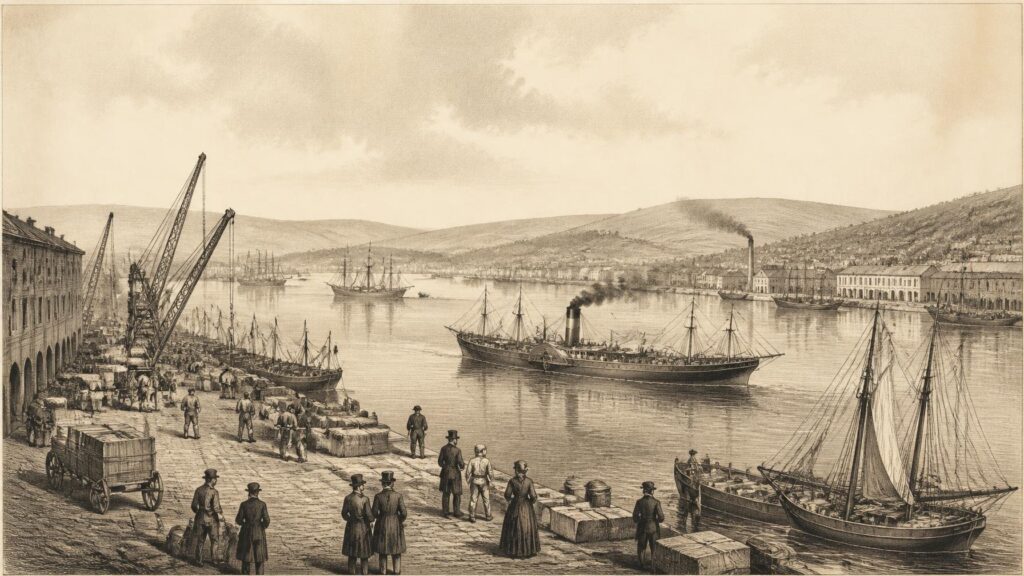
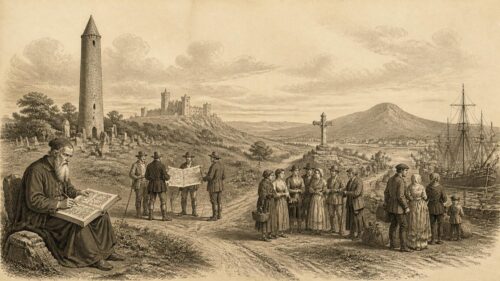
AI generated historical illustration, not a contemporary photograph.
At a Glance
When the Taoiseach Micheál Martin received Prime Minister Keir Starmer in Cork on 12 and 13 March 2026, the occasion was formally the second annual UK-Ireland Summit. Historically, it was also an attempt to give regular form to a relationship that has long been essential, often troubled, and never merely bilateral. The meeting addressed trade, energy, defence, culture, youth participation and migration, yet its deeper setting was the constitutional and human connection between Ireland, Great Britain and Northern Ireland.
Historical Setting
The phrase “UK-Ireland relations” can make a complicated history sound deceptively tidy. Ireland and Britain are close neighbours, but their connection has been formed by conquest, settlement, resistance, migration, partition, commerce and family life. It has included coercion and conflict, but also millions of ordinary crossings for work, education, marriage, military service, religious affiliation and cultural exchange. No modern leaders’ meeting can escape that inheritance, even when its agenda is deliberately practical.
The Cork summit therefore deserves consideration not as an isolated piece of contemporary diplomacy but as part of a long movement away from relationships governed chiefly by dispute. That movement has never been straight or guaranteed. The constitutional revolution that created the Irish Free State in 1922 did not settle the question of Northern Ireland, while the decades of violence generally called the Troubles showed the limits of merely managing disagreement from London, Dublin and Belfast. The gradual construction of institutions, habits of consultation and mutual legal commitments became as historically important as individual negotiations.
In March 2026, the two governments presented their work as a programme extending to 2030. Such language necessarily belongs to policy rather than history: it records intentions, not achievements. Yet historians can still recognise why a programme framed around regular summits matters. It creates a visible rhythm of contact between two governments whose interests are unusually entangled by geography, the land border in Ireland, the Common Travel Area, all-island infrastructure, shared seas and the continuing responsibilities of both states in relation to the Belfast Agreement.
Cork was an apt, though not inevitable, setting. Its harbour and mercantile past speak to Ireland’s outward-facing connections; its history of emigration makes it a city with enduring familial ties to Britain; and its modern institutions embody research, industry and cultural life. Choosing Cork after the inaugural summit in Liverpool also offered a reciprocal gesture. Liverpool’s Irish associations are among the most conspicuous in Britain. The movement from Liverpool to Cork made the summit sequence itself a modest statement that relations are sustained by communities as much as by capitals.
Imperial Legacies
Any historical account of a modern Irish-British meeting must begin with restraint. It should not imply that contemporary partnership erases the unequal power relationships of earlier centuries, nor should it treat political reconciliation as a sentimental reconciliation of all memories. The history of English and later British rule in Ireland, the plantations, the Penal era, the Union of 1801, the Great Famine, revolutionary politics and partition remains contested in public memory. These are not simply old grievances retained for ceremonial purposes. They influence language, identity, commemoration and political trust.
The summit was not designed to adjudicate these histories. It could not have done so. Its significance instead lies in the fact that Irish and British governments can now meet openly in an Irish city to discuss common material problems without making historical disagreement disappear. That distinction is important. Mature relations do not require a single shared story of the past. They require the capacity to disagree about history while maintaining agreed rules, institutions and respect for differing constitutional identities.
Migration supplies another essential context. Large numbers of Irish people made lives in Britain during the nineteenth and twentieth centuries, particularly in industrial cities and ports. Their descendants form part of British society, while British people have also lived and worked throughout Ireland. These connections are neither a mere political metaphor nor a uniformly harmonious tradition. Irish migrants encountered poverty and prejudice; Britain also became a place of opportunity, organisation and cultural creativity. The result is an unusually dense web of family associations across the Irish Sea.
The language used at Cork—“shared ties”—could sound bland if detached from this history. Properly understood, however, it recognised that ties can be intimate without being uncomplicated. Cultural connection does not make political power equal, and family links do not make all communities interpret the past alike. The usefulness of the phrase lies in its modesty: it identifies a fact of social life rather than claiming that history has been resolved.
Constitutional Change
The most decisive modern framework for relations was the Belfast or Good Friday Agreement of 10 April 1998. It was both a multi-party agreement involving Northern Ireland’s principal political traditions and an international agreement between the British and Irish governments. Its constitutional principles included consent concerning Northern Ireland’s status, recognition of the right of people in Northern Ireland to identify as British, Irish or both, and commitments to equality and human rights.
Its institutional design is especially relevant to the summit. Strand One concerned devolved government in Northern Ireland. Strand Two established North-South arrangements involving Northern Ireland and Ireland. Strand Three created East-West institutions: the British-Irish Council and the British-Irish Intergovernmental Conference. This architecture did not make every dispute disappear, and it did not permanently prevent interruption to devolved government. It did, however, establish a constitutional vocabulary in which relationships could be managed through consent, parity of esteem and structured contact rather than through exclusion.
The two governments are commonly described as co-guarantors of the Agreement. That phrase carries more than diplomatic courtesy. It recognises that London and Dublin have particular obligations to uphold the framework within which Northern Ireland’s political life operates. The 2026 summit’s references to the Agreement and to the protection of associated rights should therefore be read as part of a continuing state responsibility, not merely as ceremonial homage to a past breakthrough.
Interpretation is necessary here. The summit was not itself an institution created by the Agreement, and it should not be confused with the British-Irish Council or the intergovernmental conference. It was a new annual leaders’ forum, created by political agreement in 2024 and first held in 2025. Nevertheless, it operated within a relationship transformed by the Agreement. The summit could concentrate on energy grids, research cooperation and cultural projects precisely because a wider constitutional settlement had made sustained official contact more normal and more legitimate.
Institutional Architecture
Historians often focus on dramatic negotiations, signed documents and memorable handshakes. Durable relations, however, are more commonly maintained through routine work: departmental contact, ministerial meetings, shared technical standards, joint funding and quiet problem-solving. The institutions established after 1998 made this work more visible and more durable, even when their political effectiveness varied.
The British-Irish Council, formally established when the British-Irish Agreement came into force in December 1999, brings together the Government of Ireland, the UK Government, the Northern Ireland Executive, the Scottish and Welsh Governments, and the governments of the Isle of Man, Guernsey and Jersey. Its existence is a reminder that relations across these islands cannot be reduced to a dialogue between Dublin and London. Devolved administrations and Crown Dependencies have distinct interests, especially in areas such as energy, transport, environment and culture.
The British-Irish Intergovernmental Conference is narrower but constitutionally weighty. It provides a forum for British and Irish governmental discussion of non-devolved matters relating to Northern Ireland and for broader bilateral cooperation. Its April 2026 communiqué, issued after the Cork summit, explicitly referred to the UK-Ireland 2030 agenda. That sequence offered early evidence that summit commitments could feed into established mechanisms rather than float above them as public relations.
There is an important limitation. Institutions do not themselves create political agreement. They can provide channels for discussion, but their effectiveness depends on participation, trust and administrative capacity. The historical achievement of the post-1998 settlement was not that it abolished disagreement; it gave disagreement places in which to be handled. The value of an annual summit will depend on whether it strengthens that practical culture or merely duplicates it.
Liverpool Prelude
The immediate origin of the Cork meeting lay in the political reset agreed by Taoiseach Simon Harris and Prime Minister Starmer at Farmleigh House in September 2024. The leaders announced their intention to hold annual leader-level summits, placing the first in March 2025. That decision followed years in which Brexit had placed severe strain on the wider relationship between the United Kingdom, Ireland and the European Union, particularly over arrangements affecting Northern Ireland.
The inaugural summit took place in Liverpool on 5 and 6 March 2025. There, Martin and Starmer adopted the UK-Ireland 2030 Joint Statement. The document presented itself as the beginning of a strengthened relationship and set out a broad agenda including economic cooperation, energy, security, culture, education and people-to-people ties. Its language was ambitious, but its importance lay partly in restoring a predictable political habit: a summit was to be annual rather than exceptional.
That did not mean that every issue in Anglo-Irish relations was newly solved. The political and legal consequences of the United Kingdom’s departure from the European Union remained real. Ireland’s membership of the European Union, Northern Ireland’s distinctive post-Brexit arrangements and the maintenance of an open land border created a relationship more intricate than that between most neighbouring states. The 2030 programme was an attempt to build cooperation around this complexity rather than deny it.
The Liverpool setting had symbolic force. It was a British city profoundly shaped by Irish migration and by maritime commerce with Ireland. Yet its importance should not be overstated into folklore. Liverpool was not chosen because it could somehow represent every Irish experience in Britain; no city could. Rather, it offered a meaningful place from which to begin a renewed process, while Cork supplied a similarly resonant setting for the second gathering.
Cork Gathering
The second summit took place in Cork on 12 and 13 March 2026. The Irish delegation included the Taoiseach, Tánaiste Simon Harris and ministers responsible for foreign affairs, energy, transport, justice and other areas. The UK delegation included the Prime Minister, the Northern Ireland Secretary, and ministers responsible for energy, environment and business. The breadth of representation conveyed that the agenda was intended to reach beyond traditional foreign affairs.
The governments used the theme “Shared Prosperity, Shared Seas, Shared Ties.” It linked economic policy, maritime security and cultural or social connection. A summit plenary was accompanied by a business roundtable, a reception marking cultural ties, engagement with the Ireland-UK Youth Forum Advisory Group and a research-oriented visit. These events were not all equal in constitutional importance, but together they illustrated the summit’s effort to bind formal government policy to business, institutions and younger citizens.
The joint statement issued on 13 March framed the meeting as a review of Liverpool’s commitments and a further stage in delivery. It identified deeply intertwined economies, electricity interconnection, cultural collaboration, migration cooperation and future digital identity arrangements among its subjects. An updated memorandum of understanding on defence cooperation was also announced, covering maritime cooperation, cyber defence, air-domain information sharing and joint procurement.
These are documented commitments. Their practical value cannot be judged solely from the statement. A summit communiqué is evidence that governments have agreed priorities and publicised them; it is not evidence that each promise has been completed. The historian’s task is to retain that difference. In this respect, the most telling question after Cork was not whether the language sounded warm, but whether departments, regulators, companies and institutions would carry the undertakings forward.
Economic Interdependence
Trade gave the summit much of its practical urgency. The governments described bilateral trade as worth approximately €2 billion each week, while Irish official material referred to annual trade of €129 billion and stated that the United Kingdom was Ireland’s second-largest trading partner. Such figures should be handled carefully, because trade statistics can measure goods, services and different geographical bases in different ways. Their broad meaning is nevertheless clear: the relationship is economically consequential on both sides of the Irish Sea.
Economic interdependence is not simply a matter of large corporations. It includes food producers, transport firms, professional services, technology businesses, retailers, universities and families whose incomes rely on cross-channel work. The summit’s attention to construction, finance, technology, research and clean energy reflected the desire to situate Irish-British relations in sectors expected to shape future growth rather than in older assumptions about trade alone.
Before the summit, the UK Government announced a package of investment commitments by Irish firms in the United Kingdom, reported as £937 million and expected to support about 850 jobs. This was a contemporary policy announcement, not a historical verdict on economic relations. It did, however, underline an often neglected point: Irish economic activity in Britain is not a marginal feature of the relationship. Irish businesses are investors and employers as well as exporters, just as British firms have long been embedded in Irish commercial life.
The summit’s economic language also had a defensive quality. Both governments spoke of affordability, resilience, skills and infrastructure against a background of international instability. Such terms reflect shared concerns, but cooperation does not abolish competing national priorities. Taxation, subsidy, industrial policy and regulatory choices can generate disagreement. A useful historical reading of Cork is therefore not that it created a single economic space, but that it recognised the costs of neglecting a deeply connected one.
Energy Security
Energy was among the clearest examples of cooperation driven by geography. Ireland and Britain share maritime spaces with substantial offshore renewable potential, while electricity interconnectors already link their systems. The Cork statement noted more than one gigawatt of interconnection and treated additional grid capacity as relevant both to consumer costs and to collective security of supply.
The summit welcomed engagement between MaresConnect and EirGrid regarding a possible connection in north Dublin, and the two governments stated an intention to ensure progress on both MaresConnect and the North-South Interconnector by the end of 2026. The phrasing matters. It did not prove that either project was finished, nor that planning, environmental or engineering questions had vanished. It recorded a political commitment to progress. Infrastructure often tests whether summit diplomacy can survive contact with regulation, public consultation, finance and construction.
Offshore wind was another major theme. The Irish and Celtic Seas connect the two states materially and environmentally. They can be seen as sources of energy, routes of trade, habitats requiring protection and spaces of strategic vulnerability. The summit’s approach joined decarbonisation with affordability and security, an illustration of how climate policy is increasingly inseparable from industrial and defence policy.
There is a historical irony in this emphasis. The Irish Sea was once chiefly imagined in political history as a channel separating two islands or carrying people between them. In the twenty-first century it is increasingly discussed as shared infrastructure: a corridor for cables, pipelines, shipping, data and renewable generation. Cork’s maritime setting made that change especially visible. Whether cooperation can reconcile commercial ambition with ecological protection remains an open question rather than an accomplishment already secured.
Maritime Concerns
The language of “shared seas” also reflected heightened concern about critical infrastructure. Subsea cables and energy connections are difficult to see but central to modern life. Their vulnerability has made maritime awareness, port capacity, surveillance and emergency planning matters of bilateral interest. The updated defence memorandum announced at Cork included enhanced maritime cooperation, while the summit itself connected maritime security with wider resilience.
For Ireland, this discussion has particular sensitivity because the state’s defence policy and military capacities differ from those of the United Kingdom. Cooperation does not mean military alignment or the abandonment of Irish neutrality. The documented memorandum instead described areas in which the two governments intended closer bilateral work. It is therefore more accurate to see Cork as expanding practical security cooperation than as redefining Ireland’s constitutional or diplomatic identity.
Historical language about the sea can easily become romantic. The Irish Sea has carried literature, music, migrants and commerce, but it has also been a route of military power and strategic anxiety. In the 2026 context, its renewed importance arose from undersea infrastructure and the changing European security environment. The summit did not settle those wider dangers. It showed that both governments regarded them as reasons for closer consultation.
Cultural Exchange
The cultural dimension of Cork was unusually concrete. On 12 March, the Irish Government announced €5 million for twelve collaborative projects under the UK-Ireland Cultural Cooperation Programme. The projects were to run from 2026 to 2030 and included theatre and music co-productions, archival research, exhibitions, professional exchanges, digital work and improved access to cultural venues for people with disabilities.
These programmes matter historically because culture is one of the places where Irish-British relations are continuously remade outside official diplomacy. Writers, musicians, performers, curators, scholars and audiences have long moved ideas across the Irish Sea. That traffic cannot be reduced to government sponsorship, and its most important work will often be critical rather than celebratory. A credible cultural partnership should permit difficult histories, divergent identities and artistic disagreement as well as shared presentation.
The inclusion of archival research was especially promising. Archives do not deliver a single uncontested past; they preserve records through which competing interpretations can be tested. Joint work involving national libraries, archives and cultural bodies may enable new scholarship on material distributed between institutions in Ireland and Britain. The benefit will be greatest if access, provenance and historical complexity are treated seriously rather than used only to decorate an official relationship.
Cork City Hall’s cultural reception, with Irish and British participants, illustrated the summit’s public face. The symbolism was reasonable: music and performance can make state relations intelligible to wider audiences. Yet culture should not be asked to perform false reconciliation. The documented achievement was funding and institutional collaboration. The broader claim that culture heals historical division remains an interpretation, and one that can only be assessed over time.
Youth Voices
The summit also received the findings of the first Ireland-UK Youth Forum, held in Dublin in January 2026. Its advisory group comprised young people aged sixteen to twenty-four, and participants came from Ireland, Northern Ireland, England, Scotland and Wales. The governments said that the next plenary would be hosted by the United Kingdom in 2027.
There is a temptation to treat youth participation as a decorative addition to high politics. That would miss its historical relevance. The generation now entering adulthood did not experience the early years of the Troubles as adults, and many were born after the Belfast Agreement. Their relationship to Britain, Ireland, Europe, identity and the border is formed in circumstances different from those of earlier generations. They inherit the peace settlement, but they also inherit unresolved questions about housing, climate, work, migration and political representation.
The youth forum did not possess legislative power, and its recommendations did not bind either government. This should be stated plainly. Its value lay in creating a channel through which younger participants could identify shared concerns and be heard by leaders. If the forum becomes regular, responsive and connected to actual policy, it may acquire significance as part of the social infrastructure of the relationship. If its reports are received politely and ignored, its historical importance will be slight.
Northern Dimension
Northern Ireland was not merely one item on the Cork agenda. It was the constitutional condition that made the relationship between Dublin and London different from any ordinary bilateral partnership. The summit reaffirmed the importance of the Good Friday Agreement, while later discussions at the British-Irish Intergovernmental Conference referred to energy, taxation, digital identity, legacy matters and continuing cooperation against terrorism and paramilitarism.
There is a risk in treating Northern Ireland as an abstract “bridge” between the states. It is a society with its own political institutions, communities and contested identities. Any Anglo-Irish initiative that is intended to affect the region requires sensitivity to the principle of consent and to the legitimacy of local democratic institutions. The Good Friday Agreement’s achievement was not to dissolve British and Irish identities into a new consensus. It was to protect plural belonging within an agreed constitutional framework.
The Cork summit’s potential contribution was indirect but significant. Energy connections, economic opportunity, security coordination and protection of travel rights can all affect daily life in Northern Ireland. The joint statement’s commitments therefore had relevance to the region, even though the summit was not a substitute for the Northern Ireland Executive, the North-South Ministerial Council or the British-Irish Intergovernmental Conference.
Historical caution remains necessary. Better intergovernmental relations can support peace, but they do not by themselves resolve questions of constitutional aspiration, identity or legacy. The summit’s language was strongest when it recognised shared responsibilities without pretending that these deeper questions had become simple.
Travel Rights
The Common Travel Area supplies a crucial foundation beneath the summit’s more visible announcements. It predates both states’ membership of the European Union and allows British and Irish citizens to move, reside and work in either jurisdiction with associated rights in areas including employment, education, healthcare, social benefits and certain elections. Its practical importance becomes most evident when people cross the Irish Sea or the Irish land border without experiencing their lives as acts of international diplomacy.
Brexit made the Common Travel Area more conspicuous because Ireland remained in the European Union while the United Kingdom left. The governments have repeatedly affirmed their intention to maintain the arrangement, and the 2026 summit added an undertaking to expand immigration data-sharing arrangements aimed at preventing abuse of Common Travel Area free movement by people not entitled to its benefits. It also stated that future digital identity systems should be developed in partnership so that Common Travel Area rights and rights under the Good Friday Agreement would be protected.
This is an area where fine detail matters. Free movement for British and Irish citizens does not mean the absence of all immigration control, nor does it erase the differing immigration systems operated by Ireland and the United Kingdom. Digital systems, data-sharing and border administration can have serious consequences for privacy, equality and access to rights. The summit recognised the need for cooperation; it did not settle every legal or ethical question that such cooperation raises.
Security Cooperation
The updated bilateral defence memorandum was one of Cork’s most substantial formal outcomes. According to the UK announcement, it covered maritime cooperation, cyber defence, air-domain information sharing and increased joint procurement. In the context of European insecurity and concern over critical infrastructure, the measure indicated a willingness to deepen practical coordination.
It should not be mischaracterised. Ireland and the United Kingdom retain different defence traditions, alliances and political debates. The memorandum was evidence of collaboration in specified fields, not evidence that their policies had become identical. Nor did it make public every operational detail. This is a reasonable limit: security cooperation frequently involves information that cannot be fully disclosed. Historians of the future will require records, parliamentary scrutiny and declassified material to assess its long-term impact.
The summit’s security agenda also sat alongside police cooperation and work against paramilitarism mentioned in the April intergovernmental communiqué. The historical lesson of the peace process is that security cannot be separated neatly from rights, legitimacy and political consent. Cooperation that protects people while respecting the constitutional guarantees of the Agreement is more likely to endure than security policy presented as an end in itself.
Political Limits
For all its breadth, the Cork summit had limits. It was a meeting between governments, not a treaty-making conference or a constitutional convention. Its joint statement created political commitments and administrative direction, but many outcomes depend on regulators, legislatures, businesses, local authorities, cultural institutions and public consent. Its agenda was wide precisely because contemporary interdependence is wide; that breadth can also make implementation difficult to measure.
Nor should friendly language obscure areas of possible tension. Ireland’s European Union membership and the United Kingdom’s post-Brexit position produce differing legal and commercial interests. Energy projects face planning and environmental challenges. Migration cooperation invites scrutiny. Northern Ireland remains politically sensitive. Historical memory is diverse, and not everyone will view the strengthening of British-Irish state cooperation through the same constitutional lens.
The summit’s advocates would answer that these are reasons for regular contact, not arguments against it. That is a persuasive interpretation, though still an interpretation. Annual meetings can prevent misunderstandings from hardening and can generate administrative momentum. Equally, they can become formulaic if leaders issue broad declarations without reporting concrete progress. The announced intention to review delivery within the 2030 programme offers a standard against which future summits can be judged.
Historical Meaning
The historical meaning of Cork lies less in a single dramatic settlement than in its attempt to normalise structured cooperation. In earlier eras, meetings between British and Irish leaders were often dominated by crisis: constitutional rupture, violence, negotiations over Northern Ireland or disputes arising from wider European change. The 2026 summit still carried the weight of those histories, but its core agenda included research, cultural institutions, electricity networks and youth exchange. That shift in subject matter is itself evidence of a changed relationship.
It would be wrong to call the result a final reconciliation. Reconciliation is not a finish line that governments can announce, and the past cannot be repaired through a communiqué. A more supportable conclusion is that the summit demonstrated the continuing usefulness of a relationship grounded in the Belfast Agreement, the Common Travel Area and practical cooperation. It brought a deliberately broad set of concerns into the same political frame.
The location mattered too. Cork is not merely an attractive backdrop, nor a symbolic substitute for policy. It is a city shaped by Atlantic trade, emigration, education, culture and industry, and it looks both outward to the wider world and eastward across the Irish Sea. Hosting the summit there made visible the proposition that Ireland-UK relations belong not only to state offices in Dublin and London but also to cities, regions, families and institutions.
Future Tests
The test of Cork will be delivery. Progress on electricity interconnection and the North-South Interconnector, meaningful implementation of cultural projects, continuation of the youth forum, protection of Common Travel Area rights, and effective but accountable security cooperation will provide clearer evidence than summit rhetoric. The 2026 British-Irish Intergovernmental Conference’s reference to the Cork commitments suggested that follow-up had begun, but implementation across the remainder of the decade will determine the summit’s lasting place in the record.
Future historians may identify the annual UK-Ireland Summit as an important addition to the post-1998 architecture: a flexible leaders’ mechanism able to join economic, environmental, cultural and security policy. They may instead conclude that its role was chiefly symbolic, with enduring work done elsewhere by established institutions and officials. Both possibilities remain open.
For the present, the responsible judgment is more limited. The summit was a documented renewal of high-level contact, held in Cork in March 2026, and it produced identifiable commitments. It drew its credibility from a much longer history: from the hard lessons of conflict, the constitutional discipline of the Belfast Agreement, the lived reality of cross-channel ties and the practical necessity of cooperation between neighbours. Its ambition was not to escape that history, but to work within it more constructively.


Cork’s most interesting implication is that the Irish Sea is being recast from a historical boundary into shared infrastructure, linking energy security, decarbonisation, trade and maritime defence. The article carefully distinguishes political commitments from completed outcomes, particularly regarding MaresConnect and the North-South Interconnector, whose progress will depend on regulation, finance, consultation and construction. This raises a wider question about whether annual summits can convert symbolic goodwill into the routine administrative cooperation envisaged after the Belfast Good Friday Agreement. How should observers assess success by 2030: through completed energy links, resilient supply and affordability, or through stronger institutions and cross-community confidence?