Dáil Éireann1919 CE
In 1919, Sinn Féin MPs established Dáil Éireann at Dublin’s Mansion House, declaring independence, adopting a Democratic Programme and claiming authority denied by Britain. The same day, the Soloheadbeg ambush killed two policemen, signalling escalating conflict. De Valera’s escape, presidency and mission strengthened republican propaganda and fundraising. The Dáil developed ministries, a loan, publicity and courts, aided by Cumann na mBan, despite proscription. Limerick’s permit strike demonstrated labour resistance. British repression accompanied plans for separate parliaments, foreshadowing partition. By December, the attempted assassination of Lord French highlighted violence. Ireland ended with rival British and republican authorities, amid hardship and uncertainty.
Dateline
In 1919, Irish politics crossed a constitutional threshold while violence began to acquire a new and more organised character. The year did not produce a settled revolutionary government, nor a continuous war across every county. Rather, it opened a contest between the British administration based at Dublin Castle and an Irish republican movement that claimed democratic authority, built institutions, sought money and recognition abroad, and increasingly relied on armed Volunteers. For many people, daily life still centred on farms, workshops, shops, churches, schools and families recovering from the First World War and influenza. Yet events at the Mansion House, in rural Tipperary, in Limerick and in Dublin steadily changed what political authority meant in Ireland.
A Parliament Claims Authority
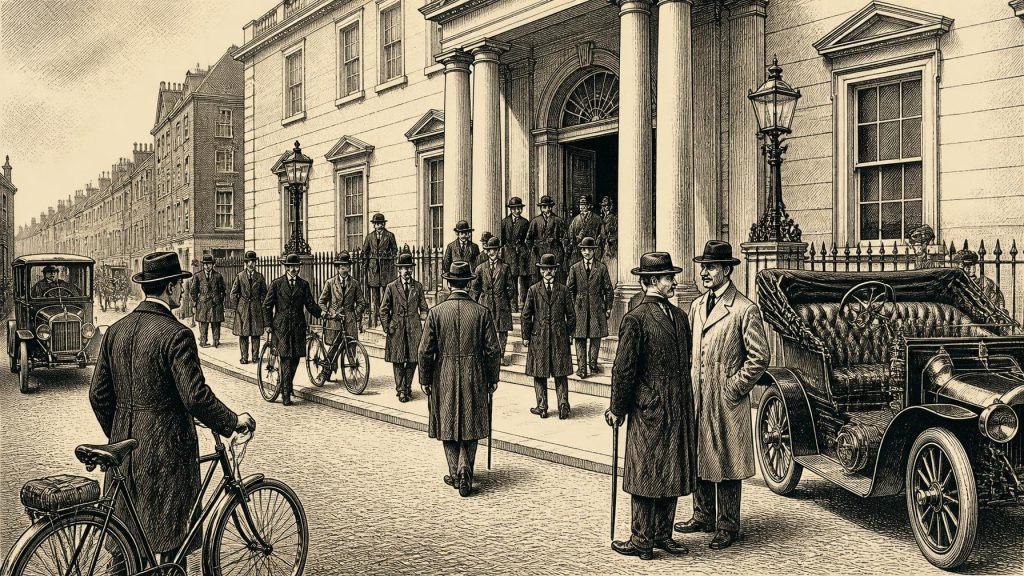
On 21 January, Sinn Féin representatives elected in the general election of December 1918 assembled in the Round Room of Dublin’s Mansion House rather than taking their seats at Westminster. They constituted themselves as Dáil Éireann. Not every elected member could attend: some were imprisoned, while others were absent for other reasons. Cathal Brugha, acting in the absence of the imprisoned Éamon de Valera, presided as temporary president. The proceedings deliberately gave public expression to the cultural politics of the movement: Irish was central to the sitting, though documents were also made available in English.
That first meeting adopted a short constitution, ratified a Declaration of Independence and approved a Message to the Free Nations of the World. The declaration presented the republic proclaimed in 1916 as now endorsed by an electoral mandate, asserted that the Dáil alone could legislate for Ireland, and sought international recognition. These were claims, not facts accepted by the British government or foreign states. Britain continued to govern Ireland as part of the United Kingdom; the Dáil had neither recognised sovereignty nor control of the civil service, revenue or armed forces. Nevertheless, it provided the republican movement with a representative institution through which to challenge British rule.
The Democratic Programme adopted that day made the republican project more than a constitutional demand. Its language promised public responsibility for children’s welfare, health, old age, industry, land resources, fisheries, waterways and trade. It condemned the Poor Law system and envisaged a free and Gaelic Ireland in which private rights would be subordinate to the common good. The document did not become an enacted social programme in 1919: the Dáil lacked the administrative power to deliver such ambitions. Its importance lay in defining the social expectations that could accompany independence, at a moment of severe post-war hardship and continuing public-health anxiety.
Soloheadbeg: A Separate Act, a Lasting Symbol
On the same day, a small group of Tipperary Volunteers ambushed a Royal Irish Constabulary escort carrying gelignite near Soloheadbeg, close to Tipperary town. Two constables, James McDonnell and Patrick O’Connell, were killed. Seán Treacy, Dan Breen and Séamus Robinson were among those associated with the operation. The Volunteers intended to seize explosives, but the deaths ensured that the encounter became a defining early episode of the War of Independence.
The coincidence of date has encouraged a neat historical picture: parliament in Dublin and war in Tipperary beginning together. It should be treated with care. The ambush was not ordered by the newly assembled Dáil, and the armed campaign was not yet a uniform national conflict. It was, however, a profound escalation. The British authorities quickly proclaimed South Tipperary a Special Military Area under wartime emergency powers. The clash also demonstrated the problem that would shadow the year: republican political leaders sought popular legitimacy and international standing while local armed men made decisions that could determine the scale of confrontation.
Violence remained intermittent in 1919 when compared with the harsher campaigns of later years. The force facing republicans was principally the Royal Irish Constabulary, backed by the British Army and the Dublin Metropolitan Police; the Black and Tans and Auxiliaries belonged to the subsequent escalation, not to this year. Nevertheless, attacks on police, arms raids, arrests, searches and prosecutions increasingly unsettled communities. Policemen and their families, Volunteers and their relatives, and civilians caught near raids or shootings all lived with the growing consequences of political conflict.
Leadership, Escape and Diplomacy
Éamon de Valera’s escape from Lincoln Prison on the night of 3–4 February gave the republicans a major propaganda success. De Valera, Seán McGarry and Seán Milroy escaped using a key fashioned inside the prison after tools and materials had been smuggled in. De Valera returned to Ireland later that month. On 1 April the Dáil elected him president and approved a ministry. Arthur Griffith took foreign affairs, Cathal Brugha defence and Michael Collins finance. Countess Markievicz, still imprisoned, was appointed minister for labour on 2 April, making her presence in the ministry an important, if constrained, landmark for women in Irish political life.
The new cabinet faced a practical contradiction. It declared itself the government of Ireland but needed to operate within, beside and against the existing British state. It therefore worked through trusted networks rather than a conventional civil service. Women of Cumann na mBan were especially important as secretaries, couriers, organisers and fundraisers. Their work was not merely auxiliary to dramatic armed episodes: correspondence, record-keeping, safe travel and local collections were essential if a clandestine administration was to function.
De Valera left for the United States in June. His mission aimed to secure sympathy, diplomatic recognition and financial support among Irish Americans, at a time when the Paris Peace Conference made the language of national self-determination unusually powerful. The mission did not persuade the American government to recognise the Irish Republic or secure a place for Ireland at Paris. It did, however, make the Irish claim highly visible, mobilise supporters and connect domestic events to a transatlantic public. International diplomacy became a long campaign of persuasion rather than a single decisive appeal.
Making an Alternative State
Much of the Dáil’s significance in 1919 lay in experiments with authority rather than grand declarations. In May, a republican court sat at Ballinrobe in County Mayo, emerging from local arbitration practices. During June, the Dáil considered a more organised system of parish, district, circuit and supreme courts. Such courts could offer an alternative forum for disputes and reduce recourse to Crown institutions. Their reach varied greatly, and they were not yet a comprehensive national judicial system. Still, the effort showed that republicanism was becoming concerned with ordinary order as well as resistance.
Finance was equally revealing. The Dáil authorised an internal loan in June, and subscriptions began to be sought publicly in late August. Michael Collins’s finance department presented the loan as an investment in Irish self-government, while local Sinn Féin organisations and Cumann na mBan activists helped to publicise and collect it. Raising funds was a test of confidence as much as a budgetary measure. Money was needed for offices, communications, relief, propaganda and the widening machinery of the republican cause.
The British response exposed how vulnerable this public-facing work was. Dáil Éireann was proscribed in September, with police and military raids following. Newspapers that carried advertisements for the loan, including the Cork Examiner, suffered suppression or seizure of equipment. The prohibition drove the Dáil further underground but did not end its activity. In November, the Irish Bulletin began publication as the Dáil’s official news sheet, intended to bypass hostile reporting and communicate the republican case at home and abroad. The conflict was therefore also a struggle over printers, notices, circulation and the credibility of information.
Limerick’s Permit Strike
The most striking labour episode of the year came in Limerick. After the death and funeral of Robert Byrne, a republican and trade-union activist, the authorities imposed a Special Military Area around the city on 9 April. Thousands of workers faced military controls on movement and required British passes to enter the area for work. The Limerick Trades and Labour Council answered with a general strike, beginning what became known as the Limerick Soviet.
For roughly two weeks in April, the strike committee organised food supplies and issued locally authorised passes rather than accepting the military permit system. The term “soviet” reflected the international political vocabulary of the period, but the immediate dispute was over military restriction, civic dignity and the ability to earn a living. The episode displayed a remarkable capacity for local organisation, involving unions, businesses, clergy and residents with differing politics. It also revealed limits: sustaining a city-wide stoppage was difficult, and the strike ended after negotiations while the restrictions were relaxed. Limerick nonetheless showed that resistance to British authority could take industrial and civic, not only military, forms.
Proscription and the Road Towards Partition
By autumn, British policy combined repression with renewed constitutional planning. On 24 September, Walter Long, chair of a Cabinet committee on Ireland, recommended separate parliaments for different parts of the island. The committee’s report reached Cabinet in November. Nothing was yet enacted in 1919, and the eventual boundaries of Northern Ireland had not been legally fixed. But this was an important stage in the development of the two-parliament scheme that would be legislated for in 1920. It made plain that London’s answer to Irish demands might divide, rather than reunify, political authority on the island.
For unionists, particularly in the north-east, the republican Dáil’s all-Ireland claim was unacceptable. For republicans, partitionary proposals were incompatible with the nation whose independence they had proclaimed. Those opposed visions existed alongside the practical divisions of religion, employment, locality and political allegiance. The Dáil’s Democratic Programme spoke in inclusive national terms, but it did not resolve how a republic would win the consent of a substantial unionist population.
A Darker December
On 19 December, an IRA party attempted to kill the lord lieutenant, Field Marshal Sir John French, at Ashtown outside Dublin. French escaped when his car passed the obstruction prepared for the ambush. Martin Savage, one of the attackers, was killed; Dan Breen was wounded. The attack was condemned by newspapers and Catholic churchmen, illustrating that republican violence did not command unquestioned approval even among people sympathetic to national self-government.
By year’s end, the central reality was not simply that Ireland had declared independence, nor simply that shots had been fired. Two rival systems of authority were taking shape. The British state still possessed law, armed forces and international recognition. The Dáil, denied those advantages, had acquired an electoral claim, ministers, funds, publicity networks, emerging courts and supporters willing to challenge the existing order. The influenza pandemic’s recent devastation, strained post-war livelihoods and political uncertainty formed the human background to that contest. In 1919, Ireland entered a revolutionary period whose outcome remained wholly undecided.
Source References
Hover over a number to see the source. Select it to open the source.

- [1] DECLARATION OF INDEPENDENCE. – Dáil Éireann (1st Dáil) – Tuesday, 21 Jan 1919
- [2] DEMOCRATIC PROGRAMME. – Dáil Éireann (1st Dáil) – Tuesday, 21 Jan 1919
- [3] First Dáil
- [4] 1912–1923 Timeline – UCD Decade of Centenaries
- [5] Treacy, Seán | Dictionary of Irish Biography
- [6] Breen, Daniel (‘Dan’) | Dictionary of Irish Biography
- [7] Sock, Eamon de Valera escape from Lincoln Prison, February 1919 | National Museum of Ireland
- [8] Eamon de Valera’s American Tour, 1919–1920 | University College Cork
- [9] DÁIL ÉIREANN – 19 June 1919
- [10] Dáil Éireann loan. | National Library of Ireland Catalogue
- [11] Underground justice: the Dáil Courts | RTÉ History
- [12] Arrests and raids follow proclamation against Dáil Éireann | Century Ireland
- [13] Banned! Why nationalist groups were driven underground in 1919 | RTÉ History
- [14] Irish media and propaganda in the War of Independence | RTÉ History
- [15] Local pass, The Limerick Soviet, 1919 | National Museum of Ireland
- [16] The Limerick Soviet 1919 | History Ireland
- [17] Cumann na mBan and the War of Independence | RTÉ History
- [18] Michael Collins’ Diaries: glimpses of a diplomatic connection | National Archives of Ireland
- [19] Attempt To Kill Lord French | RTÉ Archives
- [20] Walter Long and the making of the Government of Ireland Act, 1919–20 | Irish Historical Studies
- [21] 1919 . . . Congress! On Al-Record Senate
- [22] Death, Demography and the Denominator: New Influenza-19 Mortality Estimates for Ireland, 1918–19 | University College Cork
Primary Sources
- DECLARATION OF INDEPENDENCE. – Dáil Éireann (1st Dáil) – Tuesday, 21 Jan 1919
- DEMOCRATIC PROGRAMME. – Dáil Éireann (1st Dáil) – Tuesday, 21 Jan 1919
- First Dáil
- 1912–1923 Timeline – UCD Decade of Centenaries
- Treacy, Seán | Dictionary of Irish Biography
- Breen, Daniel (‘Dan’) | Dictionary of Irish Biography
- Sock, Eamon de Valera escape from Lincoln Prison, February 1919 | National Museum of Ireland
- Eamon de Valera’s American Tour, 1919–1920 | University College Cork
- DÁIL ÉIREANN – 19 June 1919
- Dáil Éireann loan. | National Library of Ireland Catalogue
- Underground justice: the Dáil Courts | RTÉ History
- Arrests and raids follow proclamation against Dáil Éireann | Century Ireland
- Banned! Why nationalist groups were driven underground in 1919 | RTÉ History
- Irish media and propaganda in the War of Independence | RTÉ History
- Local pass, The Limerick Soviet, 1919 | National Museum of Ireland
- The Limerick Soviet 1919 | History Ireland
- Cumann na mBan and the War of Independence | RTÉ History
- Michael Collins’ Diaries: glimpses of a diplomatic connection | National Archives of Ireland
- Attempt To Kill Lord French | RTÉ Archives
- Walter Long and the making of the Government of Ireland Act, 1919–20 | Irish Historical Studies
- 1919 . . . Congress! On Al-Record Senate
- Death, Demography and the Denominator: New Influenza-19 Mortality Estimates for Ireland, 1918–19 | University College Cork