

Parish Crowns
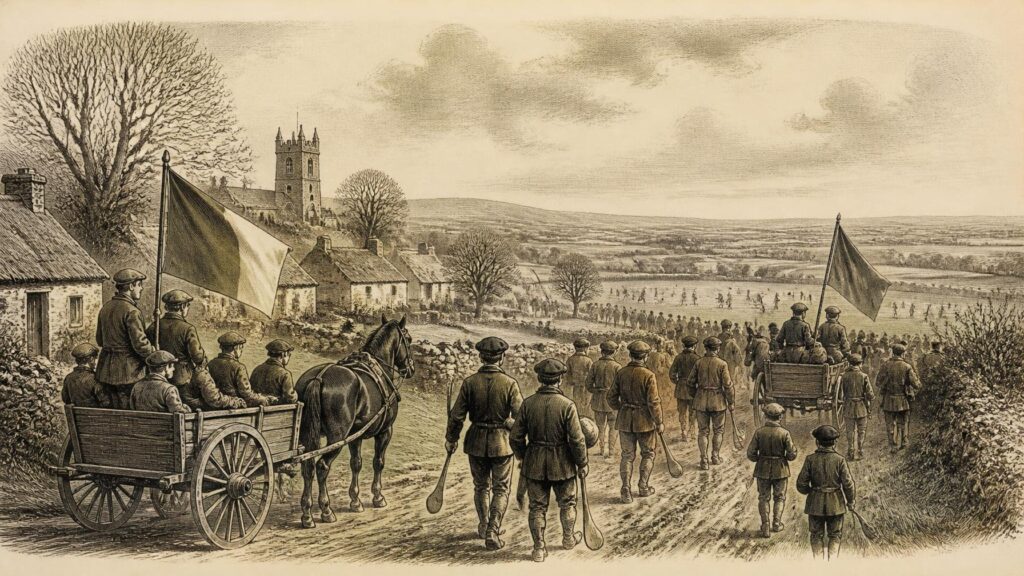
AI generated historical illustration, not a contemporary photograph.
At a Glance
All-Ireland club finals are among the clearest expressions of how Irish sport moves from a parish field to a national stage. They are not one competition, nor even the property of one governing body: the phrase embraces decisive matches in Gaelic football, hurling, camogie and ladies’ Gaelic football, across senior and lower grades. Yet the underlying idea is shared. A locally rooted voluntary club, having negotiated its own county and province, is asked to represent a particular community before an audience drawn from the island and its wider diaspora. The final is therefore at once a match, a public ritual and a historical record of local organisation.
Local Foundations
The starting point for understanding an All-Ireland club final is the club rather than Croke Park. The Gaelic Athletic Association’s own account of its structures calls the club the Association’s most numerous and most important unit. Its account notes that roughly 2,300 clubs in Ireland form a network in communities across the country, while club activity encompasses games, culture, administration and social life. Such language can sound ceremonial, but it describes a practical reality. Clubs organise teams, fields, fundraising, coaching, transport, fixtures and a dense calendar of meetings. They also become repositories of local memory: photographs in clubrooms, lists of championship teams, old jerseys, minute books and the names attached to grounds and trophies.
That local character distinguishes club finals from the better-known inter-county All-Ireland championships. County teams bring together selected players from many clubs; a club side is normally identified with a smaller geographical, familial and social catchment. In a final, the club name is often heard as a shorthand for a village, parish, townland, suburb or district. This does not mean that every club has a simple or ancient territorial identity. Some serve expanding towns, some are urban organisations, some arise from amalgamation, and some have names commemorating national figures or cultural ideals. Still, the appeal of a club final lies partly in the perception that the players and supporters share an unusually immediate connection.
The GAA was founded in 1884, and its early history is inseparable from the organisation of local clubs. The Association’s historical account presents the emergence of clubs as part of a wider revival and codification of Irish games. Hurling and Gaelic football were not invented by the GAA; rather, the Association supplied rules, regular competition and an institutional framework. Over time county championships became the principal tests of club standing. The All-Ireland club series came much later, after generations in which a county championship itself could be regarded as the summit of a club season.
That sequence matters. A national club championship did not replace local competition; it extended it. The county championship remains the foundation because it determines who can progress. The GAA’s official rules describe county, provincial and All-Ireland stages as parts of a single competition. County champions are eligible for All-Ireland club competition, subject to the detailed regulations governing representative teams, eligibility and grades. The national final is consequently the visible end of a chain of local decisions, contests and voluntary labour.
National Ambition
The senior GAA club championships in football and hurling emerged in the 1970–71 season. Their appearance was historically significant because it created an organised means by which county champions could measure themselves across provincial boundaries. In football, East Kerry defeated Bryansford of Down in the inaugural final on 21 November 1971. East Kerry was a divisional side, a reminder that the early competition differed in important respects from later expectations. The present principle that a club champion should be an actual club, rather than a representative combination, reflects the desire to make the national contest a contest between recognisable local associations.
In hurling, Roscrea of Tipperary won the inaugural senior club championship in 1971, defeating St Rynagh’s of Offaly at Birr. The early finalists reveal something important about the purpose of the series. They placed teams from different hurling regions in meaningful competition, rather than allowing provincial success to remain the outer boundary of a club season. In both codes, the new championships were not merely an additional fixture list. They altered the scale on which a successful club could imagine itself.
The conventional provincial route gave the competition an all-island shape. County champions entered provincial championships in Connacht, Leinster, Munster and Ulster; provincial winners then progressed towards All-Ireland semi-finals and final. The structure echoed the older architecture of the GAA itself, which is organised on club, county and provincial lines. It also meant that a final was never simply a meeting of two teams. It represented, in compressed form, a succession of county and provincial contests, with all the delays, replays, weather, travel and local attention that those contests involved.
There is a temptation to tell this development as an inevitable march towards a national club championship. The evidence suggests a more cautious interpretation. Club fixtures had to coexist with county championships and, increasingly, with the demands placed on inter-county players. The GAA’s rules and later debates about calendars show that the relationship between county autonomy and national coherence has always required negotiation. An All-Ireland final is a triumphant conclusion, but the route to it depends on a fixture system that is never entirely free from strain.
The historic records also resist the idea that only traditional county powers could prosper. The GAA roll of honour for senior club hurling includes champions from Tipperary, Cork, Kilkenny, Galway, Wexford, Clare, Offaly, Antrim and Dublin. Ballyhale Shamrocks, Birr, Portumna, Blackrock, Athenry, James Stephens, Loughgiel Shamrocks and Cuala appear among the leading names. Their success illustrates continuity, but the list also records different kinds of local strength: rural parishes, market towns, city clubs and clubs from counties not always placed at the centre of inter-county hurling narratives.
Provincial Passage
To reach an All-Ireland final, a club must normally survive a change in scale. County competition is familiar: opponents may be neighbours, relatives may be on opposite sidelines, and earlier league or championship meetings shape expectations. Provincial competition introduces teams that are less familiar but whose standing has been established by winning elsewhere. The journey therefore broadens a club’s field of reference. Supporters who might seldom travel beyond their county for sport find themselves following a team through another province, then perhaps to a neutral semi-final or a major final venue.
Such travel has historical significance. The GAA’s national and provincial structure has long helped make Irish county and provincial geography meaningful in everyday life. Club championships add another layer to that mapping. A small place becomes legible to outsiders through a team name; a district is associated with a particular style, support or sequence of results. This is not evidence that sport alone creates local identity. Rather, it shows how sport provides a conspicuous occasion on which existing attachments can be displayed, renewed and sometimes contested.
The provincial stage also complicates the romantic image of the isolated parish. Clubs do not operate outside institutions. County boards set local championships; provincial councils administer provincial rounds; central authorities regulate the All-Ireland series. The GAA explains that provincial councils organise provincial competitions, assist with investment and operate alongside historic provincial lines. The club final is therefore local in representation but layered in governance. A winning captain may lift a cup for a community, yet that moment rests on rules, registrations, disciplinary processes, fixture arrangements and gate administration extending far beyond the club itself.
Grades make this structure more inclusive, though never perfectly equal. Senior championships draw the strongest clubs in established counties, while intermediate and junior All-Ireland competitions give other county champions a national route. The logic is important: a small club or a club in a developing code can pursue an All-Ireland title appropriate to its competitive level. The GAA’s regulations explicitly provide for grading of counties in All-Ireland club championships. This is administrative language, but it recognises that a national competition needs more than one doorway if it is to reflect the uneven distribution of players, population and resources.
Even so, grades should not be treated as minor footnotes to senior sport. Intermediate and junior finals have frequently marked defining episodes in local history. The cup may be different, and public attention smaller, but the achievement can carry equal emotional weight within the winning community. Historical writing should avoid reproducing only the hierarchy of national media. The club archive often preserves a more democratic record: a junior final photograph or a handwritten list of a travelling party may matter more locally than a senior final broadcast.
Hurling Memory
Hurling club finals have generated some of the most durable images in modern GAA history. The formal senior competition began in 1970–71, but its meaning rests on a longer hurling inheritance. The GAA’s history of hurling emphasises both the game’s deep cultural associations and the nineteenth-century process by which rules and organised competition gave it a new institutional life. It would be unsafe to turn that long inheritance into an unbroken, uniform story. What can be said securely is that, by the time a national club championship was introduced, hurling clubs already carried powerful local claims to tradition and prestige.
The early roll of honour illustrates both strongholds and movement. Roscrea’s inaugural victory was followed by titles for Blackrock, Glen Rovers, St Finbarr’s, James Stephens and other distinguished clubs. Later winners such as Birr, Portumna, Clarinbridge, St Thomas’, Cuala and Ballygunner demonstrate that the competition’s history cannot be reduced to one county’s supremacy. Ballyhale Shamrocks’ record is especially striking. The official GAA roll of honour records eight senior titles through 2020, a total which conveyed not simply a successful team but an era of sustained club capacity.
Dominant clubs create a problem and an opportunity for historians. Their trophy totals are easy to enumerate, but statistics alone can obscure the organisational conditions beneath them: juvenile structures, coaching traditions, local population, relations with schools, continuity of volunteers and the presence of talented generations. None of these factors guarantees success, and it would be careless to infer a complete explanation from results. Nevertheless, repeated success usually indicates that achievement was not the work of a single afternoon. It was sustained over years by people whose names seldom appear in match reports.
The final itself has often been treated as a test of a club’s place in hurling memory. Winning the county championship may establish local authority; winning the provincial title brings recognition among established rivals; winning the All-Ireland places a club in a longer national roll. The documentary record turns that memory into a more durable public fact. The GAA’s digital archive, launched in 2019 with support from the Broadcasting Authority of Ireland, includes recorded All-Ireland club finals from 1989. Its significance is considerable. Television footage does not contain every aspect of a final, but it preserves play, voice, weather, crowd and ceremony in a way that newspaper reports and recollections cannot.
Archival footage also encourages a useful distinction between evidence and nostalgia. Supporters may remember a final as a wholly perfect day, while the recording may reveal missed chances, difficult conditions or long spells of uncertainty. Neither version is false. Personal memory records meaning; film records selected visual and audible events. The historian’s task is not to dismiss local recollection, but to recognise its form. A club final is remembered through emotion and family story as well as through scorelines.
Football Pathways
Gaelic football’s club championship developed on a parallel timetable, yet its history has its own texture. The inaugural 1970–71 title won by East Kerry illustrates the early role of divisional representation. Bellaghy of Derry, winners in the following season, are commonly identified as the first individual club to take the title. That shift is more than a point of trivia. It reveals an emerging expectation that the national championship should elevate a self-contained club community rather than a temporary combination of clubs.
Over subsequent decades the football final became an arena where clubs from very different settings met. Kerry, Dublin, Cork, Galway, Mayo, Roscommon, Tyrone, Down, Armagh and other counties supplied prominent contenders. The terms “club” and “community” remained persuasive, but the communities varied greatly. Some were rural and dispersed; others belonged to suburbs or expanding towns; some had access to unusually deep playing resources; others built success around a small cohort and exceptional continuity. The final did not erase those differences. It brought them into sharper view.
Football’s club championship also underlines the importance of the calendar. The competition historically crossed from autumn county championships into winter provincial rounds and finals in the following year. That seasonal arc helped form its atmosphere. Dark evenings, heavy pitches, Christmas fixtures and journeys in poor weather became part of the cultural memory of club football. It also made the competition vulnerable to congestion. County championships finish at different times, while clubs containing inter-county players must accommodate wider commitments. The result is a structure cherished for its drama yet persistently debated for its practical demands.
In 2019 the GAA announced that club action would receive a more substantial window in its calendar planning. The announcement did not solve every difficulty, and it should not be read as proof of a final settlement. It does, however, demonstrate official recognition of a longstanding issue: a sport built on clubs must make sufficient time for clubs to play. All-Ireland finals are the most visible reward, but their integrity depends on the less glamorous question of whether competitors have a coherent season in which to prepare.
The football final also connects amateur competition with large-scale public spectacle. A club that may ordinarily play before a modest local attendance can find itself at Croke Park or another substantial venue, beneath television cameras and before a national audience. This transition can be exhilarating, but it changes the experience. Players are still amateurs representing their clubs; the occasion nevertheless exposes them to a level of scrutiny more commonly associated with inter-county sport. Supporters, too, become part of a national performance through colour, banners, songs and travel.
Women’s Games
Any historical account confined to the GAA’s men’s football and hurling competitions would be incomplete. Camogie and ladies’ Gaelic football developed through distinct organisations and histories, but their All-Ireland club finals are equally important evidence of women’s sporting organisation in Ireland. Their records correct the common but misleading assumption that the national club final was solely a male institution of the 1970s.
The Camogie Association’s roll of honour begins with Celtic of Dublin defeating Deirdre of Belfast in 1964. Association material explains that the All-Ireland senior club championship was introduced to mark the Diamond Jubilee of An Cumann Camógaíochta. The first provincial winners came from Munster, Leinster, Connacht and Ulster, and the competition was retained after the jubilee rather than ending as a one-off celebration. The source distinguishes the 1964 inaugural championship from the first official club final in 1965, when St Patrick’s of Glengoole met Deirdre at Casement Park. This is a valuable reminder that sporting origins can be more complicated than a single founding date suggests.
Camogie’s club final history consequently predates the senior GAA club championships by several years. Its roll of honour includes teams from Dublin, Tipperary, Kilkenny, Galway, Limerick, Wexford, Cork, Derry, Antrim and elsewhere. The breadth of this list challenges a narrow geography of women’s games. It also records the endurance of clubs whose names recur across decades. Repetition in the roll of honour should not be mistaken for inevitability; it is evidence of repeated competitive success, while the precise causes require local research in each case.
Ladies’ Gaelic football offers another important chronology. The Ladies Gaelic Football Association’s Cavan history records Mullahoran as winners of the first All-Ireland club championship, and describes later final appearances in 1978 and 1979. This kind of county-based institutional record may appear modest beside a national roll of honour, but it is historically rich. It preserves not only an achievement but a team list, opposition, venue and local response. Such documentation demonstrates how women’s clubs made national competition meaningful long before contemporary growth in broadcast attention and sponsorship.
There is no need to romanticise this history. Women’s sporting organisations often worked with fewer resources, less media coverage and weaker archival survival than men’s counterparts. Records can therefore be fragmentary, names misspelled, photographs unidentified and fixtures remembered through oral testimony rather than comprehensive databases. That makes the work of preservation more urgent. It also requires caution. Where a club history makes a claim, the historian should state the claim’s institutional source and avoid converting every local tradition into an independently verified fact.
The shared use of the phrase “All-Ireland club final” should therefore invite comparison without erasing difference. Camogie and ladies’ football have their own governing bodies, competitions, cups, histories and traditions. Yet all four codes show the same essential pattern: clubs give players a route from local participation to an island-wide contest, and the final gives their achievements an enduring public form.
Island Connections
The word “All-Ireland” has particular resonance because the competitions reach across Ireland’s political border. Clubs from the six counties of Northern Ireland participate within the GAA’s sporting geography, as do camogie and ladies’ football clubs in their respective structures. This does not make sport politically neutral, nor should historical writing pretend that it does. Gaelic games have long carried cultural and political meanings. But the club championship provides a practical, recurring form of all-island association: teams travel, compete and are recorded within a common sporting framework.
Ulster clubs are not ornamental participants in this story. Bellaghy’s early football success, Loughgiel Shamrocks’ senior hurling titles, Slaughtneil’s achievements in camogie, and the recurrent appearance of clubs from Antrim, Armagh, Down, Derry, Fermanagh and Tyrone demonstrate that national club competition has consistently included northern communities. The historical value of this participation lies not in a simplistic claim of sporting harmony, but in the durable institutional links created through fixtures, administration and shared occasions.
London also has a place in the wider club world. The GAA notes its extensive overseas development among the Irish diaspora, and its club regulations make provision for affiliated clubs where a county board does not exist. The relevant scale should be kept in view: an All-Ireland final principally tells an Irish story, but that story has never been wholly confined to the island. Migration, return, family networks and overseas units have shaped the personnel and imagination of Gaelic games from the nineteenth century onward.
For supporters, an All-Ireland final can therefore act as a reunion point. People who have left a locality return, relatives organise travel, and club colours become visible in railway stations, motorways and city streets. This is an interpretation rather than a measurable universal rule. Not every final produces the same migration of people or the same homecoming. Still, the repeated association of club finals with journeys and reunions helps explain their emotional intensity. The match condenses a community’s dispersed connections into a particular place and day.
Final Rituals
A final is more than the seventy minutes, or whatever playing time the rules prescribe. It is a sequence of rituals: the team bus leaving, the gathering at a club house, the journey, the warm-up, the parade or entrance, the national symbols, the whistle, the presentation, the return. Some of these practices are formally organised; others arise informally and vary from club to club. Their historical importance lies in repetition. Repeated actions give supporters a vocabulary for marking an extraordinary occasion.
Trophies give that ritual a material centre. In football the senior prize is the Andy Merrigan Cup; in hurling it is the Tommy Moore Cup. The names themselves connect club competition to older sporting lives and local commemoration. A cup is not merely an object handed over for a photograph. It allows the winning group to enact possession, responsibility and continuity. It will return to the club, be carried through a locality, be displayed and eventually passed on. The cup’s journey after the final often becomes as memorable as the game.
Venues matter in similar ways. Croke Park carries exceptional symbolic weight as the GAA’s principal stadium and headquarters, but finals have also been staged elsewhere. Birr’s place in the inaugural hurling final is one example. Casement Park’s hosting of the first official senior camogie club final is another. Such sites prevent an overly Dublin-centred account. A national final can be staged in a famous arena, but its historical meaning derives from the meeting of particular clubs and particular supporters, not from architecture alone.
Folklore naturally gathers around finals. A supporter may recall a miraculous goal differently from a contemporary report; a wet day may become wetter in the telling; the decisive speech may acquire words no recording confirms. Folklore should not be treated with contempt. It shows how communities assign meaning to experience. But it is not the same as documented evidence. The score, venue and official team list can often be verified through programmes, newspapers, association records or archive footage. The claimed last instruction in a dressing room may survive only as cherished testimony. Good local history can preserve both, provided it labels the difference.
Changing Calendar
All-Ireland club finals have changed alongside the wider organisation of Gaelic games. Sponsorship, broadcasting, training methods, travel and fixture planning have all reshaped their presentation. Allied Irish Banks’ long association with club championships is one prominent example of commercial sponsorship becoming part of the event’s public identity. The GAA announced in 2016 that AIB had then supported the GAA club championships for twenty-five consecutive years, while also backing camogie club competition. Sponsorship has supplied visibility and resources, but it has not displaced the amateur basis of the clubs themselves.
Broadcasting is another transformation. The 2019 GAA Digital Archive project placed historic club-final footage alongside recordings of inter-county matches and added contextual information including dates, results, venues, referees and team details. Its existence changes what a future historian can do. Earlier finals may be reconstructed largely from print reports and memory; later games can be watched, compared and revisited. Yet digitisation is not total preservation. What was not filmed, catalogued or retained remains vulnerable. Club historians should still value programmes, minute books, photographs and oral testimony.
The calendar remains the most revealing site of change because it exposes competing priorities. County championships need room; provincial competitions need a clear entry point; inter-county schedules command wide attention; players need recovery and certainty. The GAA has acknowledged that counties retain responsibility for shaping their own competitions, while national debate repeatedly returns to the need for a meaningful club window. This tension is not a modern aberration. It follows from the Association’s dual character: intensely local in its base, yet national in its most celebrated competitions.
There is a historical lesson here. The grandeur of an All-Ireland final should not obscure the fragility of the arrangements that produce it. A delayed county final can alter provincial fixtures; weather can disrupt plans; disputes over eligibility can shadow preparations; inter-county demands can affect availability. The ideal of a straightforward national ladder has always met the practical complexity of voluntary sport. The fact that the finals endure is evidence not of effortless tradition, but of continual organisational work.
Living Archives
All-Ireland club finals deserve to be read as living archives of Irish local history. A result list can identify winners and runners-up; footage can preserve a match; an official guide can explain qualification. None alone tells the whole story. To understand a final fully, one must also ask who trained teams, raised funds, marked pitches, cooked meals, drove supporters, recorded minutes, organised juvenile players and maintained the club through unsuccessful years. The great majority will never lift a national cup, but they make the possibility of a final real.
This perspective also guards against a common distortion. Because national titles are easily listed, it is tempting to write club history as a procession of champions. Defeat, however, has its own historical place. A losing finalist may remain a source of local pride; a semi-final run may alter a club’s ambitions; a narrow county defeat may be remembered for generations. The archive should therefore include not only victories but the broader texture of participation. A club’s history is not exhausted by its silverware.
Documented evidence permits firm statements about competitions, dates, winners and institutional rules. Interpretation allows us to see how those facts illuminate local belonging, voluntary labour and national identity. Folklore reveals how communities remember what evidence cannot completely capture. Keeping these categories distinct does not make the story colder. It makes it more trustworthy. An All-Ireland club final can be both a verifiable sporting event and a vessel for stories that outlive the final whistle.
That is why these finals occupy such a notable place in Irish history. They show the relationship between small places and national institutions without pretending that either is simple. A parish, town or urban district may stand briefly at the centre of a national occasion, but it does so through systems built by generations of organisers and players. The final crown is temporary; the club that contests it is meant to endure. In that endurance lies the deeper history of the All-Ireland club final.
The article usefully presents All-Ireland club finals as more than elite matches: they are outcomes of local voluntary labour, layered governance and journeys through county and provincial competition. Particularly striking is the comparison between celebrated senior finals and intermediate or junior victories, whose visibility may differ sharply although their communal significance can be equally profound. This raises questions about how sporting history is preserved and valued, especially when television, media attention and trophy prestige favour grades, codes or venues. How might clubs, archives and governing bodies represent memories, organisational work and achievements of lower-grade finalists alongside the better-known senior competitions?