

Changing Codes
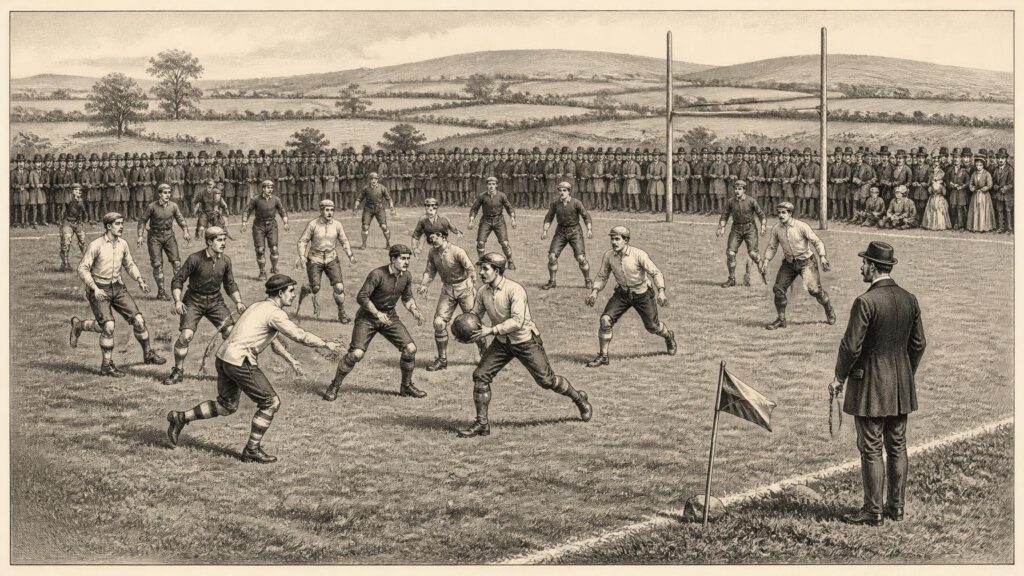
AI generated historical illustration, not a contemporary photograph.
At a Glance
Rules in Gaelic games have never been merely technical directions for referees. They are a record of how Irish people made local pastimes into national sports, argued about violence and skill, balanced inherited custom against modern administration, and repeatedly decided what football and hurling ought to look like. From the first GAA code of 1885 to the football reforms made permanent from 1 January 2026, rule changes have been a practical form of Irish history.
Local Games
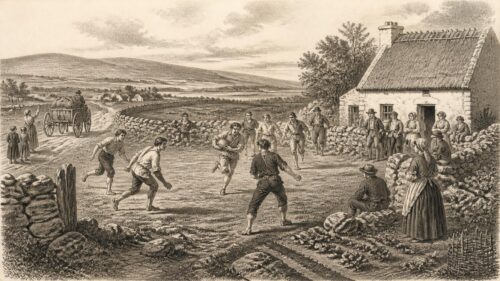
Before the Gaelic Athletic Association was founded in 1884, ball games called football, hurling, commons, camán and many other local names were played in Ireland under strikingly varied conditions. They belonged to particular places rather than to a single nationwide authority. A match might be shaped by the available field, the number of men present, a parish rivalry, an agreed target, or habits understood by those who had played together since childhood. Such games could be vigorous, spectacular and deeply valued, but local familiarity was not the same thing as a common code.
That distinction is fundamental. It is tempting to describe every older stick-and-ball or mass-football game as a direct earlier version of the modern GAA codes. The evidence does not support so simple a lineage. Hurling certainly has a long documentary and cultural history in Ireland, and football games were widespread; yet the modern sports are organised creations as well as inheritances. Their rules selected some existing practices, rejected others and borrowed organisational forms from the Victorian sporting world. They were not recovered intact from an ancient past.
Maurice Davin expressed the problem bluntly in 1884 when he wrote that local football games had no rules and were therefore often dangerous. The remark should not be read as proof that no conventions existed. Rather, it identifies the difficulty facing an association that wished to arrange matches between clubs from different districts. A game played under unwritten local expectations could work within a community. It became unstable once players, referees and spectators travelled across county boundaries and expected a result that all parties would recognise.
The GAA’s answer was codification. Codification did not abolish argument; it created a common arena in which argument could occur. A printed rule fixed a temporary answer to questions that had formerly been settled by custom, force of personality or post-match dispute: how many players were permitted, where a ball might be handled, what constituted a score, who could enter a scoring area, and what authority a referee possessed. In this respect the rule book was as important to the GAA’s growth as the championship fixture list. It made a local game portable.
Rules Made
The Association’s founders worked in an Ireland already familiar with codified sport. Association football, rugby football and athletics had written laws, governing bodies, specialist officials and newspapers prepared to report results in standard terms. Michael Cusack’s campaign for indigenous pastimes was therefore not a rejection of all British sporting influence. It was an argument that Irish games required institutions capable of competing with other organised sports. The GAA’s founders adapted contemporary models while trying to give their games a distinct identity.
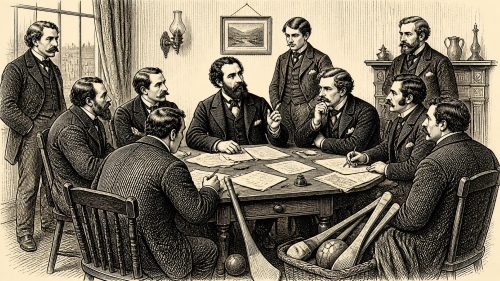
At the second GAA meeting, held in Cork on 27 December 1884, Davin was asked to lead a committee to draft rules for athletics, hurling and football. At Thurles on 17 January 1885 he presented football rules which were adopted unanimously. The early code was spare. Teams could contain up to twenty-one players; the pitch had minimum dimensions; goals were the sole means of scoring; and pushing, tripping, holding and headbutting were prohibited. A ball kicked over the sideline was thrown back by an opposing player.
The brevity of those provisions is revealing. They established a framework rather than a full constitutional settlement. In particular, the code did not yet contain the detailed regulations needed to produce uniform tactical play. Cusack later had to remind players that passing and carrying the ball in a rugby fashion were not permitted. Such interventions demonstrate that a printed rule only began the work. Clubs had to learn it, referees had to interpret it, and players had to adapt movements learned in other games.
The first football match reported under the new rules, at Callan on 15 February 1885, ended scoreless between Callan and Kilkenny. The occasion matters less as an origin myth than as evidence of an experiment being tested in public. A scoreless result before a large attendance also hints at a recurring problem in sporting legislation: rules must make a game recognisable and fair, but they must also allow it to be intelligible and rewarding to players and spectators. Nearly every later reform would revisit that balance.
Scoring Settled
Scoring provides one of the clearest examples of the early game’s rapid transformation. At first only goals decided a football match. In 1886 point posts were introduced on either side of the goalmouth, and points could decide a match if neither side scored a goal. This was not a minor adjustment. It changed where attacking players could aim, made territorial pressure more visibly productive and gave umpires a larger role in determining results.
Even the relative value of scores had to be negotiated. In 1892 a goal was set at five points, replacing the earlier principle that a goal outweighed any number of points. Four years later it was reduced to three. Modern supporters may treat three points for a goal as immemorial, but it was a settlement reached after experimentation. The change illustrates a wider reality: numerical values encode a view of sporting merit. A high value for goals privileges direct penetration of defence; a lower comparative value permits accurate kicking over the bar to matter more consistently.
Field markings developed in the same practical fashion. The earliest football grounds were not necessarily laid out to a shared template. Flags at intervals, end lines, goal areas and later 14-yard, 21-yard and 50-yard lines enabled officials to translate an infringement into a location and a remedy. In 1895 the GAA introduced the 21-yard and 50-yard lines, a seven-yard square for kick-outs and a 50-yard sanction where a defender played the ball over the end line. These markings were not decorative geometry. They made contested decisions more visible and helped define responsibility near goal.
The language which grew around these regulations shows how rules enter popular memory. “Square ball” is now one of the best-known expressions in Gaelic football, yet its origin lies in the 1895 kick-out square. The phrase later acquired a broader life as shorthand for a disputed attacking presence in the scoring area. Folklore often treats such expressions as ancient and unchanging. The documentary history is more interesting: a technical provision becomes a phrase, then a phrase becomes a shared cultural reference whose precise legal meaning continues to alter.
Moving Ball
The most distinctive feature of Gaelic football has long been its negotiation between kicking, catching, carrying, bouncing and hand-passing. None of these activities acquired its modern legal form at once. The 1895 rules limited carrying to four steps before the ball had to be struck with hand or foot; they also prohibited throwing and hopping. The player’s relation to the ball was therefore already a central concern. A code had to distinguish legitimate control from an action that turned the game into rugby, soccer, or simply an unstructured scramble.
Between 1907 and 1909 the rules allowed the ball to be caught whether it had bounced or not, while forbidding a player from picking it directly off the ground. One hop was permitted, and a forward bounce could be used under defined conditions. These provisions helped create the familiar rhythm of football: a contested high catch, a brief run, a solo or bounce, then a kick or hand-pass. They also show why a game’s apparent traditions should be dated carefully. The skills now considered characteristic were refined through successive decisions, not handed down unchanged.
There were further adjustments. The number of players fell from twenty-one to seventeen in 1892 and to fifteen in 1913. The reduction opened space and made positions more recognisable. Modern H-shaped goalposts were introduced in 1910. In 1913, too, the code reached the fifteen-a-side arrangement that remains standard. These changes linked the shape of the field, the movement of the ball and the number of bodies contesting it. A rule about numbers is also a rule about pace, congestion and tactical possibility.
Hand-passing became especially contentious in the twentieth century. In 1950 it was restricted to the closed fist. In 1975 an open-handed hand-pass was allowed. In 1981 all hand-passed scores were disallowed, a rule that preserved the primacy of kicking in the act of scoring. In 1990 players were permitted to fist a point but not a goal. These are not contradictory curiosities. They show administrators repeatedly trying to preserve a game in which hand skills aid movement and possession without displacing kicking as a defining test of attack.
Order Enforced
Rule changes also chart the slow professionalisation of amateur administration. Early football needed officials, defined areas of authority and procedures trusted by competing teams. The 1888 rules recommended a whistle for referees and allowed substitutions for injured players. By 1895 modern linesmen and goal umpires had been introduced. Their presence divided observation between different officials and made it possible to govern a larger, faster match.
The referee’s role was never simply mechanical. A 1945 booklet for referees urged that the ball be “toed into the hand” rather than picked up, while also encouraging officials not to blow for every petty infringement. Here is an enduring tension in the rules: literal enforcement can produce justice in an individual incident, yet excessive interruption can undermine flow. Modern debates about advantage, tackles, hand-passes and dissent repeat this old dilemma in altered form.
The 1965 definition of a fair charge as shoulder-to-shoulder attempted to regulate physical contact more precisely. The 1974 abolition of the third-man tackle was another important moment. Charging a player who did not possess, or was not about to play, the ball became a foul. The same year saw the introduction of the large parallelogram as a penalty area and specific protection for goalkeepers in the smaller rectangle. Such provisions did not make football non-contact. They narrowed the forms of contact considered legitimate and made player safety and positional fairness more explicit objects of law.
The historical study by John Connolly and Paddy Dolan describes this long process as the civilising and sportisation of Gaelic football. Their interpretation is useful provided it is not simplified into a tale of steady, inevitable improvement. The researchers stress that the reduction of violence was uneven and fragile, shaped by changing social expectations and continued ambivalence towards physical force. Rule books can alter sanctions, but they do not instantly transform habits. The persistence of disciplinary debate is evidence that the written code and the culture of play continually influence one another.
Penalty Arrives
The Gaelic football penalty kick offers a particularly instructive case. The GAA’s own historical research establishes that a one-on-one set piece between kicker and goalkeeper entered the rules in 1923, though the term “penalty kick” was not initially used. The change added a clause requiring all players except the goalkeeper to stand clear of the scoring space when a free was brought back to the 14-yard line for a foul in the parallelogram.
The wording was cautious, even cryptic, but the practical result was significant. Until then the remedy for a foul had been a free kick, however near the goal it occurred. The new provision recognised that a foul in a scoring position could destroy an opportunity whose value an ordinary free did not restore. In 1925 the rule was clarified further: all players other than the defending goalkeeper and the kicker had to stand outside the 21-yard line.
The delayed adoption of the name is historically revealing. The set piece was an adaptation of the soccer spot-kick, itself associated with William McCrum of Milford, County Armagh, but the GAA was strongly invested in distinguishing its code from association football. In an Ireland emerging from revolutionary conflict and partition, words could carry ideological weight. The reluctance to use a familiar soccer label did not prevent the GAA from adopting a practical solution, but it demonstrates that sporting identity was expressed through vocabulary as well as technique.
This episode also warns against overconfident historical claims. Contemporary Congress reports did not clearly explain every stage by which the 1923 amendment was made. Dónal McAnallen’s research notes that some changes to printed rules were not necessarily settled in the public manner expected today. The evidence is sufficient to date the rule’s arrival, but not to reconstruct every conversation behind it. Responsible history should preserve that difference between what documents establish and what may only be inferred.
Congress Power
As the GAA expanded, rules increasingly became matters for a representative institution rather than the informal judgment of a small group of founders. Congress, comprised of delegates from the Association’s units, became the authority able to enact, amend or rescind rules in the Official Guide. Between Congresses, Central Council and specialist committees could manage administration, interpretation and proposals, but major changes required a constitutional route through the Association.
This structure gives GAA rule-making a distinctive democratic character. A proposal may arise from a club, a county board, referees, medical advisers, coaches, players or a central committee; it can be tested in competitions, revised through experience and debated by delegates. That does not mean every participant has equal influence, nor that agreement is painless. It does mean that the game’s laws are made within the organisation’s own representative culture rather than imposed by an external league owner.
Joe Lennon’s doctoral study of legislation in Gaelic games is important here. It argues that playing rules should be easy to read, remember and apply, and it gathers and compares sets of football and hurling rules from 1884 to 1999. His work helps explain why rule reform is more than an argument over tactics. A rule that spectators cannot understand, players cannot remember and referees cannot administer will fail even if its stated purpose is admirable.
Administrative rules can possess historical significance beyond the field. The GAA’s former Rule 27, rescinded in 1971, had prohibited members from playing or attending specified rival games. Its removal reflected changes in Irish society, the practical difficulty of enforcement and a reassessment of cultural boundaries. Rule 42, governing the use of GAA grounds for non-Gaelic games, was temporarily relaxed in 2005 so rugby and association football internationals could be staged at Croke Park during redevelopment of Lansdowne Road. Such decisions remind us that “GAA rule changes” include institutional identity as well as the mechanics of scoring.
Hurling Change
Hurling’s history requires equal care. It is deeply rooted in Irish cultural memory and recorded tradition, but nineteenth-century hurling was not a single uniform game awaiting rescue. Different regions played different stick-and-ball forms. The GAA’s formal rules brought selected versions into a national framework, eventually privileging the fast field game now recognised as modern hurling. The achievement was not the preservation of every local form; it was the creation of a common code capable of sustaining clubs, county competitions and national championships.
Like football, hurling has changed through constant attention to possession, contact and spectacle. The hand-pass is a good example. A lawful hand-pass requires a distinct striking action, yet officials have repeatedly faced the difficulty of distinguishing a strike from an impermissible throw at match speed. In 2010 the GAA clarified the football hand-pass after a Congress change. In hurling, concern about the growing frequency and legality of hand-passing led to trials in higher-education competitions during 2023 and to further proposed trials in 2026. The issue is not simply pedantry: the way the sliotar may be transferred shapes whether hurling rewards striking, aerial skill and open contest or becomes a more possession-dominated game.
Safety has brought perhaps the most visible hurling reform. Helmets had advocates long before they became universal. Some pioneers were mocked as overcautious, a response that now appears dated but should be understood as part of a wider sporting culture that associated bareheaded play with toughness. Evidence gathered through injury research helped change the argument. Helmet use with facial protection became compulsory for underage players first and for all levels from 1 January 2010.
This was a rule change supported by a measurable safety rationale. GAA material reports substantial reductions in serious facial and eye injuries after mandatory helmet use. The precise pattern of injury may vary by study and setting, but the historical point is secure: medical evidence, equipment standards and the willingness of Congress to legislate together changed the visual culture of hurling. A helmet and faceguard are now normal equipment, not an eccentric departure from tradition.
Modern Football
Recent football reforms demonstrate that the old process of experimentation remains alive. In 2014 the black card was introduced for specified cynical behaviour: deliberate pull-downs, trips, collisions after the ball had been played, threatening conduct and aggressive remonstration with match officials. The measure recognised that some fouls are committed not in a genuine contest for possession but to prevent an opponent exploiting space or momentum. It tried to distinguish tactical obstruction from ordinary error.
The sanction itself evolved. A black card initially involved a replacement within the permitted substitutions; from 2020, a player receiving one spent ten minutes in a sin bin with no substitute allowed. That alteration made the immediate cost fall upon the offending team, rather than merely upon the individual. Other recent changes included the kick-out mark in 2017, the advanced mark in 2020, concussion substitutions in 2021 and revised kick-out arrangements. Each responded to a perceived pressure: defensive fouling, low-risk recycling, uncertainty over aerial catches, welfare, or the desire for more contestable restarts.
In late 2024 Special Congress approved a package of temporary football enhancements for the 2025 season. The package included one-versus-one throw-ins, a requirement for kick-outs to travel beyond a 40-metre arc, restrictions on goalkeeper recycling, a solo-and-go restart after fouls, positional requirements designed to maintain players in both halves, a revised mark and a two-point reward for scores from beyond the new arc. The measures were unusually extensive, but their motives were familiar: increase attacking opportunity, reward kicking, discourage delay and lessen extreme defensive congestion.
What distinguishes this reform from folklore about a sudden reinvention is the documented process around it. The Football Review Committee drew on surveys, workshops, player and referee engagement, test games and data gathered during competitions. The rules were temporary during 2025 precisely so that they could be observed and altered. In October 2025, Special Congress passed the motions adopting the revised changes permanently, with effect from 1 January 2026. That date matters: the reforms were not merely proposed for 2026; they became permanent rules from that day.
Historical Meaning
The historian should resist two opposite myths. One imagines Gaelic games as timeless survivals whose essential rules descend untouched from remote antiquity. The other imagines the rules as arbitrary inventions, detachable from culture and place. Neither is adequate. The evidence shows a continuing relationship between inheritance and innovation. The GAA drew authority from Irish games and Irish cultural nationalism, but it made those games national through modern mechanisms: rule books, committees, championships, trained officials, marked pitches and representative votes.
Rules have therefore been instruments of inclusion and exclusion. They decide who may play, what equipment is required, which kinds of physical force are acceptable, whose judgment counts and how an achievement is valued. They can mark a boundary between Gaelic football and rugby, or between hurling and an older local stick game. They can also soften boundaries, as when institutional restrictions are removed or welfare provisions recognise that the duty to protect players outweighs older displays of hardness.
There is no final, perfect code waiting at the end of this history. Every revision creates new interpretations, new tactical adaptations and new complaints. A rule intended to open play may generate an unforeseen defensive system; a safety provision may require fresh guidance; a scoring reward may alter where players choose to shoot. This is not evidence of failure. It is the ordinary condition of a living sport administered by people with different memories, interests and hopes.
For Emerald Archives, the most enduring lesson is that GAA rule changes are a form of collective self-description. They show the Association defining fairness, courage, skill, safety, amateurism and Irish sporting identity in public. The rule book is not dry material beside the real history of matches and crowds. It is one of the places where that history was made.
The article shows that Gaelic games were not simply preserved from local tradition, but deliberately shaped into national sports through rules concerning scoring, contact and possession. I am particularly struck by the recurring tension between safeguarding distinctive skills and keeping matches fluent, fair and understandable to players and spectators. The debates over football’s hand-pass and hurling’s transfer of the sliotar suggest that technical regulations can quietly redefine a game’s identity. How should Congress weigh historical character, player safety, refereeing practicality and tactical innovation when deciding whether a rule change protects Gaelic games or fundamentally reshapes them for future generations alike?