

Irish Estates
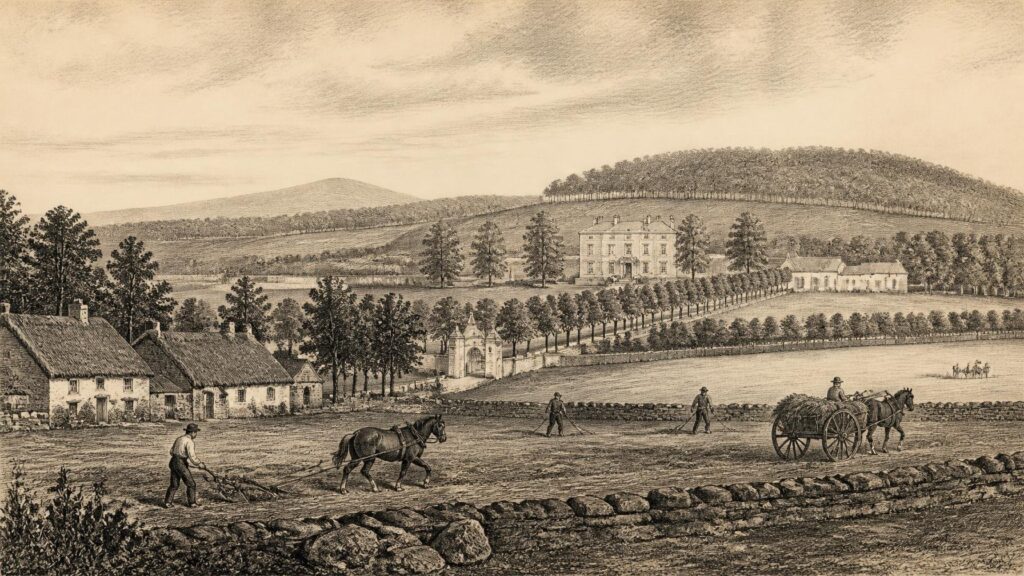
AI generated historical illustration, not a contemporary photograph.
At a Glance
An Irish estate was not simply a house with grounds, nor merely an acreage entered in a deed. It was a working system of property and power: a network of townlands, tenants, rents, roads, farms, woods, labourers, agents, family obligations and political influence. Its history cannot be reduced either to the grandeur of the Big House or to a single story of oppression. Yet the unequal control of land made the estate one of the central institutions through which Irish society was ordered, contested and eventually transformed.
Changing Meaning
The word “estate” has acquired several meanings in Ireland. It may describe a landed proprietor’s entire property, including farms held by tenants and the owner’s own demesne. It may mean the house at the centre of that property, its parkland and service buildings. It may also refer to the legal interest held in land, or, in modern speech, to a housing development. Historical usage requires greater precision. The Irish landed estate was ordinarily an arrangement in which one owner, family, institution or trust controlled land that was occupied and worked by many others under a variety of tenures.
That arrangement varied greatly by place and period. Some estates stretched across several counties; others comprised a modest country house, a demesne and a handful of farms. Some were owned by titled families, others by merchants, professional people, churches, educational institutions, charitable bodies or corporations. A landlord might be resident, visiting seasonally, based in Dublin, or permanently absent in Britain or elsewhere. The practical work could be entrusted to a land agent, a steward, bailiffs and clerks. The term therefore identifies a social and administrative structure as much as a landscape.
It is tempting to treat the estate as an exclusively Protestant or Anglo-Irish phenomenon. The Protestant landed elite held a conspicuous share of political and economic power in the eighteenth and nineteenth centuries, and the association is historically important. But it is incomplete. Estate ownership, intermediate tenures and commercial interests were more varied than the shorthand permits. Equally, tenants were not a single undifferentiated body: large farmers, shopkeepers, graziers, cottiers, labourers and subtenants possessed very different degrees of security and influence. The estate’s importance lay partly in its capacity to bind these unequal positions together.
Seventeenth Origins
The foundations of the later estate system were laid amid conquest, confiscation, plantation and legal change during the seventeenth century. Land had long carried political authority in Ireland, but successive wars and settlements altered who held it and upon what terms. Crown policy transferred extensive lands from older proprietors to new grantees, soldiers, officials, adventurers and settlers. The Ulster Plantation, organised after 1609, divided much of the confiscated land into designated estates, commonly measured in blocks of 1,000, 1,500 or 2,000 acres, and imposed conditions relating to settlement and building.
These transfers should not be imagined as producing a uniform, finished pattern overnight. Older Gaelic and Old English landholding practices did not simply vanish from the lived landscape, and local arrangements could remain complicated. Nevertheless, the accumulation of land in large properties increasingly linked ownership to the authority of the Crown, English legal concepts of title and an expanding market in leases, mortgages and inheritances. The plantation estate was both a territorial project and a defensive one: houses, bawns, tenants, roads and religious institutions could all be expected to support a new political order.
The Restoration and Williamite settlements further altered ownership. By the later seventeenth century, a more recognisably modern estate economy was taking shape in many districts. Landlords sought dependable rental income; tenants sought access to land, security and the means to improve farms. The relationship was never merely personal, despite the later language of paternal obligation. It was governed by contracts, customary expectations, family connections, local bargaining and the unequal ability of proprietor and occupier to bear risk. The estate became a mechanism through which these interests were recorded and enforced.
Legal Foundations
An estate depended on paperwork. Deeds established title and conveyed property; marriage settlements protected family interests; wills divided or preserved inheritances; mortgages raised capital; leases defined occupation; rentals listed those expected to pay; and maps made land legible to owners, agents and prospective purchasers. Such records were not neutral descriptions. They were instruments of management. They classified people and places according to what mattered to the estate: acreage, rent, arrears, boundaries, improvements, timber, buildings and legal obligations.
A lease might state the term, annual rent, acreage and conditions relating to repairs, crops, drainage, building or planting. Terms varied dramatically. Some occupiers held long leases, including leases measured by lives or for ninety-nine years. Others were tenants from year to year, or relied on arrangements that were insecure and sometimes unwritten. The degree of security affected every decision about a holding. A tenant uncertain of renewal had less reason to invest in a house, drains or fences; a landlord concerned with maintaining estate value might demand improvements while retaining the power to alter terms.
Estate maps were particularly consequential. They could preserve field names, the names of occupiers, the layout of farms, roads, watercourses, quarries, woods and the demesne. They can predate the first Ordnance Survey mapping, which began in 1824, and are often among the most detailed surviving visual records of local landscapes. Yet they show the estate’s view of that landscape. A map may record an occupier’s name without revealing a family’s vulnerability, a disputed boundary, a subtenant’s presence or the labour that made the parcel productive.
Layered Tenures
The simple image of landlord and tenant conceals a layered system. A proprietor might lease a large tract to a middleman, who sublet it to smaller tenants, who might themselves let portions to others. This pyramid could spread risk and allow owners to receive rent without daily involvement, but it could also make responsibility obscure. The person collecting money from a cottier was not necessarily the person whose name appeared on the estate’s main rental. By the time rent reached the head landlord, it may have passed through several hands.
Subdivision could help families remain on the land during periods of population growth, but it could also create holdings too small to support a household safely. In some regions, dependence on the potato enabled a dense rural population to survive on very limited plots, while seasonal labour, conacre and informal arrangements helped fill the gap. These strategies were adaptations to poverty and constrained opportunity, not evidence of rural contentment. The estate system was entwined with them because it regulated, directly or indirectly, access to the essential resource: land.
Regional contrasts mattered. Parts of Ulster developed practices and expectations that differed from much of the rest of the island, including the custom later described as Ulster tenant right. Elsewhere, large grazing farms, tillage districts, congested western townlands and estates near expanding towns produced distinct local conditions. There was no single rural Ireland and no single estate experience. Generalisations remain useful only when they leave room for different soils, markets, religions, family structures, inheritance practices and degrees of landlord supervision.
Estate Authority
Land conferred influence beyond the collection of rent. Before democratic reforms broadened the electorate, property qualifications made landholding especially significant in political life. Estate owners and their allies could sit on grand juries, serve as magistrates, participate in poor-law administration and exercise influence in parliamentary elections. The franchise, patronage and open voting gave proprietors opportunities to encourage, pressure or direct tenants. The estate was therefore a political as well as an economic institution.
Its authority was visible in the built environment. The landlord’s house stood within a demesne, often separated from surrounding farms by walls, gates, lodges and designed approaches. Estate villages, schools, churches, mills, gatehouses and workers’ cottages could express improvement, philanthropy, control or all three at once. A planned village might provide better buildings and new employment while also displaying an owner’s authority over the locality. Interpretation must resist the assumption that aesthetic order necessarily meant social benevolence.
The demesne itself was not idle ornament. It might include a home farm, gardens, stables, woods, game coverts, dairies, workshops and accommodation for servants and labourers. It supplied food, leisure and status, and could serve as a demonstration of agricultural experiment. The labour required to sustain it was substantial. Gardeners, carpenters, coachmen, domestic servants, herdsmen, gamekeepers, masons and casual labourers all formed part of the estate world, though they are less visible in surviving family portraits and architectural histories.
Domestic Worlds
The term Big House is useful but potentially misleading. It refers to country houses ranging from relatively modest residences to very large mansions. Their size, architectural ambition and landscaped settings distinguished them from most rural dwellings, but they were not identical in wealth or security. A family could possess an imposing house and still be burdened by debts, settlements and declining income. Conversely, the estate’s centre might be a less spectacular house whose owner managed land effectively and held considerable local influence.
Domestic life in these houses rested on invisible systems of service. Kitchens, laundries, dairies, servants’ halls, nurseries, coach yards and stables formed part of the working household. Women’s labour was essential both inside the house and in estate families more generally, although the formal documentation often favours male owners, agents and tenants. Marriage settlements, dowries, widow’s provisions and inheritance arrangements reveal that estates were family assets, but they also show how property could restrict the choices of those expected to preserve it.
Literary memory has sometimes cast the Big House as a vanished world of elegance and cultivation; nationalist memory has understandably emphasised domination, exclusion and the unequal ownership of land. Both perspectives can draw on real evidence, but neither should displace local investigation. A particular house may have been a centre of employment, sociability and architectural patronage while also presiding over harsh rent collection or evictions. Historical judgement is strongest when it examines conduct, records and circumstances rather than assigning moral meaning from a building’s appearance.
Agents Office
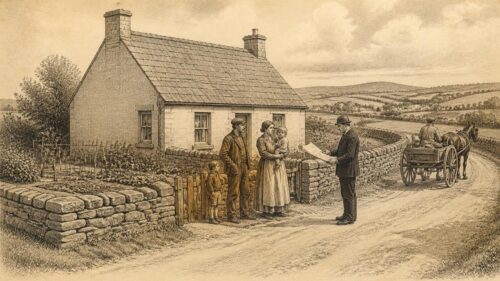
For many tenants, the estate was encountered not through the owner but through the agent’s office. The land agent assessed rents, issued notices, collected arrears, supervised repairs, negotiated leases, reported on crops and recommended action to the proprietor. Agents travelled the estate, consulted maps and rentals, and corresponded with landlords who could be distant geographically and socially. Their reports are indispensable historical evidence because they describe weather, prices, drainage, disease, distress and local disputes. They are also partisan documents, written to advise the owner and justify administrative decisions.
Estate offices generated an extraordinary paper trail: letter books, account books, rent ledgers, labour books, valuation lists, plans, insurance papers and memoranda. A rental can identify occupiers and annual charges; correspondence can disclose conflict behind the entries. Arrears were not merely numbers. They may indicate failed crops, illness, emigration, bereavement, depressed prices or an estate’s determination to enforce its claims. Conversely, a tenant named regularly in a rent roll should not automatically be assumed prosperous; payment records do not reveal every debt, sacrifice or assistance from kin.
Management could include genuine investment. Some proprietors and agents encouraged drainage, reclamation, road building, improved livestock, tree planting and new farm buildings. Such schemes might benefit occupiers, particularly where tenure was secure and costs were shared fairly. But “improvement” was not an innocent word. It often meant making land more profitable, consolidating small holdings, altering customary rights or imposing an external model of efficient agriculture. The people displaced by improvement seldom appear in the celebratory language of estate reports.
Famine Crisis
The Great Famine exposed the terrible fragility of rural life within the estate system. Beginning with potato disease in 1845, the catastrophe brought hunger, disease, mortality and migration on an immense scale. Responsibility cannot be assigned in a single formula. Government policy, the structure of the United Kingdom, market conditions, poverty, dependence on the potato, local resources and individual decisions all mattered. Estates were nevertheless central sites at which relief, rent demands, employment, consolidation and eviction were experienced.
Landlords responded differently. Some financed soup kitchens, employment schemes, emigration assistance or rent reductions; some were themselves deeply indebted and unable or unwilling to sustain relief; some relied on official poor-law mechanisms; others pursued clearance and consolidation. A claim that all landlords behaved alike is unsupported. So is any comforting claim that charitable acts redeemed the system as a whole. The structural imbalance remained: tenants and labourers faced hunger and dispossession with far fewer resources than proprietors, creditors or the state.
The Famine also damaged estates financially. Rents fell or became uncollectable, while poor rates and relief demands increased. Debt, previously concealed by rising rental income or family credit, became acute on many properties. Population decline through death and emigration changed the pattern of occupation. Larger farms could be created from abandoned or consolidated small holdings, and the post-Famine countryside acquired a different social geography. Empty cabins, altered field patterns and the memory of lost households became part of the estate’s long afterlife.
Debt Sales
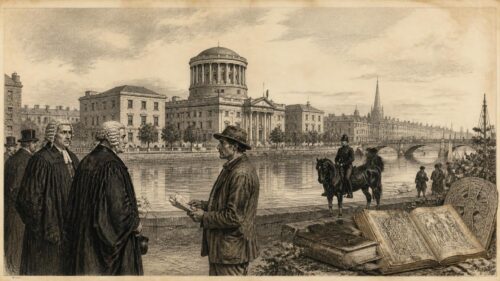
The crisis of indebted ownership led to one of the great reshaping mechanisms of nineteenth-century Ireland: the sale of encumbered estates. An estate could be burdened by mortgages, annuities, family settlements, unpaid interest and accumulated obligations. The Encumbered Estates legislation of the late 1840s and the subsequent Landed Estates Court created procedures through which troubled properties could be sold with a clearer title. For creditors, this offered a means of recovery. For purchasers, it opened an opportunity to acquire land. For tenants, the result could be uncertain and sometimes alarming.
Sales did not automatically destroy an estate. A new owner might retain the existing structure, appoint another agent and continue much as before. But the process could sever longstanding relationships, however unequal, and place tenants before purchasers concerned chiefly with return on investment. Auction advertisements, maps, particulars and court records are valuable sources because they describe acreage, tenants, rents, buildings, mineral possibilities and sporting rights. They must also be read critically. Sales literature was designed to make property attractive, not to provide an unvarnished account of hardship or conflict.
Debt sales complicate the popular image of an unchanging Ascendancy. Landed society was never static. Families rose, married, borrowed, inherited, partitioned property, failed and sold. Mercantile and professional purchasers entered the class of proprietors; long-established names disappeared from districts they had dominated. This mobility did not remove the underlying inequality between owner and tenant, but it reminds us that “the landlord” was a legal and economic position as well as a cultural identity.
Land Agitation
By the later nineteenth century, the land question had become inseparable from constitutional politics, rural organisation and national self-government. Agricultural depression intensified pressure, while tenant activists demanded security of tenure, fair rents and freedom to sell their interest in a holding. The Land League gave these demands national force. Boycotting, rent resistance, public meetings, intimidation and coercion occurred alongside organised political campaigning, legal challenges and parliamentary action. The Land War was not a single uniform campaign, and local histories differ sharply.
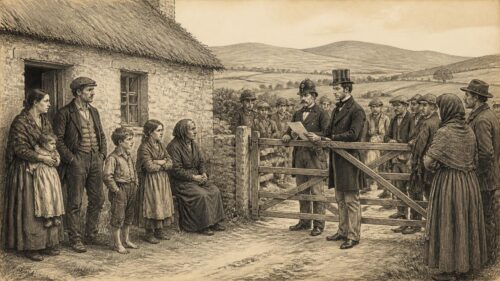
Estate relations became more openly adversarial. Tenants could organise collectively where isolated negotiation had left them weak; landlords and agents could invoke the law, employ emergency assistance or seek police and military protection. Eviction became a potent symbol because it made the unequal power embedded in property visible: a family’s home and livelihood could be removed in the name of rent or contractual right. At the same time, historians must distinguish documented individual cases from later retellings, which may simplify motives or merge separate events.
The rhetoric of the period was powerful precisely because land was more than a commodity. It was livelihood, family continuity, local standing and national belonging. The demand for ownership therefore carried an emotional as well as an economic force. That does not mean every tenant sought the same outcome, or that every proprietor opposed reform. It means that the older estate settlement had lost much of its legitimacy among those who worked the land, while the British state increasingly recognised that legal reform was necessary to contain an enduring political crisis.
Legislative Change
Land legislation gradually altered the balance between landlord and tenant. The Land Law (Ireland) Act 1881 established a new framework associated with fair rent, fixity of tenure and free sale for many tenants, while creating a Land Commission to administer key parts of the system. Its provisions did not abolish landlordism, and their practical reach was subject to qualifications, litigation and later amendments. Still, the Act represented a major intervention in what had previously been represented as a private contractual relationship.
Land purchase became increasingly significant. Earlier measures had enabled limited purchase, but later legislation made transfer from landlord to tenant far more practicable. The 1903 Wyndham Act is often identified as the decisive moment because it provided more attractive financial arrangements and encouraged voluntary sales. Tenants could purchase holdings through state-backed advances, repaid as annuities, while vendors received incentives to sell. The change was gradual rather than instantaneous, and individual estates followed different timetables, but the direction was unmistakable.
These measures altered the meaning of ownership. A farmer who purchased a holding gained a security unavailable under tenancy, though the burden of repayment remained real and the holding might still be too small or poor to guarantee prosperity. Land purchase did not solve every rural problem: migration, labour shortages, congestion, agricultural prices and unequal farm sizes persisted. Yet it dismantled the basic economic relationship on which the classic landlord estate depended. The old order was being converted, parcel by parcel, into a landscape of owner-occupiers.
National Transition
The revolutionary decade and the establishment of the Irish Free State accelerated attention to remaining estates and untenanted land. The Land Act 1923 empowered the Land Commission within a new constitutional setting and addressed purchase, vesting, resale and the acquisition of land. Its structure demonstrates that land reform was not simply a symbolic repudiation of landlordism. It involved valuations, bonds, annuities, title, appeals, rights of way, bogs, sporting rights, fisheries, minerals and the administrative reconstruction of ownership.
The Land Commission became a significant force in reshaping the countryside, particularly through the redistribution of larger holdings and the rearrangement of farms. Its work could answer demands from landless men and congested districts, but it also involved difficult choices about eligibility, viability and location. Not every applicant could receive land; not every subdivision produced an economically secure farm. The Commission’s decisions therefore created new expectations and resentments even as they ended much of the older estate structure.
North of the border, land reform followed a related but distinct path under the institutions of Northern Ireland and earlier United Kingdom legislation. The island’s estate history should not be forced into a single post-1922 narrative. Nevertheless, across Ireland the broad transformation was clear: the age in which a relatively small class of proprietors received rents from a large body of agricultural tenants had been fundamentally weakened. The country house, demesne and surviving estate office remained, but their former economic foundation was often gone.
Material Remains
The estate still survives in the Irish landscape, though rarely as a complete system. Demesne walls, gate lodges, avenues, estate cottages, mills, walled gardens, bridges, planned villages and patterned plantations remain visible. Field boundaries and road alignments may preserve older divisions, while place names recall former houses, families, woods and farms. Some country houses became schools, hospitals, hotels, museums, prisons, religious houses or private residences. Others were demolished, burned, abandoned or left as ruins.
These remains deserve neither automatic reverence nor casual destruction. They are evidence of architecture, design, labour and local memory, but they can also embody exclusion and unequal power. Conservation is most meaningful when it interprets the whole estate landscape rather than isolating the mansion from the people who built, cleaned, repaired, cultivated and inhabited its surrounding world. A gate lodge without its road network, a walled garden without its workers, or a house without its tenant farms tells only a fragment of the story.
The destruction of some houses during the revolutionary period has acquired a powerful place in public memory. Each case requires careful documentation. Causes included political violence, military use, economic decline, changing ownership, fire and deliberate demolition. It is inaccurate to treat every loss as the same event or to claim that all surviving houses represent uninterrupted family continuity. The historical landscape is a palimpsest: what remains, what was removed and what has been repurposed are all part of the evidence.
Archival Evidence
Estate archives make possible a more grounded history. The National Archives of Ireland identifies leases, rentals, lease books, correspondence, agents’ reports and estate maps among the principal surviving record types. These materials can connect a named person to a townland, reconstruct a farm’s tenure or show how a family moved through an estate over generations. The National Library of Ireland, the Public Record Office of Northern Ireland, local libraries, county archives and university collections also hold major deposits. Many collections, however, remain incomplete, dispersed or privately held.
The University of Galway’s Landed Estates project has made an important research guide available for estates and historic houses in Connacht, Munster and part of Ulster between about 1700 and 1914. It brings together information from a wide range of historical sources and demonstrates the value of approaching estates comparatively. It also makes an essential methodological point: a family name, house name or estate name may appear in several forms. Researchers should test spellings, consult maps and townland names, and avoid assuming that a surname alone identifies a single property.
Estate records preserve power unevenly. Owners and agents wrote most of them, so tenant voices may appear only when a rent was unpaid, a lease was negotiated, a dispute arose or an eviction was contemplated. Researchers should therefore read against the grain, comparing estate papers with census returns, parish registers, valuation records, newspapers, poor-law documents, oral history and local archaeology. A silence in the archive is not proof that nothing happened. It may instead reveal whose experiences the record-keeping system considered important.
Memory Folklore
Folklore remains indispensable to estate history, but it must be identified as folklore rather than converted automatically into fact. Stories of hidden tunnels, cruel agents, benevolent ladies, famine walls, secret marriages or dramatic evictions may preserve emotional truths, local values and memories of unequal authority. They can guide research towards a place, family or event. They cannot alone establish dates, numbers, motives or responsibility. A historical article should state clearly when a claim rests on oral tradition and when it is corroborated by contemporary documentation.
The phrase “famine wall” offers a useful example. Some demesne walls were built or extended during the Famine years and may have provided paid labour, but not every high estate wall dates from that crisis or served relief purposes. Similarly, a ruined cottage may be associated locally with eviction, yet its abandonment may have followed migration, consolidation, fire or ordinary decay. The respectful approach is not to dismiss local memory, but to preserve its wording, seek evidence and retain uncertainty where evidence does not decide the question.
Family memory can be equally selective. Descendants of landed families may retain letters, portraits and stories of charitable conduct; descendants of tenants may retain memories of hardship, displacement and resentment. Neither form of memory should be privileged automatically. Their divergence is historically revealing. It shows that the estate was experienced from unequal positions and remembered through different inheritances. The task is not to force a reconciliation where none exists, but to make the differing evidence visible.
Lasting Legacy
The historical Irish estate ended neither on one legislative date nor with the disappearance of every country house. It was dismantled through overlapping processes: debt sales, tenant resistance, judicial intervention, purchase schemes, political change, taxation, economic decline and the redistribution of land. Its legal remains could persist long after its social authority had weakened. Conversely, cultural influence could endure in landscape, architecture, family memory and local assumptions about who belonged where.
Its legacy is especially apparent in the relationship between land and identity. The struggle for ownership shaped modern political language, while the physical estate shaped villages, roads, woods and farms. Country houses may still provoke admiration, discomfort, curiosity or anger because they are not neutral relics. They were headquarters of institutions that generated employment and architectural patronage, but also rent dependency and unequal authority. A mature historical account can hold these realities together without pretending that they cancel each other out.
To study Irish estates is therefore to study Ireland’s changing distribution of power. The surviving house is only the most visible remnant. Beneath it lie maps and rentals, labour and tenancy, debts and improvements, Famine losses, agitation, legislation and memory. The estate’s history is not a decorative appendix to national history; it is one of the ways national history was made in fields, kitchens, offices, courtrooms and townlands across the island.
The article highlights how estate archives both illuminate and obscure rural experience. Maps, rentals and agents’ letters preserve occupiers’ names, rents and holdings, yet often omit subtenants, women, labourers, informal agreements and hardship behind arrears. This creates an interpretative challenge: surviving records were produced to manage property, even when they support local history. Comparing them with oral tradition, archaeology, census material and tenant correspondence may show how far the administrative landscape differed from lived experience. How should researchers balance the rich detail of estate papers against their silences when reconstructing relationships between land, power and memory in Ireland over time?