

Irish Law
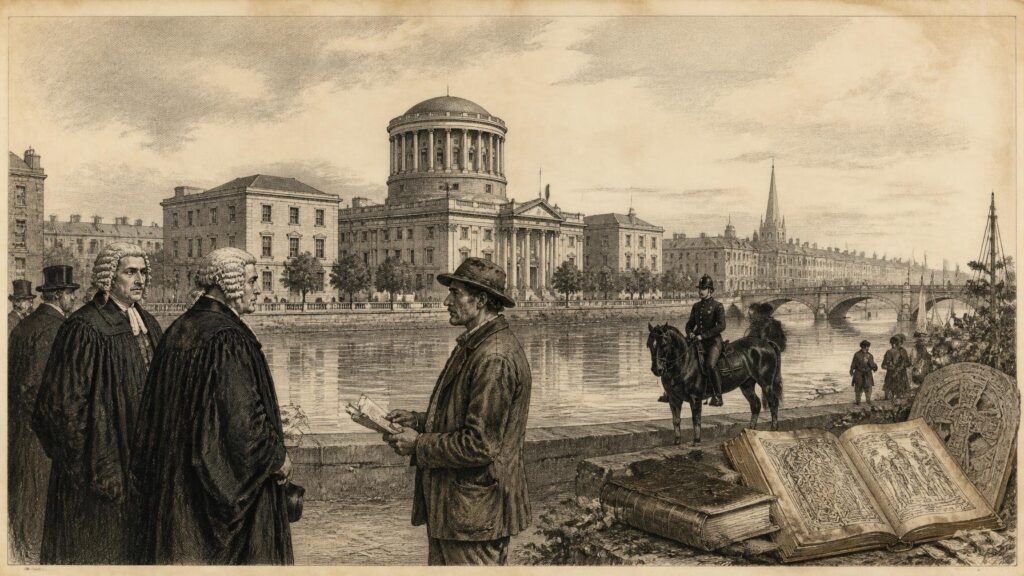
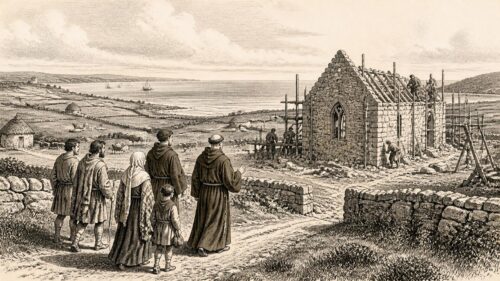
AI generated historical illustration, not a contemporary photograph.
At a Glance
Irish law has never been a single, unbroken inheritance. It has been a succession of legal languages, institutions and claims to authority: early Irish jurists working through kinship and honour; churchmen adapting learned norms; English officials extending royal jurisdiction; landlords, tenants and activists fighting over property; revolutionary courts asserting an alternative sovereignty; and constitutional judges defining the powers and limits of the modern State. Its history is therefore not simply the story of rules. It is a history of who could command obedience, whose injuries counted, what property meant, and how people in Ireland sought justice when formal power seemed remote or hostile.
Legal Beginnings
The oldest substantial body of indigenous Irish legal material is usually called Brehon law. The familiar label is useful, but imperfect. It derives from breitheamh, broadly a judge or legal expert, and can suggest a tidy national code administered by a uniform judicial caste. The surviving evidence does not support that simple picture. What survives is a large and difficult corpus of law tracts, glosses, commentaries, legal vocabulary and later compilations in Irish. The principal texts were first committed to writing in the early medieval period, while most surviving manuscript witnesses are much later. They preserve layers of linguistic and intellectual development rather than a transcript of one original moment.
For that reason, historians must separate three things. First, the texts are evidence of legal thought: they set out classifications, remedies, procedures and ideal arrangements. Secondly, they are evidence of the society imagined by learned writers, especially relationships between ranks, households, clients, churches and kin. Thirdly, they may, in varying degrees, reflect actual practice. The third proposition cannot be assumed merely because a rule is written down. A technical tract might describe an old norm, an aspirational norm, a rule used in some regions, or a point disputed among specialists. Early Irish law is consequently valuable precisely because it is rich, but its richness demands caution.
Its world was not that of the territorial state familiar today. Political power was fragmented among numerous kingdoms and lordships, whose rulers depended upon networks of kin, clientship, tribute and military following. A king was important to legal order, yet was not simply a sovereign legislator issuing commands to an obedient population. Law was embedded in relationships. Status affected entitlement, responsibility, the value placed upon injury and the ability to give binding guarantees. The law’s detailed ranking of persons can look alien to modern readers, but it made social obligations legible within a society where public authority had limited bureaucratic reach.
Much early Irish law concentrated on maintaining order after a breach rather than punishing wrongdoing through imprisonment or an impersonal state penalty. Compensation, suretyship, pledges and distraint were central mechanisms. If a person failed to meet an obligation, property could be seized under prescribed forms; if an injury was done, payment could be owed according to the harm and the status of those involved. This did not mean that violence was irrelevant or that legal order was gentle. It meant that enforcement was commonly conceived through recoverable obligations, collective pressure and reputational consequences. The aim was often settlement and equilibrium, not the later criminal-law ideal of prosecution by the state.
The early material also reveals close attention to ordinary economic life. It discusses cattle, crops, land use, contracts, lending, hospitality, neighbourhood duties and the risks arising from animals. Such provisions have made the texts indispensable to historians of farming and household organisation. Yet this should not encourage picturesque readings in which law becomes a catalogue of quaint customs. Rules about livestock or fences concerned wealth, subsistence and conflict. In a pastoral and agricultural society, an animal damaging crops, a disputed boundary or a failed loan could jeopardise livelihood and honour alike.
There is no secure basis for attaching exact prehistoric dates to an imagined original Irish legal system. Later tradition sometimes projected legal authority into a remote heroic past and associated laws with famous figures. Such stories are historically revealing as expressions of cultural memory, but they are not documentary proof of legislation enacted in that distant era. The evidence begins with texts produced in a Christian, literate Ireland, albeit texts containing material of considerable antiquity. The distinction matters. It preserves the achievement of early Irish jurists without turning their work into folklore presented as fact.
Learned Lawyers
The people called brehons were not judges in the modern sense of salaried public officials appointed by a central state. They were learned legal specialists, often attached to powerful families or lordly households, whose authority rested upon expertise, reputation and patronage. Their work belonged to a broader culture of professional learning in medieval Ireland, alongside poets, genealogists, historians and ecclesiastical scholars. Legal knowledge could be inherited and cultivated within families, but it was also textual, technical and demanding. The dense classifications and compressed style of the tracts required interpretation, and commentary became essential to their use.
That learned character is one reason why the surviving corpus is not a transparent voice of every social group. Much of it was written by and for educated men. It supplies unusually detailed evidence about women’s property, marriage arrangements, fosterage and household rights, but it does not offer a modern doctrine of gender equality. Women could possess property and appear as legal actors in certain contexts; the rules governing unions and separation could provide for divisions of assets; and the texts distinguish different kinds of relationship. At the same time, rank, kinship, economic dependence and male authority were pervasive. To call the system wholly progressive is as misleading as to call women legally invisible.
Marriage is a particularly clear example of why modern labels fail. Early Irish jurists classified unions in ways that do not map easily onto either sacramental marriage or contemporary civil marriage. Their concern with contributions of property, responsibility for children, fault and the division of resources could make separation imaginable in circumstances where later religious and statutory systems were more restrictive. But these arrangements operated inside a hierarchical social order. The rights of a wealthy or well-connected woman cannot simply be generalized to every woman. Legal capacity depended on context, status and resources.
Christianity reshaped legal learning rather than replacing it at once. Ecclesiastical and secular norms interacted over centuries. Clerics participated in scholarship; legal texts used Christian concepts; canon law introduced wider European traditions; and churches possessed land, privileges and their own interests in dispute. The relationship was not a clean contest between pagan native law and imported Christian law. It was an extended process of adaptation in which learned writers reconciled, distinguished and sometimes reworked norms. Irish legal writing is therefore a record of contact with Latin learning as well as an expression of vernacular culture.
The famous image of a brehon sitting beneath a tree and delivering inherited wisdom belongs more to later imagination than to securely documented legal procedure. Outdoor assemblies certainly formed part of medieval political life in many societies, and law could be declared or settled in communal settings. But the romantic scene, endlessly reproduced in popular illustration, flattens a sophisticated manuscript culture into a rustic tableau. The most reliable evidence points instead to professional jurists using memorised learning, texts, glosses and established forms of reasoning in the service of patrons and communities.
The early legal corpus also complicates assumptions about kingship. A ruler was expected to uphold justice, but he too was constrained by status obligations, custom and the need to retain support. Legal thought associated good rule with prosperity, peace and proper judgement. This should not be mistaken for constitutional government in the modern sense. There was no parliament representing a national people and no supreme court enforcing a written constitution. Nevertheless, the insistence that power carried duties gave later generations a vocabulary for judging rulers morally and politically.
Norman Arrival
The Anglo Norman intervention from the late twelfth century did not erase existing law in a single event. It introduced new claims of lordship, new settlers, new ecclesiastical connections and eventually institutions associated with English royal government. But authority spread unevenly. In some places, especially within the lordship centred on Dublin and in regions of dense settlement, common-law courts, sheriffs, boroughs, charters and manorial arrangements gained influence. Elsewhere, Gaelic lordships retained substantial power and indigenous legal learning continued. Medieval Ireland was a zone of legal plurality.
English common law arrived not merely as a body of rules but as an institutional system. Royal writs, itinerant justices, juries, county courts, sheriffs and recorded pleadings created ways of making claims that were different from the relationship-centred structures of early Irish law. The common law also came with a political assertion: justice issued, in principle, from the king. This was a powerful claim even where the Crown’s practical reach was weak. It tied law to conquest, administration and landholding.
Yet the distinction between English law and Irish law was never entirely geographical or ethnic. Lords of different backgrounds made practical accommodations; settlers adopted local habits; Gaelic elites used charters and royal mechanisms when advantageous; church institutions crossed cultural boundaries; and people could seek whichever forum best served a dispute. Medieval legal history is full of such overlap. A binary story in which a complete English system confronted a complete Irish system disguises the compromises and improvisations through which power actually worked.
Land was central to the encounter. English feudal concepts of tenure, inheritance and lordship were applied through grants and settlements, while Gaelic understandings of kin, succession and lordly authority retained force beyond the strongest areas of royal control. The term “gavelkind”, commonly employed by English commentators, was an outsider’s label for practices they considered incompatible with English inheritance. Likewise, “tanistry” was used to describe a mode of succession in which suitability and kin-group claims mattered more than automatic primogeniture. Such terms became politically charged because they allowed colonial writers to define Gaelic custom as disorder requiring correction.
The medieval lordship itself was often unstable. English kings could assert theoretical dominion over Ireland while relying on magnates whose interests were local and whose allegiances were variable. The effective area of direct administration contracted and expanded. In the later Middle Ages, statutes such as those enacted at Kilkenny attempted to police cultural boundaries, restrain intermarriage and curb the adoption of Irish law and language among settlers. Their very existence indicates anxiety about assimilation and the weakness of simple legal separation. Law here served as an instrument for constructing colonial difference.
It would be wrong, however, to portray common law as merely alien coercion and indigenous law as merely communal justice. Both systems were tied to hierarchy. Both could protect property and privilege. Both depended on unequal distributions of power. Their significance lay in their different institutional bases and political implications. Common law connected local disputes to royal authority and documentary procedure. Gaelic law remained more deeply entangled with kinship, lordship and learned professional families. Their coexistence gave litigants opportunities, but it also produced uncertainty and contest.
Tudor Conquest
The Tudor reconquest transformed the legal history of Ireland by making the extension of English law a central object of government. Sixteenth-century rulers and officials increasingly sought not simply nominal lordship but effective jurisdiction, regular administration and a political order bound to the Crown. The policy often described as surrender and regrant required Gaelic and Gaelicised lords to submit titles to the monarch and receive them back under English forms. It was a legal and political strategy: customary authority was to be translated into recognisable tenures, while the Crown gained a framework for allegiance and succession.
English officials frequently represented indigenous legal practices as barbarous, uncertain or contrary to good government. These descriptions were polemical as well as administrative. They justified intervention and cast conquest as reform. In practice, the Crown’s agents faced the difficulty of enforcing a legal system in areas where local lords, kin groups and learned families still commanded loyalty. Courts could be established, sheriffs appointed and statutes proclaimed, but paper institutions did not automatically produce obedience.
The destruction or displacement of Gaelic political structures nevertheless altered the conditions in which indigenous law could survive. The learned hereditary families who maintained legal texts and expertise lost patrons or adapted to radically altered circumstances. In the early seventeenth century, royal judges treated customs such as tanistry and gavelkind as void within the common-law order. Decisions associated with the Case of Tanistry marked more than a technical resolution of inheritance. They announced that the Crown’s courts would decide which customs counted as law and which would be excluded as unreasonable.
This was legal centralisation through adjudication. The English common law had long contained arguments about custom, but in Ireland the question bore the weight of conquest. A custom could not be accepted merely because a community observed it; it had to survive the standards applied by royal judges. Those standards were presented as universal reason, yet they operated within a colonial project that privileged Crown authority, individualised tenure and predictable succession over collective kin claims. The language of legality could thus conceal a redistribution of political power.
Religious change intensified the process. The Reformation in Ireland was uneven and politically fraught, but the Tudor state’s assertion of supremacy affected ecclesiastical property, jurisdiction and allegiance. Dissolution and redistribution of monastic lands transformed ownership. The legal status of the established church became intertwined with government, while Roman Catholics increasingly encountered disabilities that would later harden into a broad penal structure. Law did not simply reflect confessional divisions; it helped make them administratively consequential.
The plantation of Ulster after the Nine Years War provides a sharp example. Land confiscation, surveys, grants and settlement plans translated military victory into legal title. Plantation was never simply a legal event, and law was never enough to secure it; coercion, migration, resistance and economic change all mattered. Yet legal instruments were indispensable. They defined estates, authorised corporate towns, allocated privileges and attempted to reorder a region. The resulting pattern of ownership and identity had consequences far beyond the seventeenth century.
Protestant Ascendancy
The seventeenth century brought war, confiscation and repeated constitutional upheaval. The rebellion of 1641, the wars of the three kingdoms, Cromwellian conquest, Restoration settlement and Williamite victory all had legal consequences, especially for landholding and religion. Acts of settlement and explanation, commissions, forfeitures and grants determined who could hold property and on what terms. To describe these changes as legal is not to sanitise them. Law worked alongside military force and political exclusion, giving durable form to victories won in conflict.
By the eighteenth century, the Irish parliament at Dublin legislated for a kingdom connected to the Crown and, after 1801, absorbed into the United Kingdom. Its authority was limited by the constitutional relationship with Westminster, notably the mechanisms associated with Poynings’ Law and later statutory arrangements. Nevertheless, it was an important lawmaking institution for those admitted to its political world. Its membership and electorate were narrow; its social composition overwhelmingly Protestant and propertied; and its legislation often reinforced confessional hierarchy.
The Penal Laws are remembered as a comprehensive machinery of oppression against Catholics. Their history should be treated with precision. The statutes did impose serious disabilities touching property, education, office-holding, religious practice and political participation, though their provisions changed over time and their enforcement varied considerably by place and period. They were not a single timeless code operating with equal severity in every decade. Nor did later relaxation remove their long-term effects. They entrenched a political order in which legal rights were unequally distributed according to religion.
Property was especially important. Restrictions on inheritance, leasing and acquisition were designed, in part, to fragment Catholic landed power and secure the Protestant interest. Such provisions show how law can shape social structure through apparently technical rules. A rule about succession or a lease was never merely private when it affected which community could maintain estates, educate children or exercise local influence. Penal legislation also encouraged strategic behaviour: conversion, family arrangements, trusts and evasions could become means of negotiating an intrusive legal regime.
At the same time, the eighteenth-century Irish legal world was not static. Lawyers, judges, borough corporations, grand juries and local magistrates operated within a growing culture of statute, precedent and professional practice. The Irish bar acquired prestige, and Dublin’s Four Courts became an enduring symbol of legal authority. The language of rights, liberty and constitutional balance circulated among Protestants who might oppose arbitrary executive power while accepting the exclusion of much of the population. That contradiction is crucial to understanding Irish political history.
Folklore and later political memory sometimes describe the Penal Laws as a uniform prohibition that drove every Catholic practice wholly underground. The reality was more complicated. Catholic worship and education were constrained and vulnerable, yet communities found ways to sustain religious life; enforcement depended upon local conditions and political priorities. Acknowledging complexity does not diminish the injustice. It shows how systems of discrimination operate unevenly, through both formal penalties and the constant knowledge that rights are contingent.
Imperial Courts
The Act of Union came into force on 1 January 1801, abolishing the separate Irish parliament and incorporating Ireland into the United Kingdom’s parliamentary structure. The Union did not abolish Irish courts or instantly standardise every branch of law with England. Ireland retained distinctive institutions, legal professions and administrative arrangements. But legislative sovereignty now lay at Westminster, and the relationship between law, representation and national identity changed fundamentally.
Nineteenth-century Ireland was governed through an elaborate combination of central departments, local officials, magistrates, courts, police and statutory bodies. The common-law courts dealt with civil and criminal matters, while assizes and quarter sessions brought higher and intermediate justice around the country. Petty sessions handled a great volume of minor offences and local disputes. Grand juries, composed largely of property holders, performed important county functions before later local-government reform. The legal landscape was therefore not confined to the great courtrooms of Dublin; it included small courthouses, police stations, landlords’ offices and administrative boards.
The system’s formal ideals included jury trial, judicial procedure and equality before the law, but access was deeply unequal. Litigation required money, literacy, time and knowledge. Juries were selected from restricted social pools. Magistrates were frequently drawn from local elites. Poor people encountered law most often as tenants, labourers, defendants, witnesses or petitioners rather than as equal participants. Irish legal history must therefore examine not only statutes and appellate decisions but also the social conditions under which people could use legal remedies.
Daniel O’Connell’s career demonstrates the political force of legal argument. As a barrister and campaigner, he used courts, public meetings, elections and constitutional language to attack exclusion and advocate Catholic emancipation. Emancipation in 1829 removed major barriers to Catholic parliamentary participation, but it also came with a sharp increase in the property qualification for many electors, reducing the electorate dramatically. Reform could thus enlarge one category of rights while narrowing another. Law was not a straightforward ladder towards inclusion.
The famine years exposed the relationship between legal structures and human catastrophe. The Poor Law created workhouses and administrative unions before the Great Famine, and those institutions became central to relief. Landlord and tenant law, estate administration, eviction, debt and emigration were all implicated in the crisis. No single statute caused the famine, which arose from crop failure and wider economic and political circumstances, but legal choices affected who bore its costs and how relief was organised. The workhouse system’s harshness was institutional as well as ideological.
Criminal law and policing also developed under the Union. The Royal Irish Constabulary became a powerful national force, combining civil policing with a prominent role in political order. This structure helped make the state visible in rural life. Its presence could offer protection or investigation, but it could equally be experienced as surveillance and coercion, particularly in periods of agrarian agitation or nationalist mobilisation. The law’s authority was inseparable from the means used to enforce it.
Land Conflict
Land was the central legal question of nineteenth-century Ireland because land was central to livelihood, power and belonging. Tenants’ claims for security of tenure, fair rent and freedom to sell an interest in their holdings challenged a system in which landlords possessed extensive legal rights. Agrarian custom, local expectation and moral economy frequently collided with formal property law. The conflict was not simply between law and lawlessness: it was often a struggle over what law ought to recognise as a legitimate interest in the soil.
Tenant-right practices varied, notably in Ulster, and could acquire considerable local force without being identical to statutory entitlement. Farmers and labourers relied on collective pressure, associations, boycotts and at times violence to resist evictions or rent demands. Landlords resorted to courts, agents, police and contractual rights. The language on each side could invoke legality. To a landlord, enforcement of rent or recovery of possession could be lawful protection of property. To a tenant, a legal regime indifferent to improvements and livelihood could appear fundamentally unjust.
The Land War from 1879 placed these tensions at the centre of British and Irish politics. The Land League used organisation, publicity and resistance to push for change. Coercion legislation attempted to curb agitation, while a succession of land acts altered rent review, tenure and eventually ownership. The result was not an immediate revolution, but a profound restructuring of rural property. Over time, many tenants became owners through state-supported purchase schemes. That change transformed social relations and weakened the old landlord class.
Law was both arena and weapon in this struggle. Land courts and commissions assessed rents and administered statutory schemes. Their work turned political claims into legal categories, evidential disputes and official valuations. This could be slow and frustrating, but it also made reform durable. A campaign that began in mass mobilisation became embedded in titles, payments, tribunals and administrative records. The long afterlife of those arrangements can still be seen in patterns of ownership and rural memory.
There is a temptation to make the land question a morality play in which every landlord was an oppressor and every tenant a victim of identical circumstances. Documentary evidence shows a more varied world: different estates, local economies, religious communities, family strategies and degrees of hardship. But variation should not obscure structural inequality. The law initially placed substantial power in the hands of owners, and the political pressure for reform arose because vast numbers of occupiers regarded that settlement as insecure and unfair.
The legal history of land also illuminates a broader point. Rights are not static possessions. They are created through institutions that recognise, define and enforce claims. A tenant’s improvement might be physically obvious yet legally precarious; an owner’s paper title might be formally secure yet politically contested. The nineteenth century altered the balance by changing the legal vocabulary through which land could be held. It thereby helped prepare the ground for the political transformations of the twentieth century.
Revolutionary Justice
The revolutionary period after 1916 produced one of the most striking experiments in Irish legal history: the Dáil courts. From 1919, the republican movement attempted to establish courts that would rival or replace the institutions of British administration. Their purpose was practical as well as symbolic. A proclaimed republic required a means of settling disputes, enforcing decisions and demonstrating that its authority reached into daily life. Parish, district, circuit and supreme courts were envisaged within this alternative system.
The Dáil courts did not operate uniformly throughout Ireland. Their reach depended upon local republican organisation, the willingness of litigants and the capacity to resist suppression. In some places they dealt with civil claims and local disputes with notable success; elsewhere their operation was fragile or interrupted. Their existence shows that legal legitimacy can be contested from below. People brought cases not only because they accepted a political programme, but because they needed debts recovered, conflicts mediated and social peace maintained.
These courts also complicate any assumption that revolution is inherently hostile to legal order. Republican leaders needed procedure, records, officials and forms of appeal. They faced questions familiar to any justice system: jurisdiction, enforcement, fairness, professional competence and the relationship between law and executive necessity. The courts could express a democratic claim to sovereignty, but they were also subject to pressures of war, local power and political loyalty.
The Anglo-Irish Treaty and the establishment of the Irish Free State made their position untenable. The new administration faced two overlapping legal orders: the inherited courts created under British legislation and the republican courts established during the struggle. The latter were wound down in 1922. Later judicial decisions treated their judgments as lacking continuing legal force, an outcome that disappointed some litigants and participants. The episode nevertheless left a durable historical lesson: legality is not merely whatever the victorious state later validates. At the time, competing systems can command genuine social adherence.
The destruction of the Four Courts in June 1922 during the opening phase of the Civil War gave this transition a dramatic physical form. The complex was both a functioning centre of justice and a repository of historical records. Its destruction damaged the Public Record Office of Ireland and caused an immense archival loss. For legal historians, the event is doubly significant. It symbolises the struggle over state authority and it limits what can now be known about earlier courts, estates, administration and individuals.
The Free State therefore had to build authority amid institutional ruin. It needed courts that would command confidence while avoiding an impression of mere continuity with the old regime. The Courts of Justice Act 1924 created a new judicial structure, including a District Court, Circuit Court, High Court and Supreme Court. Although the new state inherited much law and many professional practices, it recast the legal system under an independent constitutional order. Continuity and rupture existed together.
Partitioned Jurisdictions
Partition created two legal and constitutional trajectories on the island. The Government of Ireland Act 1920 had proposed separate parliaments for Southern Ireland and Northern Ireland, together with a Council of Ireland. Southern Ireland’s institutions did not become the operative basis of government envisaged by the Act, as the revolutionary settlement led instead to the Irish Free State. Northern Ireland, however, acquired its own parliament and government, with powers over transferred domestic matters while Westminster retained ultimate authority and control over reserved fields.
This division was not simply a boundary on a map. It established distinct legislatures, courts, policing arrangements and political majorities. In Northern Ireland, the Parliament at Stormont possessed substantial authority over internal affairs from 1921 until its suspension in 1972. Formal safeguards against religious discrimination existed in the founding legislation, but the history of the state demonstrated the limits of legal language when institutions, electoral arrangements, housing policy and policing were widely perceived by the nationalist minority as unequal.
Civil-rights mobilisation in the late 1960s brought questions of law, equality and policing into sharp focus. Demands concerning housing allocation, local government franchise, electoral boundaries and police accountability were demands that public power be exercised on equal terms. The subsequent conflict, emergency measures and direct rule exposed the difficulty of maintaining ordinary legal standards amid political violence. Internment, special courts, security legislation and policing became subjects of sustained controversy. Any history of law in Northern Ireland must acknowledge both the duty to protect life and the dangers posed when exceptional powers become normalised.
In the State, the legal order evolved under the constitutions of 1922 and 1937. Northern Ireland remained within the United Kingdom and developed through legislation at Westminster, periods of direct rule, and later devolved institutions. The island’s legal history after partition must therefore resist two errors: treating either jurisdiction as the sole inheritor of Ireland’s legal past, or treating them as unrelated. They share deep institutional roots, overlapping professional traditions, common historical problems and a geography in which family, commerce, crime and political memory cross the border.
The 1998 Belfast Agreement, endorsed in referendums north and south, altered the constitutional context. It placed consent at the heart of any change in Northern Ireland’s status, created new institutions and strengthened the language of rights, equality and parity of esteem. In the Republic, constitutional amendments removed the previous territorial claim expressed in Articles 2 and 3 and replaced it with provisions framed around the entitlement of people born on the island and the principle of unity by consent. Law here did not end political disagreement, but it created structures for managing it without returning to armed conflict.
Partition also ensured that legal terminology requires care. “Irish law” can mean the law of the Republic of Ireland, the historic law of the whole island, or the legal traditions experienced in both jurisdictions. In historical writing, the meaning should be made clear rather than assumed. The broader subject is not diminished by that distinction; it is made more truthful.
Constitutional Order
The Constitution of Ireland, enacted by the people on 1 July 1937 and in operation from 29 December 1937, is the fundamental legal text of the State. It established the framework of institutions, declared Ireland a sovereign, independent and democratic state, distributed authority among legislature, executive and courts, and set out rights and directive principles. It did not create law from nothing. Article 50 continued pre-existing laws so far as they were not inconsistent with the Constitution, preserving a vast inherited body of statute and common law while subjecting it to a new constitutional standard.
That continuity is one of the defining features of modern Irish legal history. Independence did not mean that centuries of prior legal materials vanished. Old statutes, doctrines of contract, property rules, criminal procedures and court practices remained relevant unless changed by the Oireachtas or invalidated by constitutional principle. Ireland thus emerged as an independent common-law jurisdiction, not as a legal blank slate. Its judges and lawyers worked within inherited methods of precedent and interpretation even as they developed a distinct constitutional jurisprudence.
The constitutional role of courts became increasingly important in the later twentieth century. Judicial review allowed legislation and executive action to be tested against constitutional provisions. The language of personal rights, family, property, religion, education and equality supplied grounds for litigation that could shape public policy. This was not simply judicial activism or judicial restraint; both labels can obscure the actual work of interpreting a text written in a particular historical setting and amended by popular vote.
Constitutional rights were never absolute. Courts have had to balance individual liberty against public order, property against social regulation, family autonomy against child protection, and religious freedom against other legal commitments. Their decisions can become politically controversial because they translate general guarantees into outcomes affecting schools, prisons, hospitals, policing and private life. That controversy is not necessarily evidence of failure. It reflects the Constitution’s position at the centre of disputes about the proper reach of the State.
The Oireachtas remains the principal lawmaking body, but constitutional amendment belongs to the people through referendum. This gives Irish constitutional change a notably public character. Major questions have repeatedly been presented to voters, including matters involving European integration, marriage, reproductive rights, divorce and citizenship. Referendums do not eliminate disagreement; they shift it into a distinct democratic and legal process. Their results then require interpretation, legislation and administration.
The judiciary itself has changed. The modern courts include the District Court, Circuit Court, High Court, Court of Appeal and Supreme Court, alongside specialised jurisdictions and statutory tribunals. The establishment of the Court of Appeal in 2014 responded to pressure on the Supreme Court and allowed the latter to focus more closely on questions of general public importance and constitutional significance. Such institutional reform illustrates that legal history continues in administrative design as well as celebrated cases.
Rights Expansion
The later twentieth and early twenty-first centuries saw major changes in Irish law concerning private life, family, equality and bodily autonomy. These changes did not arise from law alone. They were shaped by social movements, changing religious practice, European institutions, public campaigning, litigation, political parties and individual experiences. But law was the medium through which many of those transformations became binding.
Divorce offers a clear example. The 1937 Constitution contained a prohibition on the dissolution of marriage. A referendum in 1986 rejected a proposal to remove it. A second referendum, held in 1995, narrowly approved constitutional change, and the Family Law (Divorce) Act 1996 provided a statutory framework. The sequence matters because it shows that constitutional law can both preserve a social settlement and provide the formal route for revising it. The change was neither instant nor inevitable; it followed decades of debate and a closely divided electorate.
Decriminalisation of consensual same-sex intimacy, legal recognition for same-sex couples and the approval of marriage equality in 2015 similarly demonstrate the interaction of courts, legislature and referendum. The marriage referendum was especially significant because voters approved a constitutional amendment extending marriage without distinction as to sex. It became a potent symbol of a more inclusive conception of citizenship, while also reminding observers that rights can depend on painstaking legal drafting and popular mobilisation.
Reproductive law followed another difficult path. The Eighth Amendment, approved in 1983, constitutionalised protection for the unborn in terms that generated extensive litigation and political conflict. In 2018, voters approved its repeal, after which legislation provided for regulation of termination of pregnancy. Here again, the history cannot be reduced to a simple contest between courts and parliament. It involved referendums, medical realities, personal testimony, international legal pressure and changing public opinion. Law recorded social change, but also structured the terms on which change could occur.
Equality law has also been shaped by membership of the European Union and participation in the European Convention on Human Rights system. European norms have affected employment, discrimination, data protection, environmental governance and many other fields. This does not mean that domestic law has disappeared beneath external authority. Rather, the Irish legal order has become layered: constitutional provisions, Oireachtas legislation, common-law doctrine, European Union law and international commitments may all bear upon a dispute.
Modern rights discourse can tempt readers to judge earlier law only by present standards. Moral judgement has its place, particularly where discrimination and violence are concerned, but historical understanding requires attention to context and institutional limits. The important question is not whether earlier generations used today’s vocabulary. It is how people argued for justice with the legal resources available to them, and how those resources were expanded, resisted or denied.
Living Inheritance
The history of Irish law should leave little room for myths of purity. There was no uninterrupted native legal order untouched by outside influence, and no simple moment when foreign law wholly replaced indigenous practice. Ireland’s legal traditions were formed through encounter: vernacular learning and canon law, Gaelic lordship and English common law, colonial statute and local custom, revolutionary legitimacy and institutional continuity, national constitutions and European obligations.
That complexity is not an obstacle to historical understanding. It is the subject itself. The early Irish tracts show a learned legal culture of extraordinary interest, but they do not supply ready-made answers to modern constitutional questions. Common law brought procedural forms and institutional connections that remain important, but its expansion in Ireland was inseparable from conquest and unequal power. The independent State created new constitutional authority, yet retained much inherited law. Northern Ireland’s legal institutions developed in a different constitutional setting while remaining linked to the wider history of the island.
Law also survives in material places. The Four Courts evokes the authority of the judiciary and the losses of 1922. County courthouses recall petty sessions, assizes, local government and political conflict. Estate records, manuscript law books, parliamentary journals, court reports and statutes preserve fragments of disputes that mattered intensely to those involved. Archives are therefore not merely repositories for specialists. They are where legal history becomes recoverable after the noise of political slogan and inherited legend.
The most responsible use of this inheritance is neither antiquarian worship nor cynical dismissal. Early Irish law deserves study as a complex intellectual tradition, not as evidence that medieval Ireland possessed a modern egalitarian republic. The common-law inheritance deserves scrutiny, not denial, for it shaped the legal techniques through which both domination and reform were pursued. Constitutional law deserves attention as a living system, not a sacred text beyond criticism.
Across the centuries, people in Ireland have turned to law for protection, property, status, redress, recognition and power. They have also resisted it when it seemed to defend privilege or deny justice. That double history explains why legal institutions carry such symbolic weight. They are never only courts, statutes or professional rules. They are places where the authority of the state meets the experience of the individual, and where a society repeatedly decides, imperfectly, what it owes to its members.
The article’s treatment of legal plurality is especially striking: early Irish juristic traditions, common-law institutions and ecclesiastical norms did not simply replace one another, but overlapped as communities sought remedies and rulers asserted control. This complicates national narratives that portray either Brehon law or English law as wholly coherent, uncontested systems. It also suggests that legal change depended as much on access to forums, patronage and landholding as on formal rules. How might comparing the choices available to litigants in medieval Ireland with those during Tudor centralisation deepen our understanding of how ordinary people navigated competing authorities locally in practice?