

Domestic Waters
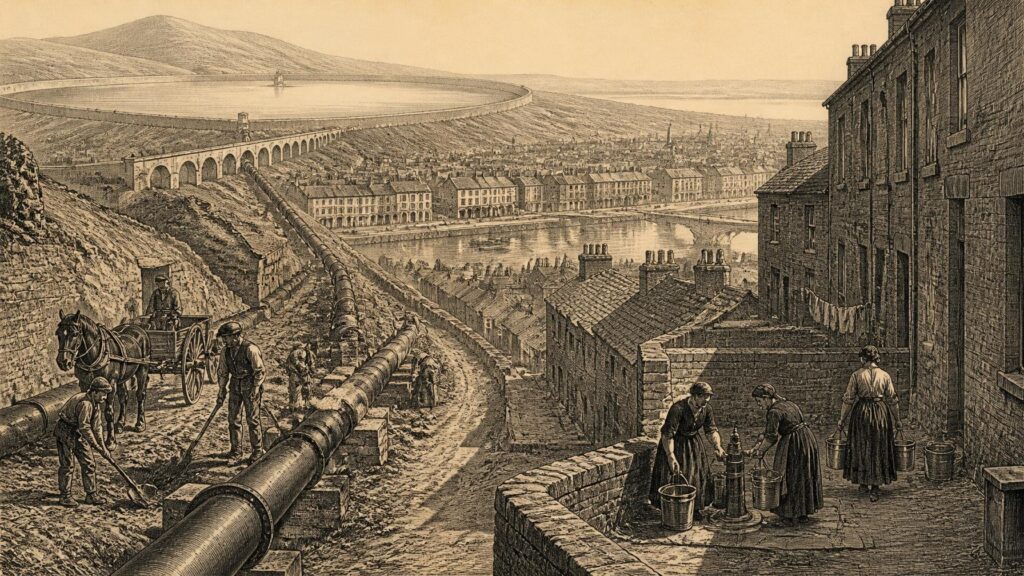
AI generated historical illustration, not a contemporary photograph.
At a Glance
Housing infrastructure and water capacity have been inseparable questions in Irish history: a house could not properly become a home merely through walls and a roof, but required dependable water, drainage, sanitation and the public institutions capable of providing and maintaining them. In Ireland, the uneven arrival of those services exposes a longer history of social difference between city and countryside, owner and tenant, established districts and expanding suburbs. It also demonstrates that “capacity” has never meant only the volume held in a reservoir. It has meant the capacity of households to obtain water without exhausting labour, of pipes and sewers to serve growing populations, of local authorities to finance works, and of the State to recognise sanitation as a condition of decent habitation.
Historical Scope
The modern language of housing infrastructure can sound recent, associated with planning permissions, treatment plants and development targets. Its underlying concerns, however, are historical. In nineteenth-century Ireland, rapid urban growth, poverty, migration and speculative building placed extraordinary pressure upon water sources, drainage arrangements and existing housing. The result was not one single Irish experience. Dublin’s large tenement population made the capital an especially stark example, but provincial towns, labourers’ cottages, rural farms and dispersed settlements each encountered the problem differently.
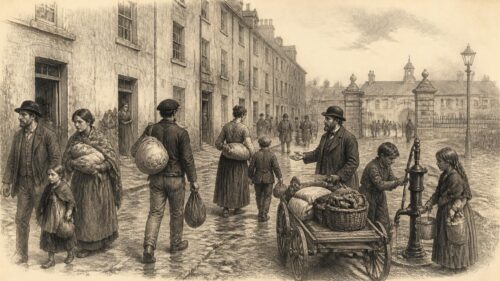
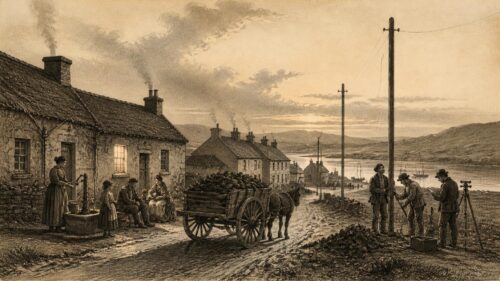
Water was a domestic necessity before it was a planning category. It was needed for drinking, cooking, washing, laundry, cleaning, animals, small trades and the use of sanitary conveniences. Where a household possessed an internal tap, sink, drain and water closet, those facilities changed daily routines as much as they changed public health. Where it did not, work multiplied. Water might have to be drawn from a yard tap, pump, well, stream or communal source, carried across a street or up several flights of stairs, heated at a fire, and used sparingly because every bucket had a cost in time and physical effort.
Housing therefore cannot be separated from the networks beyond a dwelling’s walls. A newly built estate required a source, mains, storage, pressure and drainage before it could function satisfactorily. An old house divided into tenements could be described as supplied with water while leaving several families dependent upon one tap. A rural cottage could be structurally sound while remaining beyond a public main and dependent on a well or rainwater. The distinction matters because documentary descriptions of “water supply” may record an engineering connection without revealing the unequal terms on which people used it.
The evidence is strongest for the nineteenth and twentieth centuries, when municipal records, legislation, official inquiries, census material, engineering schemes and social investigations become plentiful. These sources allow the historian to trace changing standards and policies. They do not justify a simple tale of inevitable progress. New pipes, reservoirs and housing schemes undoubtedly transformed many lives, but their benefits arrived unevenly, and failures of maintenance, affordability, water quality, drainage and administration remained recurring themes.
Urban Thirst
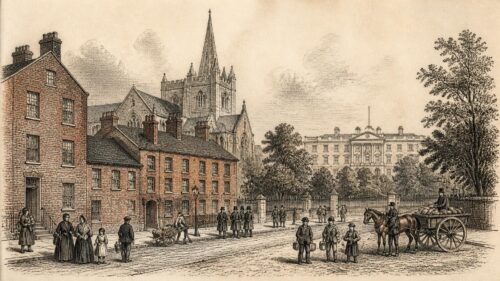
Dublin provides the clearest case of a city in which water capacity became bound up with growth and housing. The capital had older water arrangements long before the Victorian age, and the records preserved by Dublin City Archives include the Pipe Water Committee from 1737 to 1834. Such continuity should not be mistaken for adequacy. A system suited to an earlier town could be strained by a larger industrial and commercial city whose population depended on densely occupied houses, yards and courts.
By the middle decades of the nineteenth century, civic improvement legislation gave Irish town commissioners powers that connected streets, sanitation and waterworks. The Towns Improvement (Ireland) Act 1854 is revealing not just for its powers but for what it considered necessary to regulate: damage to waterworks, waste of supplied water, pollution of reservoirs and streams, and discharges from sinks, sewers and industrial activity. Water provision was already understood as a collective system vulnerable to private neglect, commercial contamination and poor drainage. The law’s concern with fouling also reminds us that supply and sanitation were two sides of the same question.
For Dublin, the Vartry scheme became the most consequential nineteenth-century answer to expanding demand. Developed by Dublin Corporation in the 1860s, it gathered water in County Wicklow and conveyed it towards the city through reservoirs, tunnel works and trunk mains. Its later custodians describe it as an ambitious engineering undertaking, much of it completed with picks, shovels, horses and carts. The physical scale matters. The scheme did not simply add another local source; it linked a rural catchment to a city through a deliberately planned system of storage and transmission.
Its historical importance lies in the fact that it enlarged the possibilities of urban domestic life while also exposing the need for constant renewal. Vartry supplied generations, and components of the original system continued to contribute to the Greater Dublin Area long after their construction. Yet its endurance was not proof that nineteenth-century infrastructure could be left untouched. A hand-cut tunnel and open reservoirs that served a previous age could become risks under later expectations of reliability, treatment and protected storage. Capacity is consequently a moving historical standard. A system may be impressive in its own time and still become inadequate, fragile or unsafe as population, technology and regulation change.
The scheme also cautions against treating an engineering achievement as a social solution in itself. Water arriving in Dublin did not automatically ensure equitable access within every dwelling. Distribution depended on the mains in a district, the condition and layout of a property, the decisions of owners and the vigilance of sanitary authorities. A city could possess a major reservoir scheme while thousands of inhabitants still experienced water through shared taps, outdoor closets and difficult carrying work.
Tenement Burdens
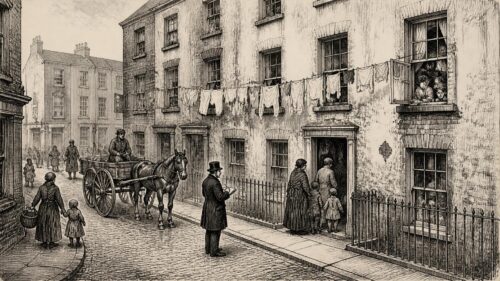
Dublin’s tenement housing made that contradiction painfully visible. Large Georgian and other substantial houses, once designed for single households of means, were repeatedly subdivided into small rented rooms. The material form of the building was thus altered without a matching transformation in water and sanitary provision. Families occupied rooms while stairways, yards, taps and closets became common spaces whose use had to be negotiated among strangers and neighbours.
Contemporary investigators and later historians consistently emphasise overcrowding, structural decay and deficient sanitation. The Royal Commission on Dublin sewerage and drainage, as summarised in Charles Eason’s 1899 paper to the Statistical and Social Inquiry Society of Ireland, had examined 9,760 houses let in tenements in 1879. It judged 2,300 of them, occupied by roughly 30,000 people, unfit for habitation. Its proposed remedies included closing ruinous premises, supervising others, improving sanitary accommodation and enforcing public-health provisions against overcrowding. That evidence does not mean every tenement was identical. It does establish that poor housing was recognised in official and professional discussion as an infrastructure and health question, not merely a matter of private misfortune.
The available figures should be handled carefully. They quantify houses and persons at particular moments, but do not tell the whole story of domestic practice, age, gender or disability. A single shared tap had unequal consequences for a physically strong adult, an older resident, a person caring for infants, or someone living on an upper floor. Women’s domestic labour was especially shaped by water access, because laundry, cooking, bathing children and cleaning depended upon it. The historical record is often administrative rather than personal, yet the routine effort behind a phrase such as “shared water supply” should not be minimised.
The Housing Inquiry associated with the Church Street collapses of September 1913 brought the condition of Dublin’s poorer housing into acute public view. Two tenement buildings collapsed, killing seven people and injuring many more. The official inquiry that followed assembled photographs, evidence, statistics and recommendations. Dublin City Council’s account of the surviving photographs records that 87,305 people lived in inner-city tenements and that the great majority occupied one room. In many tenements, courts and yards, families commonly shared a single water tap and water closet.
That description is powerful precisely because it connects crowded rooms to shared facilities outside them. The failure was not only that too many people occupied too little space. It was that water and sanitation were supplied at an intensity wholly out of proportion to household need. Queues, cleaning, night-time access, the carrying of water, the maintenance of drains and the disposal of waste all became collective burdens. In such settings, a nominal supply could coexist with practical scarcity.
Public discussion sometimes cast tenement dwellers as careless or irresponsible users of domestic facilities. Such judgements must be treated as part of the period’s moral language rather than accepted uncritically. Overcrowded buildings and inadequate facilities created conditions in which cleanliness and privacy were difficult to sustain. It is more historically defensible to say that residents operated within severe constraints imposed by property division, low incomes, poor management and insufficient civic enforcement. The sources document squalor; they do not license the historian to attribute it to inherent habits of the poor.
Civic Remedies
Legislation gradually made the relationship between housing and sanitary services more explicit. The Housing of the Working Classes Act 1890 applied to Ireland and gave local authorities powers connected with improvement schemes, clearance, streets, paving and sewers. Its provisions allowed authorities to lay out and complete streets and required appropriate sanitary arrangements in housing provided through schemes. It also addressed the potential supply of water and gas to lodging houses. These clauses show that late Victorian reformers did not conceive of working-class housing as isolated buildings; they understood it as part of a serviced urban environment.
Legislation alone did not determine outcomes. Its effect depended on rates, borrowing, land acquisition, political will, administrative capacity and local conflict. Municipal intervention could require the demolition of dangerous property, but clearance also raised the difficult question of where displaced residents would live. Rehousing was costly and slow. It could improve conditions for some households while leaving others in precarious accommodation, especially if replacement dwellings were too few or rents beyond their reach.
Dublin Corporation did undertake housing work before independence, though the scale fell far short of the city’s needs. Cormac Ó Gráda’s study of infant and child mortality notes municipal rehousing in the Liberties from the 1880s and further provision before the First World War. It also stresses the persistence of one-room tenement accommodation. The historical lesson is not that civic action was absent, nor that it was sufficient. It was partial action within a much larger inherited housing crisis.
Infrastructure was frequently less visible than new buildings, but it was integral to their success. A street required paving and drainage; a dwelling required a safe supply and a means of waste removal; an estate required a continuing authority able to repair mains and sewers. The cost of this hidden work could influence the location and pace of building. In this sense, water capacity constrained housing capacity long before modern planning terminology made that link familiar.
The Housing (Miscellaneous Provisions) Act 1931 offers an unusually direct definition of the problem. It included within “sanitary defects” inadequate air space, ventilation, darkness, dampness, absence of adequate and readily accessible water supply or sanitary accommodation, and deficient paving or drainage. The phrase “readily accessible” is important. It recognised that a theoretical water source was not necessarily a practical domestic service. Distance, access and convenience formed part of adequacy.
This was a significant development in the language of public responsibility. It did not guarantee that every family immediately gained a bathroom or internal plumbing. Rather, it supplied a legal and administrative vocabulary through which bad housing could be identified as defective. Such wording moved the debate beyond charity and moral exhortation. It located water, sanitation, drainage and light among the material standards by which a house could be judged.
Rural Divide
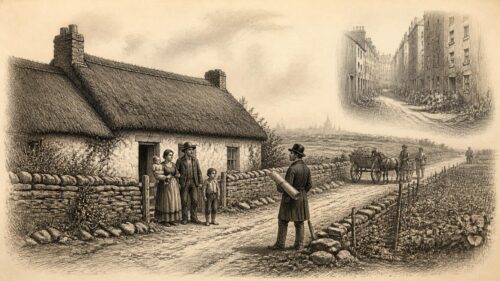
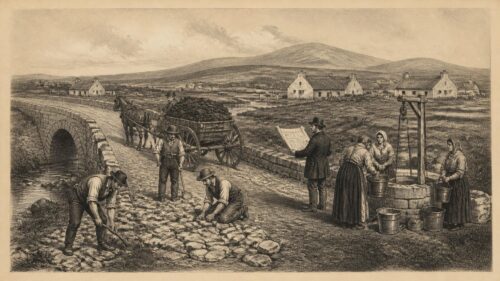
The urban story must not overshadow the countryside. Ireland’s dispersed settlement pattern made universal piped supply harder and more expensive to deliver. A rural household might rely on a well, pump, spring, stream, rainwater collection or a small private arrangement. These sources were embedded in local landscapes and domestic routines. They could be valued for familiarity and independence, yet they also made quality, quantity and reliability contingent upon weather, geology, upkeep and proximity.
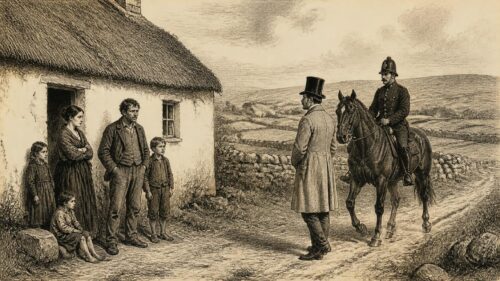
The contrast between town and country should not be simplified into urban modernity against rural backwardness. Urban tenement residents could have a piped municipal source but face severe overcrowding and shared facilities. Rural households could have more space but no internal water supply or public drainage. In either setting, the crucial historical questions are who controlled the source, how far water travelled, whether it was protected, and whether a household could use it privately and safely.
Evidence collected about domestic life around 1904 captures this unevenness. Dublin City Libraries’ historical material observes that many urban homes had running water and at least an outside toilet, while in much of rural Ireland water still had to be fetched from a pump or well and plumbing was rudimentary. The observation should not be treated as a full national survey, but it succinctly reflects an important disparity in the domestic infrastructure of the period.
Rural housing policy had its own history. Labourers’ cottages and county council schemes were shaped by late nineteenth- and early twentieth-century land and housing legislation. Scholars of Irish social housing have argued that rural provision became entwined with land reform and agrarian politics, producing a distinctive bias towards rural schemes. These cottages mattered not only because they offered new accommodation but because their location, plot size, water arrangements and drainage determined how far “improvement” reached into everyday life.
Older cottages were not uniform. Some had access to a nearby source or eventually to mains; others depended on wells and outdoor conveniences for decades. It would be misleading to assume that every newly built rural cottage possessed the full range of internal services expected in a later home. The history of housing standards is a history of changing expectations. What counted as an acceptable new house in one decade could appear clearly deficient in another.
Post-independence policy acknowledged that housing and private water supply had to be considered together. Oireachtas evidence from the early 1950s records grants for installing private water supply and sewerage facilities in dwellings located where public piped water or sewerage was unavailable. The discussions are especially revealing because they distinguished between a main existing somewhere in a district and a supply being reasonably accessible to a particular house. That gap between map and doorstep remains a useful historical measure of service inequality.
State Building
The Irish State inherited both a housing shortage and an uneven distribution of sanitary infrastructure. During the twentieth century, local authorities became central providers of social housing. Research from University College Dublin indicates that social housing accounted for a large share of national output in the 1930s, 1940s and 1950s, while local authorities built extensively in both urban and rural areas. This was a major transformation in the relationship between public power and domestic space.
New council housing could provide features unavailable in overcrowded older property: separate rooms, sculleries, yards, sinks, water closets, drains and eventually bathrooms or more comprehensive internal plumbing. Such provision should be understood as a material change in dignity and health, not merely as an increase in housing numbers. A household moving from one tenement room with a shared tap to a self-contained dwelling experienced a different relation to washing, food preparation, privacy, child care and illness.
Yet the picture was never uniform. State resources were limited; wartime conditions disrupted construction; local authority capacity varied; and rural connection to networks remained difficult. A large building programme could reduce overcrowding while not eliminating the older stock that required repair, regulation or replacement. Nor did a new dwelling automatically solve wider supply constraints. A scheme dependent on limited mains, weak pressure or inadequate sewerage could still leave residents with poor service.
The Housing (New Houses) Regulations 1950 show how standards were becoming more explicit. They required a house, where sufficient water supply and drainage were available, to have a sink and water closet; where sewers and mains were not available, other approved sanitary accommodation was required. The conditional wording is historically important. It reveals the persistence of an unequal infrastructure landscape. Regulations could demand a standard, but they also had to accommodate places not yet reached by public networks.
The Local Government (Sanitary Services) Act 1948 had already strengthened the power of sanitary authorities to require a building lacking a satisfactory domestic supply to connect to a public supply or an existing pipe connected to one. This represented an effort to turn public water networks into actual household service. Still, a statutory power did not magically finance every connection, alter every old dwelling or produce a nearby main in scattered districts. The legislation demonstrates aspiration and authority; implementation must be assessed locally and cautiously.
By the later twentieth century, the ordinary Irish expectation of a decent house increasingly included continuous water, drainage, hot water facilities and indoor sanitation. Building and rented-house regulations would state such expectations with greater precision. The change was cultural as well as technical. What earlier generations might have regarded as a desirable improvement came to be recognised as a basic standard.
Community Supply
One of the most distinctive Irish responses to uneven rural provision was the group water scheme. These community-run or community-organised arrangements emerged because public networks did not reach every dispersed settlement quickly or economically. Rather than waiting passively for a comprehensive state system, communities organised sources, distribution and local governance. The history is significant because it complicates any assumption that infrastructure must be either wholly private or wholly municipal.
Environmental Protection Agency research traces the development of the group water scheme sector and identifies the importance of community knowledge, voluntary effort and local adaptation. Its historical account notes that urban areas received piped water earlier, whereas many rural areas did not obtain it until the middle or later decades of the twentieth century. In numerous areas, group schemes rather than the public network provided the route to piped water.
The movement should not be romanticised. Community provision could bring impressive solidarity and practical ingenuity, but it also imposed responsibility. Members had to organise finance, governance, maintenance and, later, compliance with increasingly demanding quality standards. The source itself might be vulnerable to agricultural runoff, septic systems, drought or changing land use. A group scheme could reduce one form of exclusion while creating a continuing obligation to manage a technically complex service.
Its importance for housing history is direct. Piped water could make new rural construction more viable, allow older dwellings to install sinks, bathrooms and internal sanitation, and reduce the labour of carrying water. It could also support villages and small settlements whose prospects were constrained by the absence of conventional public infrastructure. Water capacity was therefore not merely a response to houses already built; it could shape whether and where houses could be improved or constructed.
Contemporary government material records that group schemes still supply a portion of Ireland’s population and that many households remain dependent on private wells or non-public wastewater systems. Those current figures should not be projected backwards as if they described earlier decades. Their value for the historian is different: they demonstrate that the long rural legacy of dispersed supply has not disappeared, even after major expansion of public and community services.
Capacity Limits
The history of capacity is not a straight line from shortage to abundance. Reservoirs, treatment plants, mains and storage all have physical limits, but those limits are shaped by demand, leakage, climate, source protection, maintenance and settlement growth. The Vartry system’s long service illustrates both endurance and vulnerability. Its twenty-first-century upgrade replaced or renewed key elements, including treatment and storage, because a historic asset had to meet modern standards of safety and reliability.
This continuity matters to historical interpretation. Ireland’s housing infrastructure has often been discussed in episodes: Victorian sanitation, interwar house building, postwar rural improvement, later suburban expansion, and present-day planning pressures. Water systems reveal the connections between those episodes. A nineteenth-century reservoir may serve a twentieth-century suburb and require twenty-first-century renewal. Decisions made in one period establish paths that later generations must maintain, adapt or replace.
Wastewater belongs in the same story. A housing development consumes capacity not only when residents draw drinking water but when used water must be collected, conveyed and treated without damaging public health or the environment. Earlier reformers spoke of drains, sewers, privies and cesspools; modern policy speaks of collection networks, treatment plants and environmental compliance. The language has altered, but the underlying requirement remains: housing can only be sustained when water enters and leaves the domestic environment safely.
For this reason, capacity arguments should not be used as a rhetorical excuse either to reject housing or to build without services. The historical record supports a more demanding conclusion. Housing programmes that ignore water and wastewater create future hardship; infrastructure programmes that disregard the needs of residents can perpetuate inequality. Successful provision requires coordinated investment and long-term maintenance, not simply the announcement of either houses or pipes in isolation.
Historical Meaning
The Irish history of housing infrastructure and water capacity is ultimately a history of citizenship. It asks which households were entitled to reliable domestic services, who paid for them, who governed them and whose complaints were recognised. The answers changed over time. Nineteenth-century municipal engineering expanded the reach of urban supply. Tenement investigations made the human cost of inadequate sanitary provision visible. Housing legislation defined access, drainage and sanitation as public concerns. Rural grants and group schemes widened the geography of piped water.
Documented evidence supports the broad outline of that transformation. Official inquiries establish the scale of Dublin’s tenement crisis; legislation records changing standards and powers; water authorities preserve the history of major schemes; and scholarly research traces the role of local authorities and community systems. Interpretation begins when these records are read together. It is reasonable to conclude that water provision was a decisive but often overlooked part of Irish housing reform. It is not reasonable to claim that any one scheme or statute alone ended poor housing.
Folklore and memory also have a place, though they must be distinguished from administrative proof. Family recollections of queueing at taps, carrying buckets upstairs, washing at a range or celebrating the arrival of a bathroom can illuminate what the official record leaves out. They are valuable testimony to lived experience when their origins and limits are acknowledged. They should not, however, be used to supply invented statistics, universal claims or precise dates absent from reliable evidence.
The surviving record offers a durable lesson. A water tap, a drain, a reservoir and a housing estate are not separate artefacts of progress. They form a connected social landscape. In Ireland, that landscape was built through municipal ambition, state intervention, community organisation and the persistent demands of households who required more than shelter. They required a workable domestic life, and that life depended upon water.
One striking theme is the article’s insistence that water capacity cannot be measured simply by reservoirs or mains. Dublin’s Vartry scheme expanded supply, yet tenement families could still share a tap and closet, while rural households might remain beyond convenient public provision. The 1931 emphasis on water being readily accessible suggests that infrastructure should be judged through everyday labour, privacy and maintenance as well as engineering scale. This raises a useful comparison between urban and rural experience: did communal urban services, despite overcrowding, sometimes offer advantages over isolated rural sources, or did both arrangements create insecurity and dependence for households?