
Sporting March
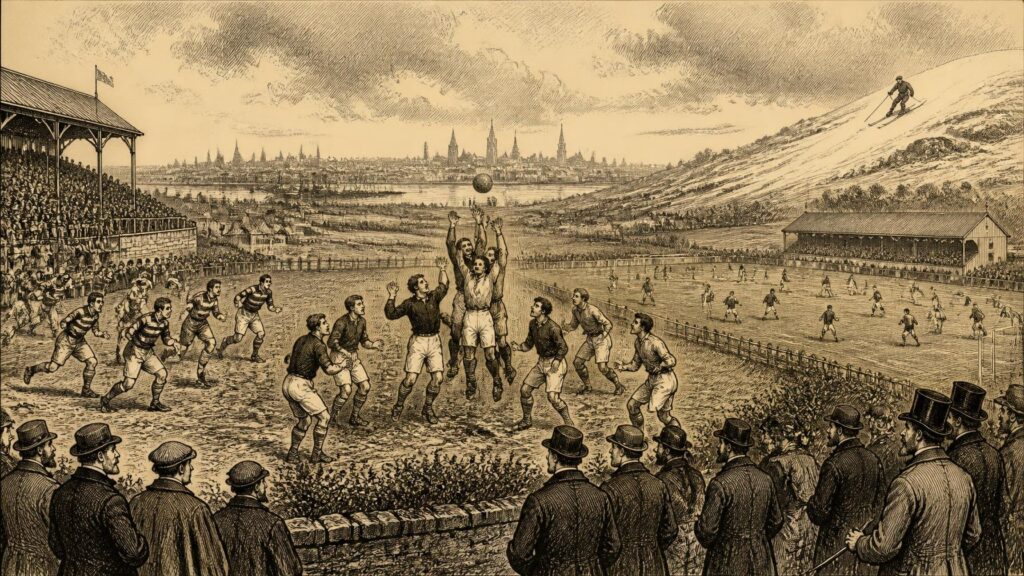
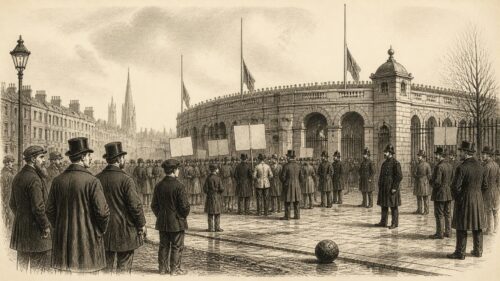
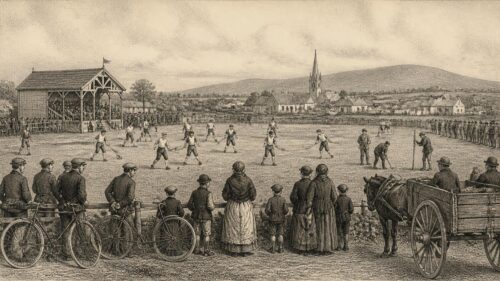
AI generated historical illustration, not a contemporary photograph.
At a Glance
March 2026 offers a revealing archival cross-section of Irish sport: a month in which the winter of international competition met the opening pressures of spring, and in which games administered on an all-island basis stood beside Republic of Ireland international teams and Olympic representation abroad. Its value is not simply in the scores. It shows how sporting calendars preserve older habits of association, locality, season and national expectation.
Archival Moment
A month is a small unit for history, and sport makes it smaller still. Fixtures move quickly, tables alter with one score, and a result that fills a newspaper column on Sunday can be obscured by the next round before the week is out. Yet an archival view of March 2026 permits something that a simple list of winners does not. It allows the month to be read as evidence of the different structures through which sport has long been organised in Ireland: county, club, province, island, state, diaspora and international federation.
The subject is necessarily selective. No short survey can record every school match, club training night, road race, local league fixture or volunteer effort that gave the month its real density. Nor should a record of leading events be confused with the entirety of sporting life. The official calendars nevertheless make clear that March was crowded. Team Ireland listed international engagements in athletics, hockey, swimming, gymnastics, sailing, weightlifting and equestrianism. Sport Ireland’s high-performance calendar placed hockey World Cup qualifying in Santiago and the World Athletics Indoor Championships in Toruń within the same month. The leading national games were therefore only part of a much wider field.
That breadth matters historically. Irish sport has often been described through a limited set of familiar emblems: Gaelic games, rugby and association football. They remain indispensable, but they do not exhaust the record. In 2026, a small Winter Olympic team had just returned from northern Italy; football staged men’s and women’s international fixtures; rugby’s Six Nations reached its closing rounds; and the GAA’s National Leagues reached their hundredth season of finals. March joined these worlds rather than replacing one with another.
The following account distinguishes evidence from interpretation. Scores, dates, named competitions and institutional arrangements are documented. The argument that they formed a shared seasonal pattern is an interpretation based on that evidence. It is not a claim that all Irish people experienced sport in the same way, nor that a single national sporting identity existed without qualification. Ireland’s sporting traditions have always been plural, and the political geography of the island remains important to their administration and meaning.
Seasonal Rhythms
March has long occupied an unusual position in the Irish sporting year. It is neither the full quiet of winter nor the settled assurance of summer. Pitches are often heavy, weather can disrupt travel and fixtures, and supporters follow competitions whose eventual importance may lie weeks or months ahead. The GAA’s league programme traditionally belongs to this threshold season: its contests are competitive and consequential, yet they also form preparation for the provincial and All-Ireland championships to come. Rugby’s northern-hemisphere championship, by contrast, reaches judgement in March. Football inhabits both modes at once, with the domestic season beginning while international windows interrupt it.
This seasonal overlap is not merely an inconvenience of scheduling. It helps explain the emotional character of the month. In Gaelic games, counties seek promotion, avoid relegation, test panels and encounter opponents in conditions very different from championship summer. In rugby, a campaign that began in February advances towards a final ranking, with all the compressed pressure that a five-round international championship can generate. In association football, March can carry the uncertainty of qualification as well as the more ordinary work of building a domestic league season.
Official fixture-making gives this rhythm institutional form. The GAA’s 2026 master schedule set the Allianz Football League finals for 28 and 29 March, while the Division Two, Three and Four hurling finals were also assigned to that weekend. The same schedule placed the Division One hurling finals on the following weekend in April and the provincial football championships in mid-April. In that ordering, the league was not an isolated tournament but the bridge between winter inter-county activity and the more historically resonant championship season.
Weather remained more than background scenery. The 2026 Allianz League regulations expressly provided for forced postponements caused by weather or unplayable surfaces, including the possibility of refixing a match and, in exceptional circumstances, playing outside a county’s home venue. Such procedural detail is mundane, but it is historical evidence of the physical realities underlying an apparently polished national competition. Irish sport is frequently mediated through television, statistics and social media; it still depends upon fields, roads, changing rooms, volunteers and local judgement about whether a surface is fit for play.
There is a temptation to regard March’s wet grounds and unsettled fixtures as romantic survivals. That would be misleading. The difficulties they present are practical: player welfare, travelling costs, supporter access and the integrity of competition are all involved. Yet the persistence of these questions also shows why sporting history cannot be reduced to elite performance. The material world of sport continues to shape its calendar.
League Centenary
The most conspicuous historical marker in Gaelic games during March 2026 was the centenary of National League finals. The GAA described 2026 as one hundred years since the first such finals, an anniversary that invited reflection on an institution sometimes treated as secondary to the championship. That secondary status has never been simple. The League has supplied meaningful county rivalry, regular winter and spring fixtures, experimental possibilities and, increasingly, routes to promotion, relegation and championship consequence.
The GAA’s own centenary account characterised the League as a competition that had travelled from comparative indifference towards much greater acceptance. This is an institutional interpretation rather than a neutral law of history, but it has force. Generations of players and followers have debated whether league success should be prized or treated cautiously. The answer changes with a county’s circumstances. For a side seeking confidence, status or a higher division, a League campaign can be central. For a county with ambitions later in the summer, it may be viewed as a proving ground. These positions are not contradictory; they arise from the competition’s multiple functions.
The 2026 season demonstrated that the League remained capable of producing decisive drama. On 29 March Donegal defeated Kerry by 3-20 to 2-10 in the Division One final, securing the county’s second National Football League title after its earlier success in 2007. Meath won Division Two, overcoming Cork by 1-22 to 2-17. The numerical finality of these results should not obscure the longer settings from which they emerged: county teams built on clubs, local coaching systems, volunteer administration and the all-island organisational framework of the GAA.
Donegal’s success also illustrates a familiar historical feature of Gaelic football: the recurrence of counties within changing tactical eras. A title is never simply a repetition of an earlier one. Players, rules, preparation and media conditions alter. Nevertheless, the language of a second League title necessarily brings prior achievement into the present. Supporters read the new victory against memories of 2007, just as Kerry’s defeat was understood through a much longer county tradition. Sport creates such layered time. A match is played once; its significance is assembled from what came before.
March 2026 was also shaped by the League’s revised competitive environment. The GAA’s regulations connected league position to qualification and ranking for the Senior Football Championship and Tailteann Cup. This made the final rounds more than ceremonial preliminaries. When the GAA published permutations before the final regulation round, it noted that places in finals, promotion and avoidance of relegation remained at stake across all four divisions. The practical message was clear: March results could alter a county’s path into the next phase of the year.
One should be wary, however, of projecting modern certainty backwards. The centenary is an opportunity to recognise continuity without pretending that the League has always held precisely its 2026 position. Competitions are made by changing rules, economic resources, broadcast arrangements, player workloads and public attention. The League of the 1920s belonged to a young organisation working in a newly transformed political landscape. The League of 2026 occupied a media-rich, highly regulated sporting culture. The connection is real, but it is institutional rather than identical.
Rugby March
Rugby offered another version of the month’s concentrated sporting time. The Six Nations, whose roots extend to the older Home Nations and Five Nations championships, has made late winter and early spring a recurring period of international attention. Its annual compression creates a distinctive form of public memory. Results in March are often recalled with unusual clarity because they settle a championship, decide a Triple Crown possibility, or reshape the interpretation of a whole campaign.
Irish rugby’s own historical material records this depth of memory. Its account of the 2009 win in Cardiff placed that victory within a sixty-one-year gap since Ireland’s previous Grand Slam, showing how an individual match can bear decades of anticipation. The same historical record describes championship competition as beginning in 1883. Such long chronology explains why modern fixtures attract meanings beyond the immediate table. They are new games in old relationships, played between unions whose sporting connections long predate contemporary broadcasting and sponsorship.
In March 2026 Ireland’s men played Wales and Scotland at the Aviva Stadium. The match against Wales on 6 March ended Ireland 27, Wales 17. Ireland scored four tries, through Jacob Stockdale, Jack Crowley, Jack Conan and Jamie Osborne, and gained a bonus point. Contemporary match information records an attendance setting, selected players and a detailed sequence of scoring. For the historian, those details are useful evidence; for the supporter, they are the elements from which recollection begins.
The Wales match also supplied a reminder that international rugby is never solely the story of established names. Irish Rugby noted that Nathan Doak became a fourth debutant of the 2025–26 season, while further players made first Six Nations appearances in the period. Selection change is among the quiet engines of sporting history. It marks the point at which a team’s inherited reputation meets uncertainty: a new player may establish a career, provide a single memorable appearance, or disappear from the highest stage. In all cases, the record of debut preserves the transition.
The final-round meeting with Scotland, scheduled for 14 March, confirmed the place of March in the Six Nations calendar. It was not merely a fixture after Wales but the closing chapter of Ireland’s championship campaign. The sold-out status recorded in the squad update further demonstrates the demand attached to such matches. Yet attendance should not be taken as proof of a uniform culture. Rugby’s social geography, its provincial structures and its historical relationship with different communities have all been subjects of change. The national team can command wide attention while the game retains particular institutional histories in schools, clubs and provinces.
That institutional continuity is especially significant on an island divided between two states. The Irish Rugby Football Union selects and administers a team representing the whole island of Ireland. This fact is often stated simply, but its historical importance is substantial. It has required symbols, practices and accommodations that differ from those employed by organisations operating solely within the Republic. March internationals therefore belong both to international sporting competition and to a longer story of all-island sporting governance.
Football Crossroads
Association football supplied a different pattern of jurisdiction and possibility. The Football Association of Ireland, founded in 1921, governs the game throughout the Republic of Ireland and is affiliated to FIFA and UEFA. Its March 2026 programme showed the range of national-team football: senior men, senior women, under-age teams and schools competitions all appeared in the official calendar, while the domestic women’s league season and the men’s League of Ireland were beginning or underway.
The men’s senior side travelled to Prague for a World Cup qualifying play-off semi-final against Czechia on 26 March. The result was a 2-2 draw after extra time, followed by a 4-3 defeat on penalties. The FAI report records that Ireland led by two goals before Czechia recovered, and that the shoot-out ended the country’s hopes of reaching the 2026 FIFA World Cup. Penalty defeats are particularly liable to become condensed folklore: remembered through a saved kick, an altered lineup, a near miss or an imagined alternative future. The documented fact is more limited but no less sharp: the tie was level after extra time and was lost in the shoot-out.
The FAI’s later statistical review placed the Prague result within a 2025–26 campaign of eleven matches, four wins, five draws and two defeats. This broader frame matters. A single elimination match inevitably dominates recollection, but international teams are built through more prosaic sequences of fixtures, changing squads and tactical experiments. The report itself treated the March result as the end of one qualification effort and the beginning of preparation for UEFA Euro 2028, which Ireland will co-host. Whether that future prospect alters the remembered significance of March 2026 is a question for later historians, not a conclusion that can be reached in advance.
Five days after Prague, the Republic drew 0-0 with North Macedonia at the Aviva Stadium. The match gave senior home debuts or first senior appearances to younger players including James Abankwah and Bosun Lawal. A scoreless friendly can seem slight beside a play-off defeat, yet these matches are part of the historical fabric of a side. They test personnel, sustain public connection and furnish the first entries in international careers. Sport’s archive is not composed only of trophies and calamities; it also contains these transitional evenings.
The women’s team entered March in World Cup qualifying. Ireland lost 2-1 to France at Tallaght Stadium on 3 March, despite taking an early lead through captain Katie McCabe, and then lost by the same score in the Netherlands four days later after McCabe converted a penalty. The FAI described both outcomes as narrow defeats. The language is appropriate, but it should not conceal the competition’s hard arithmetic: performances of character do not automatically yield points.
There is a longer history behind those fixtures. Women’s football in Ireland has had to seek recognition, resources and institutional support within a sport long organised principally around men’s competition. The very fact that March’s official calendar contained senior World Cup qualifiers, under-age internationals, a Women’s President’s Cup and the opening round of the Women’s Premier Division is evidence of a wider competitive infrastructure. It does not demonstrate equality achieved; calendars cannot establish that. It does show the formal presence and increasing visibility of women’s football across several levels.
Winter Echoes
By March 2026 the Winter Olympic Games in Milano and Cortina d’Ampezzo had ended, but their afterlife belonged to the month. Team Ireland’s four-athlete delegation made a useful corrective to any narrow image of Irish sporting geography. Ireland is not a winter-sport power in the conventional sense, yet it has maintained a Winter Olympic presence since Albertville in 1992, when two bobsleigh crews represented the country. The history is small in numbers, but it is not marginal in human effort.
At the 2026 Games Ben Lynch became the first Irish skier to qualify for a Winter Olympic halfpipe final and finished eighth, a result Team Ireland identified as among Ireland’s best at the Winter Games. Cormac Comerford competed in four alpine events; Anabelle Zurbay made her Olympic debut; and Thomas Maloney Westgård finished twenty-third in the 50-kilometre cross-country mass-start classic. These are precise accomplishments, not symbols to be inflated into a transformation of Irish winter sport. Their significance lies in the demonstration of a sporting Ireland connected to disciplines and landscapes beyond its usual public imagination.
The Olympic Federation of Ireland’s history page places the 2026 performances within a longer line that includes the 1992 bobsleigh debut, Tamsen McGarry as the first Irish woman at a Winter Olympics in 2002, and Clifton Wrottesley’s fourth place in skeleton at Salt Lake City. Such institutional histories are valuable, though they naturally favour national representation and achievement. A fuller social history would also ask about athlete migration, access to snow facilities, family resources, coaching abroad and the meaning of representing Ireland in sports with little domestic infrastructure.
Still, the return from Italy was more than an administrative footnote. In early March Team Ireland reported extensive public engagement around the Games. Digital impressions are not equivalent to enduring participation or historical importance, but they are evidence that the team reached audiences well beyond the small number of competitors. In the modern sporting archive, attention itself has become measurable. Historians should handle such figures cautiously: online visibility can be brief, uneven and shaped by platform systems. It nonetheless forms part of how national sporting narratives are now made.
Island Institutions
The most productive way to read March 2026 is not as a contest for the title of Ireland’s principal sport. It is to recognise several institutional maps operating together. Gaelic games organised counties across the island; rugby’s representative structure did likewise; the Republic’s football teams competed through the FAI; Olympic athletes represented Ireland through another national framework; and many other sports worked through their own governing bodies, clubs and international affiliations.
These structures have histories that are sometimes cooperative and sometimes contested. Sport has never stood outside politics, class, religion, migration or language. Nor has it simply mirrored them. A club can create local solidarities that cross other divisions, while a representative team can become the focus of disagreement over symbols and belonging. The history of Irish sport therefore requires precision. It is not enough to call an event “national” without asking which institution selected the team, what territory it served, which anthem or flag was used where relevant, and how participants understood representation.
March makes these distinctions visible because so many fixtures occur simultaneously. A Donegal supporter following the League final could also follow the Republic of Ireland in Prague; a rugby household might watch Ireland in the Six Nations while a family member played in a local GAA or football fixture; an athlete preparing for an international event could have little direct connection to any of these spectacles. The unity is temporal, not necessarily experiential. They shared a month, not a single public.
Yet it would be overly sceptical to deny common patterns altogether. Voluntary labour remains central in many Irish sports. The club still provides an important setting for participation and social connection. International fixtures retain a capacity to gather dispersed attention. And the seasonal calendar continues to organise expectation: spring leagues, March finales, summer championships and autumn retrospection. These are not myths, although their strength varies by place, sport and generation.
Memory Making
What will endure from March 2026? Some results will be retained because they were titles: Donegal’s League victory will occupy the county record alongside 2007. Some will persist because they were near misses: the men’s football play-off in Prague is likely to be recalled through its lost two-goal advantage and penalty shoot-out. Others will survive through personal rather than national memory: an under-age debut, a journey to an away match, a local club’s difficult league fixture, or a child watching a Winter Olympian for the first time.
Public memory will simplify. It commonly prefers heroic victories, painful defeats and identifiable protagonists. The historian’s task is not to dismiss that process but to restore some of the circumstances it omits. The 2026 League finals rested on a century of competition. The Six Nations fixtures carried relationships built across more than a century of championship rugby. The FAI’s March programme belonged to an association founded in 1921 and to wider debates over football’s place in Irish society. The Winter Olympians followed a national Olympic winter debut in 1992.
Folklore will form around these events too. Supporters will say that a particular score “changed everything”, that a team was destined for a title, or that a single decision lost a campaign. Such sayings can be historically interesting as expressions of feeling, but they are not evidence in the same sense as a match report, fixture list or official result. The difference need not diminish them. Folklore reveals what people wished had happened, feared would happen, or believed their sporting community to be.
March 2026 should therefore be preserved as more than a catalogue of outcomes. It was a month in which Irish sport displayed its layered inheritance: old competitions renewed, governing bodies working within different territorial arrangements, women’s and men’s representative teams pursuing difficult goals, and athletes carrying Irish colours into disciplines far from the traditional field or stadium. The records are incomplete, as all records are. But they establish enough to show that sport in Ireland was not one story. It was a dense collection of histories meeting, briefly and vividly, in a single spring month.
March 2026 illustrates how Irish sport operates through overlapping identities rather than one simple national story. The GAA’s all-island county framework, rugby’s island-wide representative team, and Republic of Ireland football’s state-based international programme share a crowded calendar while carrying distinct histories, symbols and communities. The article also suggests that seemingly modest events, such as debuts, league promotion battles and Winter Olympic participation, may acquire significance beyond immediate results. This raises an intriguing interpretive question: when historians look back on this month, how should they balance headline outcomes with the quieter institutional and personal developments that reveal Ireland’s plural sporting geography?