
Irish Sport
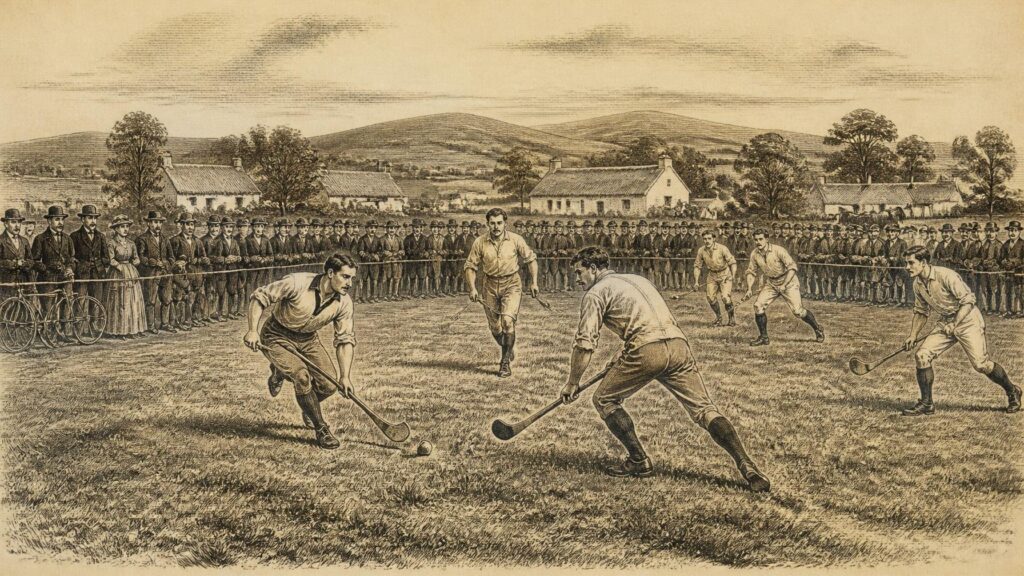
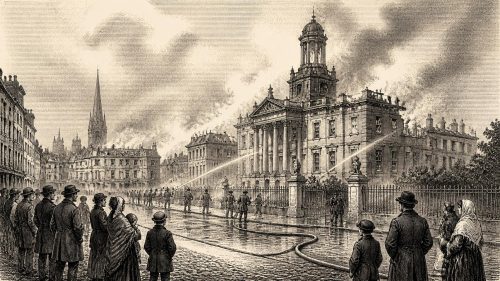
AI generated historical illustration, not a contemporary photograph.
At a Glance
In Ireland, sport has never been merely recreation. It has been a way of organising neighbourhoods, displaying class and gender, debating national allegiance, preserving inherited practices, and sometimes making political conflict painfully visible. The history of Irish sport is therefore not the history of one game or one institution, but of many overlapping sporting worlds: hurling and football, athletics and horse racing, cricket and rugby, association football and boxing, rowing and cycling, camogie and women’s football. Their changing fortunes illuminate the history of the island itself.
Ancient Echoes
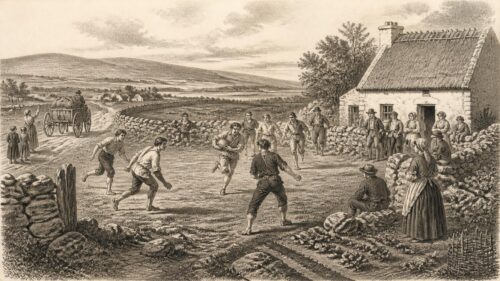
The temptation to describe Irish sport as an unbroken survival from a remote Celtic past should be resisted. Such language belongs partly to the powerful mythology through which modern Ireland has understood itself. The hero Cú Chulainn is associated in medieval literary tradition with stick-and-ball play, and hurling has long occupied an exceptional place in stories of Irish prowess. Folklore, epic literature and later nationalist writing all gave the game an aura of great antiquity. They are important historical evidence for the meanings later communities attached to hurling, but they are not a substitute for proving that a modern match is identical to an early medieval game.
There is, nevertheless, substantial documentary and material support for the antiquity of stick-and-ball games in Ireland. Early Irish legal material refers to sporting injuries and to equipment, while medieval narrative sources describe a ball, curved stick and competitive play. Archaeological finds, including hurleys and sliotars preserved in wet ground, strengthen the case that related games were played over many centuries. What cannot safely be claimed is uninterrupted sameness. Rules, numbers, fields, local customs and social settings changed repeatedly. The modern sport called hurling is both heir to older practices and the product of nineteenth-century codification.
This distinction matters because historical continuity is not a simple line. A game may retain a name, a stick, a ball or a remembered ancestry while being reorganised by new institutions. In Ireland, as elsewhere, modern sport emerged when local pastimes became governed by written rules, fixtures, county structures, championships, trained officials and large audiences. Hurling’s depth in the historical record gave revivalists an inheritance to invoke; the Gaelic Athletic Association gave that inheritance a durable modern form.
Older recreations also belonged to seasonal and local life. Informal contests could take place at fairs, holidays and communal gatherings; they were not necessarily benign. Accounts of pre-modern games often suggest large numbers, loose boundaries and a physicality that later reformers found alarming. That past should not be romanticised as a lost democratic golden age. Participation depended on locality, custom, land access, wealth and social standing. Yet it explains why games could carry such emotional force when nineteenth-century organisers claimed to be reviving national pastimes.
Colonial Codes
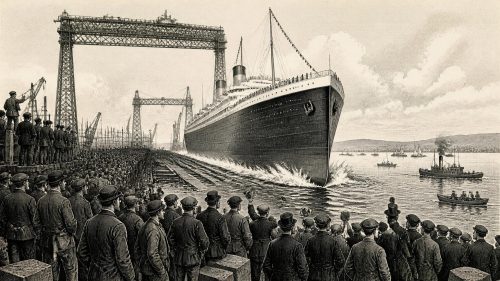
The sporting landscape of eighteenth- and nineteenth-century Ireland was shaped by the island’s place within the United Kingdom and by connections with Britain and the wider empire. Elite and middle-class forms of sociability flourished in clubs, schools, military settings and universities. Horse racing had deep roots and broad appeal, though ownership, patronage and access reflected great inequalities. Cricket, rowing, hunting, athletics, rugby and association football developed through overlapping networks of gentry, professionals, merchants, clergy, soldiers, teachers and pupils.
It is misleading to label these sports simply foreign and Gaelic games simply native. Cultural traffic moved in both directions across the Irish Sea, and games acquired Irish adherents for reasons that included pleasure, status, education, employment and local companionship. Trinity College Dublin helped foster rugby; schools disseminated games through their pupils and masters; military personnel and commercial travellers carried rules between towns. Cricket was particularly strong in some regions during the nineteenth century. Association football became highly significant in Belfast and other urban centres. Rugby developed a distinctive all-island institutional life.
These sports also reveal differences within Ireland. Industrial Belfast, provincial towns, rural parishes and the capital did not share a single sporting culture. Urbanisation, denominational affiliation, class and the availability of enclosed grounds all mattered. A commercial city with factories, newspapers and regular transport could support leagues and spectator sport in ways that a thinly populated rural district could not. Conversely, parish-based networks later provided Gaelic games with a formidable local infrastructure.
Victorian ideals of amateurism added another layer. Amateur sport was often presented as morally improving, cultivating discipline, courage and self-command. In practice, it could enforce social exclusion. Rules about payment, occupation and club membership favoured people with leisure, money and connections. Irish sporting history, accordingly, cannot be read only as a national contest between games. It is also a record of who had time to play, who controlled grounds and associations, whose physicality was celebrated, and whose participation was constrained.
Organised Pastimes
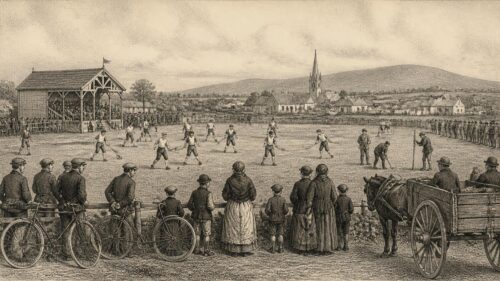
By the later nineteenth century, sport increasingly meant association. Clubs offered a constitution, subscriptions, officers, fixtures and a regular social calendar. Newspapers advertised matches and reported results, helping distant events become common conversation. Railway travel made inter-town competition more practicable. Standard rules allowed teams that had never met to compete on terms understood by both. Spectators could now follow championships extending beyond their own locality, while athletes and players acquired reputations outside their home districts.
This process was not unique to Ireland, but Irish institutions gave it particular forms. Sporting bodies became arenas in which political and cultural loyalties could be expressed without being reducible to party politics. A member might join for exercise, friendship or ambition rather than nationalism; another might view the same club as an assertion of national dignity. The coexistence of those motives is essential. Retrospective accounts often make every nineteenth-century player a conscious patriot. The evidence suggests a more complex world in which enjoyment, rivalry, identity and politics met but did not always coincide.
Athletics occupied a central place in this transformation. Meetings attracted competitors and crowds, offered prizes and created disputes over control. Michael Cusack and Maurice Davin did not invent popular physical recreation, nor did they find an island without organised sport. Their intervention came amid a vigorous sporting culture, with rival authorities and contested standards of amateur conduct. What they helped create was a national association able to link athletic competition with a programme for the cultivation of Irish games.
The expansion of club life had lasting consequences. Voluntary labour became a defining feature of Irish sport: secretaries writing letters, local committees raising money, groundsmen preparing fields, families organising travel, and communities debating selections. This was civic activity as much as entertainment. The club could be a social centre, a source of prestige, a venue for courtship and argument, and a place in which local loyalties were made visible. It could also reproduce exclusions of class, gender, religion or politics. Its historical importance lies in both capacities.
National Revival
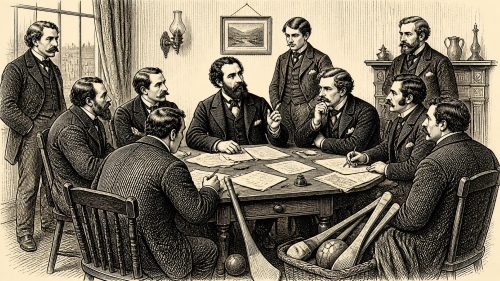
On 1 November 1884, a meeting at Hayes’s Commercial Hotel in Thurles, County Tipperary, founded the Gaelic Athletic Association for the preservation and cultivation of national pastimes. Maurice Davin became its first president, while Michael Cusack was among its leading organisers and public advocates. The founding was an important moment in the wider Gaelic revival, but the Association’s success was not inevitable. It had to recruit clubs, publish rules, organise contests, establish authority and overcome internal conflict.
The early GAA combined cultural aspiration with practical reform. Local forms of football and hurling varied considerably. A match between sides accustomed to different customs could become confused or dangerous. Codification did not merely protect a pure ancient game; it created a common game from diverse practices. The rules for Gaelic football adopted in 1885 and subsequent revisions were modern instruments. They defined the field, the team, permitted actions, scoring and the authority of officials. Hurling likewise became subject to increasingly coherent regulation.
Its founders and supporters frequently contrasted Irish games with the prominence of English sporting institutions. That rhetoric was part of a broader assertion that Irish people should govern their own cultural life. Yet the GAA was itself an unmistakably modern association, using newspapers, meetings, committees, subscriptions and championships in ways familiar across Britain and Europe. Its originality lay not in existing outside modern sport but in adapting modern organisation to a distinct cultural claim.
The Association expanded quickly. Scholars have noted that its early affiliated-club growth compared strikingly with that of rival football organisations. This was facilitated by a rural and small-town social base, by the symbolic appeal of national pastimes, and by the adaptability of club organisation. The GAA’s influence was especially strong because it made parish, county and nation mutually intelligible sporting units. A player could represent a local club, a county and, in imagination, Ireland. That ladder of affiliation became one of the most enduring patterns in Irish public life.
Its history was never politically uniform. The GAA experienced disputes among constitutional nationalists, physical-force republicans and others, while clerical, regional and personal interests all affected its direction. The Association’s public identity acquired nationalist associations, but members were not one political bloc. To treat the GAA as simply an arm of any movement is to erase its arguments, compromises and ordinary participants. It is more accurate to say that it became one of the major institutions through which Irish national feeling could be practised, contested and transmitted.
Rules Authority
Rules are sometimes treated as dry technicalities, but in sport they distribute power. They decide who may play, what conduct counts as fair, how a contest ends and which body may speak for a game. The GAA’s work of standardisation transformed hurling and Gaelic football from a collection of local games into sports capable of national championship. It also created offices and procedures through which disputes could be appealed, discipline administered and authority recognised.
Such administration could be contentious. Early Irish sport included sharp rivalries between associations, particularly in athletics. Questions about amateurism, control of meetings and the legitimacy of competing bodies were not peripheral. They concerned money, prestige and the right to define the sporting public. The GAA’s early leaders made athletic meetings central to their programme, in part because athletics attracted mass participation and could demonstrate organisational reach.
The famous restrictions often called the Ban on foreign games also show how regulation reflected cultural politics. These restrictions changed over time and their operation varied in experience and severity. They should not be reduced to a cartoon of blanket hostility, nor dismissed as inconsequential. They expressed an effort to preserve an institutional boundary between Gaelic games and sports identified with British influence. For some members that boundary was a matter of principle; for others it created personal and local tensions in a country where sporting tastes overlapped.
The eventual removal of the ban in 1971 marked a significant institutional change, but not the end of sporting identity. By then Gaelic games had long been embedded in Irish life and could sustain themselves without the same formal separation. The episode demonstrates that traditions are not fixed relics. They are maintained through decisions, rules and arguments, and they change when communities decide that inherited boundaries no longer serve their purposes.
Gendered Fields
For much of recorded Irish sporting history, public authority and media attention belonged disproportionately to men. Women played, trained, organised, travelled and watched, but their work was frequently less visible in official narratives. This imbalance was reinforced by social ideas about femininity, respectability and physical exertion. It affected access to facilities, acceptable clothing, school provision, press coverage and the right to hold power within organisations.
Camogie offers a particularly important corrective. The Camogie Association was founded in 1904, only two decades after the GAA. Its formation showed that women were not simply waiting to be admitted to an established sporting nation; they were constructing their own organisation, competitions and traditions. The first All-Ireland camogie championship was played in 1932. Its players competed within a culture that often prescribed restrictive dress and behaviour, yet they sustained a game that became central to women’s sporting life across the island.
The history of camogie is not merely a female counterpart to hurling. It has its own administrators, players, rules, championships and struggles for recognition. It also discloses the unevenness of national revival. Cultural movements that celebrated the Irish people could still allocate authority and physical freedom unequally. Women’s participation challenged that contradiction in practical ways: by founding clubs, taking the field, building county competitions and insisting that athletic skill belonged to them as well.
Later developments in ladies’ Gaelic football, association football, athletics, hockey and other sports further widened opportunities, although equality remained incomplete. The historical question is not whether women belonged in Irish sport; abundant evidence shows that they did. The question is why archives, commemorations and resources so often made their contribution less visible. Recovering these histories changes the picture of Irish sport from a male national pageant into a fuller account of voluntary effort, bodily autonomy and social change.
Revolutionary Ground
Sport intersected with revolutionary politics most tragically at Croke Park on 21 November 1920. During the War of Independence, Crown forces entered the ground during a Dublin–Tipperary football challenge match and opened fire. Fourteen people died. The victims included players, spectators and children. The event formed part of the day subsequently remembered as Bloody Sunday, after killings earlier that morning connected with the conflict between the IRA and British intelligence personnel.
The Croke Park shootings were not simply a symbolic attack on a game. They were the killing and wounding of civilians at a crowded public event. Historical investigation has had to disentangle conflicting accounts, official statements, witness testimony and later commemoration. The detail matters because memory can simplify catastrophe: the match was a challenge game rather than an All-Ireland final, and claims repeated over decades have sometimes been corrected by archival research. The central fact, however, is clear: a sporting crowd became the target of lethal state violence.
Because the GAA already carried nationalist associations, Bloody Sunday gave Croke Park an intensified place in public memory. Michael Hogan, the Tipperary footballer who was killed, became especially emblematic, and the Hogan Stand later commemorated him. Yet concentration on a famous player should not obscure the other dead, whose ages, occupations and backgrounds reveal the ordinary public gathered at the match. Their deaths made sport inseparable from the human cost of the conflict.
There is a broader historical lesson in this episode. Sporting grounds can appear separate from political struggle, but they are public spaces where identities are displayed, crowds assemble and institutions become visible. In wartime, that visibility can be dangerous. Croke Park’s later role as a national stadium carries the memory of 1920 not as an ornament to sport, but as a reminder that games have taken place within the hardest circumstances of Irish history.
Partitioned Allegiances
The partition of Ireland introduced new complexity into sport without producing a single sporting map. Some organisations continued to operate on an all-island basis; others divided or developed separate jurisdictions. Rugby retained all-island structures. The GAA and Camogie Association also maintained all-island forms. Association football developed separate governing bodies in Belfast and Dublin. Athletics became a particularly fraught field in arguments over territory, representation and international recognition.
These arrangements cannot be explained by geography alone. They were shaped by existing institutions, political allegiances, international affiliations and the practical interests of administrators. A sport founded before partition could possess habits of all-island organisation that survived the constitutional divide. Another, particularly one with strong ties to British associations and different regional bases, could follow a different course. Each sporting code developed its own answer to the question: who was entitled to represent Ireland?
The interwar years showed how representation could become a form of diplomacy. Irish athletes and officials used international competition to argue for a national identity distinct from Britain. At the same time, political and sporting authorities in Britain, Northern Ireland and the Irish Free State contested boundaries of jurisdiction. Research on Irish participation in the British Empire Games demonstrates that sporting administration could become an arena for state formation, propaganda and disagreement over the territorial meaning of Ireland.
It would be wrong to imagine that all athletes experienced these disputes in the same way. Many wished principally to compete. Others embraced an all-island ideal, British identity, Irish republican nationalism, unionism or more local loyalties. Sport supplied a setting in which these identities could coexist, clash or be temporarily set aside. Its institutions were not above politics, but neither were they only politics by another name.
Social Worlds
The deepest influence of Irish sport may lie in its everyday social worlds. A club is often a place where children first encounter organised responsibility, where newcomers meet neighbours, where emigrants maintain attachments, and where bereavement and achievement are collectively marked. Its labour is usually voluntary and recurrent: subscriptions collected, kits washed, pitches lined, transport arranged, fixtures negotiated and fundraisers held. This work rarely appears in grand national narratives, yet it has sustained sporting life for generations.
Sport has also provided a language of place. Counties, parishes and towns acquire reputations through teams and rivals. Those reputations may be exaggerated or playful, but they can hold real emotional weight. Championship matches create occasions when dispersed communities gather, listen to broadcasts or follow events from abroad. Irish migration extended these networks. Clubs founded by emigrants carried games to Britain, North America, Australia and elsewhere, while return visits and correspondence connected overseas players with home communities.
That communal strength should not conceal tensions. Local sport can generate rivalry, pressure and exclusion as well as fellowship. Access to participation has depended on money, transport, disability provision, gender, ethnicity, school opportunity and the willingness of institutions to welcome people. The historical record is strongest for formal bodies and celebrated men, which means that less visible participants require deliberate attention. A mature history of sport must acknowledge the gaps in its own archive.
Nor should sport be treated as a cultural silo. It has influenced journalism, music, language, architecture, commerce and ritual. Stadiums and grounds became landmarks; match reports shaped newspapers; Irish-language names and symbols entered public display; cups, jerseys and photographs became family heirlooms. Sporting life has been at once local and national, intensely personal and widely shared.
Enduring Meanings
Hurling’s inscription on UNESCO’s Representative List of the Intangible Cultural Heritage of Humanity in 2018 recognised the game’s social and cultural significance, including its transmission through clubs and schools. The recognition should not be mistaken for proof that present-day sport is an untouched ancient survival. Its greater value is in acknowledging that communities preserve living practices through participation. Heritage, in this sense, is not only an old object in a case; it is a skill, memory and relationship carried forward by people.
The history of sport in Ireland is best understood as a history of adaptation. Medieval references and archaeological finds demonstrate deep roots for hurling-like games. Nineteenth-century associations introduced modern rules and institutions. National revivalists attached games to cultural independence. Women built organisations in the face of persistent inequality. Revolution and partition made sporting grounds sites of memory, diplomacy and dispute. Meanwhile, rugby, soccer, cricket and many other sports ensured that Irish sporting identity remained plural rather than singular.
That plurality is the central point. No one game can stand for all Ireland, and no simple opposition between native and imported sports can explain the island’s past. Sport has offered accommodation and resistance, continuity and innovation, local attachment and international ambition. It has made national identity visible, but it has also revealed competing definitions of nation, community and belonging.
To study Irish sport, then, is to study how people made institutions from leisure and meaning from contests. It is to see the parish field, the city club, the schoolyard, the racecourse and the stadium as historical places. On those grounds, Ireland has played out arguments about culture and power, mourned its dead, celebrated its champions and repeatedly remade the terms on which a community might call itself a sporting nation.
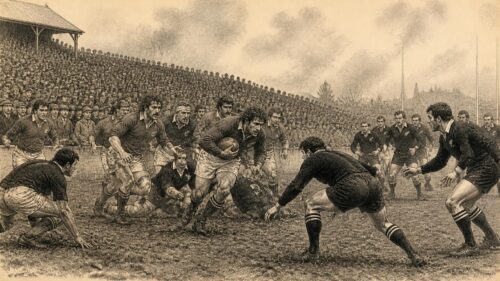
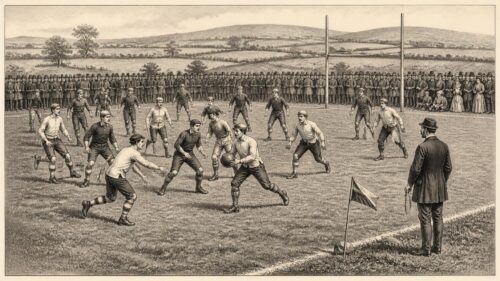
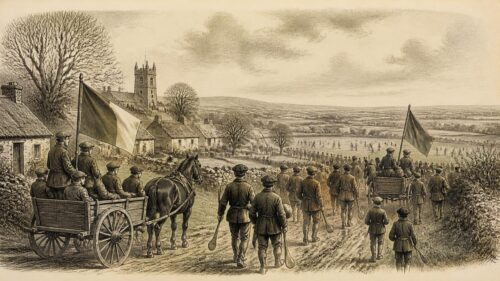

The article’s portrayal of Irish sport as overlapping rather than singular is especially revealing when set beside partition. Gaelic games connected parish, county and national identities, while rugby maintained all-island structures and soccer developed differently across jurisdictions. This suggests that sporting institutions could both preserve relationships across political borders and sharpen distinctive allegiances within them. It also complicates assumptions that particular games neatly represent fixed communities. How far do you think all-island sporting bodies have encouraged shared cultural connections since partition, and in what ways might local class, gender, migration and religious identities have limited or reshaped that unifying potential?