Digital Banking
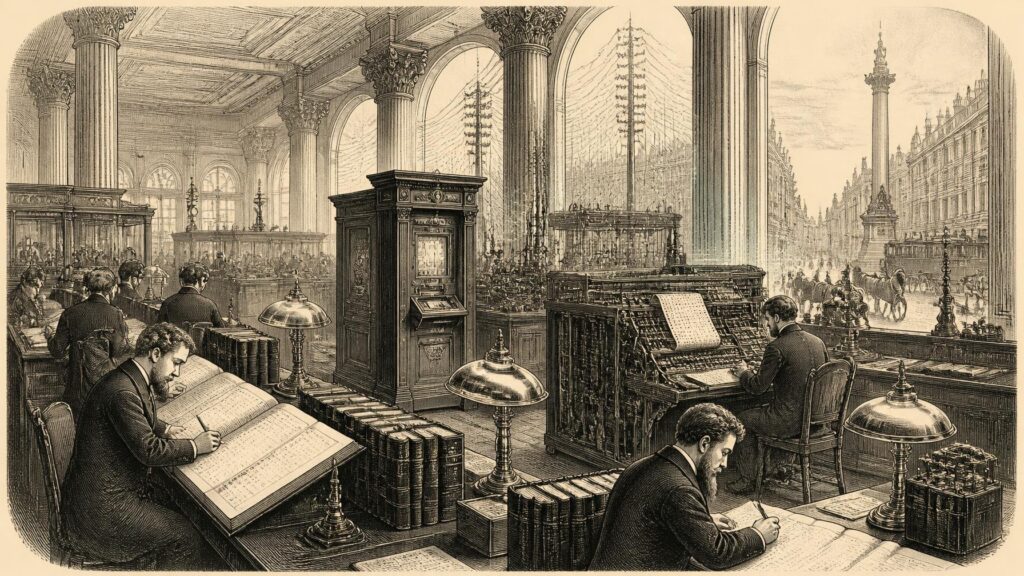
AI generated historical illustration, not a contemporary photograph.
At a Glance
Digital banking in Ireland did not begin with the smartphone. It emerged through a long alteration in how money was recorded, authorised, moved and trusted: from paper cheques carried between branches to computerised accounts, cash machines, telephone services, web portals, European payment networks and mobile applications. Its history is therefore not simply one of technological progress. It is also a history of changing public habits, the retreat and reinvention of the bank branch, the increasing importance of regulation, and a recurring Irish concern that convenience must not leave vulnerable customers behind.
Cash Foundations
For much of the twentieth century, everyday Irish banking was conspicuously physical. A customer brought cash to a counter, received a passbook entry, wrote or cashed a cheque, or spoke with a clerk who knew the local family, farm or business. The bank branch was at once a workplace, a ledger room, a source of credit and a public institution embedded in the commercial geography of town and village. Banking depended upon paper records, clearing arrangements, fixed hours and the movement of documents between institutions. Even when internal accounting became increasingly mechanised, the customer-facing experience remained largely personal and place-bound.
The major bank strikes of 1966, 1970 and 1976 demonstrate the world from which digital banking arose. RTÉ’s archive records that the six-month stoppage of 1970 occurred before automated teller machines and online self-service banking. Cash supplies became strained, while traders and others improvised arrangements for accepting cheques. Later retellings have sometimes converted this episode into a romantic story of pubs becoming substitute banks. There is a documented basis for the wider point: commercial relationships, local knowledge and trust helped maintain transactions when the normal clearing-bank system was disrupted. Yet it should not be treated as proof that formal banking was unnecessary. The disruption imposed hardship, delayed settlement and exposed traders to fraud and loss.
That experience offers a useful historical contrast. The pre-digital system relied heavily on face-to-face judgement and on institutions whose operations could be interrupted by closed premises and unavailable staff. The later electronic system would reduce dependence on the branch counter, but it would create a different dependence: on telecommunications, software, electricity, data centres and shared payment infrastructure. In both periods, banking rested on confidence. What changed was the machinery through which that confidence was expressed.
By the later twentieth century, Ireland’s banks were already moving towards centralised information processing. The object was not initially to abolish the branch, but to make the branch network quicker, more standardised and less dependent on paper travelling through the system. Computers could reconcile accounts, process transactions and give staff access to balances more rapidly than older manual routines. This quieter back-office transformation was a necessary precondition for later public-facing digital services. A customer could not safely withdraw money from a machine or inspect an account remotely unless a central system could recognise the account and update it reliably.
Machine Arrival
The automated teller machine was the first highly visible sign that Irish retail banking could occur without a clerk. Bank of Ireland’s historical record places its first PASS ATM in 1980, while RTÉ’s 1979 report on Allied Irish Banks’ planned self-service machines shows how novel the idea appeared at the time. The machine was explained in simple terms: insert a card, enter identifying information and receive cash, with the terminal connected to a central computer capable of checking the state of the account.
That apparently modest service altered the rhythm of banking. A cash withdrawal no longer had to coincide with opening hours or an encounter at a counter. The ATM redistributed access from the interior of a branch to the pavement outside it, and eventually to shopping centres, transport locations and other sites beyond the traditional bank premises. It introduced the familiar combination of plastic card, personal code and machine verification. These were early forms of the authentication practices that would later become central to online and mobile banking.
The transition was gradual rather than revolutionary. A machine that dispensed cash did not replace the many activities still associated with a branch: depositing funds, seeking a loan, making business payments, resolving an error, handling a cheque or receiving advice. Nor did it immediately erase geographical inequalities. Networks took time to spread beyond larger towns and cities. Nevertheless, the ATM accustomed customers to the proposition that an account could be accessed electronically and independently. In that respect, it did cultural work as well as commercial work.
The card itself also mattered. It connected an account to an increasingly international payments environment. Cash machines and payment cards made banking more portable, while their operation required common technical standards and co-operation between banks. The electronic transaction became a new kind of record: less visible to the customer than a stamped passbook or cancelled cheque, but capable of being processed at speed and at scale. The later history of digital banking is in part the history of making that invisible record intelligible, secure and available to the account holder.
Network Change
Before the public encountered banking on the internet, electronic systems were already changing the movement of money between institutions. A European Central Bank account of payment systems in the early 1990s described the Dublin Bankers’ Clearing as handling paper debits, credit items and electronic funds transfer transactions. It also noted the use of electronic data interchange between the principal banks and the use of SWIFT for international communications. This is important because it corrects a common misconception: digital banking was not born when customers first opened a browser. It developed from earlier electronic clearing, messaging and institutional data exchange.
In this phase, digitalisation was most apparent to banks, businesses and specialist users rather than to every household. Companies had reasons to seek quicker access to account information, more efficient payroll arrangements, remote payment authorisation and improved links with overseas partners. Financial institutions, meanwhile, were managing larger volumes of transactions and facing pressure to reduce the cost of labour-intensive processing. The technology did not make the banking system frictionless, but it changed where the friction occurred. Manual sorting, transport and transcription increasingly gave way to technical compatibility, security protocols and systems maintenance.
Telephone banking formed an important bridge between the branch and the web. Bank of Ireland records the launch of Banking 365 Telephone Banking in 1996, though telephone-based financial services had antecedents in the preceding decade. A customer could obtain information or instruct a transaction without travelling to a branch, but still through conversation with a human agent. In historical terms, it preserved an element of personal service while shifting the point of contact from the counter to the call centre.
Other experiments show that the route to internet banking was not predetermined. Early home-banking systems could use proprietary terminals or services delivered through telephone lines. Their limitations included cost, limited public connectivity, uneven technical confidence and the difficulty of ensuring secure transactions. The widespread web eventually offered a more flexible common interface. It was not the first electronic channel in Irish banking, but it was the channel that could reach households and businesses without requiring a dedicated banking terminal.
Web Experiments
Irish internet banking emerged in the late 1990s, during the wider expansion of web use and electronic commerce. Contemporary technical-historical material preserved by TechArchives records Bank of Ireland’s pilot of Banking 365 On-line in 1997 and identifies it as the first secure online-banking offering to personal customers in the State. The service initially allowed users to view account balances and transaction status rather than freely conduct the range of payments now expected from online banking. This distinction matters. Seeing an account remotely was a significant innovation, but moving money remotely presented greater risks and demanded stronger controls.
The cautious beginning reflected the conditions of the time. Domestic internet access was still far from universal; many users relied on slow dial-up connections; and banks had understandable concerns about reliability, customer support and fraud. Bank of Ireland’s own history records 1997 as the year Banking 365 Online Banking was launched, while contemporary reporting shows that business customers gained more extensive online facilities shortly afterwards. By 1998, Bank of Ireland was promoting a commercial service allowing customers to access accounts and authorise payments, with encryption and digital-signature technology central to its security claims.
The move online did not instantly displace telephone or branch banking. Early web services were an additional channel, often presented as a convenience for technically confident customers rather than a universal replacement for established practice. Customers had to learn passwords, navigation, browser settings and the new discipline of safeguarding credentials. Banks, in turn, had to make remote interfaces understandable enough for ordinary account holders while retaining procedures capable of detecting unauthorised activity.
The period also reveals an important feature of Irish digital-banking history: it was entwined with Ireland’s growing technology sector and its position in European communications and financial services. Yet this should not be reduced to a triumphalist story. The internet offered an apparent escape from the cost of branch networks, but the savings depended on customers adopting the service and on institutions continuing to invest in systems, security and assistance. The web was not a substitute for trust; it became another setting in which trust had to be earned.
Legal Frameworks
Technology alone could not make electronic banking ordinary. A payment instruction sent through a network had to have legal status; electronic communications had to be recognised; and consumers and businesses needed a clearer sense of their rights and obligations. In the late 1990s, parliamentary discussion on the Information Society raised precisely these questions, including the enforceability of contracts concluded electronically and the authentication of parties to them. Such debate is historical evidence of uncertainty rather than a sign that Ireland lacked digital ambition. Law often follows new practice, but it also makes widespread adoption less hazardous.
The Electronic Commerce Act 2000 formed part of this enabling environment. Its wider importance lay in recognising the legal use of electronic information and signatures in appropriate circumstances, subject to exceptions and conditions. It did not create internet banking by itself, nor did it eliminate the need for bank-specific terms, technical controls or consumer protection. It helped establish the principle that electronic dealings could have a serious and enforceable place in commercial life.
Over time, the centre of gravity moved from merely recognising electronic records to supervising an expanding range of payment providers. The European Union’s payment-services legislation was especially significant. The revised Payment Services Directive, widely known as PSD2, became Irish law through the European Union (Payment Services) Regulations 2018. The Central Bank of Ireland explains that the framework covers electronic payment activities including credit transfers, direct debits, card payments and mobile and online payments, and gives the Bank a central authorisation and supervisory role.
This was more than a technical legal adjustment. It reflected a change in who might provide payment services. The older model centred overwhelmingly on banks holding the customer’s account and controlling the payment relationship. The newer framework contemplated payment institutions, electronic-money institutions and regulated third parties operating across the European Economic Area. It also fostered the idea, often called open banking, that a customer could permit regulated services to access account information or initiate payments under defined conditions. The promise was greater choice and innovation; the accompanying challenge was ensuring that customers understood what they were consenting to and whom they could hold accountable.
Strong customer authentication became a prominent element of this new settlement. Extra checks, security devices, app approvals and one-time codes could be frustrating, particularly for people accustomed to a single password or a branch visit. Historically, however, they show how digital banking matured. The system could no longer assume that the principal danger was a stolen cheque or forged signature. It had to address phishing, malware, impersonation, data theft and remote fraud conducted at scale.
European Integration
The adoption of the euro created one foundation for a more integrated payments system, but monetary union did not automatically make every electronic payment equally simple across borders. Ireland’s entry into the Single Euro Payments Area, or SEPA, was a later and consequential stage. The Central Bank’s National Payments Plan described the obligation to move domestic electronic credit transfers and direct debits to SEPA equivalents by 1 February 2014. In practical terms, this meant abandoning national legacy arrangements in favour of shared European standards.
SEPA’s historical importance can be obscured by its technical vocabulary: IBANs, BICs, XML formats, credit-transfer schemes and direct-debit mandates. Yet these standards changed ordinary experience. A household paying a bill, a small employer making wages, or a business collecting regular payments increasingly operated through systems designed for a European rather than exclusively Irish market. The practical objective was not merely speed. It was interoperability: the capacity for a payment account in Ireland to send or receive euro payments under common rules across participating countries.
The consequences were mixed in the way major infrastructure changes often are. Standardisation made new forms of cross-border activity more feasible and reduced the isolation of national arrangements. It also imposed migration work on banks, software suppliers, businesses and public bodies. Customers had to become familiar with identifiers that appeared less intuitive than the old domestic account-number conventions. The historical lesson is that digital transformation often appears seamless only after extensive and largely unseen co-ordination.
The Central Bank has subsequently described how Irish electronic credit transfers and direct debits migrated to the pan-European STEP2 system after the SEPA regulation, while domestic Laser card arrangements gave way to international card schemes. These developments placed Irish payments more firmly within European and global networks. That integration brought reach and standardisation, but it also meant that the everyday act of buying groceries, paying rent or transferring funds depended on infrastructures beyond the traditional national clearing system.
Crisis Aftermath
The banking crisis that followed the property boom of the 2000s did not originate in retail digital technology. Its causes lay in lending, property exposure, funding, governance, supervision and the wider international financial crisis. The Oireachtas banking inquiry was established to examine the systemic crisis and the political, economic, social, cultural, financial and behavioural factors involved. It would be historically misleading to claim that online services caused that collapse.
Nevertheless, the crisis shaped the environment in which digital banking expanded. Banks under severe financial and reputational pressure sought lower-cost operating models, while customers encountered institutions differently after the loss of confidence produced by the crash. Branch rationalisation, staff reductions, restructuring and the search for more efficient channels all formed part of the post-crisis landscape. Digital self-service could be presented as convenience, but it also aligned with a commercial preference to shift routine work away from expensive physical networks.
The public meaning of a bank branch consequently changed. It remained important for cash, complex advice, business relationships and customers requiring assistance, but it no longer held an unquestioned monopoly over basic transactions. A balance check, transfer, bill payment or card query might occur on a computer or phone. The traditional branch did not vanish, but it became one channel among several. This was a profound social change for communities accustomed to seeing banking as a local civic presence.
It is tempting to describe the change as an inevitable result of technological progress. That is an interpretation, not a simple fact. Corporate strategy, post-crisis economics, regulation, consumer choice and the availability of alternative channels all mattered. Technology made a smaller branch footprint possible; it did not by itself determine which services would be removed, where closures would occur or how adequately customers would be supported through change.
Mobile Habits
The smartphone shifted digital banking from a destination to a constant accompaniment. Internet banking had generally required a desk, a browser and a deliberate session. Mobile applications placed balances, card controls, payments, alerts and authentication devices in the customer’s pocket. Contactless cards and mobile wallets further blurred the distinction between banking, shopping and communications. The transaction could be authorised in seconds at a till, on public transport or from a kitchen table.
The coronavirus pandemic accelerated behaviours already under way. Public-health restrictions and changed shopping habits increased reliance on remote services and electronic payments. But the pandemic should be understood as an accelerant rather than the single origin of digital banking. The relevant technologies, regulatory frameworks and business strategies had been developing for decades. The unusually rapid shift in use during the early 2020s instead revealed how much of the institutional groundwork had already been laid.
Recent official statistics show the scale of the transformation. The Central Bank’s payment data record billions of transactions by Irish-resident payment-service providers and identify electronic card payments, online payments and electronic credit transfers as central components of the contemporary system. Such figures are useful indicators, but they do not mean that every customer uses digital services in the same way or with the same confidence. A large national total can coexist with exclusion, anxiety or practical difficulty for particular groups.
Digital-only providers also changed the competitive story. The Central Bank advises consumers that such firms may be authorised in Ireland or elsewhere in the European Economic Area and may offer services in Ireland through European passporting arrangements. Their emergence challenged the older assumption that banking required a dense local branch estate. At the same time, it raised new questions about deposits, customer support, regulatory status and the difference between a full-service bank, an electronic-money institution and an app that provides a payment interface.
Public Access
As digital banking became routine for many customers, access to cash and face-to-face assistance returned as major public questions. This may seem paradoxical, but the two issues are linked. A payment system is not judged solely by its speed for the most connected users. It is also judged by whether people can function when they do not own a suitable device, lack reliable connectivity, have limited digital skills, experience disability, fear fraud, or simply prefer cash for budgeting and privacy.
Irish policy discussion has increasingly recognised that cash remains part of national resilience. The Oireachtas Library and Research Service has noted concerns that reduced access can contribute to financial exclusion and that cash provides a safety net when electronic banking or payment infrastructure fails. The Department of Finance’s National Payments Strategy likewise treats the future of digital payments, payment fraud and the continuing role of cash as connected questions rather than competing subjects.
Branch closures and the withdrawal of some banks from the Irish market made these concerns more immediate. Official parliamentary material records substantial changes to the retail landscape in the early 2020s, including closures, the movement of services to An Post arrangements and the planned departure of Ulster Bank and KBC Bank Ireland. These events cannot be explained only through digital adoption, but online and mobile channels were central to the argument that customers could carry out more routine business without a local branch.
The historical significance lies in the redefinition of public access. In a branch-centred era, access meant proximity to a counter and the ability to speak to staff. In a digital era, it may mean a broadband connection, a smartphone, a usable interface, identity documents, an accessible authentication method and confidence in avoiding scams. A system can be technically available while remaining practically inaccessible. That is why the history of digital banking belongs not only to the history of innovation, but also to the history of citizenship, inclusion and public service.
Trust Questions
Every stage of Irish banking history has had its characteristic anxieties. In the age of paper, customers worried about forged signatures, lost cheques and bank failures. In the age of the ATM, concern centred on cards, personal codes and machine error. In the age of online and mobile banking, fraudsters can exploit speed and distance through phishing, impersonation, false investment schemes and deceptive payment requests. The Central Bank’s recent fraud reporting confirms that payment fraud remains a serious and growing concern within an increasingly digital system.
This does not mean that digital banking is uniquely unsafe. Electronic records can assist tracing, monitoring and dispute resolution, while banks can detect unusual activity more rapidly than in many paper-based systems. But the customer’s role has become more demanding. A person must now assess messages, websites, calls, app prompts and requests for credentials. The boundary between private domestic space and financial activity has weakened: the kitchen table or mobile screen has become a place where high-value financial decisions can be made under pressure.
Trust also concerns resilience. Cash can remain usable during certain local failures, whereas digital payments depend on an interlocking chain of devices, power, telecommunications, bank systems and payment networks. Conversely, cash can be lost, stolen or unavailable in a locality with few distribution points. The historical question is therefore not whether one method should wholly replace the other. It is how Ireland can retain a payments ecology robust enough to support different needs and to withstand disruption.
Folklore has often attached simple morals to banking change: that machines inevitably make institutions impersonal, that every new payment technology is liberating, or that older methods were inherently more trustworthy. The documentary record supports none of these absolutes. Technology can widen access for some and narrow it for others; it can make routine transactions easier while making fraud more sophisticated; and it can reduce the need for a branch without eliminating the human need for explanation and help.
Historical Meaning
The history of digital banking in Ireland is best understood as a succession of layers rather than a clean replacement of old by new. Paper clearing, branch service, cards, ATMs, telephone contact, web banking, European infrastructure, mobile apps and cash all overlap. Some older practices decline, but they can remain important in particular places or for particular people. The Irish experience also shows that infrastructure which appears private in daily life has public consequences. Banks make commercial choices, yet their decisions affect local economies, access to welfare and wages, the viability of small businesses and the capacity of citizens to manage their own money.
There is a distinctly Irish chronology within the broader international story. Bank strikes exposed the vulnerabilities of a branch-and-paper system; early computerisation and ATMs made self-service credible; the late 1990s web connected Irish banking to the new internet economy; legislation supplied legal recognition; SEPA embedded domestic payments in a European framework; the post-crisis period altered the economics of branch banking; and the smartphone made digital access habitual. None of these stages was inevitable in its exact form, and none alone explains the present.
The phrase “digital banking” can suggest a finished condition, as if banking has crossed a clear boundary from analogue past to electronic future. History advises greater caution. The systems continue to change, regulators continue to adapt, fraud changes with the technology, and the argument over cash, branches and inclusion remains active. What has endured is the essential social purpose of banking: keeping records that people believe, moving value that others will accept, and maintaining confidence that an entry on a ledger—whether written in ink or displayed on a screen—will be honoured.


The article presents digital banking as a gradual transfer of trust from familiar branch relationships and paper records to interconnected systems, regulation and personal authentication. Its account of post-crisis branch rationalisation is striking: services marketed as convenient can also reflect banks’ efforts to reduce costs, while cash users, rural communities and people needing assistance may lose access. The comparison with dependence on branches also suggests that digital networks create vulnerabilities, including outages and fraud. How should Ireland balance innovation and payment integration with preserving choice, human support and resilient access to money for customers whose circumstances make digital-first banking unsuitable?