
Columba Sources
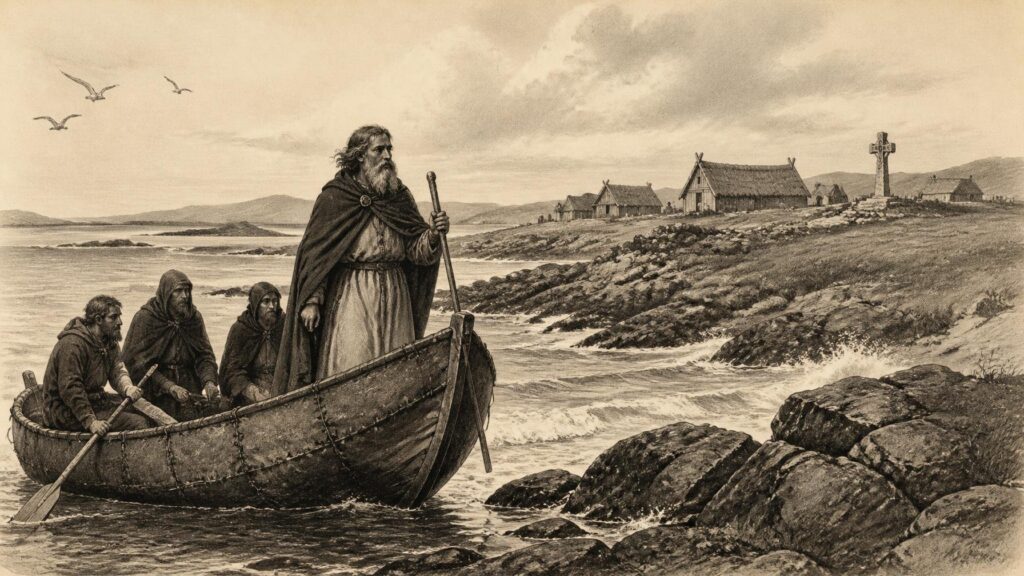
AI generated historical illustration, not a contemporary photograph.
At a Glance
Columba, known in Irish as Colum Cille, belongs to the small company of early medieval figures whose remembered life cannot be confined within a modern frontier. Born into an eminent Irish kindred, trained within Irish Christian culture and long revered in Irish churches, he founded Iona in the western seas and made that island the centre of a religious network linking Ireland, Dál Riata, Pictland and, later, Northumbria. His historical importance rests not only upon missionary tradition, but upon the enduring power of an Irish monastic community that preserved his name, wrote his Life and shaped the ways in which he would be understood for centuries.
Irish Beginnings
The basic outline of Columba’s life is comparatively secure, though the details of his youth are not. He was born about 521 and died in 597. His Irish name, Colum Cille, is commonly understood as “dove of the church”; the Latinised Columba carried the same meaning. He belonged to Cenél Conaill, a north-western branch of the powerful Uí Néill dynastic complex. That connection is historically significant. In sixth-century Ireland, religious communities did not stand apart from kinship and lordship: monasteries could be places of prayer, learning, landholding, hospitality and political negotiation, while their founders and abbots often drew authority from family standing as well as spiritual reputation.
Later tradition places Columba’s birth at Gartan in what is now County Donegal. The association is venerable and important to local memory, but it cannot be demonstrated by contemporary evidence. The same caution applies to much of the familiar story of his early education. Adomnán, his principal biographer, names ecclesiastical teachers and presents him as a man formed by reading, discipline and monastic devotion, yet does not supply the consecutive childhood narrative expected of a modern biography. The historical conclusion is modest but substantial: Columba emerged from the learned and aristocratic world of northern Ireland, and his subsequent influence was inseparable from the connections that this background gave him.
In modern retellings he is sometimes made into an isolated hermit, a purely Scottish saint, or the single-handed converter of a whole people. None of those descriptions is adequate. He was an Irish churchman operating in a maritime Gaelic world. Sea routes were not merely dangerous margins between countries; they were avenues of travel, kinship, trade and ecclesiastical communication. The waters between Donegal, Argyll and the Hebrides connected communities that later national histories have too often separated.
Sources Surviving
The chief narrative source is the Vita Columbae, the Life of Columba written in Latin by Adomnán, abbot of Iona from 679 until 704. It was composed roughly a century after Columba’s death, probably in the closing years of the seventh century. That interval matters. Adomnán did not know Columba personally, though he stood within the community Columba had founded, shared his Cenél Conaill background and had access to inherited testimony, monastery traditions and perhaps earlier written material. His work is therefore indispensable, but it is neither a contemporary diary nor an impartial modern history.
Adomnán arranged the Life in three books according to the kinds of marvel attributed to the saint: prophecies, miracles of power and angelic visions. This organisation tells readers what kind of book it is. It aims to demonstrate sanctity through signs, presenting Columba as a holy man whose insight reached distant events, whose prayer affected illness and weather, and whose life was attended by the unseen world. Yet hagiography can preserve historical information precisely because it was written for communities that recognised places, people, political relationships and institutional claims. The Life contains names of Irish and British churches, rulers, islands, clerics and kin-groups that make it a major witness to the Irish Sea world.
The textual history of the work is itself remarkable. The earliest surviving manuscript witness, the Schaffhausen manuscript, was written in an Irish hand before 713, only a short time after Adomnán’s death. Later manuscripts preserve the text in different forms. The survival of a relatively early witness does not turn every miracle into verifiable fact, but it gives the Life exceptional importance among early medieval insular sources. It also demonstrates the strength of the Columban literary tradition, which maintained and transmitted a sophisticated Latin account of its founding saint.
Hagiographic Method
A responsible reading of the Life holds two ideas together. First, Adomnán’s intention was devotional and institutional. He wrote to honour Columba, to encourage veneration and to establish the prestige of Iona and its dependent churches. Secondly, that purpose does not make the work worthless as history. It shows rather that historical details have to be tested according to their nature. Statements concerning Columba’s Irish kinship, his residence on Iona, his dealings with Irish and Dál Riatan rulers, and his death at Iona are supported by the broader shape of the evidence. Detailed speeches, exact foreknowledge and spectacular interventions belong to a genre in which theological meaning was central.
The distinction is especially necessary where later folklore has become attached to the saint. The popular tale that Columba copied a psalter belonging to Finnian and then caused, or bore guilt for, the battle of Cúl Dreimne has been repeated as though it were a contemporary explanation for his departure from Ireland. Adomnán does not offer that explanation. He describes Columba as leaving to be a pilgrim for Christ. The copy dispute and penitential exile story derive from later tradition, and the famous proverbial judgement about every book having its copy belongs to that later narrative world. It may preserve memories of conflicts over authority, books and patronage, but it should not be treated as a securely documented episode in the saint’s life.
Seaborne Passage
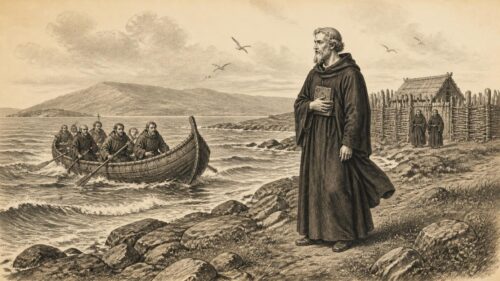
Columba left Ireland in about 563, when he was said to be in his forty-second year, and settled on Iona, a small island off the coast of Mull. Historic Environment Scotland identifies the arrival of Columba and twelve companions in 563 as the beginning of the monastery traditionally associated with the site. The number twelve has obvious apostolic resonance and may be literary as well as numerical, but the central event is beyond reasonable doubt: an Irish religious leader established a major monastic community in the Hebrides during the sixth century.
To describe this as an exile from Ireland can obscure as much as it reveals. Iona lay in the political and cultural orbit of Dál Riata, the Gaelic kingdom whose territories extended across the North Channel. Columba’s kin had interests and associations in that wider zone, while sea travel joined rather than divided it. The move did not mean a simple abandonment of Ireland. Adomnán’s account repeatedly has Columba connected with Irish visitors, Irish monasteries and Irish political affairs. He returned to Ireland on some occasions, and his ecclesiastical familia, or federation of churches, had foundations on both sides of the sea.
There is no need to suppose one exclusive motive for the foundation. The language of pilgrimage expresses a genuine ascetic ideal: voluntary departure from one’s homeland could be understood as a radical form of religious devotion. At the same time, Iona offered a position within a Gaelic kingdom where family and royal links could support a new monastic centre. Spiritual aspiration, kinship strategy and political opportunity were not opposing explanations in the sixth century. They were often intertwined.
Island Community
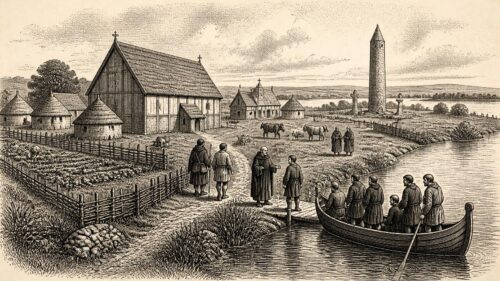
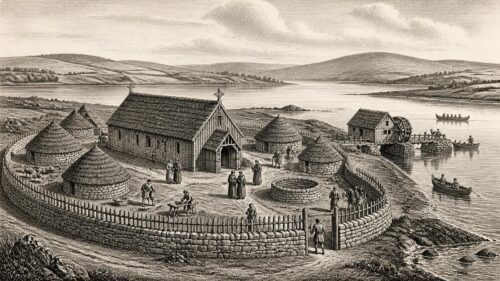
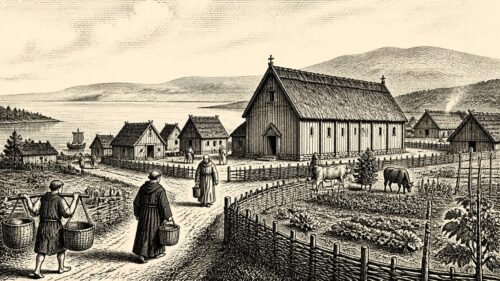
Iona was not merely the retreat of an individual saint. It became a working monastery, a place structured by worship, labour, hospitality, reading and authority. Adomnán’s narratives offer glimpses of an enclosed religious community with a church, refectory, guest accommodation, barns, fields, workshops and boats. His monks copy books, receive visitors, travel between islands, manage supplies and respond to the commands of their abbot. Archaeology cannot reproduce the sixth-century monastery in full, since much of the visible abbey complex is medieval, but the Life preserves a valuable picture of early monastic organisation.
The abbot’s office lay at the centre of this system. Columba is depicted as a demanding superior: attentive to discipline, concerned with food stores and work, capable of rebuke, and expected to offer spiritual judgement. This is one reason the Life should not be reduced to a collection of fairy tales. Its miracles operate in a recognisable institutional setting. A storm threatens sailors; illness disrupts a community; a shortage endangers a household; a visitor seeks healing or counsel. The supernatural episodes are framed by the practical conditions of monastic life.
Iona’s position also shaped its culture. The island was exposed to sea and weather, but it was connected by boats to a network extending through the Hebrides, Argyll and Ireland. In Adomnán’s writing, voyages are hazardous and spiritually charged, yet routine enough to carry messages, monks and supplies. The community’s reach depended upon that mobility. It developed not despite its island setting but through it.
Monastic Authority
The Columban community was not a modern denomination with fixed territorial boundaries. Its influence rested on relationships among houses associated with Columba, commonly described as his paruchia or ecclesiastical federation. The mother-house at Iona held prestige, and its abbot exercised a pre-eminent place within the network. Many early abbots were connected to Columba’s kin-group, illustrating how hereditary patterns could coexist with monastic ideals. Such kinship was not a mere corruption of religion from an external political sphere; it was one of the social languages through which institutions secured continuity and support.
The Life also makes clear that bishops were present in the church but that the abbot of Iona could enjoy higher practical status within his own community. This has sometimes been used to make sweeping claims about a wholly separate “Celtic Church”. That phrase is misleading if it suggests a unified, independent and doctrinally exotic church opposed in every respect to Rome. Irish and insular Christianity was diverse, connected to wider Latin Christendom and marked by regional customs. Columba’s world was distinctive in its monastic networks and Gaelic social setting, but it was not isolated from the Christian culture of western Europe.
Royal Networks
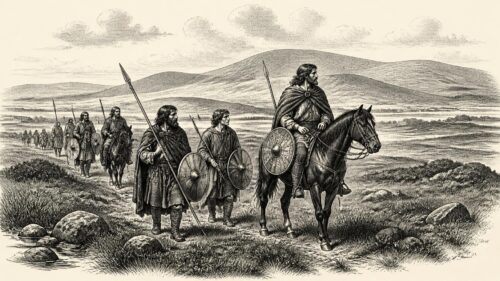
Columba’s aristocratic origins made him a figure of consequence among rulers. Adomnán portrays him in contact with Irish kings and with the royal house of Dál Riata. His authority was religious, but it had political effects: an abbot with a strong following, extensive kin connections and a respected monastery could mediate disputes, bless rulers and influence alliances. The modern distinction between religious and secular power cannot simply be projected backwards onto this setting.
One celebrated episode concerns Áedán mac Gabráin of Dál Riata. Adomnán states that an angel instructed Columba to ordain Áedán as king. Historians have often treated the account cautiously. It may reflect the status and political concerns of Iona in Adomnán’s own day as much as a precise record of a sixth-century inauguration. Even so, it confirms the broad reality that Columba and Iona were closely entangled with Dál Riatan kingship. The community’s location and survival depended partly on royal patronage; rulers, in turn, benefited from the legitimacy, literacy and interregional connections a monastery could provide.
His Irish links remained powerful. The Dictionary of Irish Biography notes that his influence and connections helped reinforce an alliance between the Uí Néill and Dál Riata. It would be unsafe to attribute every later Columban political development directly to Columba’s personal design, but the pattern is clear: Iona became a meeting point between northern Irish dynastic interests and the Gaelic west of Britain. Its history cannot be understood by treating either Ireland or Scotland as a self-contained stage.
Pictish Encounters
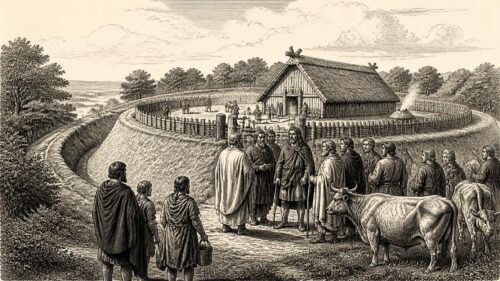
Adomnán’s best-known narrative outside Iona concerns Columba’s journey to the Picts and his meeting with King Bridei near the river Ness. The story presents the saint overcoming opposition at the royal fortress, gaining entry through prayer and impressing the king with prophetic insight. Later retellings often make this a dramatic moment of national conversion, but the evidence does not support so simple a conclusion. Christianity had reached northern Britain through several channels, and the conversion of peoples was a long, uneven process involving rulers, local churches and changing political circumstances.
Nevertheless, the encounter is historically revealing. It indicates that Columba travelled beyond the Dál Riatan sphere and that Iona had connections with Pictish territories. The Life contains Pictish names and episodes, making it an important source for a society otherwise difficult to see through contemporary written evidence. Adomnán’s Picts are not an undifferentiated backdrop for saintly triumph. They include rulers, interpreters, households and communities who appear within a frontier zone of communication and contest.
Folklore later furnished the journey with a creature in the River Ness, now often presented as an early appearance of the Loch Ness Monster. Adomnán does describe Columba confronting a dangerous water beast after it had attacked a swimmer. The episode should be read first as a miracle story: the saint’s command displays divine power over danger and disorder. Treating it as zoological evidence, or as proof that Columba “discovered” a modern monster tradition, mistakes the genre. Its real historical value lies in what it shows about travel, river crossing, fear and the language of sanctity.
Irish Foundations
Columba’s name became associated with an extensive range of Irish churches and monasteries. Some associations are likely to preserve genuine sixth-century foundations or early links; others are difficult to date and may reflect later efforts to claim Columban prestige. Derry, Durrow and Kells became especially prominent centres in the wider Columban tradition. Their importance demonstrates that Iona did not supersede Ireland in Columba’s story. Rather, Iona was the foremost house in a network whose Irish dimension remained profound.
Derry, traditionally linked with Columba before his departure, became one of the greatest ecclesiastical centres in the north-west. Durrow in the midlands developed as a major monastery with strong Columban associations. Kells in County Meath became crucial after Viking attacks exposed Iona to repeated danger in the late eighth and early ninth centuries. Monks from Iona established themselves at Kells in the early ninth century, and the community became an important Irish successor to the island monastery. These later developments cannot be assigned directly to Columba’s lifetime, but they reveal the durable institutional force of his cult and familia.
Such foundations were not simply religious outposts. They accumulated land, learning, craft production and memorial authority. They also offered places where the saint’s memory could be renewed and adapted. In Ireland, Columba became a patron of particular regions, communities and dynasties, but he also became a figure of national and international stature. The multiplication of Columban sites is evidence not only of devotion but of the practical advantages of association with a prestigious founder.
Books Learning
Columba’s enduring association with books is one of the strongest elements of his Irish legacy. Adomnán portrays him reading and copying, and gives his final labour as the copying of a psalter. The early Irish poem known as the Amra Choluimb Chille, traditionally attributed to Dallán Forgaill, celebrates him as a learned man associated with Psalms, law and interpretation. The precise date, authorship and historical implications of individual works remain subjects for specialist study, but the tradition of Columba as scholar and scribe is very early and deeply rooted.
The Cathach, a fragmentary Latin psalter held by the Royal Irish Academy, has long been called the Psalter of St Columba. It is among the oldest surviving Irish manuscripts and is generally dated about 600, close to but not securely within Columba’s lifetime. The traditional attribution to the saint cannot be proved. That uncertainty is important: the manuscript should not be advertised as his autograph work. Yet the Cathach’s extraordinary early date, its subsequent treatment as a Columban relic, and its association with the O’Donnell kindred illuminate how writing, sanctity and dynastic identity could become fused in medieval Ireland.
The Book of Kells provides a different example of Columban remembrance. It was made around the end of the eighth century or early ninth, long after Columba’s death, and cannot have been his personal book. Its exact place of production remains debated. Trinity College Dublin notes its association with the related communities of Iona and Kells, while evidence securely places it at Kells by the eleventh century. Whether begun on Iona, made elsewhere within the Columban sphere or completed across more than one location, the manuscript’s connection with Columba belongs to institutional memory rather than direct authorship.
Manuscript Memory
These books reveal a larger truth. In early medieval Ireland, manuscripts were not only containers for texts. They could be treasured objects, sacred heirlooms, legal symbols and, in later tradition, protective relics. The association of Columba with the copying of psalters therefore expresses more than admiration for literacy. It locates him within a culture in which scriptural learning helped establish ecclesiastical authority and where a saint’s written legacy could be claimed by succeeding communities.
Adomnán’s own Latin Life is part of that inheritance. It is highly crafted prose, shaped by biblical language and by the conventions of Christian biography, but it also preserves Irish words and names. Its composition on Iona confirms that the Columban world was intellectually ambitious. Far from an isolated edge of Europe, the Irish Sea region participated in a learned Latin culture while retaining its own Gaelic languages, social forms and memories.
Dying Abbot
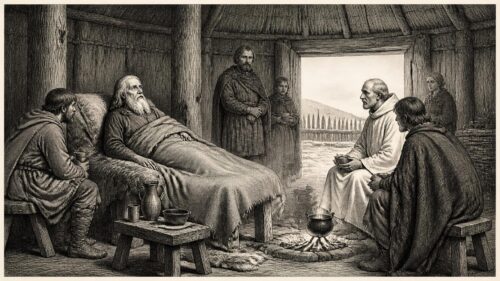
The final chapters of Adomnán’s Life give the fullest surviving account of Columba’s death. Their emotional power has ensured their place in later devotion. The abbot is shown attending to practical matters, blessing the monastery’s stores, speaking affectionately to his brethren and completing as much as he can of a psalter. He then dies in the church during the night office. The episode supplies the year, 597, and presents the death as the fitting culmination of a holy life.
Some details are plainly devotional. A heavenly light appears; a monastery horse is said to mourn; angels attend the passing of the saint. Such motifs do not offer modern evidence in the ordinary sense. They express the conviction that Columba’s death was a sacred event and that the community’s founder remained spiritually present to it. At the same time, the narrative’s concentration on buildings, work, books, food supplies and communal worship offers a vivid sense of the world in which Iona understood itself.
Columba’s burial place became central to the sanctity of Iona. The exact history of his relics is complex, and later medieval claims should be treated carefully. What is unmistakable is that pilgrimage to Iona began early. Historic Environment Scotland notes that Columba’s fame drew pilgrims to the island from the seventh century. The later medieval abbey that visitors see today was built centuries after his death, on or near the site of the earlier monastery. It is a memorial landscape, not an untouched sixth-century survival.
Cult Memory
Columba’s cult expanded across Ireland, Scotland and northern England. His feast was observed on 9 June, and his name entered place-names, churches, poetry and local ritual. In Ireland, he was especially important in the north-west, in Derry and Donegal, and among communities connected with Cenél Conaill and the O’Donnells. But his appeal was never restricted to one locality. He became a major Irish saint whose cult travelled with monastic communities and manuscripts.
Later medieval lives enlarged the narrative inherited from Adomnán. They supplied more detail about birth, schooling, quarrels, foundations and miracles, often blending earlier traditions with the concerns of their own periods. These works are invaluable evidence for the development of Columba’s cult, but not all are equally reliable for his sixth-century career. The historian must ask when a story first appears, what institution preserved it and what purpose it served. A late tradition may illuminate medieval memory even where it cannot securely establish a fact about Columba himself.
This distinction does not diminish folklore. Stories of the saint’s voyages, curses, blessings, manuscripts and encounters with kings show how communities made sense of their own landscapes and histories. Folklore is evidence of cultural life, not necessarily evidence that an event happened exactly as told. Columba’s afterlife in Irish tradition is therefore itself a historical subject: a record of changing identities, devotions and claims to authority.
Material Legacy
Physical survivals associated with Columba require the same care as literary traditions. Iona’s carved crosses, shrines, burial places and later ecclesiastical architecture attest to the island’s long-standing prestige, but most visible monuments date from well after the saint’s lifetime. The four great crosses associated with the abbey area belong largely to the eighth and ninth centuries, when Iona was a leading centre of sculpture, metalwork and manuscript art. They bear witness to the flourishing of a community that remembered Columba, not to objects he himself necessarily saw.
In Ireland, the Cathach’s eleventh-century shrine and the medieval histories of Columban churches show the material growth of devotion. Such objects were active participants in social and political life. Relics could be carried, displayed, protected and invoked. A manuscript connected to a saint could become a focus of loyalty for a ruling kindred. These practices may seem remote from modern assumptions about books and religion, but they help explain why Columba’s memory remained so potent.
The material record also guards against a misleadingly romantic image of early monasticism. Columban communities were places of labour and production as well as prayer. They needed food, timber, boats, buildings, skilled scribes, metalworkers and sculptors. Their cultural achievements were supported by resources and by relationships with patrons. Holiness and power were not separate historical categories in this setting; they were often mutually reinforcing.
Historical Columba
The historical Columba can be identified with confidence in broad outline: an Irish aristocrat and churchman, born about 521; founder of Iona around 563; leader of a monastic network spanning the Irish Sea; participant in the political and ecclesiastical affairs of Irish, Dál Riatan and Pictish society; and a figure whose death in 597 quickly became the focus of veneration. The evidence also strongly supports his reputation as a learned monastic leader and as the source of a powerful institutional tradition.
Much else remains uncertain. We cannot reconstruct a complete chronology of his youth, list every church he founded, prove his authorship of every poem assigned to him, or treat later legal and penitential legends as contemporary record. We cannot know precisely what occurred at every royal meeting described by Adomnán, nor can miracles be tested by the methods appropriate to political or material history. The proper response is neither credulity nor dismissal. It is to recognise the Life as a carefully shaped witness that preserves both historical relationships and the religious imagination of a later Iona.
Columba’s significance lies in that union of person and memory. The man of sixth-century Ireland founded a community in the Hebrides; the community of Iona fashioned his image; Irish churches, manuscripts and dynasties preserved and adapted it. Through this process, an Irish saint became one of the defining figures of the early medieval North Atlantic world.
Enduring Ireland
For Irish history, Columba matters because he shows that early Ireland was neither peripheral nor inward-looking. His career joins Donegal and Derry to Iona, Argyll, Pictland, Northumbria and the manuscript culture of Kells. His name survives in Irish poetry and place-memory; his associated books are among the great treasures of Irish heritage; his foundations helped shape ecclesiastical landscapes for generations. The sea crossing to Iona was not an escape from Irish history, but one of the means by which Irish influence travelled.
His Life should therefore be read with both appreciation and discipline. It is a work of sanctity, not a neutral chronicle; an institutional monument, not a simple memoir; and a source whose miraculous narratives require interpretation rather than contempt. In its pages, however, the contours of a real world remain visible: boats crossing stormy channels, monks copying texts, rulers seeking counsel, kin-groups sustaining churches, and an island community remembering its Irish founder. That world is the true setting of Columba’s life, and of his exceptionally long remembrance.

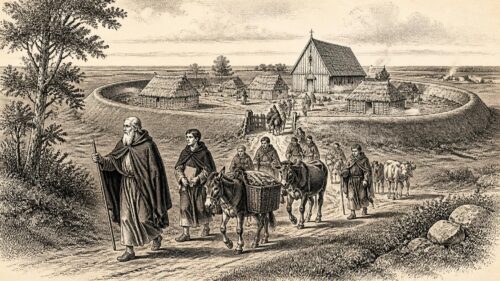
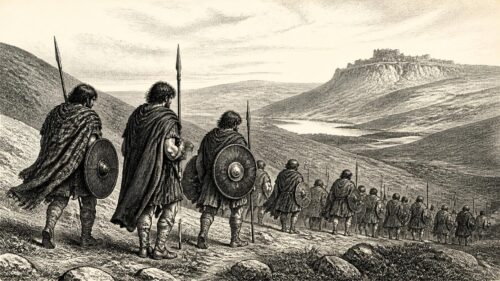
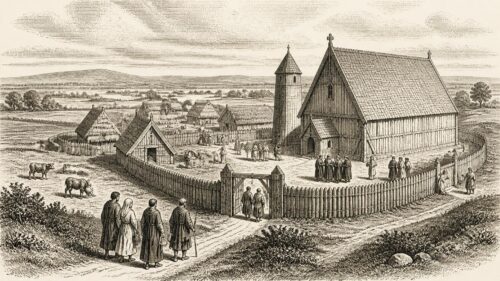
The article’s treatment of Iona challenges modern national narratives by presenting Columba’s world as a maritime Gaelic network, where Irish kinship, Dál Riatan politics and monastic ambition overlapped. This makes his move to Iona harder to classify simply as either exile or mission: pilgrimage, family connections and institutional opportunity may all have mattered. It also suggests that islands could function as centres of communication rather than remote margins. How should we interpret Columba’s foundation of Iona when comparing spiritual motivations with the political and kinship structures that enabled monasteries to flourish across Ireland and western Britain in early medieval society?